How CDSL Makes Money?
Every time you buy a share on Zerodha, Groww, Angel One or any other broker, the shares appear in your Demat account within two days. If you purchase shares on Friday, they will reflect in your account by Tuesday evening, as weekends and market holidays are not counted as working days.
But have you wondered who keeps these shares safe - and here the role of Central Depository Services Limited (CDSL) comes.
Most investors know CDSL because they receive SMS and email alerts whenever they buy or sell shares. But those notifications are only a tiny part of what CDSL actually does.
What Exactly Does CDSL Do?
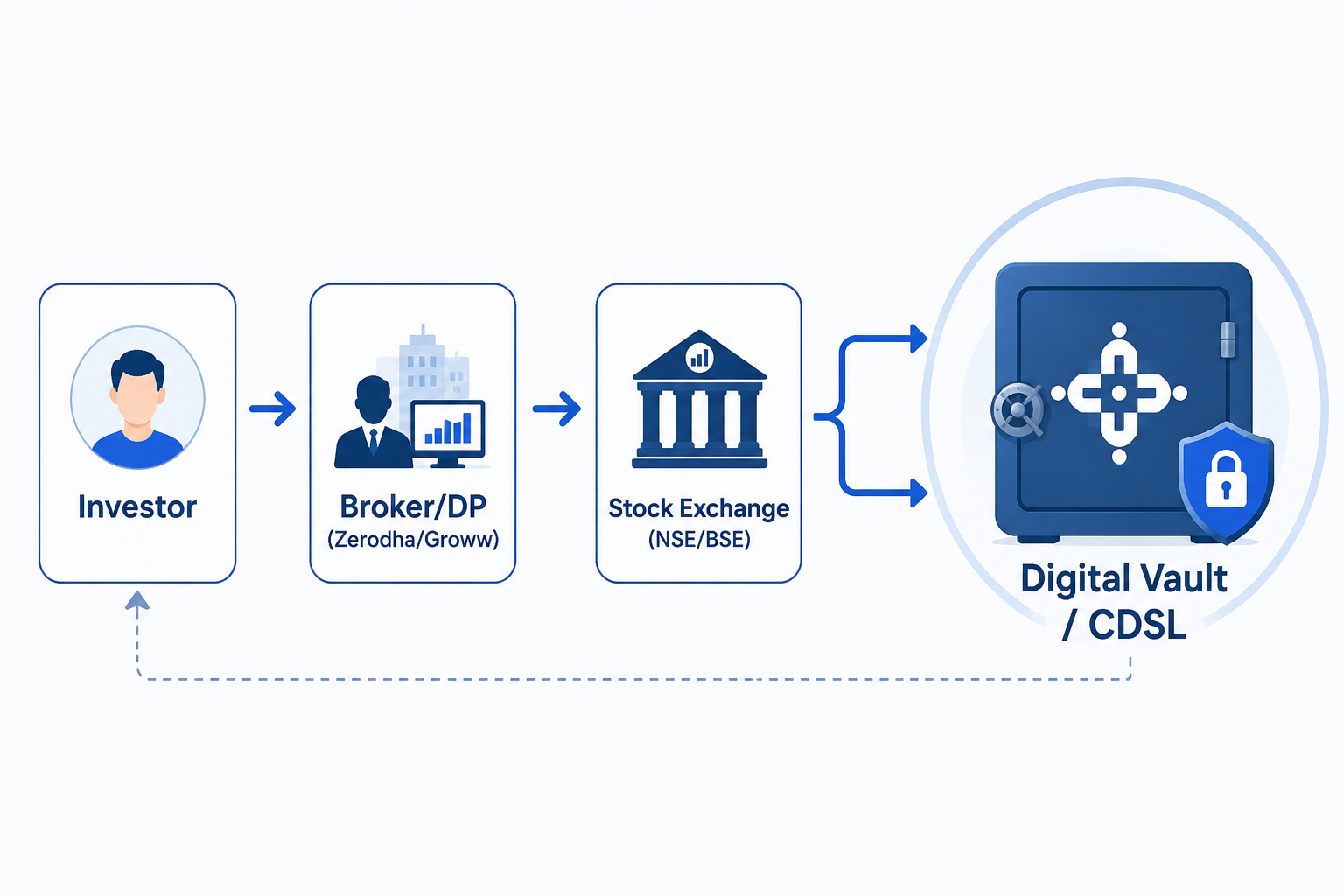
CDSL is one of India's two central securities depositories, alongside NSDL. Its core role is to maintain electronic records of securities such as shares, bonds and mutual fund units.
The important point for investors is that CDSL does not earn money simply because investors hold securities. Its business monetises the infrastructure around those securities through issuer charges, transaction-related fees, corporate actions, digital services and other financial-market infrastructure services.
This makes CDSL different from a stockbroker. A broker competes for customers and trading activity, while CDSL sits deeper in the market infrastructure and earns from the services required to maintain and process securities electronically. Now, after we have the basic knowledge of CDSL and what the company does, we should move on to the topic of how CDSL makes money.
CDSL's financial performance tells the bigger story
The strongest way to understand CDSL's business is not simply by looking at its individual revenue streams, but by looking at how its financial performance has evolved alongside the expansion of India's investor base.
In FY25, CDSL reported consolidated income of ₹1,199 crore and consolidated profit after tax of ₹526 crore, representing year-on-year growth of 32% and 25%, respectively.
The operating scale behind these numbers is equally important. CDSL had 15.30 crore demat accounts at March 31, 2025, with a 79.5% market share by number of demat accounts. The company added around 3.7 crore accounts during FY25 alone.
The significance of this growth is that CDSL is building a much larger base from which it can monetise multiple services.
More demat accounts increase the addressable base for depository-related services, while higher market participation can support transaction, corporate-action and digital-service activity.
However, FY26 also shows why investors should not assume that account growth automatically translates into proportional profit growth. CDSL's FY26 consolidated income increased only 3% to ₹1,239 crore, while consolidated PAT declined 14% to ₹455 crore.
This is an important signal: CDSL's structural growth story is strong, but its earnings can still fluctuate depending on the mix and intensity of market-linked activities.
The real CDSL investment thesis
CDSL's investment case rests on a simple structural idea: India is adding investors and financial assets faster than it is moving away from electronic ownership.
The company had 15.3 crore demat accounts at the end of FY25 and crossed 18 crore accounts during FY26.
This gives CDSL a powerful underlying growth engine. Once securities are held electronically, the depository becomes part of the infrastructure required to maintain those ownership records and process related activities.
Transaction Charges
Annual issuer charges are like a fixed subscription. Transaction charges are like paying a toll every time you use a highway.
Every time securities move from one demat account to another, CDSL's systems process the transaction.
Each transaction requires:
- Identity verification
- Database updates
- Settlement confirmation
- Regulatory reporting
- Audit trail creation
Since this work happens every single time ownership changes, CDSL earns transaction-based fees.
Example 1: Selling Shares
Rahul sells 100 Reliance shares on the stock exchange. On the settlement day, 100 shares are removed from Rahul's demat account and added to the buyer's demat account.
CDSL updates its central ownership records to complete this transfer. For processing such transactions, CDSL earns a transaction fee.
Example 2: Off-Market Transfer
A father gives 500 Infosys shares to his daughter. Since this is a gift, no buying or selling takes place, but the ownership still changes.
CDSL verifies both demat accounts, updates the ownership records, and charges a fee for processing the off-market transfer.
Why Transaction Charges Matter
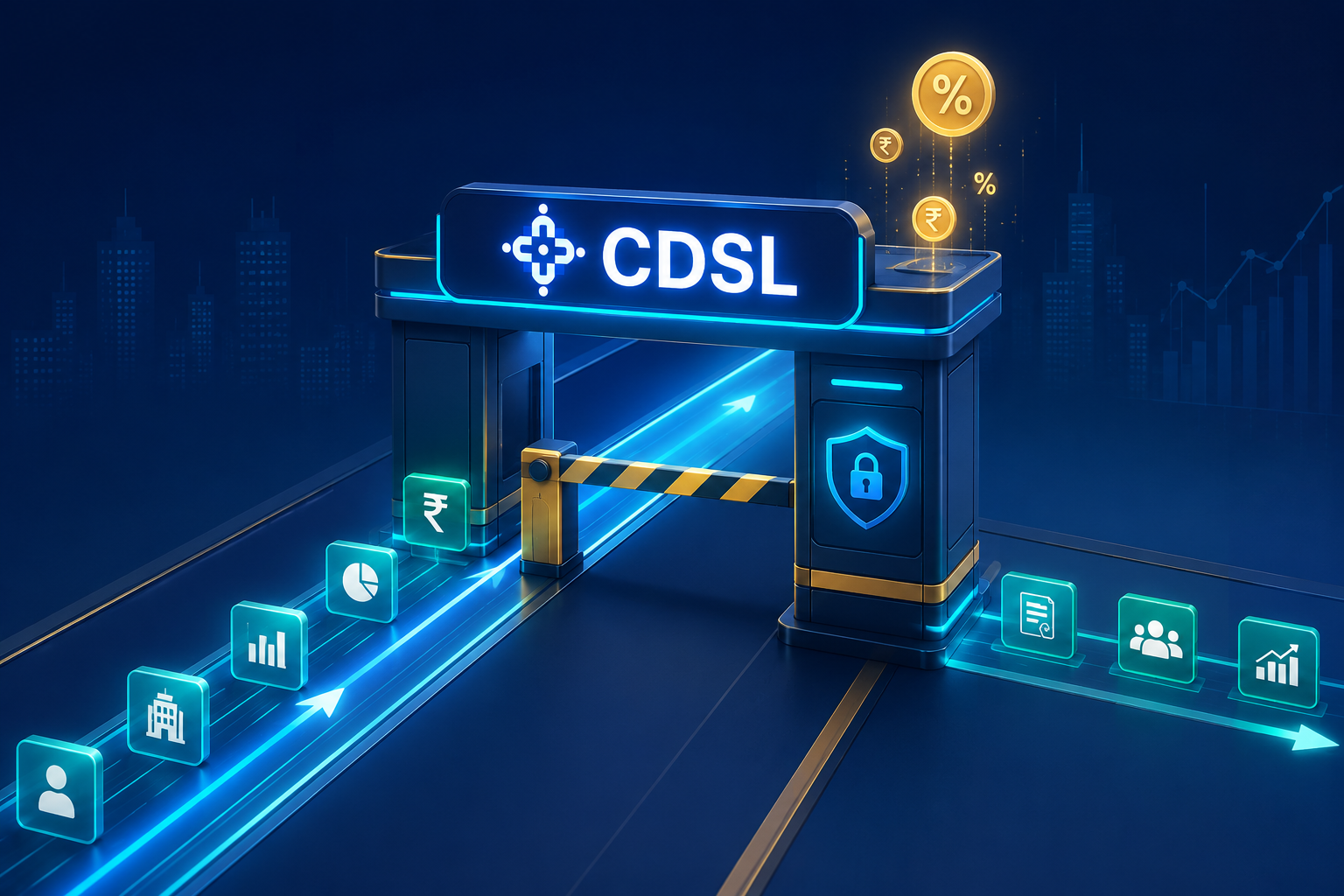
India witnesses millions of demat transactions every month. Even if the fee earned per transaction is small, the sheer volume creates a significant revenue stream.
This is similar to payment companies like Visa or Mastercard, which earn a tiny amount on each transaction but process billions of transactions annually.
IPO & Corporate Action Services
Whenever a company changes the number of shares held by investors, someone must update every shareholder's records accurately. That "someone" is often CDSL. These events are called Corporate Actions.
Bonus Shares
If an investor owns 100 shares of a company and the company announces a 1:1 bonus. The investor will now own 200 shares of that company.
CDSL updates every eligible investor's demat account automatically. Without this backend process, millions of investors would not receive their bonus shares correctly.
Dividend Record Date
Companies declare a record date to determine which shareholders are eligible for dividends. Suppose the record date is 10 July.
CDSL provides the company with an accurate shareholder list as of that date. The company then distributes dividends based on this verified ownership data.
Buyback
If a company announces a buyback of shares, then only eligible shareholders can tender their shares.
CDSL facilitates the electronic processing of these transactions by maintaining accurate ownership records and supporting the settlement process.
Why This Business Is Attractive
Corporate actions happen throughout the year across thousands of listed companies.
Each event requires secure, accurate, and regulator-compliant updates to shareholder records. Companies pay CDSL for providing these critical backend services.
e-KYC & Online Digital Services
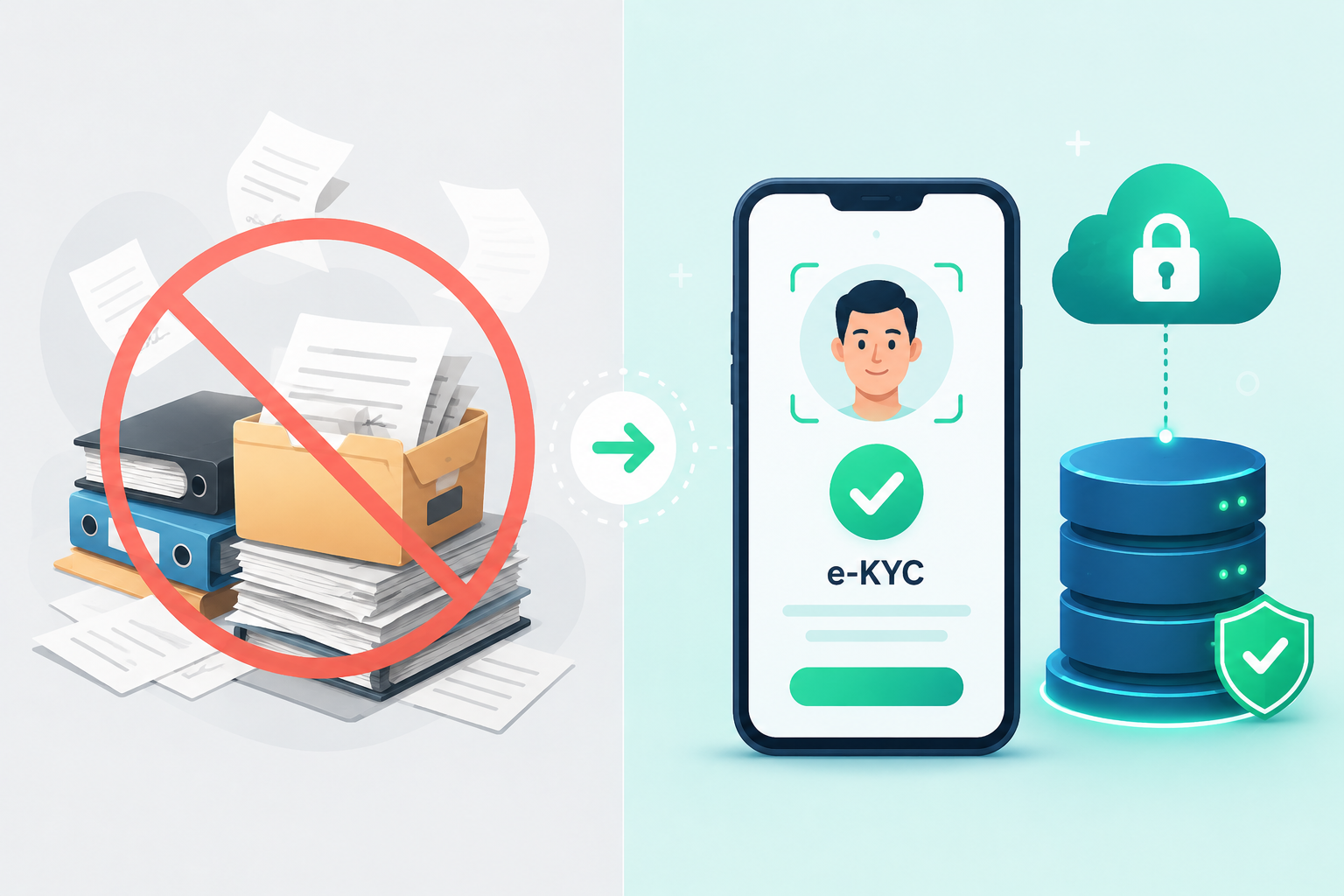
CDSL has also expanded into adjacent digital infrastructure businesses such as e-KYC, eDIS, authentication, e-voting, electronic document services and insurance repositories. These businesses use the company's existing technology and trust infrastructure to address additional financial-market requirements.
Strategically, these businesses matter because they give CDSL opportunities to diversify beyond traditional depository fees without moving too far away from its core capabilities.
However, they should not be treated as the primary investment thesis. The central driver remains the scale and monetisation of CDSL's securities-market infrastructure.
Insurance Repository

CDSL has also diversified into businesses beyond the securities market. One such area is the Insurance Repository business.
An Insurance Repository works much like a demat account, but instead of holding shares, it stores insurance policies electronically.
For example, an individual may own:
- A life insurance policy
- A health insurance policy
- A motor insurance policy
Instead of maintaining multiple paper documents, these policies can be stored digitally in a single electronic insurance account. This makes policy management easier and reduces the risk of loss or damage.
CDSL earns fees by providing the technology infrastructure that supports these electronic records.
Beyond insurance, CDSL continues to expand into other digital infrastructure services where secure record-keeping, authentication, and compliance are essential.
Final Verdict: What investors should take away?
CDSL's story is bigger than the number of demat accounts it adds each year. The company is building a large-scale financial infrastructure platform around India's growing participation in capital markets.
The structural story remains strong.
CDSL reached 15.30 crore demat accounts by FY25 and crossed 18 crores during FY26. The expansion of India's investor base provides a long-term foundation for the business.
Account growth is not the same as earnings growth.
FY26 is a useful reminder. Consolidated income rose only 3%, while PAT fell 14%. Investors therefore need to track the quality and mix of revenue rather than relying only on demat-account additions.
CDSL's competitive position matters.
Its 79.5% market share by demat accounts in FY25 gives it a powerful retail presence, but NSDL remains the key competitor. Market-share trends, issuer additions and transaction activity should remain on the investor's checklist.
Transaction activity creates an element of cyclicality.
CDSL benefits from structural digitisation, but parts of its business are still influenced by market activity, IPOs, corporate actions and transaction volumes. Investors should therefore expect earnings growth to fluctuate rather than move in a straight line.
The real thesis is structural growth plus operating leverage - but valuation matters.
If India's investor base continues expanding and CDSL maintains its competitive position, the company can potentially monetise a much larger securities ecosystem over time.
But the investment outcome will ultimately depend on whether earnings growth is strong enough to justify the valuation investors are paying for that growth.