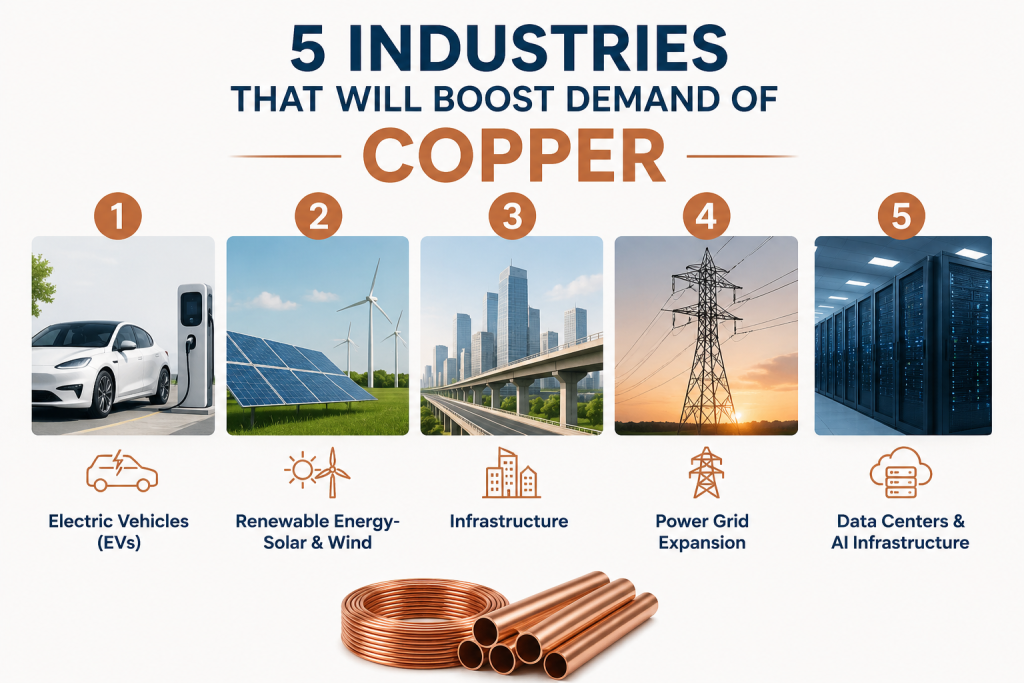
5 Industries that will boost demand of Copper?
Copper is one of those metals you rarely think about directly, but almost everything around you quietly depends on it. From charging your phone to powering entire cities, copper is sitting at the centre of the modern economy’s expansion.
Since COVID, the copper price has gone up more than 300% even outperforming the broader market in many periods.
Gold has also moved similarly but the nature of the move is very different. Gold is sentiment-driven and copper is demand-driven.
Because copper is not a precious metal, it is a base industrial metal, tied directly to real-world economic activity.
In this article, we break down the 5 industries that are quietly driving copper demand structurally higher.
Electric Vehicles (EVs) - The ‘Copper Heavy’ Revolution
Electric vehicles are not just replacing engines, they are redefining the entire architecture of a car.
A traditional internal combustion vehicle uses around 20–25 kg of copper.
An electric vehicle uses 60–80 kg. That’s a 3-4x increase.
The reason is simple: EVs are fundamentally electrical systems on wheels. Motors, batteries, inverters, charging systems-all heavily dependent on copper.
And this shift is already underway globally. Companies like Tesla, BYD, and Tata Motors are scaling EV adoption at different speeds, but all in the same direction. This is going to significantly boost copper demand, as it has been explained in our copper analysis video.
Renewable energy- Solar & Wind Infrastructure
Renewable energy looks clean on the surface, but under the hood it is extremely metal-intensive.
Wind turbines and solar farms require large quantities of copper in generators, transformers, inverters, and transmission systems.
Wind energy, especially offshore projects, is particularly copper-heavy due to long-distance power transmission requirements.
Players like Siemens Gamesa, Vestas, and Adani Green Energy are part of this expansion cycle.
Power Grid Expansion - The Invisible Backbone
Every modern economic expansion eventually hits the same bottleneck- electricity distribution.
Whether it’s EV charging stations, renewable plants, or new cities, everything depends on transmission infrastructure.
And transmission infrastructure is essentially copper networks.
Companies like Power Grid Corporation of India, Schneider Electric, and ABB are central to this buildout.
Unlike other demand drivers, grid expansion is slow but extremely long-lasting. Once built, it keeps getting upgraded and expanded.
This creates a steady, compounding layer of copper demand over decades.
Data Centers & AI Infrastructure - The Silent New Demand Engine
This is a newer, but very powerful driver.
AI, cloud computing, and digital services are pushing massive expansion of data centers. These facilities consume huge amounts of electricity and every watt has to be distributed, cooled, and stabilized using copper wiring and systems.
The surprising part: AI growth is not just a software story. It is quietly becoming a physical infrastructure story, and copper is one of its key building blocks.
Key players:
- Microsoft - Expanding global AI data center footprint
- Amazon Web Services - One of the largest global data center operators
- Google Cloud - Rapid expansion of AI-ready infrastructure
Construction & Urbanization - The Steady Giant
Unlike EVs or AI, construction doesn’t feel like a “new trend.” But it remains one of the most consistent drivers of copper demand.
Buildings require copper in wiring, plumbing, HVAC systems, elevators, and electrical distribution.
As urbanization continues, especially in emerging markets, this becomes a steady and persistent demand layer.
Companies like Larsen & Toubro, DLF Limited, and Emaar Properties represent this ongoing buildout.
It may not be explosive, but it is constant and that consistency matters.
Copper Intensity is Rising Per Unit of GDP
A key shift that often gets missed is this: economic growth today is becoming more copper-heavy than it used to be.
Earlier, growth was driven by steel, cement, and traditional infrastructure like roads and housing. Copper mattered, but it wasn’t central.
Now, that structure has changed. Modern growth is coming from EVs, renewable energy, data centers, and grid upgrades - all of which are far more copper-intensive.
Why it matters
Even the same unit of economic growth now needs more copper than before. A data center or EV ecosystem, for example, uses far more electrical infrastructure than a traditional industrial setup.
Conclusion
What ties all of this together is simple: copper demand is no longer driven by one sector, but by multiple megatrends happening at the same time- electrification, digitization, and decarbonization.
And when these trends overlap, the impact is not additive. It becomes exponential in pressure on supply.
That’s why copper is increasingly being viewed less as a commodity and more as a critical bottleneck metal of the future economy.