Netweb Technologies: Is it a Manufacturer or Assembler?
When a company builds an AI server using an NVIDIA GPU, an AMD or Intel processor, memory, storage and other components sourced from global technology vendors, the word “manufacturer” can become difficult to define. Netweb Technologies sits directly in this grey area.
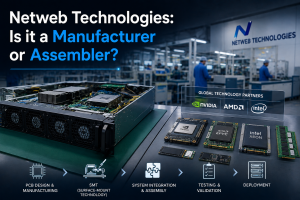
Netweb describes itself as an Indian-origin, owned and controlled original equipment manufacturer (OEM) with integrated design, development, manufacturing and deployment capabilities. Its Faridabad facility carries out PCB design, manufacturing and Surface-Mount Technology (SMT), followed by system-level integration and testing. At the same time, some of the most valuable components inside those systems including CPUs, GPUs and other hardware components come from technology partners such as NVIDIA, AMD and Intel.
So, is Netweb a manufacturer or an assembler?
The more accurate answer is: Netweb is a system-level manufacturer with an assembly-intensive manufacturing model. The distinction matters because Netweb does not manufacture semiconductors, but it does much more than simply buy finished servers and resell them.
The First Mistake Is Treating “Manufacturing” As One Activity
A server is not a single component that comes out of one factory. It is a system built through several layers.
At the bottom of the stack are components such as processors, GPUs, memory, storage devices and other electronic parts. Netweb does not fabricate these chips. Instead, it works with technology companies including NVIDIA, AMD and Intel and incorporates their technologies into its own systems.
The next layer is the printed circuit board and its design. This is where Netweb’s manufacturing claim becomes more meaningful. Its Faridabad facility supports PCB design, manufacturing and SMT for servers, storage systems and network switches. The company also says its capabilities extend to hardware product design, fine-tuned PCB layouts and system architecture.
The final layer is system integration. Components are assembled into a functioning server or computing system, configured for a particular workload, tested and deployed. Netweb therefore operates across design → board manufacturing → component mounting → system integration → testing → deployment, rather than merely distributing finished hardware.
That is why “assembler” alone is too narrow.
But Netweb Is Not A Chip Manufacturer & That Distinction Matters
The other extreme would be equally misleading.
Netweb does not manufacture the GPUs or CPUs that determine much of the computational capability of its AI systems. Its partnership with NVIDIA is particularly revealing. Netweb is a manufacturing OEM for NVIDIA Grace CPU Superchip and GH200 Grace Hopper Superchip MGX server designs and develops server variations around these platforms.
This creates a useful way to understand Netweb’s position in the value chain.
NVIDIA/AMD/Intel provide critical compute technology. Netweb turns that technology into a customised, integrated computing system.
That distinction is important for investors. The value proposition is not semiconductor IP. It is system architecture, PCB design, integration, thermal and power engineering, software, workload optimisation and the ability to deliver a complete high-performance computing infrastructure.
Netweb itself identifies expertise in system architecture, hardware and middleware, fine-tuned PCB layouts, kernel-level design, dense architectures and HPC-AI codes as part of its technical capabilities.
In other words, the company’s manufacturing moat is above the chip and below the finished infrastructure.
The Numbers Expose The Real Manufacturing Model
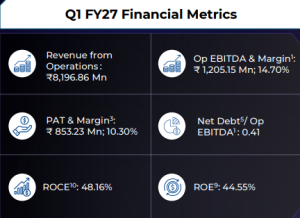
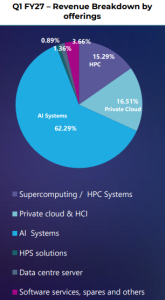
The latest quarter shows why Netweb’s manufacturing model needs to be examined beyond the simple “manufacturer versus assembler” label. In Q1 FY27, Netweb reported ₹819.686 crore in revenue from operations, up 172.13% YoY, with operating EBITDA of ₹120.515 crore and PAT of ₹85.323 crore. But the more revealing number is the composition of that revenue: AI Systems contributed ₹510.570 crore, or 62.29% of revenue from operations, after growing 484.20% YoY.
That mix matters because AI systems are not simply finished products that Netweb buys and resells. The company says these systems are based on the latest-generation GPU architectures and are designed and manufactured in India under its OEM partnerships with NVIDIA and AMD. At the same time, the underlying GPUs and processors are supplied by technology partners rather than manufactured by Netweb itself.
The balance sheet provides another clue. Inventory days rose to 110 days as of June 30, 2026, from 86 days in March 2026, while receivable days fell from 86 to 78. Management attributed the inventory increase specifically to building up raw-material stocks to secure key inputs amid surging global AI-compute demand. This is consistent with a business that must procure and hold substantial physical components before converting them into finished computing systems.
The key insight is therefore not that Netweb manufactures every part inside an AI server. It doesn’t. Its manufacturing value lies in converting globally sourced compute components into an integrated, engineered computing system. That makes the company materially different from a pure reseller, while its dependence on externally sourced high-value components means it should not be viewed as a vertically integrated semiconductor manufacturer either.
And that distinction becomes critical when assessing how much value Netweb actually adds between the GPU arriving at its facility and the completed AI system reaching the customer.
What Does Netweb Actually Manufacture?
Netweb’s manufacturing model extends beyond putting third-party components together. Its capabilities span several stages:
- PCB design and manufacturing: Netweb develops PCB layouts and manufactures boards using its SMT capabilities.
- System architecture: Its facility supports the production of x86- and RISC-based high-end computing systems.
- System integration: CPUs, GPUs, memory, storage and networking components are integrated into complete computing platforms.
- Deployment: The company’s role extends beyond manufacturing into deploying computing infrastructure for customers.
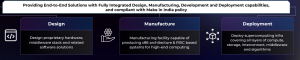
The distinction matters because a pure assembler would primarily add value by putting externally sourced components together. Netweb participates earlier in the product chain through design and engineering and later through integration and deployment. The question is therefore not whether Netweb manufactures every component, but how much value these additional layers allow it to capture. To know more, check our latest video.
Engineering Is Not Yet A Moat
Netweb has tangible evidence of engineering capability, but the evidence should not automatically be treated as proof of a durable moat.
What Netweb has:
- 125 R&D professionals as of June 30, 2026.
- 17 registered and applied patents and designs.
- Capabilities across hardware, middleware, AI infrastructure and software.
- Product development spanning AI systems, HPC, private cloud, HCI and high-performance storage.

What these numbers do not prove:
- A proprietary semiconductor technology.
- Higher R&D intensity than global peers.
- An engineering capability that competitors cannot replicate.
- How much of Netweb’s EBITDA is attributable specifically to its engineering layer.
That last point is particularly important. The 125-person R&D team proves Netweb is doing engineering work; it does not prove that this work creates a superior economic moat. The moat has to show up through repeat customer wins, sustained margins, differentiated products and increasing proprietary content.
Assembly Is A Component Of The Model, Not The Entire Model
The strongest evidence against calling Netweb a pure assembler is the breadth of its manufacturing and integration capabilities. Its Q1 FY27 presentation describes a manufacturing setup covering PCB design, manufacturing, SMT and system-level production, with the facility capable of producing both x86 and RISC-based high-end computing systems.
But assembly remains an important part of the economics. Netweb brings together externally sourced processors, GPUs, memory, storage and other components and converts them into complete computing platforms. This means the company’s value creation happens after the semiconductor is produced, rather than at the semiconductor-fabrication stage.
The distinction is visible in its operating model: Netweb says it offers integrated capabilities across design, development, manufacturing and deployment, while partnering with NVIDIA, AMD, Intel, Samsung and Vertiv.
This is why reducing Netweb to “assembler” misses the engineering layer, while calling it a fully vertically integrated manufacturer goes too far. Its manufacturing model is best described as design-led system manufacturing, where assembly and integration are essential production steps.
That distinction matters even more now because AI Systems generated ₹510.570 crore in Q1 FY27, or 62.29% of revenue. As AI becomes the dominant part of the business, Netweb’s ability to engineer and integrate increasingly complex systems rather than simply assemble components will determine how defensible its position becomes.
AI Changes The Equation Of Netweb’s Manufacturing Model
Netweb’s Q1 FY27 revenue mix provides a more useful test of its manufacturing credentials than the presence of a factory alone. AI Systems and Enterprise Workstations generated ₹510.570 crore in Q1 FY27, accounting for 62.29% of revenue from operations. The segment grew 484.20% YoY, making AI infrastructure the largest contributor to the quarter.
This is significant because Netweb’s AI offering is not limited to selling individual accelerator cards. The company describes its role as designing and manufacturing AI systems around leading accelerator architectures, while adding its own system architecture, hardware integration and software capabilities. Its portfolio includes GPU-based AI systems, composable GPU infrastructure and software for managing AI and machine-learning workloads.
The implication is important: the higher AI systems move up Netweb’s revenue mix, the more relevant system-level engineering becomes to the business model. Netweb still depends on global suppliers for critical compute components, but its product is the integrated computing infrastructure built around those components.
That makes the company’s manufacturing proposition fundamentally different from a distributor. The real value-add occurs in the layer between the externally sourced processor or accelerator and the customer’s completed AI infrastructure where Netweb designs, integrates, configures and deploys the system.
The Factory Is Only Half The Story
Netweb’s manufacturing capability becomes more meaningful when viewed alongside its deployment role. The company says its model covers the full stack- design, development, manufacturing and deployment rather than ending when a physical server leaves the factory.
Its product stack extends from HPC and AI systems to data-centre servers, storage and private-cloud infrastructure. Netweb also develops proprietary middleware and software for AI and machine-learning workloads, including GPU resource management and workload orchestration.
This creates an important distinction in how its manufacturing should be assessed. A conventional assembler is primarily paid to put components together. Netweb can participate in several additional stages- architecture, board design, system integration, software configuration and deployment.
The company reported 600+ supercomputing systems installed and 60+ HCI and private-cloud installations, indicating that its role extends beyond physical production into implementation of the infrastructure itself.
So the factory should not be viewed in isolation. Netweb’s manufacturing proposition is strongest when the physical hardware and engineering layers are considered together. Its dependence on externally sourced processors and accelerators remains real, but the finished product delivered to the customer is substantially more than a collection of those components.
The Supply Chain Sets The Ceiling
Netweb’s increasing AI exposure also makes component dependence a more important financial issue.
- GPU availability: Dependence on NVIDIA, AMD and other technology partners exposes Netweb to availability and allocation cycles.
- Supplier bargaining power: Netweb is significantly smaller than the global semiconductor companies supplying critical components.
- Working capital: Inventory days increased from 86 days in March 2026 to 110 days in June 2026.
- Margin pressure: Higher component costs can reduce the amount of AI-system revenue that ultimately converts into EBITDA.
- Growth funding: Rapid AI-system growth can require more inventory to be held before the associated revenue is recognised.
The risk becomes more material because AI Systems and Enterprise Workstations already represented 62.29% of Q1 FY27 revenue.
So the key question is not simply whether Netweb can secure more AI orders. It is whether the company can scale AI revenue without a proportionate increase in inventory intensity or erosion in margins.
The Value-Add Needs Proof
Netweb’s Q1 FY27 numbers show strong growth, but they do not separately disclose how much gross profit comes from its PCB manufacturing, system integration, software or engineering layers. That limitation matters: 62.29% of revenue coming from AI Systems does not mean 62.29% of the value is created by Netweb. The company reported ₹819.686 crore of revenue from operations and ₹120.515 crore of operating EBITDA in Q1 FY27, giving a 14.70% operating EBITDA margin.
That margin is therefore the better starting point for judging whether Netweb’s engineering capabilities are translating into economics. But it cannot, by itself, isolate the value created by Netweb from the value of externally sourced GPUs, CPUs and other components.
The more useful investor test is whether Netweb can maintain or expand its margin as AI Systems become a larger part of revenue. If AI revenue grows mainly through higher component pass-through, Netweb remains economically closer to a systems integrator. If margins hold while its proprietary design, software and integration content increases, the evidence for a differentiated OEM becomes much stronger.
The current disclosure proves engineering capability; it does not yet quantify the economic value of that engineering.
That Value Has To Scale
The next test for Netweb is whether its engineering-led manufacturing model can scale as AI becomes the core of its business. The opportunity is already visible in the order book: as of June 30, 2026, Netweb had an order book of ₹2,506.935 crore, alongside an L1 pipeline of ₹848.047 crore and a broader pipeline of ₹10,410.000 crore.
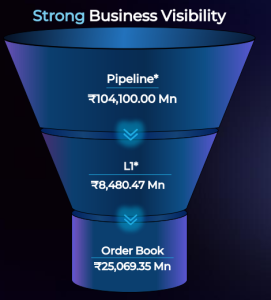
But a large order book does not automatically mean manufacturing value will rise at the same pace. AI systems require expensive GPUs, processors, memory and other components, meaning higher system volumes also increase Netweb’s exposure to component availability and procurement cycles.
The more important scalability question is therefore whether Netweb can keep increasing the engineering content per system while expanding physical production. Its Q1 FY27 operating EBITDA of ₹120.515 crore, at a 14.70% margin, provides an early indicator of the economics of this model.
If growth increasingly comes from Netweb-designed systems, proprietary software and integration rather than simply higher component volumes, the manufacturing model becomes more valuable. That is the scalability test: not how many servers Netweb can assemble, but how much system-level value it can add as volumes increase.
Where Netweb Sits?
Netweb is better compared with AI-server/system OEMs than with semiconductor companies. The closest useful global reference point is Supermicro: its model similarly combines system design, manufacturing and integration while relying on third-party compute components. At the other end is Dell, which operates at much greater scale and has a broader services and enterprise infrastructure business.
| Metric | Netweb | Dell | Supermicro |
| Revenue | ₹819.686 Cr | $43.842 Bn | $10.213 Bn |
| Profitability Metric | 14.70% EBITDA | 8.3% operating margin | 7.9% EBITDA |
| R&D intensity | Not separately disclosed | 2.2% of revenue | 2.11% of revenue |
| AI Scale | 62.29% of revenue | $16.1 Bn AI-server revenue | $39 Bn AI-server order book |
*The profitability measures are not identical, so do not directly rank the three margins as an apples-to-apples comparison.
Netweb’s 14.70% Q1 FY27 operating EBITDA margin is higher than the 8.3% operating margin reported by Dell and Supermicro’s 7.9% EBITDA margin. But this does not automatically prove that Netweb has a stronger manufacturing moat. The companies operate at vastly different scales and have different product mixes. What the comparison does show is that system-level hardware businesses can generate meaningful operating profitability without manufacturing the underlying CPUs or GPUs themselves.
The more revealing comparison is R&D intensity. Dell and Supermicro spend 2.2% and 2.11% of revenue, respectively, on R&D, while Netweb does not separately disclose R&D expense in its Q1 FY27 presentation. Netweb’s 125 R&D professionals and 17 registered and applied patents/designs establish engineering capability, but they do not quantify how much of its revenue or margin is attributable to that capability.
The Line Is Clear
The evidence points to a model that sits between pure assembly and full vertical manufacturing. Netweb does not fabricate the CPUs or GPUs that power its AI systems, and its partnerships with NVIDIA, AMD and Intel remain essential to the product stack.
But that does not make Netweb a conventional assembler. Its disclosed capabilities include system architecture, PCB design, PCB manufacturing, SMT, system integration and proprietary software, supported by 125 R&D professionals and 17 registered and applied patents and designs as of June 30, 2026.
The distinction is therefore about where manufacturing begins and ends. Netweb starts with technology developed by global component companies, but performs the engineering and physical transformation required to turn those components into complete high-performance computing systems.
That makes “assembler” too narrow because it ignores Netweb’s design and manufacturing capabilities. At the same time, calling it a fully integrated hardware manufacturer would imply control over semiconductor production that it does not have.
The most accurate description is a system-level OEM with an assembly-intensive manufacturing model. And with AI Systems already contributing 62.29% of Q1 FY27 revenue, that distinction is becoming increasingly important to understanding the company.
What Investors Should Price?
The manufacturer-versus-assembler debate ultimately matters only because it determines how much economic value Netweb can retain. Q1 FY27 shows an impressive AI transition: AI Systems and Enterprise Workstations generated ₹510.570 crore, or 62.29% of revenue from operations, while operating EBITDA stood at ₹120.515 crore, a 14.70% margin.
The evidence supports treating Netweb as a system-level OEM, but the valuation question is harder. Its 125-member R&D team, proprietary software and system-design capabilities demonstrate engineering depth; they do not yet prove that Netweb possesses a moat that competitors cannot reproduce. Meanwhile, rising inventory days show that rapid AI growth also carries a working-capital and component-availability cost.
So the key metric to watch is not whether Netweb can report another large AI-revenue jump. It is whether operating margins remain resilient as AI becomes the majority of the business, while inventory intensity normalises and proprietary engineering content increases.
If that happens, Netweb begins to look less like a low-value assembler and more like a differentiated Indian AI-infrastructure OEM. If it doesn’t, the hardware volume may grow much faster than the value Netweb captures from it.