Top 10 Stockbrokers in India by Active users
India’s stockbroking industry has undergone a dramatic transformation over the past decade. What was once dominated by branch-based brokers and paperwork-heavy account opening has evolved into a mobile-first ecosystem where millions of investors can start trading within minutes. This shift has fueled an unprecedented surge in retail participation, helping the National Stock Exchange (NSE) cross 26 crore registered trading accounts in 2026.
But registered accounts don’t tell the full story. The more meaningful measure is active clients, investors who actually trade and engage with the market. NSE’s active client data provides the clearest picture of which brokers are winning the battle for India’s growing investor base. The latest rankings reveal not only the country’s largest stockbrokers but also broader trends reshaping the industry, from the rise of digital-first platforms such as Groww and Zerodha to the resilience of established players like ICICI Securities and HDFC Securities.
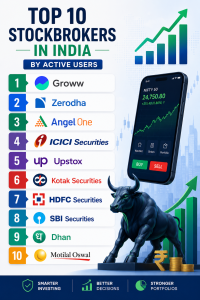
India’s Top 10 Stockbrokers by Active Users
The latest NSE active-client data shows a clear hierarchy among India’s brokerage firms. While digital discount brokers dominate the upper ranks, established full-service brokers continue to maintain significant client bases through their banking relationships, advisory services, and trusted brands.
| Rank | Stockbroker | Active Clients (Approx) |
| 1 | Groww | 1,30,59,756 |
| 2 | Zerodha | 68,47,049 |
| 3 | Angel One | 66,84,223 |
| 4 | ICICI Securities | 21,05,295 |
| 5 | Upstox | 19,23,729 |
| 6 | Kotak Securities | 13,80,379 |
| 7 | HDFC Securities | 13,61,209 |
| 8 | SBI Securities | 11,40,808 |
| 9 | Dhan | 10,61,986 |
| 10 | Motilal Oswal | 893,172 |
Source: National Stock Exchange (NSE) active client statistics. Active clients represent investors who executed at least one trade during the specified period, making this a more meaningful measure of brokerage market share than total registered accounts.
What stands out immediately is the concentration of market activity among the top three brokers. Groww, Zerodha, and Angel One collectively account for a substantial portion of India’s active retail trading population. Their dominance highlights how digital platforms have become the primary gateway to equity investing for a new generation of investors.
At the same time, the rankings demonstrate that traditional institutions have not disappeared. Brokers backed by major banking groups such as ICICI Securities, HDFC Securities, and Kotak Securities continue to benefit from integrated financial ecosystems that include savings accounts, loans, wealth management products, and long-standing customer relationships.
The competitive battle is therefore not merely between brokers, it is increasingly a contest between technology platforms and financial conglomerates. Check our video for additional information.
Groww’s Rise to the Top
The most significant development in India’s brokerage industry over the past few years has been the rise of Groww. Once known primarily as a mutual fund investment platform, the company has evolved into the country’s largest stockbroker by active users, surpassing long-time industry leader Zerodha.
Groww’s success reflects a fundamental shift in how retail investing is marketed and consumed. Unlike traditional brokers that targeted traders, Groww focused on first-time investors. Its user interface emphasized simplicity over complexity, removing much of the jargon that often intimidated new market participants. Account opening became frictionless, educational content became easier to understand, and investing began to feel as intuitive as using any other consumer app.
This strategy proved particularly effective among younger investors entering the market during and after the pandemic. As smartphone penetration expanded and digital financial services became more accessible, Groww positioned itself at the intersection of technology, convenience, and financial inclusion. The result was extraordinary. With approximately 1.30 crore active clients, the company now commands a lead that would have seemed almost unimaginable just a few years ago.
Yet Groww’s dominance is about more than user acquisition. It symbolizes the broader democratization of investing in India. The platform’s growth suggests that future brokerage leaders may be determined less by legacy relationships and branch networks and more by product design, user experience, and digital engagement.
Why Zerodha Remains India’s Most Influential Broker Despite Losing the Top Spot?
If Groww’s rise represents the future of retail investing, Zerodha remains the company that fundamentally changed India’s brokerage industry. It pioneered the discount-broking model, forcing traditional brokers to move away from expensive percentage-based commissions and adopt low-cost trading. Today, with nearly 69 lakh active clients, Zerodha remains one of the country’s largest brokerage platforms despite surrendering the top position.
Unlike many fintech companies that prioritize rapid customer acquisition, Zerodha has historically focused on profitability, product quality, and long-term customer retention. Its ecosystem including Kite for trading, Coin for mutual funds, and Varsity for investor education has helped create one of the most loyal user bases in Indian finance. The company has also demonstrated that a brokerage can achieve massive scale without relying heavily on advertising or venture-capital funding.
Active client numbers tell only part of the story. While Groww leads in scale, Zerodha continues to be viewed as the industry’s benchmark for innovation and operational efficiency. Its influence extends far beyond market share, making it arguably the most important company in the evolution of India’s modern brokerage industry.
Scale VS Profitability: Why Active Users Don’t Tell the Whole Story?
At first glance, Groww appears to be the undisputed leader of India’s brokerage industry. With nearly 1.3 crore active clients, it has built a user base almost twice the size of Zerodha’s. However, active users measure scale not necessarily business quality. A more revealing metric is how much revenue and profit a broker generates from each customer.
This is where the comparison becomes interesting. Despite having significantly fewer active clients, Zerodha has historically generated substantially higher profitability than many of its rivals. In FY24, Zerodha reported revenue of around ₹8,320 crore and a net profit of approximately ₹4,700 crore. Groww, meanwhile, generated revenue of about ₹3,145 crore and a profit of roughly ₹805 crore. While Groww’s financial performance has improved rapidly, the gap highlights the difference between acquiring users and monetizing them effectively.
The reason lies in customer behavior. Groww’s user base is heavily skewed toward first-time investors who may trade occasionally and contribute relatively lower revenue per account. Zerodha’s customers, on the other hand, tend to be more active traders and long-term investors who generate higher transaction volumes and engage with multiple products within the platform’s ecosystem. As India’s brokerage industry matures, investors and analysts may increasingly focus on metrics such as revenue per active client, profitability, and retention rather than user growth alone. The next industry leader may not necessarily be the broker with the most customers, but the one that extracts the greatest lifetime value from each customer relationship.
Angel One’s Reinvention from Legacy Broker to Digital Challenger
Angel One’s transformation is one of the most remarkable turnaround stories in India’s financial-services sector. Once known primarily as a traditional brokerage firm, the company successfully reinvented itself as a digital-first investing platform. That shift has helped it build an active client base of more than 67 lakh users, placing it among the country’s brokerage leaders.
The company’s success highlights how quickly investor preferences have changed. Rather than relying on its legacy branch network, Angel One invested aggressively in technology, mobile onboarding, and customer acquisition. This allowed it to compete directly with digital-native platforms while leveraging the trust and recognition built over decades in the market.
Its rise also carries an important lesson for the industry. The competition is no longer between traditional brokers and fintech startups; it is between firms that can adapt to changing consumer behavior and those that cannot. Angel One’s growth shows that established financial companies can remain highly competitive when they embrace digital transformation.
The Banking Giants
The rise of discount brokers has undoubtedly transformed India’s brokerage industry, but it has not eliminated the influence of traditional financial institutions. Brokers such as ICICI Securities, HDFC Securities, Kotak Securities, and SBI Securities continue to serve millions of active investors, proving that trust, banking relationships, and integrated financial services remain powerful competitive advantages. Together, these firms account for a significant share of India’s active trading population despite facing intense competition from newer digital platforms.
Their strength lies in their connection to large banking ecosystems. Customers who already maintain savings accounts, fixed deposits, loans, or wealth-management relationships with these institutions often prefer the convenience of keeping their investments within the same financial network. This creates a sticky customer base that is less likely to switch platforms solely because of lower brokerage charges or promotional offers.
The continued presence of banking-backed brokers in the top 10 rankings highlights an important reality: India’s brokerage market is not a winner-takes-all industry. While digital-first platforms are capturing a growing share of new investors, traditional brokers continue to benefit from credibility, established customer relationships, and cross-selling opportunities. As wealth creation becomes increasingly mainstream, both models are likely to coexist rather than replace one another.
Dhan: The Fastest-Rising Challenger
While Groww, Zerodha, and Angel One dominate the headlines, Dhan has quietly emerged as one of the fastest-growing brokers in India. Founded in 2021, the platform has already crossed 11 lakh active clients, an impressive achievement in an industry where acquiring and retaining users has become increasingly competitive. Its rapid rise demonstrates that there is still room for new entrants despite the dominance of established players.
Unlike many brokers that focus primarily on beginner investors, Dhan has positioned itself as a platform built for serious traders and advanced investors. Features such as sophisticated charting tools, options-trading capabilities, and deep market analytics have helped it attract a highly engaged user base. This differentiated approach has allowed the company to carve out a niche rather than compete solely on pricing or marketing.
Dhan’s growth also highlights the increasing specialization within India’s brokerage industry. As the market matures, investors are demanding more than just low brokerage fees, they want platforms tailored to their specific investing and trading needs. If the company can maintain its growth momentum while continuing to innovate, it could become one of the industry’s most influential challengers over the coming years.
Technology Has Become the New Battleground
Price competition is no longer enough to differentiate a brokerage platform. As brokerage fees have converged toward similar levels, technology and reliability have become increasingly important competitive factors.
This shift has exposed a growing challenge for the industry: platform outages during periods of extreme market volatility. Whenever markets experience sharp movements, social media often fills with complaints from users unable to place orders, access portfolios, or execute trades. These disruptions can damage customer trust because investors increasingly expect brokerage apps to function with the same reliability as digital banking platforms.
As active client numbers continue to rise, scaling technology infrastructure may become one of the industry’s biggest competitive advantages. Future leaders will not be determined solely by customer acquisition but also by their ability to maintain stability, process large volumes of transactions, and deliver a seamless experience during periods of market stress.
What These Rankings Reveal About India’s Retail Investing Boom?
The list of India’s largest stockbrokers tells a much bigger story than market share. Just a decade ago, the industry was dominated by traditional brokers and relationship-driven investing. Today, the top positions are occupied by technology-led platforms that have made investing faster, cheaper, and more accessible. The dominance of Groww, Zerodha, Angel One, and Upstox reflects how smartphones, digital onboarding, and low-cost brokerage models have fundamentally changed investor behavior.
This transformation has coincided with an unprecedented surge in retail participation. The NSE’s trading account base has expanded rapidly in recent years as younger investors entered the market, attracted by easier access to financial products and growing awareness of wealth creation through equities. Investing, once considered a niche activity, has increasingly become a mainstream financial habit for millions of Indians.
At the same time, the rankings suggest that the next phase of growth may look different from the last. As competition intensifies and customer acquisition becomes more expensive, brokers will need to focus on engagement, product innovation, and long-term investor retention rather than simply adding new accounts. The industry’s future winners are likely to be those that can build complete financial ecosystems rather than functioning solely as trading platforms.
The Regulatory Challenge Facing India’s Brokers
The brokerage industry’s explosive growth has attracted greater regulatory scrutiny. In recent years, regulators have expressed concerns about excessive speculation, particularly in the derivatives segment where a large percentage of retail traders incur losses.
SEBI has responded with measures aimed at improving investor protection, including tighter oversight of financial influencers, stricter disclosure requirements, and changes affecting options trading activity. These reforms could alter the economics of the brokerage business, especially for platforms that depend heavily on high-frequency trading volumes.
The result is a major strategic challenge for the industry. Brokers may need to shift their focus from transaction-driven revenue toward broader wealth-management services, long-term investing products, and financial planning tools. The firms that adapt successfully could emerge stronger, while those overly dependent on speculative activity may face slower growth.
Conclusion
India’s brokerage industry is in the midst of a historic transformation. Groww’s emergence as the largest broker by active users, Zerodha’s continued influence, Angel One’s digital reinvention, and Dhan’s rapid rise all point to a market that is becoming increasingly technology-driven. At the same time, the continued presence of ICICI Securities, HDFC Securities, Kotak Securities, and SBI Securities demonstrates that trust and banking relationships remain valuable competitive advantages.
More importantly, these rankings reflect the broader democratization of investing in India. Millions of individuals who once relied on traditional savings instruments are now participating in equity markets through digital platforms. As financial literacy improves and technology continues to lower barriers to entry, the competition among brokers will become less about pricing and more about delivering a superior investing experience.
The top 10 stockbrokers of today are not merely competing for market share, they are shaping how the next generation of Indians builds wealth. Their success offers a glimpse into the future of India’s financial ecosystem, one where investing is increasingly accessible, data-driven, and integrated into everyday life.