Why EVs use More Copper than Petrol/Diesel Cars?
A few years ago , electric vehicles felt like a distant concept, something experimental rather than practical . Today that picture has completely changed. EVs are not just becoming mainstream, they are gradually reshaping the entire automotive and energy ecosystem behind them.
But there is one less-discussed material sitting at the center of this transition: copper.
What most people don’t realize is that an EV doesn’t just replace a fuel tank with a battery, it fundamentally increases the metal intensity of a vehicle. And copper is the biggest beneficiary of that shift.
So the real question is simple: why do EVs require significantly more copper than traditional petrol or diesel cars?
Let’s break it down.
The Structural Difference
A petrol or diesel car is mainly a mechanical system. Fuel is burned in the engine to generate power, and electricity is used only for small functions like starting the engine, lights, and basic electronics.
An electric vehicle works completely differently. It runs fully on electricity that flows from the battery to the motor and other systems. Because of this, the entire vehicle depends on electrical connections, and copper becomes a very important material throughout the system. This has been explained in our Copper analysis video.
Why Copper Usage Increases?
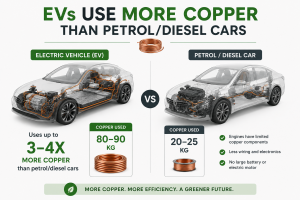
The difference in copper usage between the two types of vehicles is quite large. A normal petrol or diesel car uses around 20 to 25 kg of copper, mostly in wiring and small electrical parts.
An electric vehicle, on the other hand, can use around 60 to 80 kg or even more depending on its size and battery.
This increase happens because EVs need high-voltage wiring, battery connections, power control systems, and motor controllers. Every added electrical function increases copper demand inside the vehicle.
Motors and Battery Systems
Electric motors depend heavily on copper because copper is very efficient at carrying electricity. Motor windings are made using copper so that energy loss is low and performance stays high.
Battery systems also use copper, not inside the battery cells, but around them. Copper is used in connectors, busbars, and power distribution parts that move electricity from the battery to the motor. This creates a much more complex electrical system compared to traditional cars.
Charging Infrastructure
Copper demand from EVs is not limited to the vehicle itself. It also comes from outside infrastructure.
Charging stations, power grids, transformers, and transmission systems all need large amounts of copper to handle high electrical loads.
So EV growth creates demand in two places- inside the car and in the supporting electricity network. As EV adoption increases, this external demand becomes very important.
Thermal Management
Modern EVs produce a lot of heat because of powerful batteries and fast charging systems. To manage this heat, advanced cooling systems are needed.
Copper is used here because it transfers heat very efficiently. It is used in cooling pipes and heat exchange systems, especially in liquid cooling setups.
Why Petrol and Diesel Cars Use Less Copper?
Traditional cars do not need high-voltage systems or complex electrical networks. Their main focus is mechanical energy from fuel, so electricity is limited to basic functions.
Even with modern features, they still do not require the same level of electrical complexity as EVs. Because of this, copper usage remains much lower and more stable.
Can Copper Become the New Oil of Electrification?
For decades, oil was the foundation of the transportation industry. But as the world shifts toward electrification, copper is becoming equally important in a different way.
Electric vehicles, charging infrastructure, renewable energy systems, and power grids all depend heavily on copper because of its high electrical conductivity. Unlike oil, which powers engines through combustion, copper acts as the backbone of electrical systems.
This is why many analysts now see copper as one of the key materials driving the electrification era, much like oil once powered the fuel economy.
Conclusion
The difference in copper usage between EVs and petrol or diesel cars is not small. It is structural.
EVs are fully electrical systems, and this automatically increases copper demand inside the vehicle as well as in the supporting infrastructure like charging networks and grids.
This is why copper has become an important material in the EV transition, not just a supporting metal.