Government Policies for Shipbuilding Sector- Explained
India’s maritime ambitions are far larger than its current shipbuilding footprint. Despite possessing a coastline of more than 7,500 kilometers and sitting along some of the world’s busiest trade routes, India accounts for less than 1% of global shipbuilding output. In contrast, China, South Korea, and Japan collectively control more than 90% of the global market, dominating everything from bulk carriers and container ships to sophisticated LNG vessels.
This gap matters because shipbuilding is not just another manufacturing industry. It sits at the intersection of trade, logistics, defense, engineering, steel, and energy. Every vessel built generates demand across dozens of industries, creates high-skilled jobs, and strengthens a nation’s maritime self-reliance. Recognizing this strategic importance, the Indian government has introduced a series of policies aimed at reviving domestic shipbuilding and reducing dependence on foreign-built vessels.
The question, however, is whether policy support alone can overcome the structural disadvantages that have kept India on the sidelines of the global shipbuilding industry.
Market Share
| Country | Global Shipbuilding Market Share (approx) | Core Industrial Advantage |
| China | ~50-55% | State-backed financing, massive scale, integrated supply chains |
| South Korea | ~25-30% | Leadership in LNG carriers and high-value commercial vessels |
| Japan | ~10-15% | Advanced automation and premium eco-vessel designs |
| India | <1% | Lower labour costs but constrained by financing and supply-chain gaps |
The table highlights the scale of the challenge. India’s shipbuilding ambitions are competing against decades-old industrial ecosystems backed by deep capital pools, mature supply chains, and strong export capabilities.
Why Indian Shipyards Struggle Despite Lower Labour Costs?
At first glance, India appears well-positioned to become a major shipbuilding nation. Labour costs are significantly lower than in developed economies, the country has a large engineering talent pool, and domestic demand for ships is expected to rise alongside economic growth.
Yet shipbuilding is not won on labour costs alone.
The biggest challenge is financing. Shipbuilding projects require large upfront capital investments and construction cycles that often stretch over two to three years. While Indian shipbuilders typically face borrowing costs of around 9-11%, many Chinese and South Korean yards benefit from state-backed credit available at roughly 2-4%. That financing gap can significantly increase the cost of building a vessel, often neutralizing India’s lower labour costs before construction even begins. In shipbuilding, access to cheap capital can be just as important as manufacturing efficiency.
Scale is another problem. Chinese shipyards operate at massive capacities, allowing them to spread fixed costs across hundreds of vessels and negotiate better terms with suppliers. India’s shipbuilding ecosystem remains fragmented, limiting economies of scale and reducing global competitiveness.
Supply-chain dependence further adds to costs. Many high-value marine components continue to be imported, increasing project expenses and exposing shipbuilders to currency fluctuations and procurement delays. As a result, Indian yards often struggle to match the pricing and delivery schedules offered by their East Asian competitors.
The Government’s Policy Arsenal
Recognizing these structural challenges, policymakers have introduced multiple initiatives designed to improve competitiveness and attract investment into the sector.
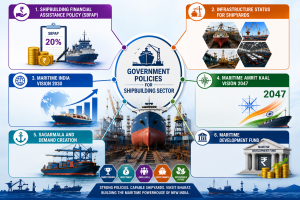
Shipbuilding Financial Assistance Policy (SBFAP)
Why was the policy introduced?
When competing for global shipbuilding orders, Indian shipyards face a structural disadvantage. While Chinese and South Korean yards benefit from cheap state-backed financing, mature supplier ecosystems, and massive economies of scale, Indian shipbuilders often operate with higher borrowing costs and lower capacity utilization. The Shipbuilding Financial Assistance Policy (SBFAP), introduced in 2016, was designed to narrow this competitiveness gap and encourage more vessels to be built within India.
How does the scheme work?
The policy provides financial assistance linked to the contract value of ships built at Indian shipyards. By lowering the effective cost of construction, the government aims to improve the ability of domestic yards to compete against foreign rivals and attract more commercial orders.
The scheme is particularly important because shipbuilding is a highly price-sensitive industry. Even small differences in project costs can determine where a shipping company places an order.
Who stands to gain?
The most direct beneficiaries are public and private shipyards. However, the impact extends much further. Domestic shipping companies gain access to a stronger local supplier base, marine equipment manufacturers benefit from higher demand, and thousands of skilled workers across fabrication, engineering, and ancillary industries stand to gain from increased shipbuilding activity.
Has it worked?
The policy has helped improve the competitiveness of Indian shipyards, but its impact has been constrained by larger structural challenges. Financial assistance can reduce costs, but it cannot fully offset the advantages enjoyed by Chinese and South Korean shipbuilders, whose access to cheaper capital and larger industrial ecosystems remains a significant edge.
Infrastructure Status for Shipyards
Why was infrastructure status needed?
One of the biggest obstacles facing Indian shipbuilders is financing. Building a commercial vessel can take several years and requires significant upfront capital. During that period, interest costs continue to accumulate, directly affecting project economics.
Recognizing this challenge, the government granted infrastructure status to shipyards, placing them alongside sectors such as roads, ports, and power projects in terms of financing eligibility.
What changes for shipbuilders?
Infrastructure status improves access to long-term funding and allows lenders to structure loans more appropriately for the long gestation periods typical of shipbuilding projects. This can help reduce financing pressure and improve project viability.
Why is financing such a critical issue?
Indian shipbuilders often borrow at interest rates of around 9-11%, while many East Asian competitors enjoy access to funding at roughly 2-4% through state-supported financial systems. Over a multi-year construction cycle, that gap can add millions of dollars to project costs and significantly weaken competitiveness.
For India, narrowing the financing gap may ultimately prove more important than any individual subsidy programme.
Maritime India Vision 2030
What is the government’s objective?
Unlike SBFAP, which focuses on improving shipyard economics, Maritime India Vision 2030 takes a broader approach. It seeks to transform the entire maritime ecosystem by strengthening ports, logistics infrastructure, coastal shipping, inland waterways, and shipbuilding capacity.
The underlying idea is simple: successful shipbuilding industries rarely emerge in isolation. They develop alongside strong ports, active shipping networks, and integrated industrial supply chains.
Key shipbuilding initiatives
The vision includes plans to expand shipbuilding and ship repair capacity, establish maritime clusters, encourage private investment, and improve India’s overall maritime competitiveness.
Maritime clusters are particularly important because they bring together shipyards, suppliers, engineering firms, research institutions, and logistics providers within a single ecosystem. This model has been a major driver of shipbuilding success in countries such as China and South Korea.
Why does it matter?
The policy shifts the focus from supporting individual shipyards to building an entire maritime economy. If implemented effectively, it could help address some of the structural weaknesses that have historically limited India’s shipbuilding ambitions.
Maritime Amrit Kaal Vision 2047
Looking beyond short-term incentives
Maritime Amrit Kaal Vision 2047 represents the government’s long-term ambition to position India among the world’s leading maritime nations by the centenary year of independence.
Where earlier policies focused on immediate competitiveness, this vision focuses on long-term industrial transformation.
What does success look like?
The strategy aims to increase India’s share of global shipbuilding, strengthen maritime exports, encourage advanced vessel manufacturing, and develop globally competitive maritime infrastructure.
It also places greater emphasis on technology, innovation, and sustainability- areas that are likely to shape the future of global shipping.
Why investors are paying attention
Shipbuilding investments are made over decades, not quarters. Long-term policy visibility reduces uncertainty and gives industry participants greater confidence to commit capital toward capacity expansion and technological upgrades.
Sagarmala and Demand Creation
Why shipbuilding needs Sagarmala?
Most policy discussions focus on increasing shipbuilding capacity. However, capacity alone means little without demand.
This is where Sagarmala plays a critical role.
How the programme supports shipbuilding?
By modernizing ports, expanding coastal shipping, improving logistics connectivity, and promoting port-led industrialization, Sagarmala increases maritime activity across the economy.
As cargo movement through coastal routes and inland waterways rises, demand for barges, ferries, dredgers, coastal cargo vessels, and support ships is expected to grow.
The bigger impact
Sagarmala addresses a challenge that many industrial policies overlook: creating customers. By expanding the domestic maritime economy, the programme helps create a more sustainable pipeline of vessel orders for Indian shipyards.
Maritime Development Fund
Why is a new fund being discussed?
Despite multiple policy initiatives, access to affordable capital remains one of the industry’s biggest challenges. Policymakers are therefore exploring the creation of a dedicated Maritime Development Fund to support shipbuilding and broader maritime infrastructure.
What could it achieve?
A dedicated funding mechanism could provide long-term capital for shipbuilding projects, vessel acquisition, and maritime infrastructure development. More importantly, it could help create a financing ecosystem tailored to the needs of the maritime sector.
Why this may be the most important policy of all?
Most of India’s shipbuilding challenges ultimately trace back to financing. If a Maritime Development Fund can meaningfully reduce capital costs, it could have a larger long-term impact on competitiveness than many traditional subsidy programmes.
Has Any of It Worked?
The answer is mixed.
India has undoubtedly strengthened its shipbuilding capabilities over the past decade, particularly in defense and strategic shipbuilding. Leading shipyards such as Cochin Shipyard and Mazagon Dock have built strong order books supported by naval and coast guard programs.
However, commercial shipbuilding remains relatively small compared to global leaders. India’s share of international shipbuilding orders continues to be negligible, and domestic yards still struggle to attract large volumes of commercial cargo vessel contracts.
This highlights an important reality. Government policies have improved the operating environment, but they have not yet transformed India’s competitive position in global commercial shipbuilding.
The gap between policy ambition and market share remains substantial.
Where India’s Shipbuilding Strength Actually Lies?
While commercial shipbuilding remains limited, India has achieved considerably greater success in defence shipbuilding. Shipyards such as Cochin Shipyard and Mazagon Dock have built strong order books supported by naval vessels, submarines, patrol ships, and coast guard programs.
This distinction is important because it suggests government policies have been more effective in strengthening strategic shipbuilding capabilities than in establishing India as a major exporter of commercial vessels.
The Green Shipping Opportunity
If India cannot realistically compete with China on scale, where does its opportunity lie?
The answer may be emerging from the global shipping industry’s transition toward cleaner fuels and lower emissions.
International regulations and decarbonization targets are forcing shipowners to rethink fleet investments. Demand is expected to increase for vessels powered by alternative fuels such as green ammonia, hydrogen, methanol, and electricity.
This transition effectively creates a new market where technological innovation may matter more than scale alone.
Rather than competing head-on with China in conventional bulk carriers and container ships, India could position itself in emerging segments such as electric ferries, green coastal vessels, offshore renewable-energy support ships, and alternative-fuel maritime infrastructure.
The advantage of this approach is that it allows India to participate in the future of shipbuilding rather than attempting to catch up in segments already dominated by established players. Check our latest video for more details.
The Real Test of Government Policy
India does not suffer from a lack of maritime vision. Financial assistance schemes, infrastructure status, long-term policy roadmaps, and port-development programs demonstrate a clear commitment to building a stronger shipbuilding industry.
The challenge lies elsewhere.
Chinese shipyards are supported by decades of investment, mature supply chains, large-scale manufacturing ecosystems, and access to low-cost financing. Matching those advantages will require more than subsidies and policy announcements.
A deeper contradiction also remains. While policymakers promote maritime self-reliance, a significant portion of commercial vessels used by Indian shipping operators continues to be sourced from foreign shipyards. Until domestic shipbuilding becomes economically competitive or policy incentives strongly encourage local procurement, the industry will struggle to achieve self-sustaining growth.
Government policies have laid the foundation, but foundations alone do not build industries.
The next phase will require execution, investment, technology acquisition, and sustained demand creation. If India can narrow the financing gap, strengthen domestic supply chains, and capture emerging opportunities in green shipping, shipbuilding could evolve into one of the country’s most important manufacturing success stories. If not, India risks remaining a major maritime nation that continues to sail on ships built elsewhere.
Conclusion
Government policies have undoubtedly improved the operating environment for India’s shipbuilding sector, but policy support alone cannot create a globally competitive industry.
Despite ambitious roadmaps and financial incentives, India still accounts for less than 1% of global shipbuilding output and faces significant challenges in financing, scale, and supply-chain development.
The real test now lies in execution. If India can narrow its financing disadvantage, strengthen domestic manufacturing ecosystems, and capitalize on emerging opportunities in green shipping, shipbuilding could become one of the country’s most important manufacturing growth stories over the next decade.