IRCTC Q1 FY27 Results Explained – Why did Margins Shrink?
IRCTC’s Q1 FY27 results look strong on the surface: revenue from operations rose 18.10% to ₹1,369.53 crore. But the earnings story underneath is far less impressive. EBITDA fell 2.67% to ₹386.67 crore, while EBITDA margin dropped from Q1 FY26’s 34.26% to 28.23%.
The surprising part is that the margin pressure came despite strong revenue growth. So, what changed? The answer lies not in weak demand, but in what kind of revenue IRCTC added and how much profit that revenue generated.
Revenue Grew Strongly, But Profit Didn’t Follow
IRCTC’s Q1 FY27 results show a clear disconnect between topline growth and earnings. Consolidated revenue from operations rose 18.10% YoY to ₹1,369.53 crore, but EBITDA declined 2.67% to ₹386.67 crore. This pushed the EBITDA margin down to 28.23% from 34.26% in Q1 FY26, a contraction of 6.03 percentage points.
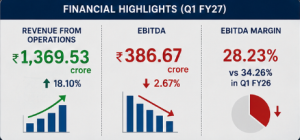
The weakness was even more visible at the bottom line. Consolidated PAT stood at ₹330.15 crore, compared with ₹330.70 crore in Q1 FY26, a decline of ₹0.55 crore despite the ₹209.85 crore increase in revenue.
| ₹ Crore | Q1 FY26 | Q1 FY27 | YoY Change |
| Revenue From Operations | 1159.68 | 1369.53 | 18.10% |
| EBITDA | 397.26 | 386.67 | -2.67% |
| EBITDA Margin | 34.26% | 28.23% | -6.03 pp |
| PAT | 330.70 | 330.15 | 0.17% |
The important takeaway is that IRCTC did not have a revenue-growth problem in Q1 FY27. It had a revenue-quality problem. The next step is to identify where that additional ₹209.85 crore came from and why it generated so little incremental operating profit. More about this has been discussed in our latest video.
Catering Drove Most Of The Revenue Growth, But Not The Profit Growth
The biggest clue behind IRCTC’s margin compression is where the additional revenue came from. Catering revenue jumped from ₹546.78 crore in Q1 FY26 to ₹732.26 crore in Q1 FY27, adding ₹185.48 crore. That means catering alone accounted for 88.38% of IRCTC’s ₹209.85 crore increase in revenue from operations.
But the profitability of that growth moved in the opposite direction:
- Catering revenue: ₹732.26 crore, up 33.92%
- Catering segment profit: ₹58.01 crore, down from ₹71.80 crore
- Catering profit decline: ₹13.79 crore
- Segment profit margin: fell from 13.13% to 7.92%
This creates the central insight from Q1: IRCTC’s fastest-growing revenue segment became less profitable at the same time that its contribution to the topline increased.
Catering’s share of revenue consequently rose from 47.15% to 53.47%. So, more than half of IRCTC’s revenue was now coming from a segment generating less profit per rupee of sales than it did a year earlier.
That explains why an 18.10% increase in revenue could coexist with a 6.03-percentage-point EBITDA margin contraction. The issue was not insufficient growth; it was the profitability and mix of that growth.
Internet Ticketing: The Highest-Margin Business Also Saw Profit Pressure
The other side of the margin story is IRCTC’s internet ticketing business, because this is where the company generates substantially more profit from each rupee of revenue. In Q1 FY27, internet-ticketing revenue was ₹360.99 crore, compared with ₹358.75 crore in Q1 FY26 - an increase of just ₹2.24 crore, or 0.62%. Yet segment profit declined from ₹301.93 crore to ₹289.63 crore, a fall of ₹12.30 crore, or 4.07%.
That creates an important contrast with catering:
- Revenue: ₹360.99 crore, up 0.62%
- Segment profit: ₹289.63 crore, down 4.07%
- Profit-to-revenue ratio: 80.23% vs 84.16% in Q1 FY26
- Profit decline: ₹12.30 crore
The significance is not simply that ticketing profit declined. IRCTC’s highest-margin segment was no longer expanding its profit pool, while catering, the much larger source of incremental revenue was becoming less profitable.
This combination is particularly damaging to consolidated margins. The business that contributes the most incremental revenue is generating weaker profitability, while the business that generates the most profit is seeing its own segment profit contract.
That makes Q1 FY27 a case of margin pressure from both ends of IRCTC’s business mix.
Rail Neer Shows The Same Pattern, While Tourism Provides A Small Offset
The margin pressure was not confined to catering and internet ticketing. Rail Neer revenue increased from ₹110.49 crore to ₹113.91 crore, but its segment profit declined from ₹15.40 crore to ₹11.17 crore in Q1 FY27. That means revenue rose ₹3.42 crore, while profit fell ₹4.23 crore.
The numbers are important because they show that the issue was broader than one weak segment:
- Rail Neer revenue: ₹113.91 crore, up 3.10%
- Rail Neer segment profit: ₹11.17 crore, down 27.47%
- Profit-to-revenue ratio: 9.81%, versus 13.94% in Q1 FY26
Tourism, however, moved in the opposite direction. Revenue increased from ₹147.70 crore to ₹168.07 crore, while segment profit rose from ₹12.86 crore to ₹19.31 crore.
That makes tourism the quarter’s profitability bright spot. But its improvement was not enough to offset the deterioration in catering, internet ticketing and Rail Neer.
The pattern is therefore becoming clear: IRCTC’s Q1 margin compression was not caused by a single business. Its largest growth engine lost profitability, its highest-margin business saw lower segment profit, and Rail Neer also weakened. Tourism was the exception rather than the rule.
What Actually Drove the Catering Margin Decline?
Catering is not simply suffering because it is a lower-margin business. The more important issue is that specific costs and the economics of newer train-catering revenue are reducing the amount of profit IRCTC retains from each additional rupee of sales.
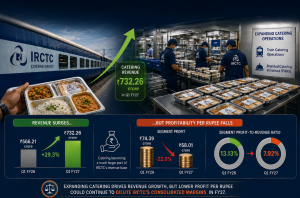
In Q1 FY27, catering revenue increased ₹185.48 crore to ₹732.26 crore, while segment profit fell ₹13.79 crore from 78.01 crore in Q1 FY26 to ₹58.01 crore. Its profit-to-revenue ratio therefore dropped from 13.13% to 7.92%. IRCTC’s management has previously explained that Vande Bharat’s prepaid catering model carries a 5% GST burden without input-tax credit on the relevant turnover, creating a direct drag on margins. The company has also said that the growing contribution of train catering and branded-catering initiatives is changing the segment mix.
There are also identifiable cost items. In the comparable management discussion, higher ECL provisioning, CSR allocation and GST/direct costs together represented ₹18 crore of additional pressure, although the previous-year base also contained a ₹33 crore legacy item that did not recur.
The important caveat is that IRCTC has not separately disclosed how much Q1 FY27 catering revenue came from Vande Bharat or branded pilots. Therefore, the defensible conclusion is that mix and cost pressures explain part of the deterioration, but the company has not provided enough disclosure to attribute the entire ₹13.79 crore profit decline to any one initiative.
The Earnings Sensitivity: What If Catering Keeps Growing?
The margin issue becomes clearer when the catering business is stress-tested. Q1 FY27 catering revenue was ₹732.26 crore, with segment profit of ₹58.01 crore, equivalent to a 7.92% margin. If revenue grows another 20-30%, the difference between sustaining an approximately 8% margin and recovering towards 13% becomes material.
| Catering scenario | Revenue | Profit at 8% margin | Profit at 13% margin | Incremental profit from 5-pp recovery |
| Q1 FY27 | ₹732.26 cr | ₹58.58 cr | ₹95.19 cr | ₹36.61 cr |
| 20% growth | ₹878.71 cr | ₹70.30 cr | ₹114.23 cr | ₹43.94 cr |
| 30% growth | ₹951.94 cr | ₹76.16 cr | ₹123.75 cr | ₹47.60 cr |
This shows why the margin question matters more than the revenue-growth headline. At 20% catering growth, a recovery from 8% to 13% would create ₹43.94 crore of additional segment profit; at 30% growth, the benefit rises to ₹47.60 crore.
For context, Q1 FY27 consolidated EBITDA was ₹386.67 crore. If all other businesses and costs were held constant, those additional catering profits would mechanically lift EBITDA to ₹430.61 crore or ₹434.27 crore, respectively. This is a sensitivity, not a forecast, because it assumes no change elsewhere in the business.
The analysis therefore identifies the real operating lever: catering does not need slower growth; it needs better profit conversion as it scales.
That makes the next few quarters important: investors should watch whether catering profit catches up with its revenue growth and whether internet-ticketing profitability recovers.
Internet Ticketing: The ₹12.30 Crore Profit Decline Needs More Investigation
Internet ticketing presents a different problem. Revenue was almost unchanged at ₹360.99 crore versus ₹358.75 crore, an increase of only ₹2.24 crore or 0.62%. Yet segment profit fell from ₹301.93 crore to ₹289.63 crore, a decline of ₹12.30 crore or 4.07%.
That reduced the segment’s profit-to-revenue ratio from 84.16% to 80.23%. The magnitude matters because internet ticketing is IRCTC’s most profitable business: even a small deterioration in its economics can have a disproportionate effect on consolidated earnings.
However, the available Q1 disclosure does not identify a single quantified expense responsible for the ₹12.30 crore decline. That distinction is important. IRCTC reported 13.39 crore tickets in the comparable quarter and ₹247 crore of convenience-fee income, while UPI accounted for 51.7% of transactions.
The evidence therefore supports a narrower conclusion: the segment generated almost no revenue growth but absorbed enough additional costs or lower-margin income to reduce profit by ₹12.30 crore. Without a company-disclosed cost bridge, assigning that decline to UPI charges, technology costs or any other single item would be speculation.
This is now a key disclosure to watch. If ticketing revenue remains stable but segment profit recovers, Q1 may reflect temporary cost pressure. If profit keeps declining despite stable revenue, the deterioration becomes much more concerning.
Conclusion
IRCTC’s Q1 FY27 margin compression currently looks too early to classify as structural, but too significant to dismiss as a temporary blip. The sharpest pressure came from catering, where revenue expanded rapidly but profitability weakened. However, part of the decline was linked to identifiable cost pressures and changes in the business mix rather than a collapse in demand.
The next two to three quarters should provide the evidence needed to determine whether the margin profile is resetting permanently. A recovery in catering profitability towards 13%, alongside stabilisation in internet-ticketing profit, would support the view that Q1 was largely a temporary margin disruption. Conversely, continued 20- 30% catering growth at around 8% margins, combined with further declines in internet-ticketing profit despite broadly stable revenue, would point towards a structural change.
For now, IRCTC’s growth engine remains intact, but the economics of that growth are under pressure. The decisive metric for FY27 will therefore not be revenue growth alone, but whether incremental revenue begins translating into incremental operating profit again.