Chinese Dumping, VAT Rebates and Anti-Involution: What Changed for Indian Chemical Stocks?
For nearly three years, the investment case for Indian chemical stocks was dominated by one problem: China had too much capacity and was willing to export the surplus at aggressively low prices.
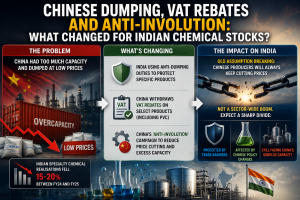
The consequences were visible in earnings. CRISIL reported that domestic and export realisations for Indian specialty chemical manufacturers fell 15-20% between FY24 and FY25, while operating-margin recovery remained fragile.
But the China story is now changing.
India is increasingly using anti-dumping duties to protect specific domestic products. Meanwhile, China has started changing the economics of exports by withdrawing VAT rebates on selected products, including PVC, and its broader “anti-involution” campaign is aimed at reducing destructive price competition and inefficient capacity.
This does not mean Chinese competition has disappeared. The more important change is that the old assumption; Chinese producers will always keep cutting prices regardless of profitability is becoming less reliable.
For Indian chemical investors, that distinction matters. The potential recovery is unlikely to be a sector-wide boom. It could instead create a sharp divide between companies protected by trade barriers, companies exposed to products affected by Chinese policy changes, and companies still competing against China’s enormous surplus capacity.
The Original Problem: Why Chinese Dumping Hurt Indian Chemical Stocks?
The chemical downturn was not primarily a demand-collapse story. In many product chains, supply was the bigger problem.
China built enormous manufacturing capacity across chemicals during its industrial expansion. When domestic demand weakened, producers increasingly looked towards export markets to keep plants running. India became one of the natural destinations.
This created a difficult equation for Indian manufacturers:
- Chinese producers could lower export prices to protect utilisation.
- Indian companies had to either match those prices or lose volumes.
- Matching prices compressed realisations and EBITDA margins.
- Even companies with rising volumes could report disappointing profit growth.
CRISIL estimated that realisations for Indian specialty chemical manufacturers fell 15-20% between FY24 and FY25 because of persistent pricing pressure. It also warned that aggressive Chinese dumping could continue to weaken pricing power and profitability.
The important investor lesson was that capacity utilisation alone was not enough to predict earnings recovery. A plant could operate at higher volumes while earning lower margins.
That explains why the chemical sector’s recovery repeatedly disappointed investors. The missing variable was pricing power.
The developments now emerging in China and India matter because they directly affect that variable.
China’s VAT Withdrawal and Anti-Involution Are Not the Same Thing
China’s VAT rebate withdrawal and its anti-involution campaign may both reduce pressure from Chinese chemical exports, but they work through different mechanisms and timelines.
VAT Rebate Withdrawal Changes Export Economics Immediately
China’s decision to eliminate the 13% VAT rebate on PVC exports from April 1, 2026 directly changes the economics of exporting. Producers can raise prices, absorb the loss through lower margins, or reduce exports if overseas sales become uneconomic.
However, VAT withdrawal does not remove excess capacity. Producers can still export aggressively if maintaining plant utilisation remains preferable to cutting production.
Anti-Involution Addresses the Supply Problem
Anti-involution policies target a deeper issue: destructive competition driven by excess capacity. Their impact depends on whether they lead to reduced expansion, lower production at uneconomic plants, or permanent capacity exits.
For Indian chemical stocks, the difference is crucial:
- Immediate catalyst: VAT changes can alter export pricing economics.
- Structural catalyst: Capacity closures can reduce global oversupply.
VAT withdrawal can affect prices quickly. Anti-involution can create a durable recovery only if it reduces physical supply.
Anti-Involution Has One Missing Proof Point: Is Capacity Actually Leaving?
China’s anti-involution campaign may signal a change in policy direction, but investors need evidence that it is changing actual supply.
The key distinction is between announced capacity rationalisation and actual capacity reduction. Restricting future expansion does little to solve oversupply if existing plants continue operating at high rates.
The indicators that matter are:
- permanent plant closures;
- cancelled or postponed projects;
- lower operating rates and production;
- declining Chinese export volumes.
The continued emergence of anti-dumping investigations in India involving products such as certain antioxidants, sodium nitrite, resorcinol and azepine intermediates also shows that Chinese competitive pressure has not disappeared.
The chemical recovery becomes credible only when Chinese supply data, not just policy announcements, starts confirming greater production discipline.
India Is Fighting A Different Battle: Product-Specific Protection
While China is attempting to change its industrial behaviour, India has increasingly used trade remedies to protect domestic manufacturers in specific chemical products.
This is important because anti-dumping duties do not protect the entire chemical sector. Their benefits are highly product-specific.
Recent cases demonstrate the scale of this intervention.
India imposed anti-dumping duties on acetonitrile imports from China, Russia and Taiwan in June 2025. The duty on Chinese imports ranged from $202 to $481 per tonne, depending on the producer/exporter.
In another example, India’s DGTR recommended a reference-price-based duty mechanism for DASDA, a chemical used in optical brightening agents and dye intermediates. Imports priced below $3,453 per tonne would face a duty equal to the difference from that reference price, subject to the government’s final decision.
India also concluded proceedings involving products such as certain antioxidants imported from China and Singapore, highlighting the continuing use of trade remedies in chemical markets.
The key investment insight is simple:
A chemical company with anti-dumping protection in its major product is fundamentally different from a company exposed to unrestricted Chinese imports.
Both may be classified as “chemical stocks,” but their earnings environments can be completely different.
The Biggest Change Is Not Demand, It Is The Competitive Equation
The most interesting shift for investors is that three separate forces are now acting on the same problem.
Earlier competitive equation:
Chinese excess capacity → aggressive exports → falling Indian prices → margin compression
Emerging equation:
Anti-dumping duties in India + weaker Chinese export incentives + anti-involution policies → potentially less aggressive price competition
Each measure attacks a different part of the problem.
- Anti-dumping duties increase the cost of unfairly priced imports entering India.
- VAT rebate withdrawal makes exports less economically attractive for Chinese producers.
- Anti-involution policies attempt to address the underlying incentive for destructive competition and excess capacity.
This combination is more significant than any individual policy.
However, the effects will not be uniform. A company manufacturing a product directly affected by Chinese VAT changes could see pricing improve quickly. In fact, management commentary from Aarti Industries indicated that pricing in its NCB chain increased by 7-10% within days, although management explicitly said the move could not be attributed entirely to VAT policy alone.
That is an important distinction.
Policy creates the opportunity for prices to recover, but supply-demand conditions determine whether the opportunity becomes sustainable earnings.
Which Indian Chemical Companies Have The Most Direct Exposure?
The impact of reduced Chinese dumping will not be spread evenly across Indian chemical stocks. The biggest beneficiaries are likely to be companies where Chinese imports directly influence the pricing of specific products.
The clearest opportunities currently fall into two categories: companies seeking protection against dumped imports and companies whose product pricing improves when Chinese competition becomes less aggressive.
1. Deepak Nitrite: The Most Direct Trade-Remedy Beneficiary
Deepak Nitrite has the strongest direct connection to the current anti-dumping cycle.
In March 2026, the DGTR issued its final findings in the investigation into DASDA, following an application from Deepak Nitrite. The authority recommended a reference-price mechanism of $3,453 per tonne for imports from China. Imports below that level would face duty equal to the difference between the import price and the reference price, subject to the government’s final decision.
The company is also directly exposed to the latest sodium nitrite case. In June 2026, India initiated an anti-dumping investigation into sodium nitrite imports from China following an application by Deepak Nitrite. The investigation was initiated after allegations that dumped imports were undercutting domestic prices and damaging profitability.
This makes Deepak Nitrite particularly important for investors because the potential benefit is straightforward: less import undercutting can improve domestic realisations without requiring a major increase in end-market demand.
2. Aarti Industries: The Benefit Comes Through Pricing Discipline
Aarti Industries represents a different type of potential beneficiary from companies protected by a specific anti-dumping duty. Its opportunity lies in whether reduced Chinese price aggression can improve realisations across its chemical chains.
The company reported FY26 revenue of ₹9,018 crore and EBITDA of ₹1,172 crore, resulting in an EBITDA margin of 13.0%. Management also indicated that pricing in its NCB chain increased by 7-10%, although the company did not attribute the entire increase solely to changes in Chinese policy.
The crucial question for investors is whether this improvement in pricing can translate into higher EBITDA.
A 7-10% increase in NCB prices does not automatically mean a similar increase in Aarti’s EBITDA. The company has not disclosed the revenue or EBITDA contribution of the NCB chain, so calculating a precise ₹ crore earnings benefit from the price increase would be speculative.
What matters instead is the movement in spreads. If higher product realisations are sustained while raw-material costs remain stable, the additional spread can contribute disproportionately to EBITDA because a significant portion of manufacturing fixed costs is already absorbed by the existing business.
For Aarti Industries, the real confirmation of a China-driven pricing recovery will therefore be whether improved realisations extend beyond isolated products and help lift its 13.0% FY26 EBITDA margin sustainably. Check our latest video to know more.
3. Atul: Resorcinol Could Become a Direct Beneficiary
Atul is another particularly relevant company because of its exposure to resorcinol.
In June 2026, the DGTR initiated an anti-dumping investigation into imports of resorcinol from China and Japan following an application by Atul Limited. The filing identified Atul as the domestic producer seeking protection from allegedly dumped imports.
Resorcinol is used in applications including tyre and rubber products and resin bonding.
This creates a direct link between Chinese pricing behaviour and Atul’s product economics.
If anti-dumping action ultimately restricts low-priced imports, Atul could benefit through:
- reduced import-price undercutting;
- better domestic pricing discipline;
- improved ability to recover manufacturing costs.
However, investors should distinguish between an ongoing investigation and an implemented duty. The June 2026 initiation is evidence that Chinese and Japanese imports are creating competitive pressure, but the earnings benefit will depend on the final outcome of the investigation.
For Atul, the key confirmation will be whether improved protection is followed by higher resorcinol realisations and stronger segment profitability.
4. Vinati Organics: A Direct Link to the Antioxidant Investigation
Vinati Organics provides another clear example of a listed Indian chemical company directly affected by imported competition.
In June 2026, the DGTR initiated an anti-dumping investigation concerning certain antioxidants imported from China, South Korea and Singapore following an application by Vinati Organics.
This is important because anti-dumping cases provide unusually direct evidence of where competitive pressure is affecting an Indian producer.
Vinati’s potential benefit is therefore different from a broad “China-plus-one” narrative.
The relevant investment question is much narrower:
Can reduced undercutting in the affected antioxidant products improve Vinati’s pricing and profitability?
If the investigation ultimately results in protection, the company could benefit from a more rational domestic pricing environment. But, again, an investigation should not be treated as an immediate earnings benefit.
The sequence investors should watch is:
Investigation → final findings → government duty → import-price response → Vinati’s realisations and margins.
That makes Vinati Organics a stock to monitor rather than one where the entire benefit should already be priced into earnings expectations.
The Chemical Earnings Equation: Spreads Matter More Than Revenue Growth
The biggest mistake investors can make during a chemical recovery is to focus only on revenue growth.
Chemical earnings are driven by spread recovery:
Selling price – raw-material cost = the margin pool available to absorb fixed costs and generate EBITDA.
This creates operating leverage.
If a company’s product price rises while raw-material costs remain stable, the incremental revenue can carry a significantly higher EBITDA contribution than the company’s existing consolidated margin.
That is why even a relatively small recovery in pricing can materially improve earnings.
But the reverse is also true.
A company may report higher revenue because raw-material prices rise and are passed through to customers, while EBITDA barely improves. Aarti Industries itself highlighted the importance of input-price pass-through and product-mix management in recent results.
Therefore, the correct sequence for investors is:
- Are product prices increasing?
- Are raw-material costs stable or falling?
- Is the spread widening?
- Is EBITDA margin responding?
Only when all four begin moving in the right direction can higher realisations be called an earnings recovery.
The strongest chemical upcycle is not rising prices. It is rising prices combined with stable costs and improving utilisation.
Why Does This Not Mean Every Indian Chemical Stock Will Recover?
The market may be tempted to treat anti-involution and VAT changes as a broad bullish signal for the entire chemical sector.
That would be a mistake.
Indian chemical companies have very different exposures:
- Some compete directly with Chinese producers.
- Some manufacture highly specialised products with limited Chinese competition.
- Some benefit from lower raw-material prices created by Chinese oversupply.
- Some have anti-dumping protection.
- Others remain completely exposed to global commodity pricing.
A reduction in Chinese price aggression helps companies selling competing products. But it can hurt companies that benefit from cheap Chinese raw materials.
Similarly, anti-dumping protection can improve domestic pricing without necessarily improving export-market realisations.
The correct analytical framework is therefore product-chain analysis, not sector analysis.
Investors should ask four questions:
- What percentage of the company’s revenue competes directly with Chinese products?
- Which specific products have trade protection?
- Is the company a beneficiary of higher product prices or cheaper raw materials?
- Can improved pricing translate into EBITDA growth, or will higher costs absorb the benefit?
The next chemical recovery will probably reward specific product exposures, not simply companies carrying the “specialty chemicals” label.
The Four Numbers That Will Confirm Whether the Chemical Upcycle Has Actually Started
Investors do not need to guess whether China’s anti-involution campaign is working. The answer will eventually appear in four measurable indicators.
1. Chinese capacity closures
Announcements are not enough. Investors should track permanent closures and cancelled expansion projects.
This is the most important structural indicator because capacity leaving the system directly reduces future oversupply.
2. Chinese export volumes and prices
If Chinese export volumes continue rising while export prices remain weak, dumping pressure has not disappeared.
A healthier market would show either:
- lower export volumes; or
- improving export prices.
Ideally, both would happen simultaneously.
3. Indian chemical realisations
Indian companies should begin reporting sustained improvement in product prices.
One isolated quarterly increase is insufficient. Investors need to see whether higher realisations survive across multiple quarters.
4. EBITDA margins
This is the final confirmation.
A chemical recovery is real only when better pricing reaches the income statement.
For Aarti Industries, the reference point is its 13.0% FY26 EBITDA margin based on ₹1,172 crore EBITDA and ₹9,018 crore revenue.
If realisations rise but EBITDA margins remain stagnant, the benefit is probably being absorbed by raw materials, logistics or competitive pressure.
Chinese policy → pricing → Indian realisations → EBITDA margins.
That is the chain investors should follow.
A break at any stage means the recovery thesis remains incomplete.
What Investors Should Watch Before Calling This the Next Chemical Upcycle?
Something has changed in the competitive environment, but it is still too early to call the end of Chinese dumping.
India is increasingly responding through product-specific trade remedies. Deepak Nitrite’s DASDA case, where the DGTR recommended a reference price of $3,453 per tonne, and the fresh sodium nitrite investigation demonstrate how directly Chinese imports can affect Indian chemical profitability.
At the same time, China’s withdrawal of export incentives can immediately alter export economics, while anti-involution has the potential to address the deeper problem of excess capacity.
But these are different catalysts.
VAT changes can affect prices quickly.
Capacity rationalisation determines whether the improvement lasts.
For investors, the most actionable approach is to watch the following sequence:
- Are Chinese plants actually closing?
- Are Chinese chemical export volumes declining?
- Are export prices rising?
- Are Indian producers reporting better realisations?
- Are EBITDA margins expanding?
The strongest investment opportunities will likely emerge where all these factors meet at the company and product level.
That makes companies with direct exposure to dumped Chinese products and meaningful operating leverage the most important stocks to monitor.
The next chemical upcycle will not begin when China announces another policy.
It will begin when Chinese supply discipline becomes visible in export data and Indian chemical companies start converting better prices into higher EBITDA margins.