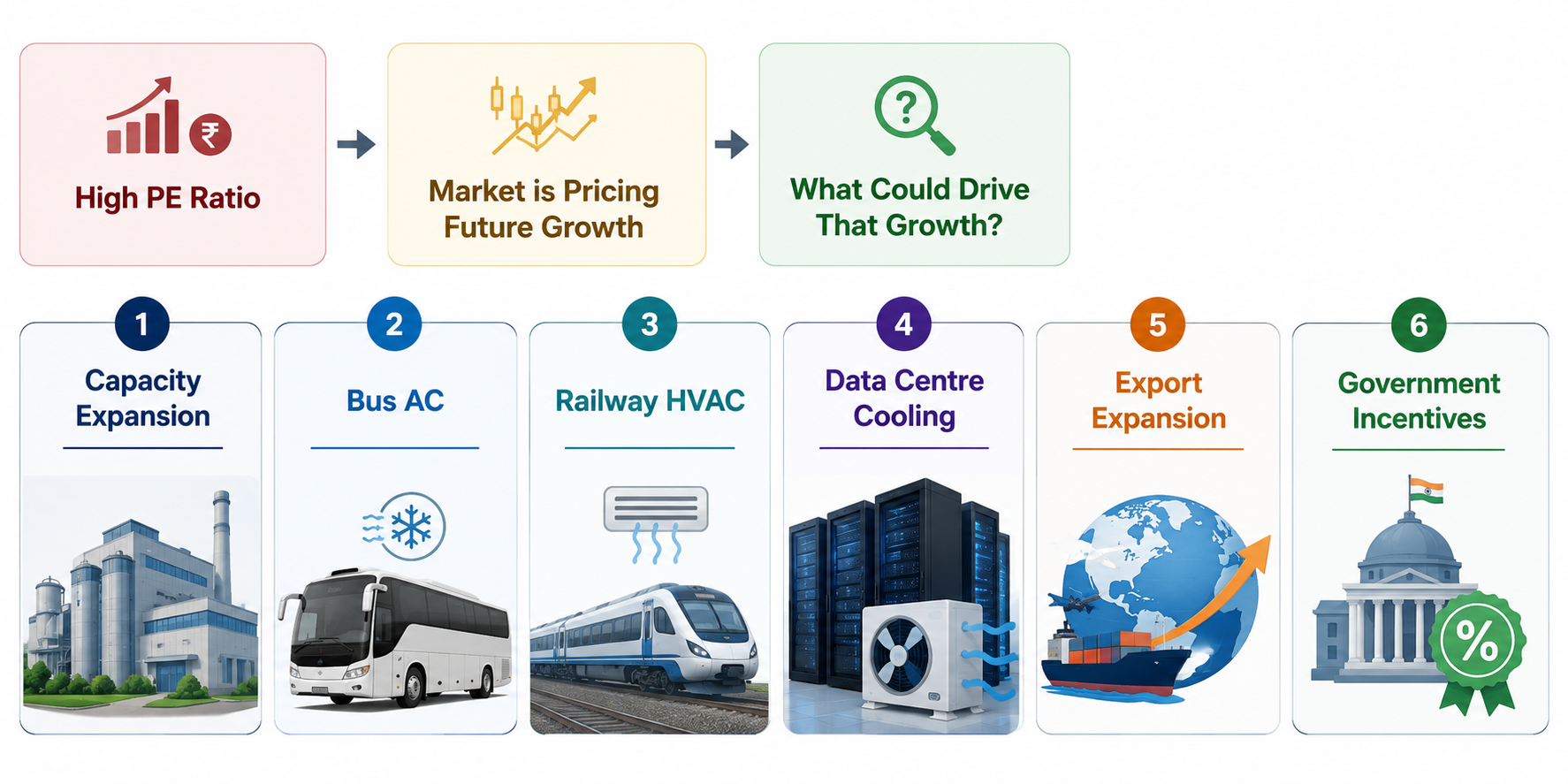
6 Growth Drivers of KRN Heat Exchanger that Justify its High PE Ratio
KRN Heat Exchanger has become one of the most closely watched companies in India's HVAC (Heating, Ventilation, and Air Conditioning) component industry. While the business has delivered strong growth, what has caught investors' attention is something else - its premium valuation.
The stock trades at a significantly higher P/E multiple than many traditional manufacturing companies. At first glance, that valuation may appear expensive. However, the market rarely assigns a premium multiple without expecting equally strong future earnings growth.
The key question, therefore, is not whether the stock is expensive today, but whether the business has enough growth opportunities to justify that valuation.
To answer that, we need to look beyond the current financials and understand what the company is building for the next few years.
Based on the management's commentary, six major growth drivers are expected to shape KRN's future growth. Together, these opportunities have the potential to expand the company's revenue base, improve margins, and diversify its business across multiple high-growth segments.
Growth Driver #1: Capacity Expansion
KRN's largest growth driver is not a future factory - it's one that has already been built.
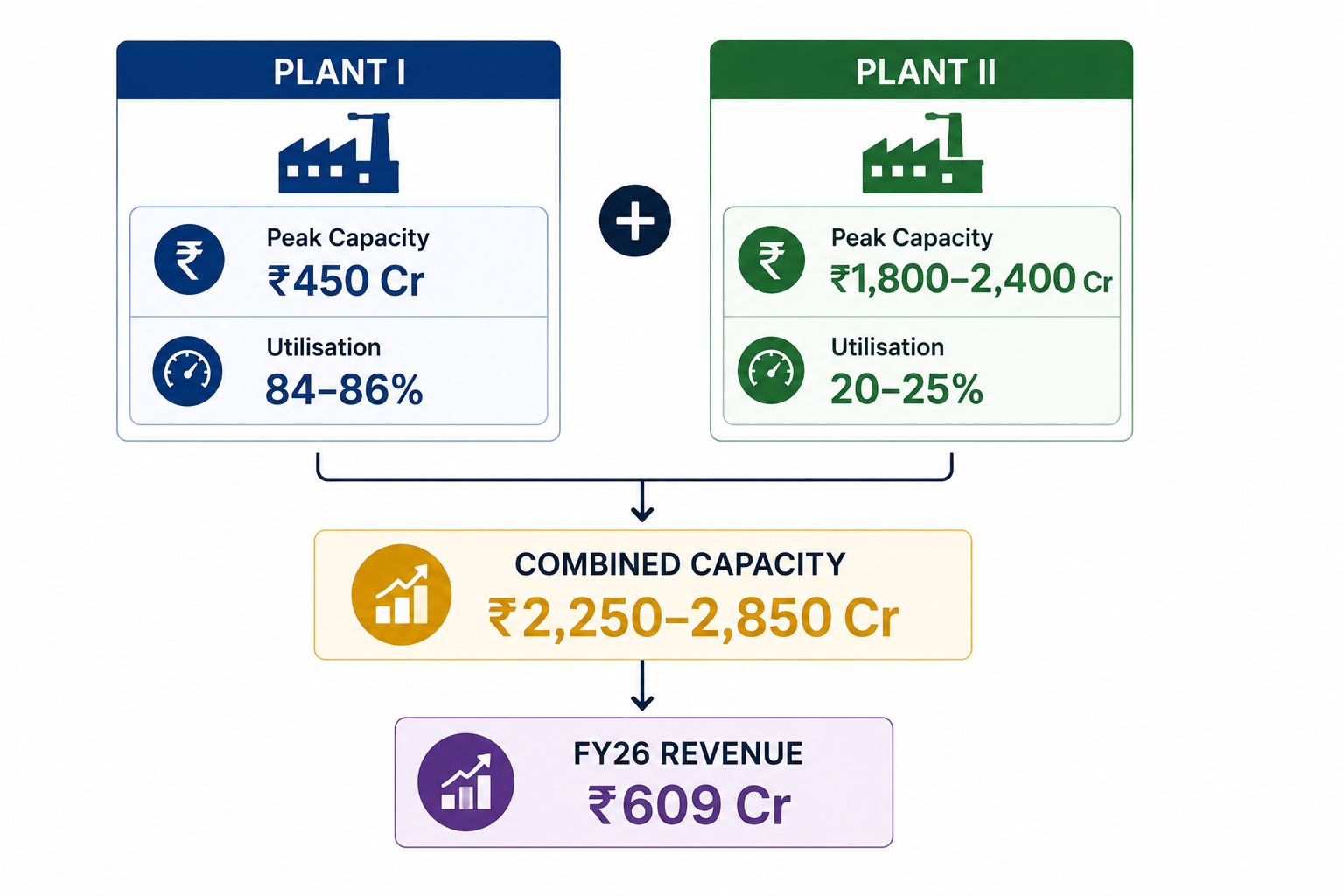
The company currently operates two manufacturing facilities. Its original Plant I in Neemrana is already operating at 84 - 86% utilisation, with a peak revenue capacity of around ₹450 crore. Since FY26 standalone revenue is already close to this level, Plant I offers limited room for further expansion.
The real growth engine is Plant II, operated through KRN HVAC Products Private Limited, a wholly owned subsidiary that was inaugurated on 31 May 2025. The new facility adds nearly six times the capacity of Plant I and has a peak revenue capacity of ₹1,800 - 2,400 crore, taking the company's total installed revenue capacity to ₹2,250 - 2,850 crore.
| Plant I Peak Capacity | ~₹450 crore |
| Plant II Peak Capacity | ₹1,800–2,400 crore |
| Total Installed Capacity | ₹2,250–2,850 crore |
| FY26 Consolidated Revenue | ₹609 crore |
This means KRN has already built enough manufacturing capacity to support revenue well above its current scale without another major expansion.
However, Plant II is still in the early stages of ramp-up, operating at 20–25% utilisation. Management aims to increase this to around 50% in FY27 and 80% in FY28. As utilisation improves, the new facility is expected to become the company's primary growth engine.
KRN's next phase of growth depends less on building new factories and more on increasing utilisation of the capacity it has already created.
Growth Driver #2: Bus AC Business
Having built significant manufacturing capacity, KRN's next focus is expanding into higher-value products.
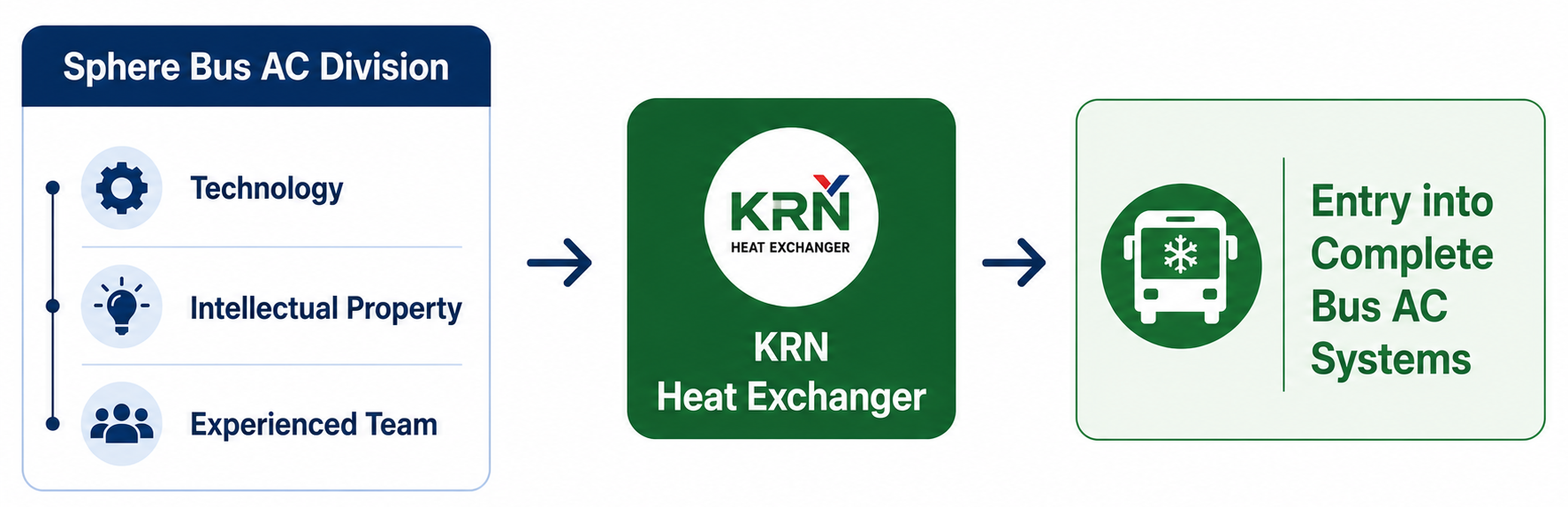
During FY26, the company acquired the assets and technology of Sphere Refrigeration Systems' Bus AC division. This was an asset acquisition rather than an equity acquisition, meaning KRN acquired the technology, intellectual property and experienced team instead of buying the entire business.
Although Sphere's existing revenue was only ₹2–3 crore, the acquisition was never about its revenue. It was about accelerating KRN's entry into the Bus AC market.
Scaling Ahead of Demand
According to the management, the Bus AC market in India exceeds ₹1,000 crore, and KRN aims to capture around 15% of this market.
Management has guided for approximately ₹160 crore of Bus AC revenue in FY27, supported by early execution. During Q4 FY26, the company added 10–15 new Bus AC customers, commenced regular supplies to its first OEM, and signed an NDA with an anchor customer.
These developments indicate that KRN's expansion into the Bus AC business has moved beyond planning and into commercial execution.
Growth Driver #3: Railway HVAC
While KRN's Bus AC business could drive near-term growth, the company is also making steady progress in the Railway HVAC segment.
Management does not expect this business to contribute meaningfully in FY27. However, several recent milestones have significantly improved the likelihood of future revenue, making Railway HVAC an important long-term growth driver.
Early Milestones Achieved
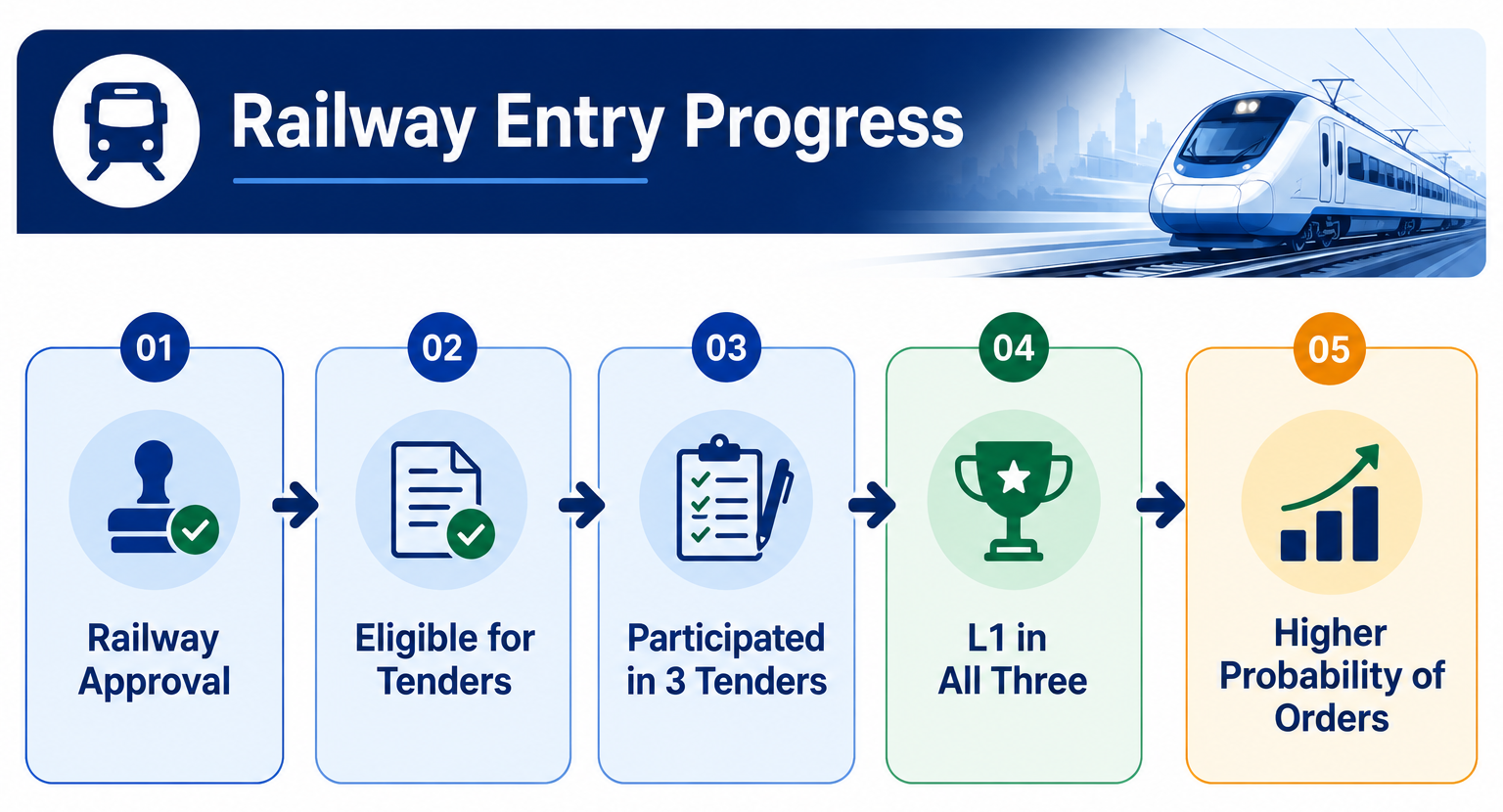
KRN has already received Indian Railways' approval for its Bar and Plate Heat Exchanger, allowing the company to participate in railway tenders.
The early signs have been encouraging.
According to the management, KRN recently participated in three railway tenders and secured the L1 position in all three. While L1 status does not guarantee an order, it substantially increases the probability of winning contracts, subject to meeting all technical and commercial requirements.
| Railway Progress | Status |
| Product Approval | ✅ Received |
| Railway Tenders Participated | 3 |
| L1 Position | 3 out of 3 |
Management's long-term ambition extends beyond supplying heat exchangers.
The company is also preparing to enter the complete Railway Coach HVAC systems market. To support this expansion, KRN has already started building the required team.
In addition, management believes the technology and expertise acquired through the Sphere Bus AC acquisition strengthens the company's capabilities in complete HVAC systems, creating a natural progression from Bus AC to Railway HVAC.
Growth Driver #4: Data Centre Cooling
If the previous growth drivers were about expanding KRN's presence in existing industries, the fourth driver is about participating in one of the fastest-growing infrastructure segments globally - Data Centres.
The rapid growth of cloud computing and AI is driving significant investments in data centre infrastructure, and every data centre requires efficient cooling systems to operate reliably.
For KRN, this has already become more than just a future opportunity. It is a business that is contributing to revenue today while also opening doors to new products and export markets.
Scaling Into a Revenue Driver
Unlike Railway HVAC, which is still in its early stages, the data centre business is already contributing meaningfully to KRN's revenue.
According to the management, the segment accounted for approximately 16–19% of FY26 revenue, and its contribution has been increasing quarter after quarter.
This indicates that data centres are gradually becoming one of the company's important end-user industries.
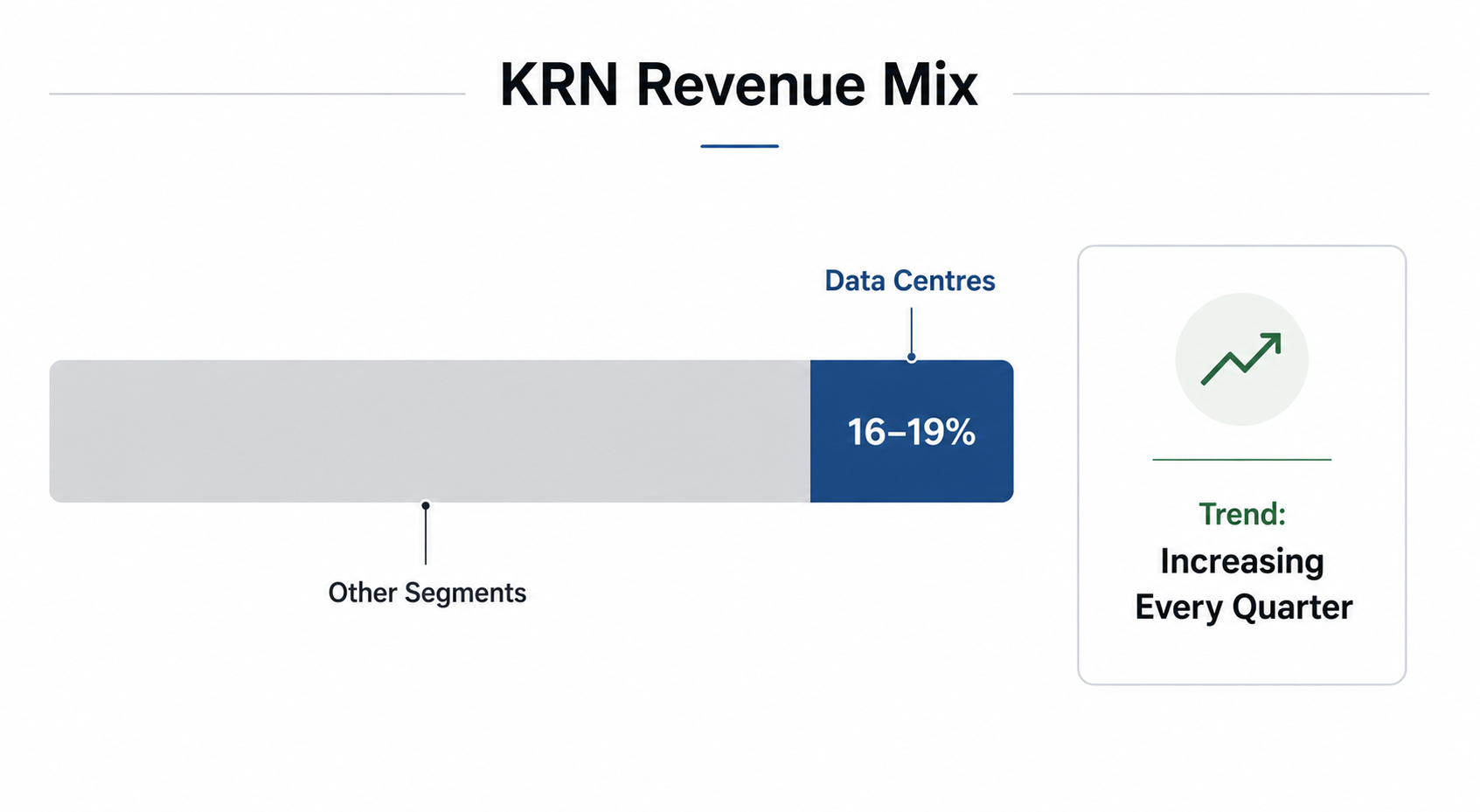
Among KRN's six growth drivers, data centre cooling stands out because it is already contributing meaningful revenue while continuing to expand.
The company is strengthening its position through existing products, developing new solutions for AI-focused liquid cooling, growing its export presence, and adding new customers.
As India's data centre ecosystem expands and global demand for cooling solutions continues to rise, this segment has the potential to become an increasingly important contributor to KRN's long-term growth story.
Growth Driver #5: Export Expansion
While most of KRN's revenue still comes from the domestic market, the company is steadily building its presence overseas.
For investors, exports are important for two reasons. First, they diversify the company's revenue base across multiple geographies. Second, export business generally carries better margins than domestic sales, making it a potential driver of both growth and profitability.
Management believes this business is still in its early stages, with significant room for expansion over the next few years.
Exports Gaining Momentum
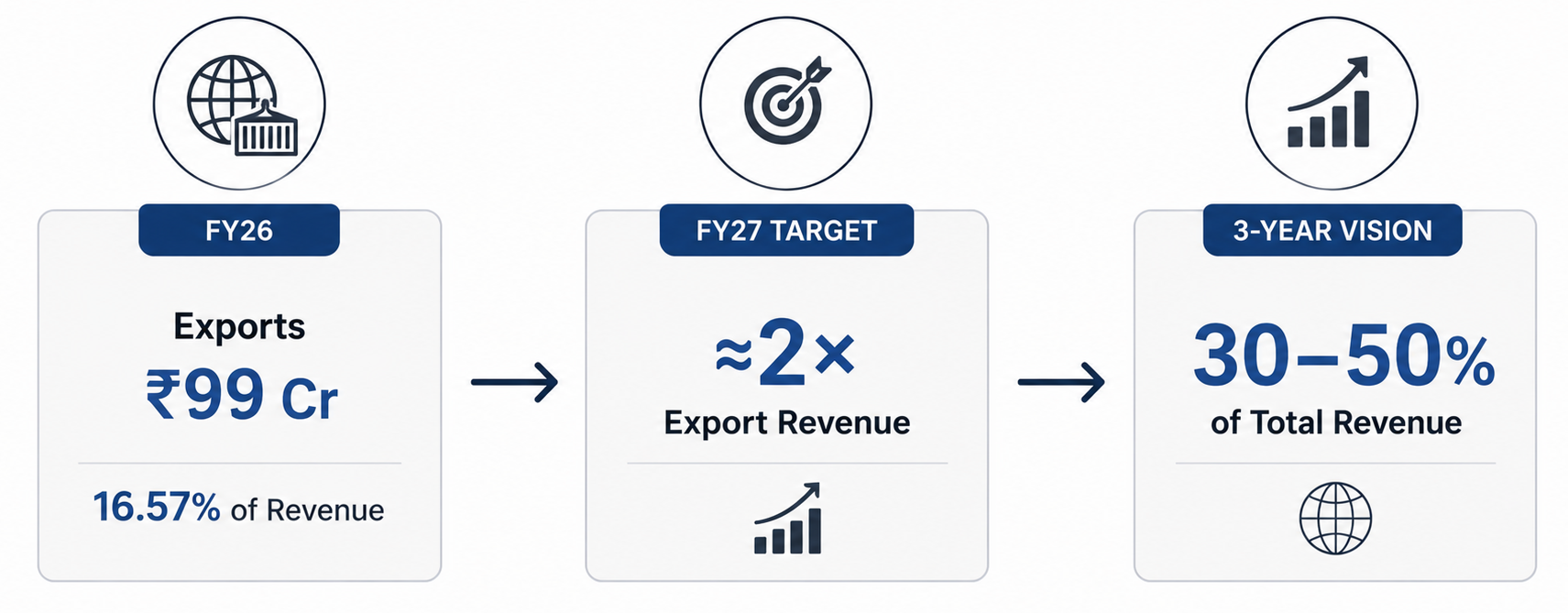
During FY26, KRN generated approximately ₹99 crore from exports, accounting for 16.57% of its total revenue.
However, management has set an ambitious target for the coming years.
The company aims to:
- Roughly double export revenue in FY27 compared to FY26.
- Increase exports to 30 - 50% of total revenue within the next three years.
If achieved, exports could become one of the company's largest growth engines
| Export Revenue | ₹99 crore |
| Share of Total Revenue | 16.57% |
| FY27 Target | Roughly Double |
| 3-Year Goal | 30–50% of Revenue |
Building Global Presence
KRN's exports are already spread across several international markets.
Its current export mix includes:
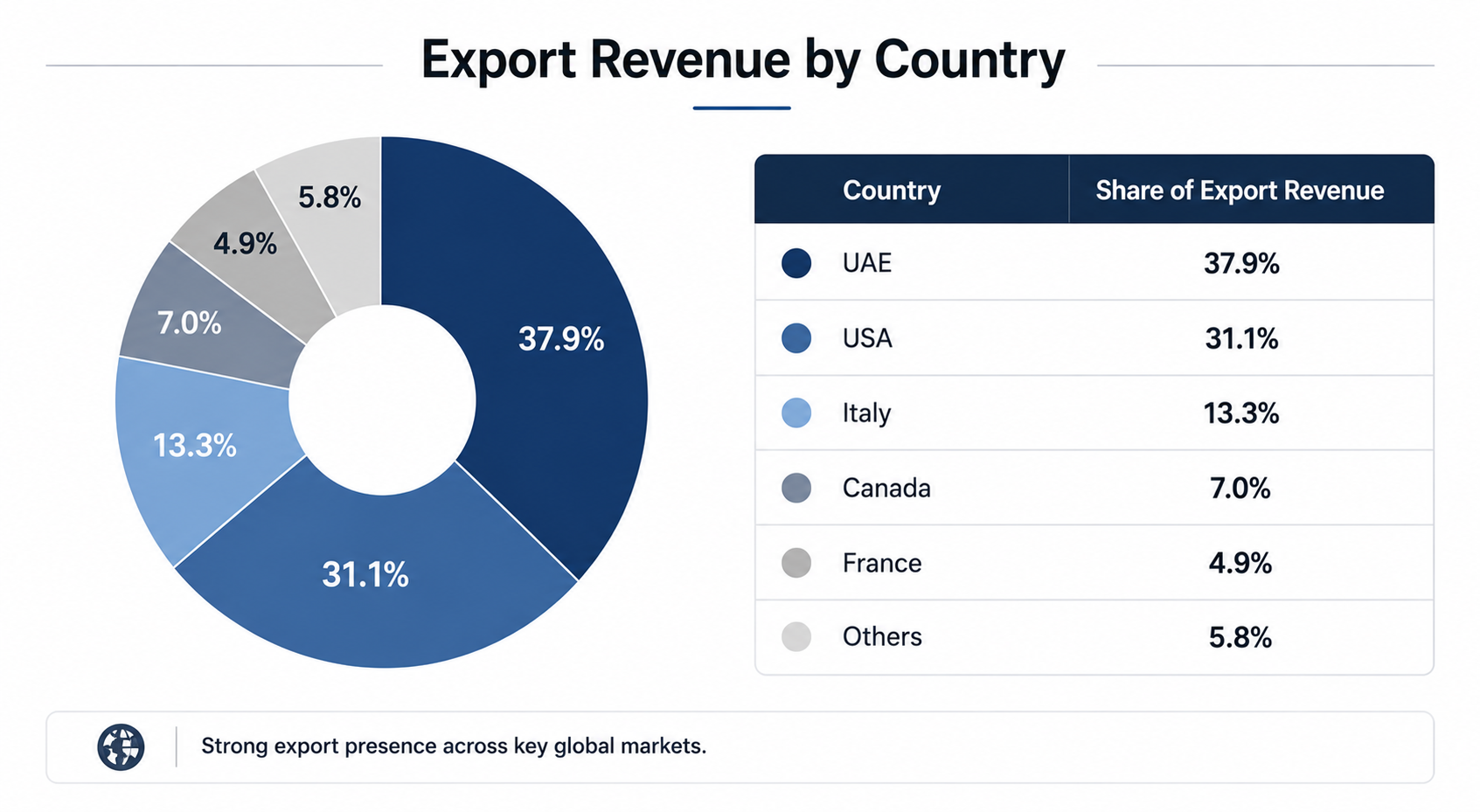
While the UAE and the US currently account for the largest share of exports, management indicated that this concentration is gradually reducing as the company expands into additional European markets.
Pilot orders are already being converted into commercial business, helping diversify the export portfolio over time.
Growth Driver #6: Government Incentives
Not every growth driver increases revenue.
Some improve profitability instead.
For KRN Heat Exchanger, government incentives fall into the second category. While they may not receive as much attention as capacity expansion or data centres, they have the potential to meaningfully improve the company's earnings once the new manufacturing facility scales up.
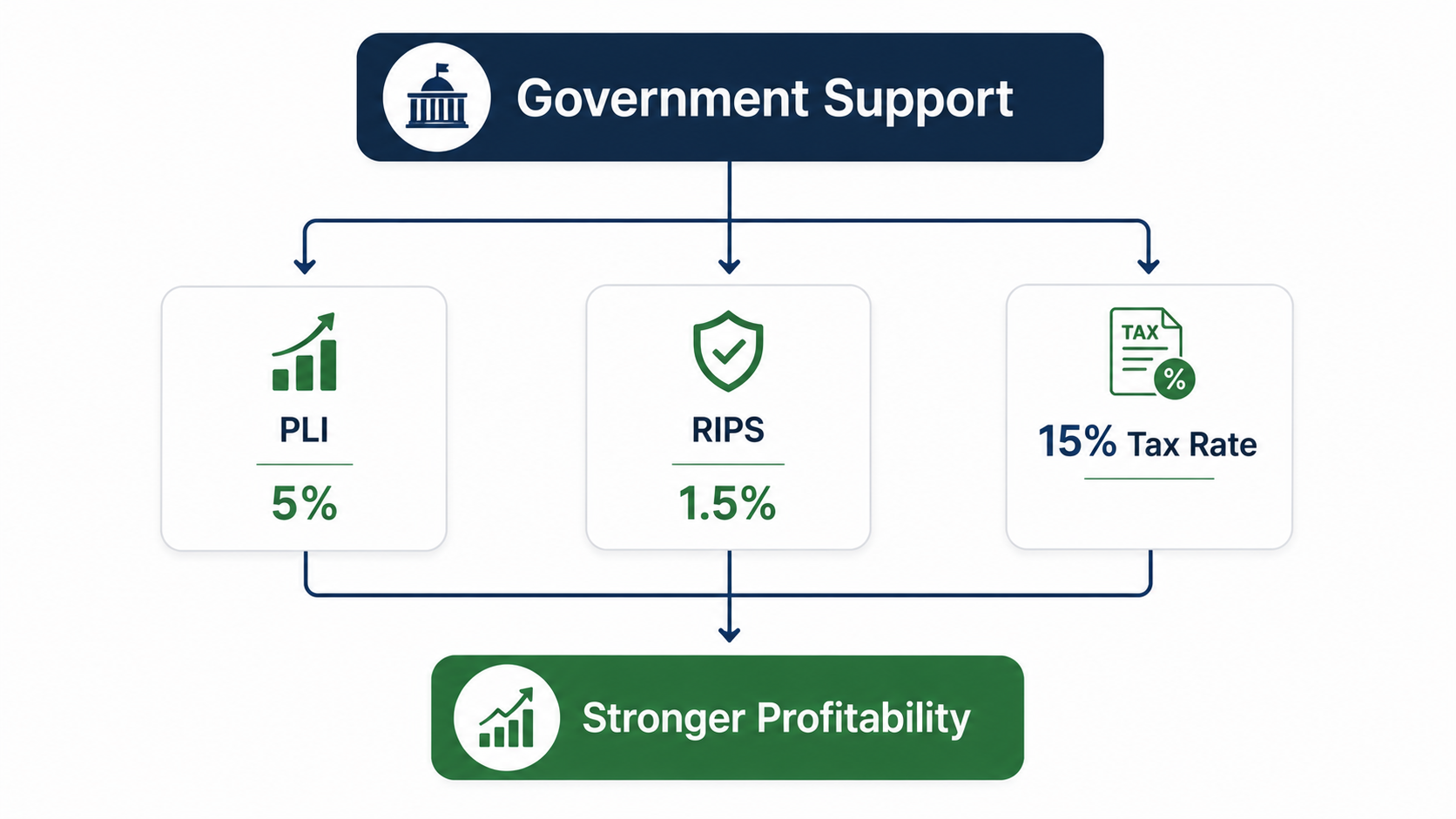
The management highlighted three separate incentives that could benefit the business over the coming years.
1. Production Linked Incentive (PLI)
The first incentive comes under the Production Linked Incentive (PLI) scheme.
According to the management, KRN HVAC Products, the company's wholly owned subsidiary, is eligible to receive a 5% incentive on eligible sales for a period of three years.
The approval is currently pending, but management expects the benefits to start flowing during FY27.
If approved, this incentive will directly support profitability as revenue from the new plant ramps up.
2. Rajasthan Investment Promotion Scheme (RIPS)
The second incentive comes from the Rajasthan Investment Promotion Scheme (RIPS).
Under this scheme, the company expects to receive an incentive equivalent to approximately 1.5% of turnover.
Unlike the PLI scheme, this benefit is expected to continue for a much longer period.
According to the management, the incentive is available for 10 years, extending up to FY35.
The required CTO certification is already in place, and the company has applied for the necessary approvals.
3. A Lower Corporate Tax Rate
The third benefit is less visible but could become increasingly valuable as the business scales.
According to the management, KRN HVAC Products qualifies under Section 115BAB of the Income Tax Act 1961, allowing it to pay a 15% corporate tax rate instead of the normal 25%.
As the subsidiary contributes a larger share of KRN's overall profits, this lower tax rate could help improve consolidated profitability.
Unlike one-time incentives, this benefit becomes more meaningful as earnings from the subsidiary continue to grow.
Combined Impact on Profitability
Each of these incentives offers value on its own.
Together, they could become a meaningful profitability lever as Plant II ramps up production.
According to the management:
- PLI could provide a 5% incentive on eligible sales.
- RIPS could add approximately 1.5% of turnover.
Combined, these two schemes represent a potential 6.5% profitability lever on revenue generated from the new manufacturing plant, subject to approvals.
When this is coupled with the subsidiary's concessional tax rate, the overall impact on earnings could become even more meaningful as utilisation increases.
Do These Growth Drivers Justify KRN's High P/E Ratio?
KRN's premium valuation is not based only on its current earnings. The market is pricing in the company's ability to execute across multiple growth opportunities.
With capacity already built, expansion into Bus AC, Railway HVAC, Data Centres, exports, and government incentives, KRN has multiple potential growth levers that can drive revenue and profitability.
However, a high valuation also leaves limited room for execution mistakes. Plant II utilisation, new business scaling, export growth, order conversions, and incentive approvals will determine whether these expectations are met.
Ultimately, KRN's valuation depends not on the opportunities it has, but on how successfully it converts those opportunities into sustainable earnings growth.
Why Competitors May Struggle to Replicate KRN's Position
KRN's advantage is not based on a single product or market opportunity. It comes from the combination of manufacturing capabilities, backward integration, technical expertise, and relationships built over time.
While competitors can invest in new capacity, replicating the entire ecosystem - from in-house component manufacturing to complete HVAC system capabilities - requires significant investment, technical know-how, and execution experience.
This integrated approach allows KRN to participate in higher-value segments such as Bus AC, Railway HVAC, and Data Centre Cooling, where simply having manufacturing capacity may not be enough.
The Bear Case: What Could Go Wrong?
A premium valuation works only when growth expectations are delivered. If execution slows, the same factors supporting KRN's valuation could become pressure points.
The biggest risks include:
- Slower Plant II Ramp-Up: If utilisation does not improve as planned, the company's large installed capacity may remain underutilised, delaying revenue growth.
- New Business Execution Risk: Bus AC, Railway HVAC, and Data Centre Cooling are attractive opportunities, but they require successful customer acquisition, order conversion, and execution.
- Export Growth Falls Short: Management's export targets require sustained international customer addition. Any slowdown could impact the expected diversification benefits.
- Incentive Delays: PLI and RIPS benefits are subject to approvals. Delays could reduce the expected profitability boost.
- High Valuation Risk: Since the stock already trades at a premium valuation, any slowdown in earnings growth or missed expectations could lead to valuation pressure.
KRN's premium valuation is supported by multiple growth opportunities, but the market has already priced in successful execution. The key risk is not lack of opportunity - it is the ability to convert those opportunities into actual earnings.
Conclusion
KRN Heat Exchanger has reached an important point in its growth journey. The company is no longer positioning itself as just a heat exchanger manufacturer but is evolving into an integrated thermal management solutions provider with products spanning HVAC, Bus Air Conditioning, Railway HVAC, Data Centre Cooling and advanced heat exchangers.
Having already completed its largest capacity expansion, with an estimated revenue potential of ₹2,250–2,850 crore, the company now has the manufacturing infrastructure required to support its next phase of growth. Going forward, the investment thesis is no longer dependent on capacity creation but on execution. Successful ramp-up of Plant II, expansion into new product categories, export growth and conversion of new business opportunities into commercial revenues will be the key determinants of future earnings.
If management executes its strategy effectively, KRN has the potential to emerge as one of the leading thermal management companies with significantly larger revenue and profits in the future.