Why Data Patterns’ ₹2,654 Crore Order Book Is Not as Simple as It Looks?
Data Patterns’ ₹2,654 crore order book looks large enough to almost settle the growth question by itself. Against FY26 revenue of about ₹925 crore, it represents nearly 2.9 times annual revenue. But there is an important catch: only around ₹920 crore was signed, while roughly ₹1,726 crore was still in the negotiated-but-not-signed category as of Q1 FY27.
That means investors should not treat ₹2,654 crore as ₹2,654 crore of guaranteed near-term revenue.
The more useful question is: how much of that number is genuinely executable, how quickly can it become revenue, and how much fresh business does Data Patterns need to keep the growth engine running?
Once those questions are asked, the order book becomes much more interesting.
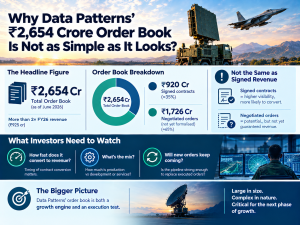
The first adjustment: ₹2,654 crore is not all equally firm
The ₹2,654 crore headline consists of approximately ₹920 crore of signed orders and ₹1,726 crore of negotiated orders.
That distinction matters because negotiated orders still have to move through formal contracting. Management has acknowledged that some expected orders could slip into FY28 or beyond because government and PSU timelines are outside the company’s control.
A simple way to quantify the risk is to apply different conversion rates to the ₹1,726 crore negotiated component:
| Conversion of negotiated orders | Signed backlog | Risk-adjusted order book |
| 50% | ₹920 Cr | ₹1,783 Cr |
| 75% | ₹920 Cr | ₹2,215 Cr |
| 90% | ₹920 Cr | ₹2,473 Cr |
| 100% | ₹920 Cr | ₹2,646 Cr* |
*The reported headline is ₹2,654 crore; the small difference is due to rounding in the ₹920 crore and ₹1,726 crore components.
Even at a 75% conversion rate, the effective backlog would be about ₹2,215 crore, rather than ₹2,654 crore.
At 50%, it falls to roughly ₹1,783 crore.
These are not forecasts of actual conversion. They are sensitivity cases showing how much the headline number depends on the negotiated portion becoming formal contracts.
The important point is that the ₹1,726 crore is an opportunity sitting inside the order book, not yet the same quality of revenue visibility as the signed ₹920 crore.
The order book has genuinely improved but the timing has not
The improvement itself is real.
Data Patterns’ order book rose from roughly ₹730 crore in FY25 to ₹926 crore at March 2026. FY26 order inflows jumped to approximately ₹1,121 crore, up 216% year on year. The Q1 FY27 headline then rose to ₹2,654 crore after including negotiated orders.
But the company’s history also shows why investors should focus on orders consumed versus orders replenished.
The order book had reached ₹1,083 crore in FY24 before falling to ₹730 crore in FY25. The decline was not caused by cancellations; execution had outpaced new order inflows.
This creates a simple equation for Data Patterns:
Opening order book + new orders − revenue executed = closing order book.
The ₹2,654 crore number is therefore only the starting point. If Data Patterns executes aggressively, the backlog can fall quickly unless new orders replace what has been consumed.
That makes the company’s roughly ₹2,000 crore FY27 fresh-order target particularly important.
The ₹350 crore services number belongs to Q4 FY26, not the ₹2,654 crore headline
There is an important date distinction around services and AMC.
At Q4 FY26, services and AMC accounted for around ₹350 crore of the order book, or roughly 38% of the order book at that point.
That ₹350 crore should not be described as 38% of the ₹2,654 crore Q1 FY27 headline order book.
The two numbers belong to different points in time.
More importantly, services have a different revenue-recognition profile from production. The ₹350 crore included multi-year contracts such as the five-year BrahMos AMC and other service agreements.
So even when the order value is secured, it is not recognised as revenue upfront.
A ₹350 crore multi-year AMC contract could provide recurring revenue and improve visibility, but its contribution is spread over several years.
This is one reason why the headline order-book-to-revenue ratio can overstate near-term revenue visibility.
What can the signed ₹920 crore actually support?
The signed backlog gives investors a cleaner starting point than the ₹2,654 crore headline.
However, Data Patterns does not disclose a complete product-by-product FY27-FY29 revenue schedule for the ₹920 crore signed backlog. So the following is an illustrative execution framework, not company guidance.
FY26 revenue was approximately 51% production, 40% development and 9% services.
Applying that mix to the ₹920 crore signed backlog gives:
- Production: ₹920 × 51% = ₹469 crore
- Development: ₹920 × 40% = ₹368 crore
- Services: ₹920 × 9% = ₹83 crore
Now assume, purely for illustration, that production converts faster, development is spread over three years and services are recognised over a longer period.
| ₹ crore | FY27 | FY28 | FY29 | Total |
| Production | 328 | 117 | 23 | 469 |
| Development | 110 | 184 | 74 | 368 |
| Services | 17 | 17 | 50 | 83 |
| Signed backlog executed | 455 | 318 | 147 | 920 |
This is not a revenue forecast. It demonstrates the timing issue.
Under this illustrative case, the signed backlog alone would support around ₹455 crore of FY27 revenue.
Data Patterns’ FY27 revenue-growth guidance of 20-25% from FY26’s approximately ₹925 crore implies:
- 20% growth → ₹1,110 crore
- 25% growth → ₹1,156 crore
Therefore, the signed backlog alone cannot explain the entire FY27 revenue target.
The balance has to come from opening execution, negotiated-order conversion, new FY27 orders and other programme activity.
That is a much more useful way to look at the order book than simply comparing ₹2,654 crore with annual revenue. Check our latest video for more details.
The working-capital cost of converting the backlog is also significant
A large order book does not only create future revenue. It can also consume cash before that revenue is collected.
Data Patterns had approximately 287 days of receivables and 186 days of inventory at FY26, while its overall cash-conversion cycle was around 365 days.
Using FY26 revenue of approximately ₹925 crore:
- Receivables at 287 days ≈ ₹727 crore
- Inventory at 186 days ≈ ₹471 crore
Now apply the same working-capital intensity to FY27 revenue:
| FY26 | FY27 at 20% growth | FY27 at 25% growth | |
| Revenue | ₹925 Cr | ₹1,110 Cr | ₹1,156 Cr |
| Receivables at 287 days | ₹727 Cr | ₹873 Cr | ₹909 Cr |
| Inventory at 186 days | ₹471 Cr | ₹566 Cr | ₹589 Cr |
| Operating cash tied up at 365-day cycle | ₹925 Cr | ₹1,110 Cr | ₹1,156 Cr |
At 20% growth, maintaining the same working-capital profile would imply roughly ₹185 crore more operating capital tied up than in FY26.
At 25% growth, that rises to approximately ₹231 crore.
Looking specifically at receivables and inventory, the additional gross amount tied up could be around ₹240-300 crore.
This is not the amount Data Patterns necessarily needs to raise externally because customer advances, trade payables and other working-capital items partly offset the requirement.
But it shows the economic cost of accelerating execution.
A larger order book can therefore increase revenue while simultaneously putting more cash into receivables and work-in-progress.
The ₹2,000 crore fresh-order target is what keeps the growth equation intact
This is perhaps the most important calculation in the order-book story.
Data Patterns is targeting 20-25% revenue growth in FY27. Starting from approximately ₹925 crore of FY26 revenue, that means:
- 20% growth → ₹1,110 crore FY27 revenue
- 25% growth → ₹1,156 crore FY27 revenue
Now assume the company executes the full FY27 revenue target against its existing ₹2,654 crore headline order book.
The remaining order book would be:
- At ₹1,110 crore revenue: ₹1,544 crore
- At ₹1,156 crore revenue: ₹1,498 crore
Management’s longer-term objective is to build an order book equivalent to roughly three years of revenue, or around ₹3,000 crore-plus.
If FY27 revenue is ₹1,110 crore, a three-year order book would be about ₹3,330 crore.
If FY27 revenue is ₹1,156 crore, three-year coverage would be about ₹3,469 crore.
That gives us the following fresh-order requirement:
| FY27 scenario | FY27 revenue | Order book after execution | 3-year coverage target | Fresh orders required |
| 20% growth | ₹1,110 Cr | ₹1,544 Cr | ₹3,330 Cr | ₹1,786 Cr |
| 25% growth | ₹1,156 Cr | ₹1,498 Cr | ₹3,469 Cr | ₹1,971 Cr |
This is strikingly close to management’s ₹2,000 crore FY27 fresh-order target.
So the ₹2,000 crore target is not simply an ambitious pipeline number. It makes mathematical sense if Data Patterns wants to execute roughly ₹1,100-1,150 crore of revenue while simultaneously rebuilding the backlog toward approximately three years of revenue.
The company essentially needs to replace most of what it consumes.
What does this mean for the ₹2,654 crore headline?
The order book is unquestionably stronger than it was a year ago.
FY26 order inflows of ₹1,121 crore, the jump to ₹2,654 crore including negotiated orders, and the roughly ₹2,000 crore FY27 fresh-order target all point to a much larger growth pipeline.
But the numbers also reveal why the headline needs to be unpacked.
Only around ₹920 crore was signed. The remaining ₹1,726 crore needs contract conversion.
Even after contracts are signed, revenue recognition depends on the nature of the order. Production can be relatively fast, large radar programmes can take two to three years, development can stretch across 12-36 months and AMC contracts can run for four to five years.
And when revenue does accelerate, the working-capital cycle means cash does not necessarily arrive at the same speed.
So the correct investor framework is not:
₹2,654 crore order book ÷ ₹925 crore revenue = nearly three years of guaranteed revenue.
It is:
₹920 crore signed + ₹1,726 crore negotiated → contract conversion → programme execution → customer acceptance → revenue → cash collection.
That sequence determines the actual value of the backlog.
The real order-book test starts now
Data Patterns has solved one problem: it has rebuilt its order pipeline after the FY25 decline.
The next challenge is harder.
It has to convert negotiated orders into signed contracts, execute the existing backlog without excessive delays, turn development programmes into production, collect cash without allowing working capital to expand disproportionately, and win roughly ₹2,000 crore of additional orders in FY27.
If it does all of that, the ₹2,654 crore headline could prove conservative because the backlog would be continuously replenished rather than simply consumed.
If order conversion slips, customer acceptance remains slow or fresh inflows fall short, the same ₹2,654 crore can provide much less near-term revenue than the headline suggests.
That is why the most important number for investors is no longer simply ₹2,654 crore.
It is the speed at which Data Patterns can turn its backlog into revenue, turn revenue into cash, and replace the orders it consumes.