Why Is PTC Industries Spending ₹700 Crore Before the Revenue Arrives?
PTC Industries is putting hundreds of crores into factories whose full revenue contribution will come only after the machines are commissioned, products are qualified and aerospace customers move them into serial production.
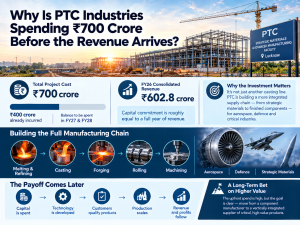
The project in question is the roughly ₹700 crore Strategic Materials Technology Complex (SMTC) in Lucknow. ICRA said around ₹400 crore had been incurred by April 2026, with the balance expected to be spent over FY27 and FY28. The project is being funded partly through debt and partly through internal accruals and available liquidity.
That is a large investment against PTC's FY26 revenue of about ₹603 crore.
But there is a number that changes how the investment should be viewed. In an earlier investor interaction, PTC's management said the materials-related capex had the potential to generate 10-15 times the investment in revenue at full capacity. Management also illustrated a 6,500-tonne materials capacity and titanium-material pricing of roughly $25-30/kg.
Those are potential economics, not a revenue commitment.
The investment case therefore comes down to one question: can PTC turn this capacity into qualified, utilised aerospace and strategic-material production quickly enough?
₹700 Crore Can Support A Much Larger Revenue Pool But It Is Not ₹7,000 Crore Of Guaranteed Revenue
PTC has disclosed the physical capacity being created more clearly than the financial return it expects.
The project has been described as having approximately 1,500 tonnes per year of sponge-based ingot capacity and 5,000 tonnes per year using waste technology, or roughly 6,500 tonnes of annual ingot capacity. CARE Ratings said the project was expected to be completed by March 2027, with fully commercial end-to-end operations expected from Q1 FY28.
There is also a useful historical management benchmark.
PTC's management previously discussed 6,500 tonnes of materials capacity and an approximate selling value of $25-30/kg. At those prices, 6,500 tonnes translates mechanically into roughly $162.5-195 million of annual material value, or approximately ₹1,350-1,700 crore at ₹83/$.
That calculation should not be treated as PTC's current revenue guidance. It is a way to understand the scale of the capacity.
More importantly, management has separately indicated that the materials capex could eventually generate revenue multiple times the original investment. At 10-15× ₹700 crore, the implied full-capacity revenue potential would be ₹7,000-10,500 crore.
But that number needs a major qualification: it is a management-stated potential for the materials capex, not a company forecast of FY28 or FY29 revenue. Revenue will depend on qualification, product mix, utilisation and the proportion of material that ultimately moves into higher-value castings, forgings and machined components.
Illustrative capacity economics
| Utilisation | Revenue at 10× capex potential | Revenue at 15× capex potential |
| 30% | ₹2,100 Cr | ₹3,150 Cr |
| 50% | ₹3,500 Cr | ₹5,250 Cr |
| 70% | ₹4,900 Cr | ₹7,350 Cr |
| 100% | ₹7,000 Cr | ₹10,500 Cr |
These are mechanical scenarios, not PTC guidance.
The important takeaway is not the ₹10,500 crore upper end. It is that even partial utilisation of the planned platform represents a potentially large revenue pool relative to PTC's current scale.
The ₹175 Crore Aerolloy Number Needs To Be Treated Carefully
One of the easiest mistakes is to take Aerolloy's FY26 revenue and attribute it directly to the ₹700 crore project.
That would be wrong.
Aerolloy generated roughly ₹175 crore of revenue in FY26, but PTC does not disclose how much of that revenue came specifically from assets financed under the new Lucknow project versus Aerolloy's existing manufacturing infrastructure.
The same distinction matters even more in FY27.
In Q1 FY27, Aerolloy generated ₹74.3 crore of total income, up 466.4% year on year, with EBITDA of ₹33.4 crore and a 45% EBITDA margin.
The quarter also demonstrated that some of the new infrastructure is beginning to support the business. PTC highlighted commissioning of VIM and VAR capability, while the 4500/5100-tonne open-die forging system at SMTC completed successful hot and cold trials during FY26.
But there is still no disclosed bridge saying:
₹74.3 crore Aerolloy revenue → X crore from the ₹700 crore project.
That number should therefore not be invented.
The better interpretation is that Aerolloy's growth demonstrates that the broader aerospace and strategic-material platform is scaling, while the ₹700 crore project is still moving through the process of commissioning, qualification and utilisation. Check our latest video for more details.
The Revenue Timeline Starts With Machines, Not Orders
The ₹700 crore investment has a built-in time lag.
FY27 - Commissioning and qualification
PTC is moving the remaining facilities through installation, trials and commissioning. During FY26, the company completed successful hot and cold trials of its 4500/5100-tonne intelligent open-die forging system. Its PAM installation was also completed and was ready for trials, with approximately 600 TPA titanium-alloy ingot capacity.
At the same time, customer qualification continues. This is particularly important for aerospace because a development or supply agreement does not automatically mean immediate serial production.
FY28 - Commercial operations and industrialisation
CARE Ratings had previously expected the end-to-end project to become fully commercially operational from Q1 FY28, subject to completion and approvals.
That does not mean every aerospace programme becomes full-scale production in FY28.
For example, Aerolloy's August 2026 Airbus agreement covers the A320neo, A330neo and A350, but explicitly includes development and qualification before serial supply.
FY29 - Scaling of qualified programmes
FY29 should therefore be viewed as a potential scaling period rather than a company-confirmed serial-production deadline. If programmes complete qualification and customers move into recurring production, utilisation can rise materially.
The critical point is that capacity commissioning and revenue recognition are two different milestones.
The Customer Pipeline Is Beginning To Validate The Capacity
The strongest evidence that PTC is building capacity against real demand is the number of programmes now entering its ecosystem.
The company has disclosed a long-term supply agreement with Honeywell Aerospace Technologies for titanium and superalloy precision investment castings. It has also secured programmes involving Safran Aircraft Engines, Blue Origin and ISRO.
The BrahMos order is particularly useful because it has a disclosed value.
PTC said it received an order worth approximately ₹110 crore, to be executed over 24 months, for critical titanium castings.
The Airbus agreement is potentially strategically significant but PTC has not disclosed the order value or production volume. It therefore belongs in the qualification pipeline, not in an assumed revenue forecast.
The same distinction applies to Blue Origin. PTC described the BE-4 programme as a development and supply order for large nickel-based superalloy investment castings. The programme validates Aerolloy's capability, but the disclosed material does not provide a production revenue figure.
This gives PTC something more valuable than a collection of unqualified opportunities: multiple customer programmes at different stages of the qualification-to-production cycle.
But they should still not all be counted as current revenue.
What Happens If Utilisation Stays Low?
This is the missing risk calculation in most discussions of PTC's capex.
The problem is not whether the company can install the machines. It is whether enough qualified production flows through them.
A useful way to stress-test the investment is to use management's 10-15× revenue-potential range and assume a 30% EBITDA margin only as an analytical assumption, broadly consistent with the high-margin profile management has discussed for the longer-term business. This is not a PTC forecast.
| Utilisation | Revenue potential | EBITDA @ 30% margin |
| 30% | ₹2,100-3,150 Cr | ₹630-945 Cr |
| 50% | ₹3,500-5,250 Cr | ₹1,050-1,575 Cr |
| 70% | ₹4,900-7,350 Cr | ₹1,470-2,205 Cr |
These figures show why utilisation matters so much.
However, they should not be converted directly into ROCE or payback. Corporate ROCE includes working capital, existing assets, depreciation, tax and the timing of capital deployment. PTC does not disclose a standalone ROCE calculation for the ₹700 crore project.
Even depreciation cannot responsibly be assigned at ₹70 crore a year without knowing the asset-by-asset useful lives, commissioning dates, residual values and capitalisation schedule.
Therefore, the rigorous conclusion is not that the ₹700 crore will pay back in a certain number of years.
It is that the economics become highly attractive only if PTC can push the new assets from qualification into sustained utilisation.
The Real Risk Is Under-Utilisation, Not The Size Of The Capex
The ₹700 crore looks large because PTC is building capacity ahead of the revenue.
But the balance-sheet risk should be viewed alongside the company's ability to monetise that capacity.
If utilisation remains around 30%, the company may have significant installed capacity without receiving the operating leverage that the investment was designed to create.
At 50%, the economics become materially different because fixed manufacturing costs can be spread across a larger production base.
At 70% and beyond, the strategic-materials platform begins to look less like a collection of expensive machines and more like a scaled manufacturing ecosystem.
That is why the next numbers investors should watch are not simply revenue growth.
They are:
- capacity commissioned
- customer qualifications completed
- tonnes produced
- capacity utilisation
- repeat/serial-production orders
- Aerolloy's EBITDA margin
- cash flow versus capex
- working-capital intensity
These metrics will reveal whether PTC is converting its capital expenditure into productive assets.
PTC Is Trying To Capture More Value From The Same Kilogram Of Metal
The logic behind the investment becomes clearer when the manufacturing chain is viewed as one system.
PTC is attempting to move from material → casting → forging → machining → finished component, rather than remaining dependent on external suppliers for every stage.
The SMTC now combines advanced melting and remelting capabilities with casting and forging. Trac Precision Solutions adds machining capability, while Aerolloy is developing the titanium and superalloy material platform. PTC describes this as an integrated materials-to-component ecosystem.
The economic advantage is potentially greater value captured per component.
A titanium ingot is one product. A forged aerospace part is worth more. A fully machined, inspected, ready-to-fit flight-critical component can capture still more value.
The Airbus agreement illustrates exactly where this strategy is heading: Aerolloy is expected to produce fully machined, ready-to-fit titanium castings through an integrated route beginning with titanium material produced by Aerolloy itself.
That is more important than simply adding tonnes of capacity.
The ₹700 Crore Is Buying The Right To Participate In Future Production
PTC's investment should therefore not be judged by asking whether ₹700 crore has already produced ₹700 crore of additional revenue.
It has not.
The company is still moving through the conversion chain:
Capex → commissioning → qualification → industrialisation → serial production → utilisation → cash returns.
The first two stages are increasingly visible. The next test is qualification and commercial ramp-up.
There is already evidence that the strategy is moving forward: Aerolloy's Q1 FY27 income reached ₹74.3 crore, the company has secured programmes involving Honeywell, Safran, Blue Origin, ISRO and BrahMos, and the Airbus agreement has opened a qualification pathway across three major aircraft families.
But the financial return on the ₹700 crore remains a future outcome rather than a reported number.
That distinction is critical.
The upside comes from turning a roughly ₹700 crore investment into a much larger, high-value aerospace and strategic-materials platform. The risk is that qualification takes longer, utilisation remains low or customer programmes scale more slowly than expected.
For PTC, therefore, the next phase is not about proving that it can build factories.
It is about proving that those factories can run full enough to turn strategic capability into recurring revenue, EBITDA and ultimately returns on capital.