How PTC Industries Is Moving From Metal Maker to Aerospace Supplier?
PTC Industries is spending hundreds of crores to become something more than a specialised metal manufacturer.
The company's strategy is to control a much larger part of the aerospace manufacturing chain from advanced-material melting and casting to forging and precision machining. That transition is already visible through Aerolloy Technologies and Trac Precision Solutions. But the bigger bet is the Strategic Materials Technology Centre (SMTC), including the Lucknow facility, where PTC is investing around ₹700 crore.
The financial question is straightforward: what does PTC need to earn from this capital to justify the investment?
Management has indicated that the SMTC infrastructure has the potential to generate 10-15 times the capex in revenue at maturity, but this is a potential and not company guidance. On ₹700 crore of capex, that would imply a theoretical revenue opportunity of ₹7,000-10,500 crore.
Even at a 20% EBITDA margin, that revenue would imply ₹1,400-2,100 crore of EBITDA. At 25%, it would be ₹1,750-2,625 crore, and at 30%, ₹2,100-3,150 crore.
The opportunity is therefore large. But PTC still has to move through three stages: qualification → production → utilisation.
PTC Is Building An Aerospace Manufacturing Chain, Not Just Another Factory
The strategic shift begins with the manufacturing process itself.
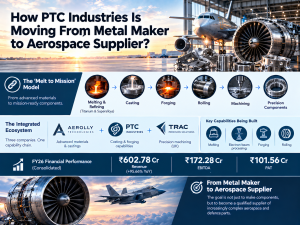
PTC's “Melt to Mission” model aims to connect advanced-material production, casting, forging and precision machining. Aerolloy provides capabilities in advanced materials and investment castings, PTC has its own casting and forging operations, while Trac Precision Solutions adds precision machining.
The SMTC takes this further upstream.
The planned infrastructure includes approximately 1,500 tonnes of VAR capacity, 5,000 tonnes of EBCHR capacity and around 4,500-5,100 tonnes of open-die forging capacity, alongside other processing infrastructure.
This matters because aerospace customers do not simply purchase a piece of metal. They require controlled materials, repeatable manufacturing processes, qualification, traceability and dimensional precision.
The strategic objective is therefore to capture more value from the same component.
Instead of stopping at casting, PTC wants to increasingly control the chain that turns a specialised alloy into a qualified, machined aerospace component.
That is what makes the company's transformation different from a conventional capacity expansion.
The ₹700 Crore Investment Needs A Measurable Return
The most important question for investors is not how much PTC is spending. It is how much this capital must earn.
A simple way to establish the hurdle is to calculate the revenue required to generate different EBITDA returns on ₹700 crore of investment.
| EBITDA margin | Revenue required for 20% EBITDA return on ₹700 Cr | Revenue required for 25% | Revenue required for 30% |
| Required EBITDA | ₹140 Cr | ₹175 Cr | ₹210 Cr |
| Revenue required | ₹700 Cr | ₹700 Cr | ₹700 Cr |
The table shows an important point: if the project eventually generates ₹700 crore of incremental revenue, a 20% EBITDA margin produces ₹140 crore of EBITDA, equivalent to a 20% EBITDA yield on the ₹700 crore capital investment.
At a 25% margin, the same ₹700 crore revenue produces ₹175 crore of EBITDA, while a 30% margin produces ₹210 crore.
This is an EBITDA-based return screen, not reported ROCE. Actual ROCE would need EBIT after depreciation and the incremental working capital required to support the business.
Management's stated 10-15x revenue potential provides a much larger theoretical ceiling: ₹7,000-10,500 crore on ₹700 crore of capex.
But that figure should not be treated as expected revenue. It is a management-indicated potential, and the investment still has to pass qualification, production and utilisation hurdles before such a scale can be realised.
The New Project Must Be Separated From Aerolloy And Trac
One of the easiest ways to overstate the success of the SMTC strategy is to count existing subsidiary revenue as if it were created by the new ₹700 crore investment.
That would be misleading.
Aerolloy generated approximately ₹175 crore of revenue in FY26, while Trac contributed ₹247.01 crore. Together, they represent a substantial portion of PTC's ₹602.78 crore consolidated FY26 revenue.
But these businesses were already contributing to the group.
Aerolloy gives PTC advanced-material and casting capabilities. Trac provides precision machining capability. Their revenue demonstrates that PTC has already built commercial operations around aerospace and other high-performance applications.
The ₹700 crore SMTC/Lucknow thesis is different.
Its purpose is to add strategic-material processing and large-scale upstream manufacturing infrastructure, including VAR, EBCHR and forging capabilities.
Therefore, the correct question is not:
“Can PTC generate ₹700 crore of revenue?”
It already generates more than that at the consolidated level.
The question is:
“How much incremental revenue and EBITDA can the new SMTC infrastructure add on top of the revenue already generated by Aerolloy, Trac and PTC's existing operations?”
That is the return test that matters.
The Aerospace Pipeline Is Real But Most Of The Financial Upside Is Still Ahead
PTC has moved beyond simply describing aerospace as a future opportunity. Its disclosed customer relationships include major names such as Airbus, Safran Aircraft Engines, Honeywell Aerospace Technologies and Blue Origin, alongside defence and space programmes involving organisations such as BrahMos, DRDO/ARDE, GTRE and ISRO/VSSC.
The Airbus relationship is particularly significant because PTC has been working on fully machined, ready-to-fit titanium castings for the A320neo, A330neo and A350 platforms. Safran's LEAP-1A and LEAP-1B programmes involve seven titanium and superalloy cast components. PTC has also disclosed work involving titanium and superalloy precision investment castings for Honeywell and large nickel-based superalloy investment castings associated with Blue Origin's BE-4/New Glenn programme.
These relationships provide evidence that PTC is progressing into demanding aerospace applications. But the financial contribution cannot be quantified programme by programme because PTC does not separately disclose the order value, production volumes or revenue attributable to most of these programmes.
There is one important exception in the disclosed order pipeline: PTC has reported a roughly ₹110 crore BrahMos order to be executed over 24 months for critical titanium castings.
The distinction matters. A component can be under development, undergoing qualification, approved for a programme or already in commercial production. These stages have very different implications for revenue.
PTC's aerospace strategy should therefore be viewed as a qualification-to-production pipeline, rather than as a collection of current revenue streams. The major opportunity is to convert these customer relationships into recurring serial production and, ultimately, use that demand to fill the new SMTC capacity.
Until programme-level volumes and revenue are disclosed, the aerospace pipeline demonstrates customer and technical validation, but not yet the full financial return from the ₹700 crore investment.
Airbus And Safran Show Why Qualification Matters
The Airbus relationship is particularly important because it involves fully machined, ready-to-fit titanium castings for A320neo, A330neo and A350 applications.
The significance is not simply the customer name.
The product specification means PTC is attempting to participate further down the manufacturing chain, rather than supplying only an upstream metal product.
The Safran relationship similarly covers seven titanium and superalloy cast components associated with LEAP-1A and LEAP-1B engines, which power aircraft including the A320neo and Boeing 737 MAX.
For both relationships, however, PTC's disclosed economics do not provide a programme-level revenue number or production volume.
That creates an important analytical distinction:
qualification creates revenue visibility; it does not create recognised revenue by itself.
The commercial payoff arrives only when qualified components enter serial production and the resulting capacity is utilised at meaningful levels. Check our latest video for more details.
The ₹700 Crore Project Is Designed To Unlock The Next Stage
The SMTC is therefore best understood as an enabling investment.
The infrastructure includes approximately 5,000 tonnes of EBCHR capacity, 1,500 tonnes of VAR capacity and roughly 4,500-5,100 tonnes of open-die forging capacity.
PTC has also indicated that around ₹400 crore of the approximately ₹700 crore investment had been incurred, with roughly ₹500 crore associated with the Lucknow facility.
The project is expected to move toward commercial operations during FY28, based on the project timelines previously disclosed.
That creates a natural sequence:
FY26 → investment and construction
FY27 → commissioning, trials and qualification
FY28 onward → commercial production and utilisation
This timing matters because PTC's current revenue cannot be used as proof that the new infrastructure is already earning a return.
The return only becomes visible as the assets move from being installed capacity to qualified production capacity and eventually to high utilisation.
What Happens If Utilisation Remains Low?
This is where the downside becomes important.
Management's 10-15x revenue potential can be used as an analytical ceiling, but not as a forecast.
If we assume, purely for illustration, that revenue scales linearly with utilisation, then:
| Illustrative utilisation | Revenue at 10x potential | Revenue at 15x potential |
| 30% | ₹2,100 Cr | ₹3,150 Cr |
| 50% | ₹3,500 Cr | ₹5,250 Cr |
| 70% | ₹4,900 Cr | ₹7,350 Cr |
| 100% | ₹7,000 Cr | ₹10,500 Cr |
These are scenario calculations, not PTC guidance.
They show why utilisation is more important than installed capacity.
At 30% utilisation, the project could still generate substantial revenue if the management-indicated potential is achieved. But the economics would also be much more sensitive to depreciation, employee costs, maintenance, financing costs and working capital.
And that matters because PTC is already carrying significant capital and working capital.
The Balance Sheet Shows The Cost Of The Transition
PTC spent ₹317.32 crore on capex in FY26.
At year-end, property, plant and equipment stood at approximately ₹737.34 crore, while capital work-in-progress was ₹310.65 crore.
The working-capital requirement is also significant.
FY26 inventory was approximately ₹299.01 crore, including ₹222.24 crore of work-in-progress, while receivables stood at ₹273.93 crore.
This creates a simple risk equation.
If new capacity is commissioned but qualification takes longer than expected, PTC can have:
higher depreciation + higher fixed costs + capital tied up in inventory/WIP + receivables + financing costs
before the corresponding revenue ramp arrives.
Conversely, if qualification converts quickly into serial production and the new assets achieve high utilisation, the same fixed-cost structure can create substantial operating leverage.
That is why the investment should be evaluated through utilisation rather than capacity alone.
PTC's Transformation Scorecard
PTC's transformation is easier to understand by looking at what each part of the platform actually contributes.
Aerolloy represents an existing commercial capability. Its FY26 revenue of approximately ₹175 crore demonstrates that PTC already has an operating business in advanced materials and investment castings. This is part of the group's current revenue base and should not be attributed to the new ₹700 crore SMTC investment.
Trac represents the downstream step. Its ₹247.01 crore FY26 contribution gives PTC precision-machining capability and allows the group to participate further along the component manufacturing chain. Again, this is an existing commercial contribution rather than revenue created by the new Lucknow infrastructure.
The SMTC is the expansion layer. Its VAR, EBCHR and forging infrastructure is intended to give PTC greater control over strategic materials and larger-scale processing. These assets are still moving through development, commissioning and qualification, so their incremental revenue is not separately disclosed.
Titanium and superalloy programmes provide the demand pipeline. Airbus, Safran, Honeywell and Blue Origin demonstrate that PTC is working on technically demanding aerospace applications. But because programme-level volumes and revenue are largely undisclosed, these relationships should be treated as potential future production rather than added to current revenue.
BrahMos provides a clearer commercial reference point. The approximately ₹110 crore order for critical titanium castings, to be executed over 24 months, demonstrates that PTC can convert its specialised manufacturing capabilities into commercial defence orders.
The important distinction is therefore between what PTC already sells, what it is qualifying and what the new infrastructure is intended to enable.
That is the real transformation: Aerolloy and Trac establish the existing commercial platform, while the SMTC is intended to expand the group's ability to manufacture strategic materials and increasingly complex components at scale.
The Real Test Is Qualification → Production → Utilisation
PTC's aerospace story should therefore be judged in three stages.
1. Qualification
Can PTC consistently produce materials and components that meet aerospace customer specifications?
The Airbus, Safran, Honeywell and Blue Origin relationships provide evidence that PTC is progressing through this stage, but programme-level financial contribution remains largely undisclosed.
2. Production
Do qualified components actually move into serial production?
This is where the current pipeline becomes revenue.
The difference between a development programme and a recurring production programme can be enormous, but PTC has not disclosed sufficient programme-level volumes to quantify that upside today.
3. Utilisation
Once the facilities are qualified and production begins, can PTC fill the new capacity?
This is ultimately what determines the return on the ₹700 crore investment.
A facility operating at low utilisation can generate impressive technical capabilities while producing disappointing capital returns. A facility with high utilisation can spread fixed costs across a much larger revenue base and create significant operating leverage.
The Investment Case Is Therefore Changing
PTC's transformation is no longer simply about selling more specialised castings.
The company is building a manufacturing platform that combines advanced materials, casting, forging and precision machining, supported by relationships with major aerospace, defence and space customers.
FY26 already provides evidence of the commercial base: ₹602.78 crore of consolidated revenue, including approximately ₹175 crore from Aerolloy and ₹247.01 crore from Trac.
But those numbers should not be confused with the return from the ₹700 crore SMTC investment.
That investment represents the next stage.
The upside depends on whether PTC can convert customer qualifications into serial production, then convert serial production into sustained utilisation.
The most important metric over the next few years will therefore not simply be revenue growth.
It will be the progression from:
₹700 crore of capital deployed → qualified capacity → serial production → utilisation → incremental EBITDA → return on capital.
That is the point at which PTC stops being merely an aerospace-capable metal manufacturer and demonstrates whether it can become a scaled aerospace supplier.