How Does PTC Industries Actually Make Money?
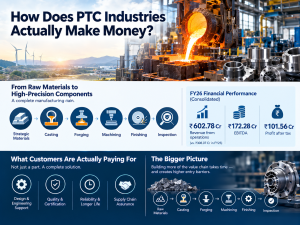
PTC Industries generated ₹602.78 crore of consolidated revenue in FY26. But that number hides an important complication: the company now has several operating entities and manufacturing capabilities, and their reported revenues cannot simply be added together.
PTC standalone reported ₹289.80 crore of revenue, Aerolloy Technologies crossed ₹175 crore and Trac Precision Solutions reported ₹247.0144 crore of turnover. Added together, those figures come to ₹711.81 crore, more than the consolidated revenue itself.
That is not an accounting error. It shows why PTC's business model needs to be understood at the group level, where transactions between companies are eliminated.
The more interesting question is what PTC is actually charging customers for. The answer is no longer just castings. The Group now spans strategic materials, castings, forging, machining and finishing.
But there is another side to the story. PTC spent ₹317.32 crore on capital expenditure in FY26, while ₹310.65 crore remained in capital work-in-progress. At the same time, operating cash flow turned negative.
So PTC's model is currently doing two things at once: building a larger manufacturing chain and trying to turn that chain into repeat revenue.
Where Did The ₹602.78 Crore Actually Come From?
The FY26 Annual Report gives three important entity-level numbers:
| FY26 reported revenue/turnover | ₹ crore |
| PTC Industries standalone revenue from operations | 289.80 |
| Aerolloy Technologies revenue | 175.00+ |
| Trac Precision Solutions turnover | 247.0144 |
| PTC consolidated revenue from operations | 602.78 |
The figures above should not be treated as a consolidated revenue bridge. PTC standalone revenue can include transactions with subsidiaries, while consolidated accounts eliminate intercompany transactions.
That distinction matters particularly for Aerolloy. Its ₹175 crore revenue is not an additional ₹175 crore that can simply be added to PTC's ₹289.80 crore.
What the numbers do establish is the changing composition of the Group. The parent company remains a meaningful revenue base, while Aerolloy has become a ₹175-crore business and Trac generated ₹247.0144 crore in its first full year of consolidation.
The Annual Report does not separately disclose consolidated revenue for industrial castings, aerospace castings, strategic materials, forging, machining or individual applications such as defence and space.
That means a precise “revenue by business” table beyond the entity-level numbers would create false precision.
The better conclusion is that PTC's consolidated revenue is increasingly coming from a combination of its established casting business and newly consolidated or developed capabilities, rather than from one product line.
Does Vertical Integration Actually Improve PTC's Economics?
This is where the investment case becomes less straightforward.
The strategic argument is easy to understand. If PTC can control more of the route from material → casting/forging → machining → finished component, it may capture more manufacturing value and reduce dependence on external suppliers.
But FY26 financials do not yet prove that vertical integration has produced higher margins.
In fact, consolidated EBITDA margin on total income declined from 31.97% to 26.78% even as EBITDA increased from ₹109.41 crore to ₹172.28 crore. Depreciation rose 72.22% to ₹36.69 crore as melting furnaces, the forging system and associated infrastructure were capitalised.
There are, however, early signs of operating leverage elsewhere.
Manufacturing expenses rose 79.20% to ₹167.91 crore, but fell from 30.42% of revenue to 27.86%. Total other expenses fell from 39.87% to 35.55% of revenue.
At the same time, employee costs increased sharply because PTC hired engineers, metallurgists and technicians to operate the new capabilities. Employee benefits reached ₹150.77 crore, or 25.0% of revenue, against 18.4% previously.
So the evidence currently points to an investment phase, not a demonstrated margin expansion phase.
The economic payoff still has to come from higher utilisation, serial production and better absorption of the expanded cost base. Check our latest video for more details.
What Exactly Did The ₹317.32 crore of Capex Buy?
The ₹317.32 crore capex figure becomes much more interesting when placed beside the asset base.
During FY26, PTC capitalised:
- Vacuum Induction Melting capability
- Vacuum Arc Remelting capability
- Plasma Arc Melting
- The titanium casting facility
- The 4,500/5,100-tonne Intelligent Open Die Forging System
- Associated infrastructure
Meanwhile, several major investments were still unfinished at year-end. The Electron Beam Cold Hearth Refining furnace, rolling mills and the balance of the Strategic Materials Technology Complex remained in capital work-in-progress.
That explains the ₹310.65 crore CWIP, up from ₹184.88 crore.
The balance sheet therefore shows a business still in the middle of its investment cycle:
₹317.32 crore capex → new assets commissioned → ₹310.65 crore CWIP still unfinished → utilisation and qualification still to follow.
What the Annual Report does not disclose is a rupee-by-rupee split of the ₹317.32 crore between Aerolloy's furnaces, forging, rolling mills, Trac or individual facilities. It also does not provide facility-level utilisation percentages or a revenue target attached to each machine.
That limitation is important. We can identify what the money built, but we cannot honestly say that ₹X crore of the capex will generate ₹Y crore of revenue by a particular year.
For PTC, the return on this capital will ultimately be visible through asset utilisation, serial-production volumes, EBITDA and cash flow, rather than through the capex number itself.
The Working-Capital Problem Is Much Bigger Than Negative Cash Flow Suggests
The negative ₹68.66 crore operating cash flow in FY26 is easier to understand when the balance sheet is examined.
Three numbers stand out:
| ₹crore | FY25 | FY26 | Increase |
| Work-in-progress | 125.37 | 222.24 | 96.87 |
| Total inventory | 208.16 | 299.01 | 90.85 |
| Net trade receivables | 143.81 | 273.93 | 130.12 |
WIP therefore increased 77.27%, while net trade receivables increased 90.48%. Total inventory increased 43.64%.
The most striking calculation is the combined increase in WIP and net receivables:
₹96.87 crore + ₹130.12 crore = ₹226.99 crore.
That ₹226.99 crore increase in these two operating assets is equivalent to about 77% of PTC's ₹294.71 crore increase in consolidated revenue.
That does not mean ₹226.99 crore is the exact amount of cash permanently trapped in working capital, payables and other balance-sheet movements also matter.
But it does show the scale of the cash requirement accompanying growth.
The company itself says the increase in WIP and receivables exceeded the cash generated by higher profit. Much of the WIP consists of ingots, forgings and castings moving through qualification and production.
So PTC's problem is not simply “negative cash flow.” It is that revenue growth currently requires substantial balance-sheet funding before that revenue becomes cash.
Qualification Is Revenue Visibility But Only To A Point
For PTC, customer qualification matters because its products are not sold like standard industrial components. Aerospace, defence and space customers require extensive testing, approval and validation before a component can enter regular production. Once a component clears these stages, however, the qualification can create a pathway toward repeat orders.
FY26 provided several examples. PTC signed a long-term agreement with Honeywell Aerospace Technologies for titanium and superalloy castings. It also secured a purchase agreement with Safran Aircraft Engines for seven cast components for the LEAP-1A and LEAP-1B engines. The company described this as the first such contract for an Indian company. Blue Origin placed a development and supply order for large superalloy castings for its BE-4 engine, while GTRE placed an order for single-crystal turbine blades. ISRO-VSSC ordered aerospace-grade double-VAR titanium ingot.
BrahMos Aerospace also placed an order for critical titanium components worth over ₹100 crore, providing the clearest disclosed evidence of order-level revenue among these programmes.
But this is where the distinction between qualification and revenue visibility becomes important. PTC does not disclose the expected revenue from most of these programmes, their annual production volumes or a programme-by-programme timeline for reaching serial production. The Annual Report indicates that several programmes are moving from qualification and low-rate production toward serial volumes, but it does not quantify what that transition could contribute to revenue.
For investors, the evidence therefore supports a stronger conclusion than simply calling these “customer relationships”, but a weaker conclusion than treating them as a quantified future revenue pipeline. The commercial opportunity is increasingly validated; the size and timing of the resulting revenue are still not separately disclosed.
The Real Economics Of PTC's Manufacturing Chain
The vertical-integration argument becomes clearer when viewed through what each stage allows PTC to do.
- Materials: Aerolloy gives PTC control over titanium and superalloy primary-metal processing.
- Casting: PTC converts those materials into complex components, including aerospace and defence castings.
- Forging: The 4,500/5,100-tonne open-die system adds another route for large and complex components.
- Machining: Trac can take selected components through five-axis machining, grinding, EDM and finishing.
- Inspection and qualification: These processes make the final component acceptable for demanding customers.
The company describes this as a connected manufacturing route rather than unrelated businesses.
But the financial statements suggest that the chain is still being monetised.
Net material cost remained broadly stable at 17.6% of revenue from operations versus 17.3% in FY25, despite the enormous increase in gross material consumption. Much of the difference was absorbed into inventory because material was still moving through production.
This is why “vertical integration improves margins” is too strong a conclusion today.
What can be said is more precise: PTC has invested to control more of the manufacturing route, and FY26 shows early operating leverage in some cost lines, but the consolidated margin has not yet expanded because the new platform is still carrying ramp-up, depreciation, employee and qualification costs.
PTC's Business Model Is Therefore A Conversion Problem
PTC has already demonstrated that it can grow revenue while expanding its manufacturing footprint.
FY26 consolidated revenue reached ₹602.78 crore, EBITDA ₹172.28 crore and PAT ₹101.56 crore. Revenue increased 95.66%, while EBITDA increased 57.45% and PAT 66.44%.
The next question is different.
Can the company convert the manufacturing capability it has built into a larger amount of qualified, repeat production without requiring the same level of balance-sheet investment each year?
Three numbers capture the challenge:
- ₹317.32 crore of FY26 capex
- ₹310.65 crore of year-end CWIP
- ₹226.99 crore increase in WIP plus net receivables
At the same time, operating cash flow was negative ₹68.66 crore.
That makes PTC's current business model less about simply “selling high-value components” and more about turning years of capital expenditure, engineering work and qualification effort into recurring manufacturing revenue and cash generation.
If utilisation rises and programmes move into serial production, the same asset base can support considerably more revenue. If qualification takes longer or volumes remain low, the company continues carrying depreciation, employees, inventory and working capital ahead of the revenue.
That is the central financial tension in the model.
So, How Does PTC Industries Actually Make Money?
PTC makes money by supplying specialised metal components, materials and precision-manufacturing services for aerospace, defence, space, energy and industrial customers.
Its revenue today comes from an established standalone business plus the expanding contribution of Aerolloy and Trac. But the company's strategy is aimed at something larger than simply increasing the number of products it sells.
It wants to control more of the manufacturing route.
That means producing strategic materials, casting or forging them into difficult components, machining selected parts and ultimately supplying customers with products that carry more manufacturing responsibility.
The financial data shows both the opportunity and the unfinished work.
Revenue has scaled rapidly. Aerolloy reached ₹175 crore. Trac generated ₹247.0144 crore in its first full year. Manufacturing-expense intensity improved. But consolidated EBITDA margin fell to 26.78%, capex reached ₹317.32 crore, CWIP stood at ₹310.65 crore and operating cash flow was negative ₹68.66 crore.
So the central question is not whether PTC has built capability. It clearly has.
The question is whether that capability can now be filled with enough qualified, repeat production to generate returns on the capital already deployed.
That is ultimately how PTC will make the next phase of its money.