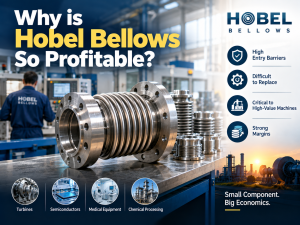
Why is Hobel Bellows So Profitable?
Hobel Bellows is interesting not because it manufactures specialised metal components, but because its economics suggest that customers are paying for qualification, reliability and supply assurance rather than merely the physical product.
In FY26, Hobel generated ₹123.74 crore of revenue. Management disclosed EBITDA margins of more than 50% and pre-acquisition ROCE of more than 50%. The business was also debt-free before acquisition.
But a 50%+ EBITDA margin needs more explanation than “Hobel has pricing power”.
The stronger evidence is the structure of its customer relationships. Around 70% of Hobel’s products are single-sourced, meaning the customer does not maintain another approved supplier for those products. At the same time, two OEM groups account for about 93% of revenue. These two numbers tell the story together.
Hobel has concentrated its business among a small number of customers, but it has become deeply embedded within those customers’ supply chains. Once a product is qualified and production is established, the economic cost of switching is not simply the difference between two suppliers’ quotations. The alternative supplier has to reproduce the required engineering, manufacturing consistency, testing and qualification.
That creates an unusual combination: high customer concentration but potentially high customer stickiness.
The important question for investors is therefore whether that stickiness survives after the acquisition and whether Hobel can convert its high EBITDA into equally strong cash returns.
The 70% Single-Source Figure Explains More Than Pricing Power
The most important number in understanding Hobel’s economics may be the 70% single-source exposure.
A single-source product does not automatically mean Hobel can raise prices whenever it wants. The more useful interpretation is that the customer has already accepted Hobel’s product into its manufacturing process and, for those products, does not currently maintain another approved source.
That changes the economics of switching.
An OEM considering another supplier may need to evaluate:
- product design and dimensional accuracy;
- material specifications;
- welding and forming consistency;
- leak and fatigue performance;
- production repeatability;
- customer-specific testing;
- qualification and validation requirements.
The cost is therefore partly operational disruption and qualification time, not simply procurement cost.
This also explains why Hobel can remain a relatively small company while generating unusually high margins. It does not need to dominate a commodity market. It needs to remain difficult to replace within specific customer programmes.
But there is an important limitation.
Single sourcing creates switching costs only while Hobel remains reliable and competitive. If a customer decides that supply security requires dual sourcing, or if another supplier completes qualification, the barrier falls.
Therefore, the 70% figure should be viewed as a source of both economic protection and future vulnerability.
Why the ₹450 Crore Acquisition Price Matters
The acquisition price becomes much more revealing when compared with Hobel’s EBITDA rather than its revenue.
At ₹123.74 crore of FY26 revenue, a 50% EBITDA margin implies EBITDA of at least ₹61.87 crore.
That means the ₹450 crore acquisition consideration represents less than 7.27× FY26 EBITDA.
The word “less” matters because Hobel’s disclosed EBITDA margin was above 50%; the actual multiple therefore cannot be calculated precisely from the publicly disclosed margin without inventing a number.
This is also broadly consistent with broker commentary describing the transaction at around 6-7× FY26 EV/EBITDA.
But the acquisition price should not be judged against EBITDA alone.
Unimech paid ₹450 crore for a business that management described as debt-free, with pre-acquisition ROCE above 50%.
The catch is that the 50%+ pre-acquisition ROCE does not automatically transfer to the consolidated business.
The ₹450 crore purchase price itself changes the capital base against which returns are measured. Management commentary has acknowledged that post-acquisition consolidated returns are lower initially, with the acquired business needing to scale to justify the capital deployed.
That makes the acquisition’s real test straightforward:
Can Hobel generate enough incremental operating profit and cash to earn an attractive return on the ₹450 crore that Unimech has committed? Check our latest video to know more.
The 50% EBITDA Margin Is Not Yet Proven To Be Permanent
There are reasons to believe Hobel’s margin has structural support. There is also not enough evidence to assume that 50%+ is a permanent steady-state margin.
The structural support comes from the business model:
single-source products + qualified OEM relationships + specialised manufacturing + high-value applications.
But several factors can reduce the margin.
First, customer concentration is extremely high. Two OEM groups account for approximately 93% of revenue. Second, the business operates in industrial markets where customer production volumes can fluctuate. Third, Unimech is now integrating Hobel into a much larger manufacturing platform, meaning the cost structure and product mix can change.
Most importantly, Unimech’s own consolidated Q1 FY27 EBITDA margin was 36.5%, even after including two months of Hobel consolidation. That is not evidence that Hobel’s standalone margin has disappeared, because the consolidated figure includes the much larger legacy Unimech business. But it does show why investors should not simply apply Hobel’s >50% margin to the combined company.
The correct test is therefore whether Hobel itself maintains its historical margin while incremental revenue grows.
If Hobel’s margin falls materially as volumes increase, the acquisition thesis changes.
Spare Capacity Could Protect Returns, If Hobel Fills It
Another reason Hobel’s historical ROCE was high is that the business reportedly had substantial manufacturing headroom.
The acquisition material indicated capacity utilisation of roughly 50-60%.
That matters because Hobel does not necessarily need to build an entirely new manufacturing base to grow. If existing equipment, people and engineering infrastructure can absorb additional production, revenue can increase faster than fixed costs.
That is potentially powerful for EBITDA.
But it also creates an important distinction between historical ROCE and future ROCE.
Historical ROCE of more than 50% tells us what the business achieved on its pre-acquisition capital base. It does not tell us what Unimech will earn on ₹450 crore of acquisition capital.
For the acquisition to recreate those economics, three things have to happen:
- Hobel’s existing customers must sustain volumes.
- Spare capacity must convert into additional revenue.
- The additional revenue must retain attractive margins without requiring proportionately large new capital expenditure.
If those conditions hold, operating leverage can help returns recover.
If they do not, the ₹450 crore purchase price becomes a much heavier denominator.
Customer Concentration Is Both the Moat and the Risk
The 93% concentration deserves more attention than simply calling it a “risk”.
Two OEM groups contributing approximately 93% of revenue means Hobel’s business is highly concentrated.
But concentration also reflects the way the business has been built.
A supplier serving a handful of large OEM programmes can become deeply integrated into those customers’ manufacturing systems. That can produce repeat orders, technical collaboration and high retention.
So the same concentration creates two opposite economic effects:
- Advantage
High concentration can mean deeper relationships, higher programme visibility and stronger customer integration.
- Risk
A production slowdown, sourcing change, qualification of an alternative supplier or technology change at one major OEM can have an outsized effect on revenue.
This is why the 70% single-source number becomes particularly important. If 70% of products are single-sourced and the customer relationships remain stable, concentration can support unusually strong economics. If customers progressively introduce second sources, the switching barrier weakens.
The investor therefore needs to track not just revenue concentration, but whether single-source status is being retained or lost.
EBITDA Is Not Enough: Can Hobel Turn Profit Into Cash?
A 50%+ EBITDA margin is impressive, but it does not automatically mean 50%+ returns for shareholders. Cash can become trapped in receivables, inventory or capital expenditure.
The available public disclosures support the description of Hobel as cash-generative, but they do not provide enough standalone post-acquisition cash-flow history to calculate a clean FY26 Hobel cash-conversion ratio without mixing entity-level and consolidated figures.
Management has described Hobel as a strong annual cash-generating business, but this needs to be tested through subsequent reported financial statements rather than assumed.
This matters even more because Unimech’s overall working-capital cycle was already around 120-125 days at FY26-end, and management indicated that it could move toward 150-160 days as larger project-based businesses scale.
Therefore, the future Hobel analysis should track:
- Hobel receivable days
- inventory days
- operating cash flow versus EBITDA
- capex required to utilise spare capacity
- free cash flow after maintenance capex
- cash generated against the ₹450 crore acquisition investment
The crucial question is not simply “Is Hobel profitable?”
It is “How much of that profit becomes distributable cash after working capital and reinvestment?”
Keep Hobel’s Current Economics Separate From Its Future Optionality
This distinction is essential.
Hobel’s existing business is already proven: metallic bellows, exhaust manifolds, tubular assemblies, established OEM relationships, exports and existing qualifications.
The aerospace, nuclear and semiconductor opportunities are different.
Unimech has said Hobel’s capabilities could be applied to nuclear reactor and cooler systems and could eventually be integrated into aerospace and semiconductor offerings. However, aerospace expansion requires further qualification, and management has indicated that aerospace cross-selling could take 2-3 years because of qualification cycles.
These opportunities should therefore not be used to justify today’s 50%+ margin.
They are optionality.
The investment case should first work on the economics of Hobel’s existing business. If nuclear, aerospace or semiconductor applications subsequently generate new programmes, they can provide incremental growth.
That distinction prevents future possibilities from being mixed with proven FY26 economics.
What Would Make Hobel’s Economics Break Down?
The biggest risk to Hobel is not that another company starts manufacturing bellows.
It is that the economic conditions supporting its current returns gradually disappear.
The warning signs would be:
- Single-source share falls: customers increasingly qualify alternative suppliers.
- Customer concentration remains high but retention weakens: the 93% concentration becomes a liability without corresponding stickiness.
- Margins decline with volume: additional revenue requires proportionately higher labour, material or manufacturing costs.
- Spare capacity fails to convert: utilisation remains low despite the ₹450 crore capital commitment.
- Working capital expands: EBITDA rises but receivables and inventory absorb the cash.
- Capex rises sharply: growth requires much more capital than the existing facilities suggest.
- Customer economics change: OEMs push for cost reductions or redesign components.
- New applications take longer to qualify: aerospace, nuclear and semiconductor optionality remains a story rather than a revenue contributor.
- Returns remain below historical levels: Hobel’s standalone >50% ROCE does not translate into an adequate return on Unimech’s acquisition capital.
That is the real test of the acquisition.
Hobel’s historical numbers show an unusually profitable manufacturing business. But the ₹450 crore transaction has converted a high-return standalone business into a capital-allocation test for Unimech.
The central question from here is no longer whether Hobel was a 50%+ EBITDA-margin, 50%+ ROCE business.
It is whether Unimech can preserve those economics while deploying ₹450 crore, integrating the company, maintaining its customer relationships, converting spare capacity into growth and turning accounting profit into cash.
That is where the acquisition will ultimately be proven or disproven.