How will Hobel Bellows Help Unimech Grow?
Unimech’s acquisition of Hobel Bellows is important because it changes what the company can manufacture, not simply how much revenue it can report.
Completed on April 27, 2026, the acquisition gives Unimech capabilities in metallic bellows, flexible tubing, metal forming, hydroforming, tube bending, welding and engineered assemblies. Hobel reported approximately ₹129 crore of FY26 revenue and EBITDA margins above 50%. It also operates a debt-free business with pre-acquisition ROCE above 50%.
But the ₹450 crore acquisition price means the deal needs to be judged against the earnings and cash generation that Hobel can sustain. At a 50% EBITDA margin on ₹129 crore of FY26 revenue, Hobel generated at least ₹64.5 crore of EBITDA. That puts the purchase consideration at less than 7x FY26 EBITDA; the exact multiple cannot be calculated because the company has disclosed only that the EBITDA margin exceeded 50%.
This makes the central question straightforward: Can Unimech preserve Hobel’s unusually high profitability while using its manufacturing capabilities to build a larger, more diversified business?
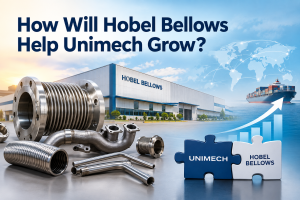
Hobel Changes What Unimech Can Manufacture
Before Hobel, Unimech’s core strength was precision machining and high-complexity manufacturing. Hobel adds a different set of processes: metallic bellows, expansion joints, flexible metallic hoses, tubing, metal forming, hydroforming, tube bending and welding.
That changes the addressable product set.
The combined business can manufacture not only individual precision components but also more complex assemblies and sub-systems involving formed, tubular and welded parts. Unimech’s acquisition announcement explicitly described the strategic objective as moving beyond precision components into higher-value engineered assemblies and sub-systems.
This distinction matters because the acquisition can increase the value captured per customer relationship. A customer that previously sourced machining from Unimech can now be served across additional manufacturing processes.
Hobel already operates at this broader product level, supplying metallic bellows, exhaust manifolds, tubular assemblies and other engineered products to global OEMs. Nearly 90% of its revenue comes from exports.
The thesis, therefore, is not simply that Unimech bought ₹129 crore of revenue. It bought manufacturing capabilities that were otherwise expected to take years to build organically. Check our latest video for more details.
The 93% Customer Concentration Changes The Risk-Reward Equation
The biggest issue with Hobel should be visible much earlier in the investment case: two OEM groups account for around 93% of Hobel’s revenue.
That concentration has two opposing effects.
On one side, long-standing OEM relationships and single-source products can create significant switching costs. Once a component is qualified and integrated into an engine, locomotive or industrial system, replacing the supplier can require requalification, testing and production disruption. This can support customer retention and pricing.
On the other side, the revenue base remains highly dependent on the production plans of a very small number of customers. A meaningful reduction in volumes from either major OEM group would have an outsized effect on Hobel.
This is particularly important because Hobel’s >50% EBITDA margin cannot by itself prove that its economics are permanently protected. The margin needs to survive customer-volume changes, pricing negotiations and the eventual cost of expanding the customer base.
For Unimech, diversification is therefore not just a growth opportunity. It is also part of the risk-reduction requirement for the acquisition.
Hobel Adds Revenue Immediately, But The Number Is Quantifiable
Hobel is already large enough to change Unimech’s consolidated revenue base.
It generated approximately ₹129 crore in FY26 revenue. Unimech consolidated only two months of Hobel in Q1 FY27 after completing the acquisition on April 27. Hobel contributed approximately ₹22 crore during those two months.
At the same monthly run rate, ₹22 crore over two months corresponds to an annualised revenue run rate of ₹132 crore. This is not a forecast, and seasonality or changes in customer volumes could alter the actual number, but it provides a useful comparison with Hobel’s ₹129 crore FY26 revenue.
The important point is that Hobel was already operating at roughly the same annual revenue scale within two months of consolidation as its entire FY26 business.
For Unimech, a full year of consolidation therefore adds a business with a demonstrated revenue base of more than ₹100 crore rather than an unbuilt growth project.
The next stage is different. Existing Hobel revenue is already visible. Cross-selling, new customers and aerospace or nuclear applications are incremental opportunities, not part of the ₹129 crore existing revenue base.
That distinction is important when assessing the acquisition.
Why Is Utilisation Only 50-60% Despite >50% EBITDA Margins?
Hobel’s reported 50-60% capacity utilisation creates one of the most interesting questions in the deal.
A business with EBITDA margins above 50% might appear economically capable of running at much higher utilisation. Yet management has indicated that Hobel currently operates at only 50-60% utilisation while targeting significant growth from its existing platform.
The company has not publicly quantified a single reason explaining the gap between utilisation and margins. Therefore, it would be wrong to assume that spare capacity automatically translates into immediate revenue.
The more likely explanation lies in the nature of the business: specialised OEM manufacturing involves qualification cycles, product-specific capacity, varying customer schedules and low-to-medium production volumes. A plant can therefore have substantial installed capacity that is not continuously utilised across every machine or product family.
The high margin also does not necessarily require full utilisation if the products carry substantial value addition and the fixed-cost base is already covered by existing volumes.
For Unimech, this creates operating leverage only if the available capacity matches future demand.
The test is simple: if Hobel’s revenue rises from ₹129 crore toward substantially higher levels without a proportional increase in capital employed, its existing capacity is genuinely valuable. If growth requires significant fresh capex much earlier than expected, the economics of the acquisition change.
₹450 Crore Acquisition: The Economics Matter More Than The Story
Unimech and its subsidiary committed up to ₹450 crore for Hobel. The transaction comprised ₹8 crore of equity, ₹55 crore of loan and ₹387 crore of compulsorily convertible debentures.
Against FY26 revenue of approximately ₹129 crore and EBITDA margin above 50%, Hobel generated at least ₹64.5 crore of EBITDA.
That means:
- Acquisition consideration: ₹450 crore
- FY26 revenue: ~₹129 crore
- Minimum implied FY26 EBITDA: >₹64.5 crore
- Maximum acquisition/EBITDA multiple based on the disclosed floor: <7.0x
- Acquisition value/revenue: ~3.5x FY26 revenue
The <7x EBITDA calculation is particularly useful because it gives investors a starting point for judging the transaction.
However, the calculation is based on Hobel’s pre-acquisition EBITDA, not Unimech’s future consolidated earnings. If Hobel retains a >50% margin and grows EBITDA without requiring equivalent additional capital, the ₹450 crore consideration can generate attractive returns on the invested capital.
If the margin falls substantially or customer concentration causes revenue volatility, the same purchase price becomes harder to justify.
Management has also indicated that the ₹450 crore investment will appear through goodwill/intangibles at consolidation, while consolidated ROCE is currently below Hobel’s standalone >50% level.
That makes post-acquisition ROCE one of the most important numbers to monitor.
Cross-Selling Is The Second Growth Engine, But It Is Not Yet Revenue
The acquisition gives Unimech two customer pools instead of one.
Hobel brings established OEM relationships, while Unimech brings its own aerospace and precision-manufacturing relationships. Management has said customers were seeking capabilities that Hobel provides, creating a route for cross-selling.
But this opportunity should not be included in current revenue expectations.
Aerospace qualification cycles, for example, can take 6-9 months for certification and longer for subsequent customer qualifications. Management has indicated that aerospace cross-selling from Hobel could take 2-3 years because of these qualification cycles.
That creates three distinct layers of growth:
- Already visible: Hobel’s existing ~₹129 crore annual revenue base.
- Near-term: Higher utilisation and a full year of consolidation.
- Long-term: Cross-selling, new OEMs and entry into aerospace, nuclear, semiconductor and other high-entry-barrier applications.
Keeping these layers separate prevents the acquisition thesis from treating future optionality as if it were already contracted revenue.
New End Markets Could Expand The Business Beyond Hobel’s Existing Base
Hobel also gives Unimech manufacturing capabilities that can be applied outside its current customer base.
The company has highlighted aerospace, nuclear, semiconductor, locomotive and power applications. Its products include bellows, expansion joints, flexible metallic hoses and tubular assemblies.
There is already evidence that Unimech is developing some of these opportunities. Its Q1 FY27 consolidated order book stood at ₹280.3 crore, including ₹87.3 crore of nuclear orders, while it also signed a long-term supply agreement with FACC for aerospace components.
But these developments should not all be attributed to Hobel.
That distinction is important. The ₹87 crore nuclear order book is part of Unimech’s broader business, while Hobel’s capabilities create an additional route into nuclear and other applications.
The acquisition therefore provides capability optionality, but the value of that optionality will depend on qualifications converting into purchase orders and serial production.
What Should Investors Monitor Over The Next 2-3 Years?
The acquisition thesis can be tested through numbers rather than management commentary.
- Hobel revenue:
The starting point is approximately ₹129 crore in FY26. Sustained growth above this level should demonstrate that the existing platform is expanding rather than merely being consolidated.
- EBITDA margin:
The acquired business entered the group with EBITDA margins above 50%. A sustained decline would directly challenge the assumption underlying the acquisition economics.
- ROCE:
Hobel’s pre-acquisition ROCE was above 50%. The consolidated figure will initially be lower because Unimech has invested ₹450 crore. A rising ROCE would show that the capital deployed is being absorbed productively.
- Capacity utilisation:
The current 50-60% utilisation level should rise as revenue grows. If revenue increases without a large jump in capex, the spare-capacity thesis is working.
- Customer concentration:
The 93% contribution from two OEM groups needs to decline over time. New customers should become meaningful enough to reduce dependence rather than simply being added at the margin.
- Cash conversion:
EBITDA growth needs to translate into operating cash flow. Working capital, receivables and inventory should be monitored alongside reported profit.
These numbers will determine whether Hobel becomes a high-return growth platform or simply remains a profitable but concentrated subsidiary.
Conclusion: The ₹450 Crore Deal Needs To Earn Its Return
Hobel gives Unimech something more important than another ₹129 crore revenue stream: it changes the manufacturing capabilities available to the group.
But the acquisition was not free. Unimech committed up to ₹450 crore against Hobel’s FY26 revenue of approximately ₹129 crore and EBITDA of more than ₹64.5 crore based on the disclosed >50% margin. That places the transaction at less than 7x FY26 EBITDA before considering future growth.
The economics therefore depend on three things happening together.
First, Hobel must retain a large portion of its >50% EBITDA margin.
Second, its 50-60% utilisation must translate into higher revenue without requiring disproportionate capital expenditure. Third, Unimech must use the acquired capabilities to reduce the dependence on the two OEM groups that currently contribute around 93% of Hobel’s revenue.
The next 2-3 years should provide enough evidence. Rising Hobel revenue, sustained margins, improving consolidated ROCE, stronger cash conversion and lower customer concentration would demonstrate that Unimech is extracting more value from the ₹450 crore investment.
If those metrics fail to improve, the strategic story of capability expansion will matter less because the acquisition will not have translated into adequate returns on the capital deployed.