Why Enviro Infra Missed Its FY26 Targets?
Enviro Infra’s FY26 miss was less about demand and more about how quickly its order book moved through the execution cycle. An order can be awarded, but revenue comes only after mobilisation, execution and billing. FY26 exposed a gap between these stages.
The company reported ₹1,145.60 crore revenue, versus its revised FY26 target of ₹1,350 crore, leaving a ₹204.40 crore shortfall. Yet EBITDA margin remained strong at 24.16%. This suggests the bigger issue was not profitability of executed projects, but the pace at which its pipeline became reported revenue.
That distinction matters because Enviro ended FY26 with an order book of ₹6,720.80 crore, almost 5.87 times FY26 revenue. The question for FY27 is therefore not whether Enviro has enough orders. It is whether it can increase the velocity of converting those orders into revenue and cash.
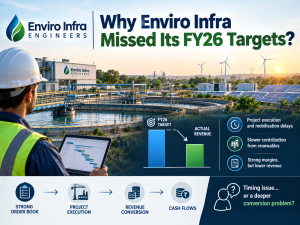
The ₹204.40 Crore Revenue Miss Was a Conversion Problem
Enviro’s FY26 revenue grew only 7.46%, from ₹1,066.06 crore to ₹1,145.60 crore, despite its much higher order pipeline.
Management had revised its FY26 revenue expectation to ₹1,350 crore. The actual number was ₹1,145.60 crore, creating a ₹204.40 crore gap.
The shortfall came down to three measurable factors:
- Delayed order finalisations slowed the start of projects.
- Mobilisation and execution took longer, pushing billing into later periods.
- Renewables generated ₹129.20 crore, below management’s ₹200 crore target, leaving a ₹70.80 crore gap from that business alone.
This means renewables explain a meaningful part of the miss, but not all of it. The remaining gap points back to the speed at which the core water business was executed.
The important takeaway is that Enviro did not have an order-book shortage. It had an order-book velocity problem.
₹6,720.80 Crore Order Book: Large, But Slow to Move
At FY26-end, Enviro’s order book stood at ₹6,720.80 crore, compared with FY26 revenue of ₹1,145.60 crore.
That is 5.87 times annual revenue.
On the surface, this provides substantial revenue visibility. But the ratio also highlights why execution velocity matters. If projects remain in design, mobilisation or early execution stages, the headline order book can grow without producing an equivalent increase in reported revenue.
FY26 demonstrated exactly that disconnect.
For investors, the useful question is therefore not simply “How large is the order book?” but:
How much of the ₹6,720.80 crore can Enviro execute, bill and collect during FY27?
That is the number that will determine whether the current backlog represents genuine near-term growth or simply longer-duration revenue visibility. To know more, check our latest video.
The ₹634.29 Crore Unbilled Revenue Needs Attention
The strongest warning sign is not EBITDA. It is the balance sheet.
Enviro’s unbilled revenue/contract assets increased from ₹312.64 crore in FY25 to ₹634.29 crore in FY26, more than doubling during the year.
This does not mean the ₹634.29 crore is fictitious revenue or automatically at risk. Contract assets arise because revenue can be recognised before the corresponding right to invoice becomes unconditional. The issue is therefore timing and conversion.
At the same time, standalone cash flow from operations after tax was negative ₹78.49 crore in FY26.
Together, these numbers show that accounting revenue and cash collection were moving at different speeds.
That makes FY27 cash conversion particularly important. If contract assets begin converting into billed receivables and cash, FY26 will look increasingly like a timing mismatch. If unbilled revenue continues rising while operating cash flow remains weak, the execution issue becomes more structural.
FY27 Scorecard: What Investors Should Track
FY27 should be judged through five measurable indicators:
| Indicator | What would support a recovery |
| Revenue | Strong acceleration from ₹1,145.60 crore |
| Order-book execution | Faster conversion of the ₹6,720.80 crore backlog |
| Unbilled revenue | ₹634.29 crore begins converting into billable revenue |
| Operating cash flow | Moves back into positive territory |
| Renewables | Revenue moves materially beyond FY26’s ₹129.20 crore |
Revenue moves materially beyond FY26’s ₹129.20 crore
The key is to watch these indicators together. Higher revenue without cash conversion would not fully resolve the concern. Similarly, order inflows without faster execution would simply increase the backlog further.
Timing Issue or Structural Execution Problem?
FY26 is that the evidence currently points more toward a timing and execution-cycle problem than a fundamental deterioration in demand.
The strongest evidence is the combination of a ₹6,720.80 crore order book and 24.16% EBITDA margin. Enviro clearly had projects and was profitable on the work it executed.
But the balance-sheet numbers prevent investors from dismissing FY26 completely. The rise in contract assets to ₹634.29 crore and negative operating cash flow show that execution has not yet translated cleanly into cash.
FY27 should settle the question. If revenue accelerates, contract assets convert and operating cash flow improves, FY26 will look like a delayed execution year. If the order book remains large while revenue, billing and cash conversion continue to lag, the problem is more likely structural.
Conclusion: FY26 Was a Velocity Problem
Enviro Infra did not enter FY27 with an order-book problem. It entered with a conversion-speed problem.
The ₹6,720.80 crore backlog gives the company substantial execution potential, but FY26 showed that having orders is only the first stage. The real value is created when those orders move through mobilisation, execution, billing and finally cash collection.
For now, the numbers point to a temporary execution-cycle issue rather than a broken business model. But that view is conditional on FY27 showing measurable improvement in revenue growth, contract-asset conversion and operating cash flow.
The biggest mistake investors could make is to focus on the ₹6,720.80 crore order book alone. FY27’s real test is how fast Enviro can turn that backlog into revenue and revenue into cash.