List of Indian Companies involved in Copper Mining
Copper is slowly moving out of the background and becoming a much more important part of the global economy. Earlier, it was just another industrial metal, but today it sits at the center of big trends like electric vehicles, renewable energy, and AI data centers.
But when you look at India specifically, a simple question comes up. Who actually produces copper here, and how strong is our domestic ecosystem?
The answer is a bit surprising. India does not have a deep mining base in copper. Most of the value lies in processing and refining, not extraction. And this creates a clear gap between rising demand and limited supply control.
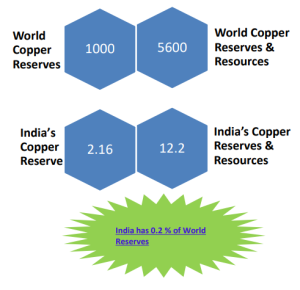
India’s Copper Reserves & Resources
- Total copper ore reserves/resources stand at 1660 million tonnes and India’s copper Ore reserves is 164 million tonnes . (Indian Minerals Year Book 2023, published in January 2025)
- Rajasthan leads with 52.25% of India's copper ore, followed by Madhya Pradesh (23.28%) and Jharkhand (15.14%).
- HCL has 160.48 million tonnes of copper ore reserves with an average grade of 1.32%.
- HCL has reserves/resources of 755.32 million tonnes at an average grade of 0.95%
Hindustan Copper - India’s Only Mining Player
If you talk about actual copper mining in India, there is only one meaningful name - Hindustan Copper Limited. It is the only integrated company that mines copper ore and processes it within the country.
Its operations are spread across states like Rajasthan, Jharkhand, and Madhya Pradesh. On paper, it has reserves and long-term potential, but in reality, production remains limited compared to global standards.
The bigger issue is scale and speed of expansion. Even though copper demand is rising, mining capacity has not kept pace due to approvals, execution challenges, and long development cycles.
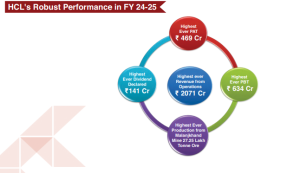
Here is a financial snapshot of Hindustan Copper FY24-25
Hindalco Industries - The Real Backbone Of Copper Processing
While Hindustan Copper handles mining, the real industrial strength of India’s copper system comes from Hindalco Industries. But interestingly, Hindalco is not dependent on mining copper ore in India.
Instead, it operates large smelting facilities like the Dahej plant in Gujarat, where imported copper concentrate is converted into refined copper. This makes it a key processor rather than a miner.
Because of this structure, Hindalco’s copper business is closely linked to global supply chains and international copper prices. It benefits from demand growth but does not control raw material supply.
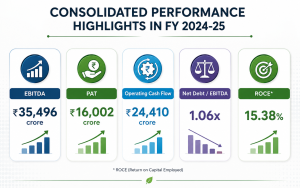
Here is a financial snapshot Hindalco Industries FY24-25
Vedanta Limited - Important but Uncertain Role
Vedanta has also been a major name in India’s copper story through its Sterlite Copper plant in Tamil Nadu. At one point, it was a significant contributor to domestic smelting capacity.
However, regulatory concerns and environmental issues led to the shutdown of its key plant, which created uncertainty around its long-term role in the sector.
This shows a broader reality of the industry in India. Even if capacity exists, sustainability, approvals, and compliance can heavily impact actual output.
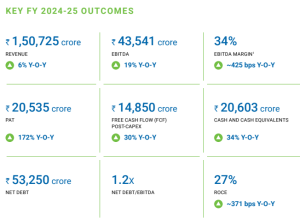
Here is a financial snapshot of Vedanta Limited FY24-25
Adani’s Kutch Copper Project - A New Direction
One of the most ambitious developments in India’s copper space is Adani Enterprises’ Kutch Copper project. It is designed to be a large-scale integrated smelting complex with global-level capacity.
If it becomes fully operational as planned, it could significantly change India’s copper refining landscape and reduce dependence on imports.
But like any large infrastructure project, the real challenge will be execution, timelines, and how it aligns with global copper cycles.
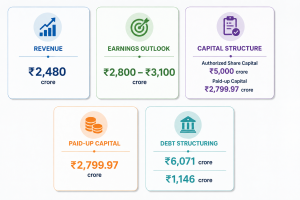
Here is a financial snapshot of Adani’s Kutch Copper project FY25
The Bigger Picture - India’s Structural Gap
When you look at all these companies together, a pattern becomes clear. India has limited mining capacity but relatively stronger processing capability.
Hindustan Copper provides a small domestic mining base, while Hindalco and Vedanta handle most of the refining and smelting. New projects like Adani are still in the expansion phase.
Despite this ecosystem, India continues to rely heavily on imported copper concentrate from countries like Chile and Peru. This makes the entire structure sensitive to global supply disruptions.
This has been properly explained in our Copper Analysis video.
Conclusion
India’s copper sector is still evolving rather than fully developed. Mining is limited, refining is stronger, and expansion is happening slowly.
But as global demand rises due to EVs, AI infrastructure, and renewable energy, this gap between demand and domestic supply control will become even more important in the coming years.