Techno Electric: The 55% Margin Business Hiding Inside a 15% Margin Company
Techno Electric is quietly changing what kind of company it wants to become.
Its power-infrastructure business remains the foundation, but a very different opportunity is taking shape alongside it: data centres. The bigger story is not simply India’s growing demand for computing capacity, but the potential for this new business to reshape Techno Electric’s earnings profile.
The question is whether the data-centre business can become large enough to transform the economics of the company itself.
The Margin Gap Is The Real Story
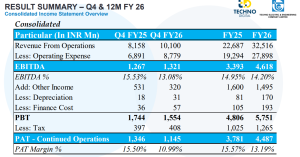
Techno Electric’s FY26 financials provide the starting point: revenue from operations stood at ₹3,251.6 crore, while EBITDA was ₹461.8 crore, giving the company a 14.20% consolidated EBITDA margin. Against this, the data-centre business is expected to generate an EBITDA margin of 55%.
The potential impact becomes clearer through a simple sensitivity analysis. If data-centre revenue accounted for:
| Data-centre share of group revenue | Data-centre revenue | Implied consolidated EBITDA margin* |
| 5% | ₹162.58 crore | 16.24% |
| 10% | ₹325.16 crore | 18.28% |
| 20% | ₹650.32 crore | 22.36% |
*Assumes the remaining business retains a 14.20% EBITDA margin and the data-centre business earns a 55% margin. These are scenario calculations, not company guidance.
The takeaway is striking: at a 20% revenue contribution, the higher-margin business could lift the consolidated EBITDA margin to 22.36%, even without any improvement in the rest of the company.
This is why the 55% figure matters. Scale, not the margin alone, determines whether the data-centre business can transform Techno Electric’s earnings profile.
From EPC Execution to Digital Infrastructure Ownership
Techno Electric’s data-centre strategy matters because it changes what the company owns and how it earns. Its established EPC business is centred on executing infrastructure projects, whereas data centres allow the company to develop and operate digital infrastructure and build a recurring revenue stream around those assets.
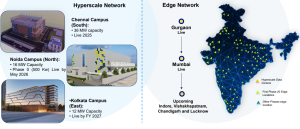
That transition is already underway. Techno Electric has a 36 MW Chennai data centre, while its edge-data-centre network has also begun operations. The Gurugram EDC is live and 100% occupied, and the Mumbai EDC is operational.
This distinction is important because an EPC contract largely monetises execution. An owned digital-infrastructure asset can continue generating revenue after construction is complete. Techno is therefore attempting to add an asset-backed, recurring component to a business historically driven by project execution.
The strategy also builds on capabilities the company already possesses across electrical, mechanical, civil and structural engineering. techno AR.pdf The opportunity is to turn those capabilities into a scalable digital-infrastructure platform and eventually make that higher-margin business large enough to reshape the economics of the group.
Chennai Is The First Real Test
Chennai is the most important proof point because it is Techno Electric’s first live hyperscale campus. Phase I has 36 MW of capacity and is live, while the facility has a design PUE of 1.35.
The available disclosures, however, do not provide a contracted-capacity figure, occupancy percentage, revenue generated, revenue potential or a specific MW capacity for Chennai Phase II. The company only indicates that Chennai Phase I is live and that further expansion forms part of the wider strategy. Those gaps should not be filled with assumptions.
That makes the validation framework straightforward:
- Contracted capacity: disclosure of signed customer commitments.
- Occupancy: evidence that the 36 MW live capacity is being monetised rather than simply commissioned.
- Phase II: a specific capacity and commissioning timeline would establish the next scaling step.
- Revenue: actual data-centre revenue will show whether capacity is translating into commercial traction.
- Margin: the decisive test is whether realised profitability moves toward the expected 55% EBITDA margin.
Chennai therefore needs to prove three things simultaneously: customer demand, utilisation and economics. Until those are visible, the project demonstrates execution capability but not yet the full financial potential of the data-centre model.
The Bigger Bet Is The Edge Network
Techno Electric’s data-centre strategy extends beyond large hyperscale facilities. Its partnership with RailTel is designed to build an edge network across 102 locations in 23 states, creating a distributed layer alongside its larger data-centre campuses. The network is intended to use RailTel’s 61,000+ km optical-fibre infrastructure and provide sub-50 millisecond latency access to nearly 40% of India’s population.
The strategic value is that Techno is not pursuing just one type of data-centre customer or location. Hyperscale facilities concentrate computing capacity, while edge infrastructure brings computing closer to users and applications. Together, they create a broader digital-infrastructure proposition that can serve different latency and computing requirements.
There is already evidence of this model beginning to operate. Gurugram is live and 100% occupied, while Mumbai is operational, with additional locations including Indore, Visakhapatnam and Chandigarh in the pipeline.
For Techno, this network could become an important differentiator. The opportunity is not simply to add more data-centre capacity, but to build an interconnected platform where hyperscale capacity and edge infrastructure reinforce each other.
The 250 MW Ambition Needs To Earn Its Returns
Techno Electric plans to create 250 MW of hyperscale and edge data-centre capacity through a $1 billion investment programme. On a simple portfolio basis, that translates into exactly $4 million of planned investment per MW.
The more interesting question is what that investment could produce. Using FY26 group revenue of ₹3,251.6 crore only as a scenario base, if data centres eventually represent 5%, 10% and 20% of group revenue, the corresponding revenue per MW across the full 250 MW portfolio would be ₹0.65032 crore, ₹1.30064 crore and ₹2.60128 crore, respectively. At a 55% EBITDA margin, that translates into ₹0.357676 crore, ₹0.715352 crore and ₹1.430704 crore of EBITDA per MW.
These are analytical scenarios, not forecasts. The company does not disclose a data-centre revenue-per-MW target or EBITDA-per-MW target, so a genuine ROCE calculation cannot yet be established from the available disclosures.
That limitation is itself important. The 55% margin can look attractive, but investors ultimately need to see how much recurring EBITDA the $1 billion investment produces and how quickly that capital gets deployed and recovered.
Power Is The Differentiator Behind The Data-Centre Bet
Techno Electric’s power advantage is more specific than simply having experience in electricity. The company has capabilities in EHV substations up to 765 kV, transmission lines and renewable-power integration. It also says it has built 160 of PGCIL’s 276 substations, giving it a substantial record in high-voltage grid infrastructure.
That matters because a data centre’s power requirement does not begin at the server rack. It begins with securing reliable grid connectivity and building the electrical infrastructure capable of delivering that power continuously. Techno’s advantage, therefore, is potentially upstream of the data-centre operator: it already understands high-voltage evacuation, substations and grid integration.
This does not automatically give Techno an advantage over established data-centre operators in areas such as customer relationships or cloud services. But it can reduce the distance between power availability and commissioned computing capacity.
The company itself identifies power delivery as a binding constraint as AI workloads drive higher-density computing.
The differentiated proposition is therefore clearer: Techno is combining a data-centre platform with an engineering capability that established digital-infrastructure players typically have to source externally.
The EPC Business Is Still Carrying The Weight
The data-centre opportunity may be the most exciting part of Techno Electric’s story, but the company’s financial engine is still its established infrastructure business. That matters because the new digital platform has to scale alongside rather than replace the business that currently generates most of the company’s revenue.
Techno Electric entered FY26 with a consolidated order book of ₹9,566.515 crore. Transmission accounted for ₹6,185.186 crore, while smart metering contributed ₹1,564.543 crore. FGD and distribution orders stood at ₹777.511 crore and ₹369.239 crore, respectively.
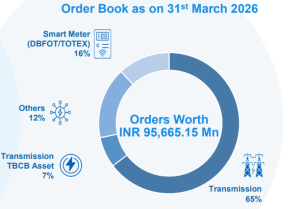
That order book gives Techno visibility in its existing businesses while it builds the data-centre platform. It also creates an important strategic dynamic: the company does not need to abandon EPC to pursue digital infrastructure. Instead, it can use its established execution base while gradually building a second earnings engine.
This makes the transition less about EPC versus data centres and more about EPC funding scale while digital infrastructure changes the future mix. The success of the strategy will ultimately depend on whether the newer business can grow fast enough to become financially significant without weakening the economics of the existing one.
The 55% Margin Is Only The Beginning
The most important part of Techno Electric’s data-centre thesis is not the headline margin itself. It is what that margin could do to the company’s overall earnings mix if the business scales.
At a consolidated EBITDA margin of 14.20% in FY26, the existing business has a very different profitability profile from the 55% EBITDA margin expected for the data-centre business.
But a high-margin segment does not automatically translate into high consolidated margins. The data-centre business first needs to generate meaningful revenue, achieve strong utilisation and expand its contribution relative to EPC and other established operations. This is why capacity announcements alone are not enough to validate the thesis.
The more useful way to track the transition is to watch whether data-centre revenue begins to become material, whether the expected margin is achieved and how much capital is required to generate that earnings contribution.
That last point is particularly important. A 55% EBITDA margin can look attractive on paper, but shareholders ultimately benefit only if the business converts that operating profitability into strong returns on the capital invested.
For Techno Electric, therefore, the real opportunity is not simply building a 55%-margin business. It is making that business large, profitable and capital-efficient enough to change the economics of the group. To know more check our latest video.
What Could Go Wrong?
The downside needs to be measured against the same variables that make the opportunity attractive.
- If margins fall short: At a 20% data-centre revenue contribution, a 40% margin would produce a consolidated EBITDA margin of 19.36%, versus 22.36% at 55%. At 30%, it falls further to 17.36%.
- If utilisation remains weak: Lower utilisation would reduce data-centre revenue while much of the infrastructure investment remains committed. The problem is particularly important because the planned programme involves $1 billion of investment for 250 MW, or $4 million per MW.
- If scaling takes longer: The 55% margin has little consolidated impact until data centres become a meaningful portion of group revenue. At a 5% revenue share, the scenario margin is only 16.24%; at 20%, it reaches 22.36%.
- If capital efficiency disappoints: EBITDA margin alone cannot establish ROCE. The company has not disclosed enough data-centre-specific financial information to calculate the actual return on the planned investment.
The downside is therefore not simply that the data-centre business fails. It could succeed operationally but still generate inadequate returns if utilisation, margins or capital efficiency fall short.
What Investors Should Watch Now?
The data-centre thesis now needs a more quantitative scorecard. Investors should track:
- Revenue contribution: Does data-centre revenue move toward becoming a meaningful share of group revenue? The sensitivity shows why this matters: at 5%, 10% and 20% contribution, the implied consolidated EBITDA margins are 16.24%, 18.28% and 22.36%, respectively.
- Realised EBITDA margin: The key benchmark is the expected 55% margin. A 40% or 30% outcome would materially reduce the earnings uplift.
- Capacity utilisation: Chennai has 36 MW live, while Noida has 16 MW, Kolkata 12 MW, and the broader strategy includes 102 edge locations across 23 states.
- Capital deployed per MW: The planned $1 billion investment across 250 MW implies $4 million per MW.
- Cash returns: Actual data-centre EBITDA, cash generation and capital employed will ultimately determine whether the high-margin thesis translates into attractive ROCE.
The most important shift is therefore from tracking MW announcements to tracking MW monetisation, margin and returns. That is where the data-centre story moves from potential to proof.
Conclusion
Techno Electric’s data-centre strategy is interesting because it could change the quality of its earnings, not just their size. The company currently operates at a 14.20% consolidated EBITDA margin, while its data-centre business is expected to deliver a 55% EBITDA margin.
But the gap will matter only if Techno can scale the business. Its 36 MW Chennai facility is already live, Gurugram is 100% occupied, and the company is building toward a broader 250 MW data-centre portfolio.
That makes the next stage less about proving that data centres are an attractive industry and more about proving Techno Electric can execute the model profitably. Customer acquisition, utilisation, realised margins and returns on invested capital will determine whether the opportunity becomes a meaningful earnings engine.
The company does not need to abandon its EPC roots for this to work. The bigger possibility is that its established infrastructure business remains the foundation while digital infrastructure gradually becomes the higher-margin growth engine.
If that transition happens, the most important change may not be how much Techno Electric earns but what kind of business those earnings come from.