Multi-Chip Modules Explained: Why Advanced Packaging Matters More Than Ever?
When people talk about the semiconductor industry, most conversations revolve around chip manufacturing. But here’s something many investors overlook: a chip’s value isn’t created only during fabrication. Packaging and assembly play an equally important role in determining its performance and usability.
As India pushes to strengthen its semiconductor ecosystem, advanced packaging technologies such as Multi-Chip Modules (MCMs) are becoming increasingly important. In fact, they could play a major role in helping India establish itself in the global semiconductor value chain.
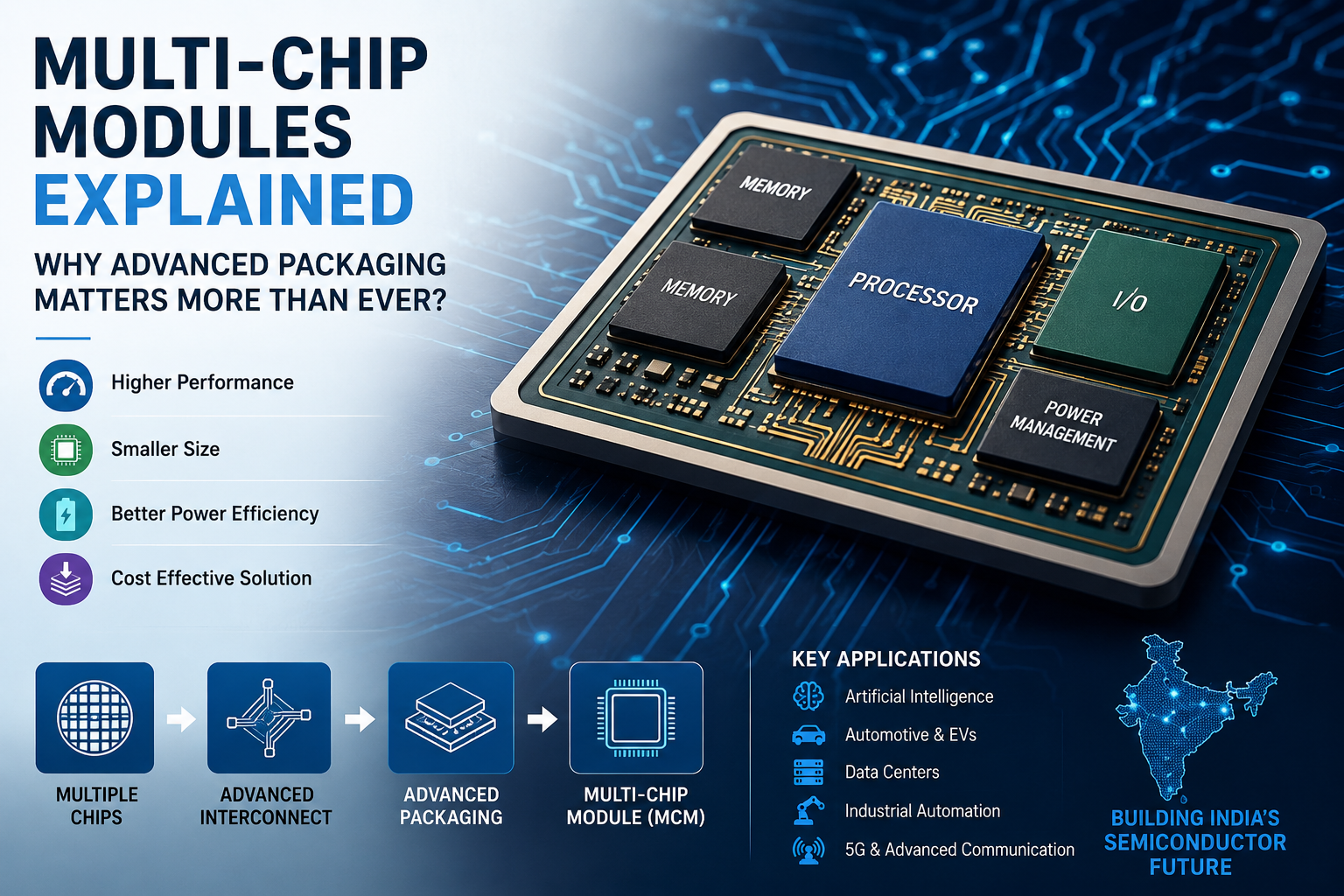
What is a Multi-Chip Module?
A Multi-Chip Module (MCM) is a semiconductor package that combines multiple chips into a single unit. Instead of relying on one large chip, manufacturers integrate several specialized chips that work together as a single system.
This approach allows companies to improve performance, reduce space requirements, and build more complex electronic systems without increasing manufacturing complexity significantly.
Why Advanced Packaging is Gaining Importance?
For decades, semiconductor progress was driven by making chips smaller and more powerful. However, as manufacturing costs continue to rise, producing larger and more advanced chips has become increasingly challenging.
Advanced packaging offers an alternative path. By combining multiple chips into a single package, manufacturers can achieve higher performance and efficiency without relying solely on next-generation fabrication technologies.
According to industry estimates, the global advanced packaging market is expected to grow from roughly $40-45 billion today to over $65-70 billion by 2030, driven by AI, high-performance computing, and automotive semiconductors.
The Link Between MCMs and India’s Semiconductor Ambitions
India’s semiconductor strategy is not limited to building fabrication plants. Under the India Semiconductor Mission, the government has committed incentives worth approximately ₹76,000 crore ($10 billion) to support semiconductor manufacturing, packaging, and design initiatives.
This is important because advanced packaging requires lower capital investment compared to leading-edge chip fabrication while still creating significant value. As a result, packaging and OSAT are emerging as practical entry points for India’s semiconductor ambitions.
Why This Matters for Companies Like Kaynes Technology?
The importance of advanced packaging became evident when Kaynes Technology recently shipped India’s first commercially manufactured Multi-Chip Module from its OSAT facility. The module integrated multiple semiconductor components into a single package, demonstrating India’s growing capabilities in advanced packaging.
For companies like Kaynes, this represents an opportunity to move beyond traditional electronics manufacturing and participate in higher-value segments of the semiconductor supply chain. This has been explained in detail in our Kaynes Technology Stock Analysis video.
The Growing Opportunity Ahead
Demand for advanced packaging is expected to rise as industries such as artificial intelligence, electric vehicles, industrial automation, and data centers require increasingly powerful semiconductor solutions.
For example, A typical internal combustion engine vehicle contains around $500 worth of semiconductors, while premium electric vehicles can contain $1,000-$1,500 or more, increasing demand for advanced packaging solutions.
As chip complexity increases, Multi-Chip Modules are becoming a preferred approach for delivering higher performance. This trend could create substantial opportunities for companies involved in semiconductor packaging and testing.
Challenges to Consider
While the opportunity is significant, advanced packaging remains a highly specialised field. It requires sophisticated manufacturing capabilities, skilled talent, and strict quality standards.
In addition, global leaders in semiconductor packaging have spent decades building expertise and scale. India will need sustained investment and successful execution to compete effectively in this segment.
Conclusion
Multi-Chip Modules may not receive as much attention as chip fabrication, but they are becoming increasingly important to the future of the semiconductor industry. As advanced packaging gains prominence, it is creating new opportunities across the semiconductor value chain.
For India, this trend could be particularly significant. With growing investments in OSAT facilities and semiconductor infrastructure, advanced packaging has the potential to become one of the country’s most important entry points into the global semiconductor industry.