RR Kabel – Data Center Business, Revenue Mix & Growth Guidance
India's data center industry is entering a phase of rapid expansion, fueled by the growth of AI, cloud computing, digital payments, OTT platforms, and the government's push for data localization. As businesses and consumers generate more digital data, the demand for large, reliable data centers continues to rise.
Behind every data center lies an extensive electrical infrastructure. A single hyperscale facility requires thousands of kilometers of power, control, networking, and fire-resistant cables to ensure uninterrupted operations and high reliability.
This is where RR Kabel fits into the ecosystem. While the company does not build or operate data centers, it supplies the electrical cables and wiring solutions that form a critical part of their infrastructure. As India continues to add new data center capacity, RR Kabel stands to benefit from the increasing demand for high-quality and reliable cable solutions.
RR Kabel's Role in India's Data Center Ecosystem
A modern data center is essentially a highly sophisticated electrical network. While servers process and store data, they can only function if electricity is delivered safely and continuously across the entire facility.
From the moment power enters the campus until it reaches an individual server rack, it passes through multiple stages of electrical distribution, each requiring specialized cable solutions.
This is where RR Kabel plays an important role. The company manufactures a wide range of power and specialty cables that are used across different parts of a data center's electrical infrastructure.
Although these cables account for a relatively small portion of the total project cost, they are mission-critical because even a minor cable failure can lead to equipment damage, downtime, or safety risks.
How Electricity Flows Inside a Data Center
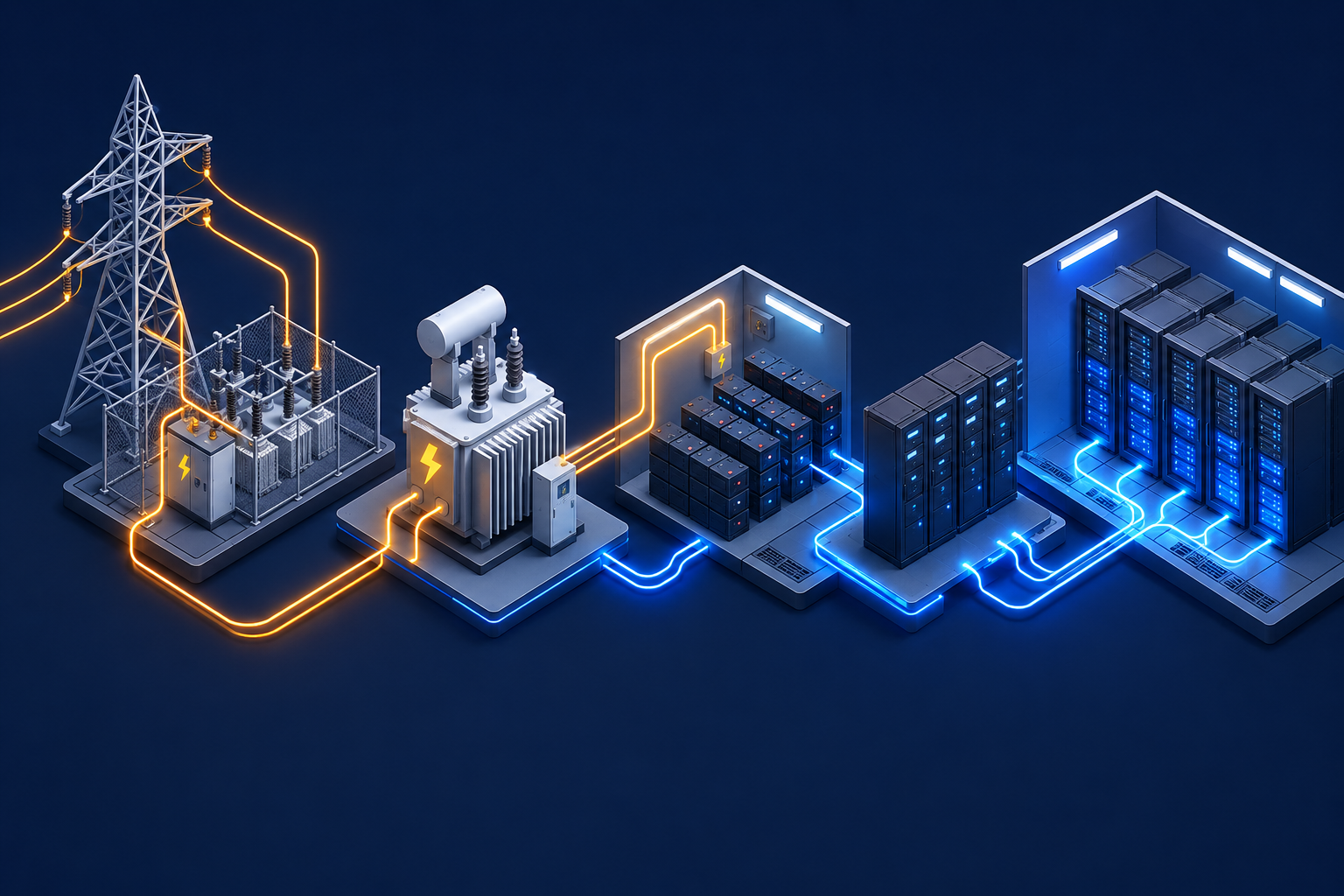
The flow of electricity inside a typical data center follows a structured path:
Grid Power – Substation – Medium Voltage (MV) Distribution – Transformers – Low Voltage (LT) Distribution – UPS Systems – PDUs (Power Distribution Units) – Server Racks
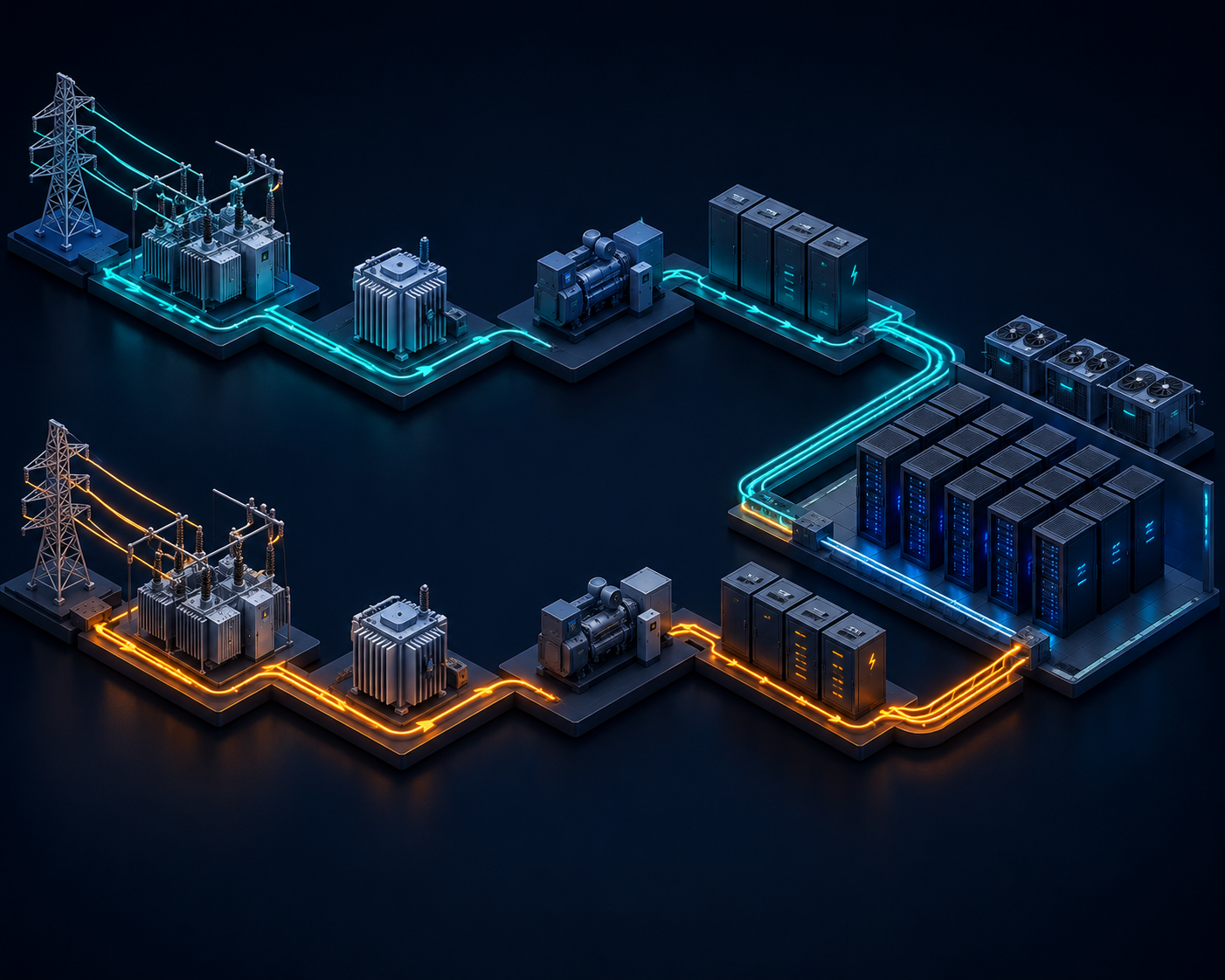
Alongside this power network, separate control and communication cables continuously connect sensors, cooling systems, fire detection systems, security equipment, and the Building Management System (BMS), ensuring that every critical operation is monitored in real time.
Where RR Kabel's Products Are Used
| Data Center Component | RR Kabel Product | Purpose |
| Incoming Power from Grid/Substation | Medium Voltage (MV) Cables | Carry high-voltage electricity from the utility grid or substation to transformers with high reliability. |
| Internal Power Distribution | Low Voltage (LT) Cables | Distribute electricity from transformers and UPS systems to switchboards, PDUs, cooling equipment, and other electrical loads. |
| Server Rooms & Emergency Systems | Fire Survival Cables | Continue supplying power during a fire, allowing emergency lighting, fire alarms, smoke extraction systems, and other critical safety equipment to remain operational. |
| Building Management System (BMS) | Control Cables | Connect sensors, HVAC systems, generators, UPS units, and automation equipment to enable centralized monitoring and control. |
| Communication & Networking | Data & Communication Cables | Transmit operational data between monitoring devices, security systems, automation equipment, and communication networks within the facility. |
Why Data Centers Can Become a Premium Business
The opportunity for RR Kabel is not just about supplying more cables – it's about supplying higher-value cables. Unlike conventional buildings, data centers demand premium electrical infrastructure due to their critical nature.
Key reasons include:
- Higher cable density: Thousands of servers, cooling systems, UPS units, and networking equipment require dedicated power, control, and communication cables, resulting in significantly more wiring per square foot.
- Redundant power architecture: Most data centers are designed with N+1 or 2N redundancy, meaning multiple power paths and backup systems are installed to ensure uninterrupted operations.
- 24×7 uptime requirements: Since even a few minutes of downtime can result in significant financial losses, cables must deliver exceptional reliability and long service life.
- Stringent safety standards: Data centers require flame-retardant, fire survival, and low-smoke cables that can continue operating during emergencies while minimizing fire and smoke hazards.
- Strict certifications: Cable suppliers must comply with rigorous quality and safety standards, creating higher entry barriers and favouring established manufacturers like RR Kabel.
A data center doesn't necessarily consume the highest volume of cables, but it demands some of the highest-quality and highest-value cable solutions. This makes the sector a far more profitable opportunity than many conventional construction projects – an insight that many retail investors often overlook.
Revenue Mix – What Actually Drives RR Kabel?
Although RR Kabel has expanded into fans, lighting, switches, and other electrical products, its business is still overwhelmingly driven by its Wires & Cables segment. In FY26, the company generated ₹8,764 crore, or around 90% of its total revenue, from Wires & Cables, while the FMEG business contributed the remaining 10%.
Revenue Mix (FY26)
| Segment | Revenue (₹ Cr) | Share of Total Revenue |
| Wires & Cables | 8,764 | ~90% |
| FMEG | 959 | ~10% |
| Total | 9,722 | 100% |
Within the Wires & Cables business, the product mix is also important. Around 73% comes from wires, including house wires and industrial wires, while the remaining 27% comes from cables, such as power cables, control cables, fire survival cables, and data & communication cables.
Why Should Investors Care?
- House wires mainly benefit from residential and commercial construction.
- Industrial wires are driven by factories and manufacturing expansion.
- Power and specialty cables are used in infrastructure projects such as data centers, railways, renewable energy, transmission & distribution, and industrial plants.
- These projects consume much larger quantities of cables and typically require higher-specification products, making them more value-accretive.
This shift is important because RR Kabel is strategically increasing its focus on the B2B cable business. Management has identified data centers, infrastructure, renewable energy, and railways as key growth areas over the coming years.
As India's infrastructure spending accelerates, demand for power and specialty cables is expected to grow faster than traditional house wires, creating a larger long-term opportunity for RR Kabel.
The Bigger Story Isn't Data Centers Alone
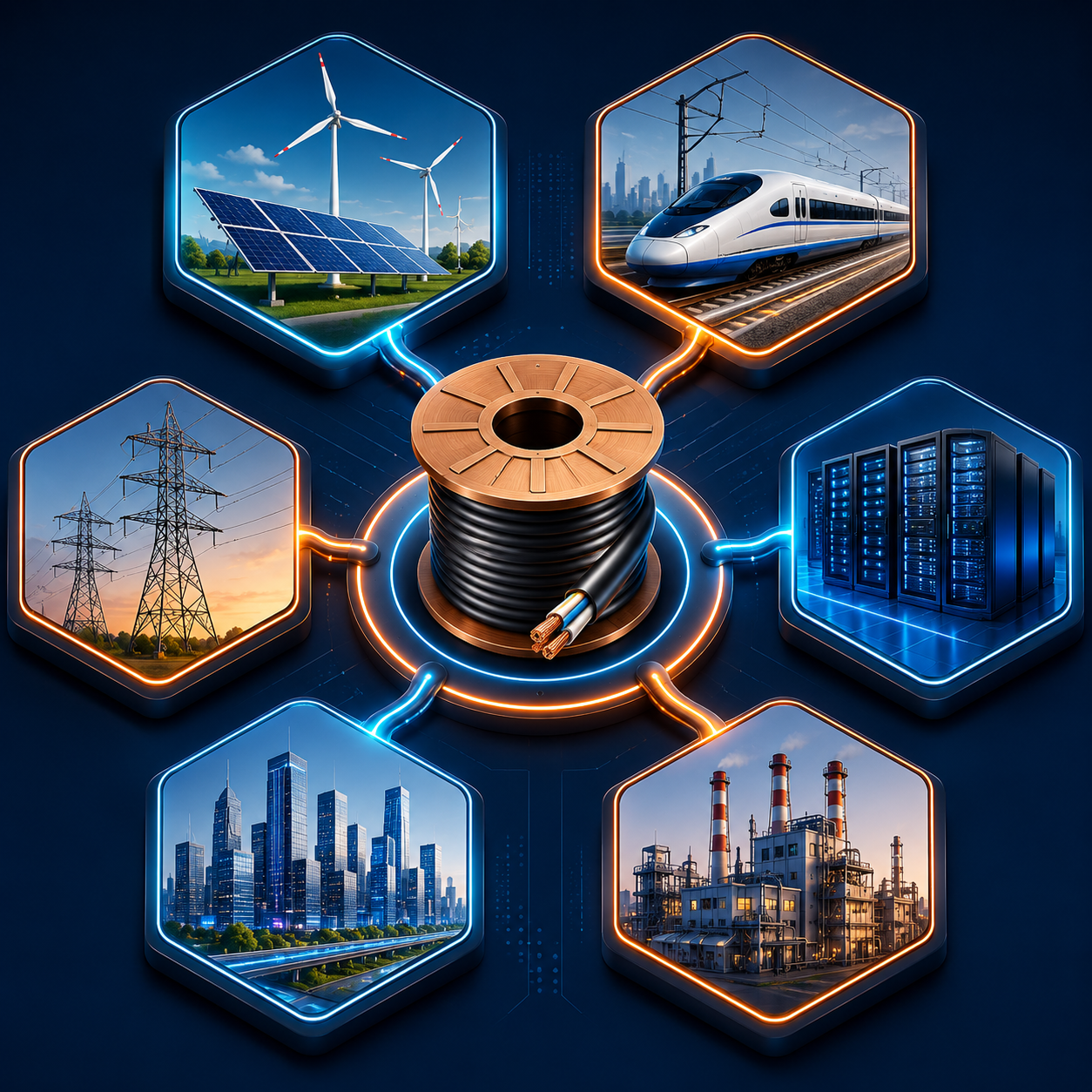
While data centers are an exciting long-term opportunity, they are not the sole growth driver for RR Kabel. The company's strategy is built around supplying cables to multiple high-growth industries that are benefiting from India's infrastructure and industrial expansion.
Some of the key structural demand drivers include:
- Data Centers: Rising investments in AI, cloud computing, and digital infrastructure are driving demand for high-performance power and specialty cables.
- Renewable Energy: Large-scale solar and wind projects require extensive cabling for power generation, transmission, and grid connectivity.
- Railways: Expansion of metro networks, railway electrification, and station modernization continue to increase cable demand.
- Transmission & Distribution: Strengthening India's power grid and expanding transmission networks require significant volumes of medium- and high-voltage cables.
- Smart Cities: Urban infrastructure projects, commercial buildings, and public utilities create demand for power, control, and communication cables.
- Industrial Capex: As manufacturing capacity expands across sectors, new factories and industrial plants require reliable electrical infrastructure.
This diversified end-market exposure is one of RR Kabel's biggest strengths. Instead of relying on a single industry, the company is positioned to benefit from several long-term investment cycles simultaneously.
Even if one sector experiences slower growth, demand from other infrastructure segments can help sustain the company's growth trajectory, making its business model more resilient over the long term.
Project RRise - Can Management Actually Deliver?
To accelerate its next phase of growth, RR Kabel launched Project RRise, a three-year strategic roadmap (FY26–FY28). Rather than focusing only on revenue growth, the company has set measurable operational targets that indicate how it plans to improve both scale and profitability.
| Metric | FY28 Target |
| Wires & Cables Volume CAGR | 18% |
| W&C EBIT Margin | 10.5% |
| EBITDA Growth | 2.5x |
| Total Capex | ₹1,200 Cr |
| Capacity Expansion | 1.7x |
| RoCE | >20% |
18% Volume CAGR – Why It Matters More Than Revenue Growth
Revenue can fluctuate because the prices of copper and aluminium—the key raw materials for cables—move up and down. A rise in metal prices may increase revenue even if the company sells the same quantity of cables.
Volume growth, however, measures the actual increase in cables sold. It reflects genuine demand, market share gains, and execution capability. That's why RR Kabel's target of 18% annual volume growth is a stronger indicator of business expansion than revenue growth alone.
10.5% EBIT Margin – How Can RR Kabel Achieve It?
Management expects the Wires & Cables EBIT margin to improve to 10.5% by FY28. This is expected to be driven by:
- A higher share of power and specialty cables, which typically earn better margins than standard house wires.
- Better operating leverage as fixed costs are spread over higher production volumes.
- Increasing sales of premium and institutional products.
- Higher capacity utilisation as new manufacturing facilities ramp up.
Together, these factors can improve profitability even if revenue growth moderates.
The encouraging part is that management has already made early progress. W&C EBIT margin improved from 8.9% in FY26 to 9.9% in Q1 FY27, while volume growth remained strong, suggesting the company is moving in line with its stated roadmap.
Capacity Expansion – The Hidden Growth Driver
Many investors see ₹1,200 crore of capex as just another spending figure. In reality, this investment is the foundation for RR Kabel's future earnings growth. Around 80% of the capex is being invested in the cable business, with the objective of increasing overall manufacturing capacity by 1.7x by FY28.
The investment creates a chain reaction:
₹1,200 Cr Capex – Higher cable manufacturing capacity – Ability to execute larger institutional and infrastructure orders – Better economies of scale and capacity utilisation – Higher operating margins – Higher earnings and return on capital
This is particularly important because RR Kabel is increasingly targeting sectors such as data centers, renewable energy, railways, and power infrastructure, where customers require large and consistent cable supplies. Without sufficient manufacturing capacity, the company would struggle to capitalize on these opportunities.
In other words, the capex is not merely about building factories—it is about creating the manufacturing scale needed to support higher-value orders, improve profitability, and sustain long-term earnings growth.
This shift is also creating a new and increasingly important demand centre for the wire and cable industry: data centres. As India rapidly expands its digital infrastructure, the amount of power, connectivity and electrical cabling required inside these facilities is rising sharply. for more information on data centres, you can watch my video Data Center Stocks in India
Final Verdict – What Investors Should Really Watch
RR Kabel should not be viewed as a data center company. Its business is, and will likely remain, fundamentally centered around wires and cables, which contributed around 90% of its FY26 revenue. Data centers currently account for a negligible share of revenue and are still in the early stages of execution, making them a long-term growth opportunity rather than an immediate earnings driver.
The real investment thesis lies in management's ability to execute Project RRise. Investors should closely monitor whether the company can deliver its targeted 18% volume CAGR, improve W&C EBIT margins to 10.5%, expand manufacturing capacity by 1.7x, and increase the contribution of higher-margin cable products.
Successful execution of these targets would have a much greater impact on long-term earnings than a few individual data center orders.
At the same time, RR Kabel is benefiting from multiple structural demand drivers, including data centers, renewable energy, railways, transmission & distribution, and industrial infrastructure.
This diversified exposure reduces dependence on any single industry while positioning the company to participate in several long-term investment cycles simultaneously.
If management executes well and India's infrastructure investment continues to accelerate, RR Kabel could emerge as one of the key beneficiaries of the country's expanding electrical infrastructure ecosystem.