KPIT Technologies: Business Model, Customers and Risks
The automotive industry is rapidly evolving from being hardware-driven to software-defined. As automakers invest in electric vehicles, autonomous driving, connected mobility, and AI-powered features, software has become one of the most critical components of modern vehicles.
This shift has created a significant opportunity for KPIT Technologies, a global technology company that specializes exclusively in automotive software and engineering solutions. Unlike traditional IT companies that serve multiple industries, KPIT focuses entirely on the mobility sector, partnering with leading automobile manufacturers and Tier-1 suppliers to develop the software that powers next-generation vehicles.
Today, the company works across key automotive technologies such as Software-Defined Vehicles (SDVs), electric powertrains, connected vehicles, autonomous driving, digital cockpits, and vehicle engineering. Its deep domain expertise and long-term engineering partnerships have made it one of the leading automotive software specialists globally.
Business Model
KPIT Technologies is a global technology company focused exclusively on the automotive and mobility industry. The company helps vehicle manufacturers develop Software-Defined Vehicles (SDVs) by providing embedded software, AI, digital engineering, and system integration solutions across the entire vehicle lifecycle.
Unlike diversified IT companies that serve multiple industries, KPIT follows a domain-focused strategy. Its customers include global passenger vehicle manufacturers, commercial vehicle OEMs, and Tier-1 automotive suppliers that are investing in electric, connected, autonomous, and intelligent vehicles.
How KPIT Makes Money?
KPIT primarily earns revenue by partnering with automotive customers on multi-year engineering programs. Instead of building physical vehicle components, the company develops, integrates, validates, and maintains the software that controls various vehicle functions.
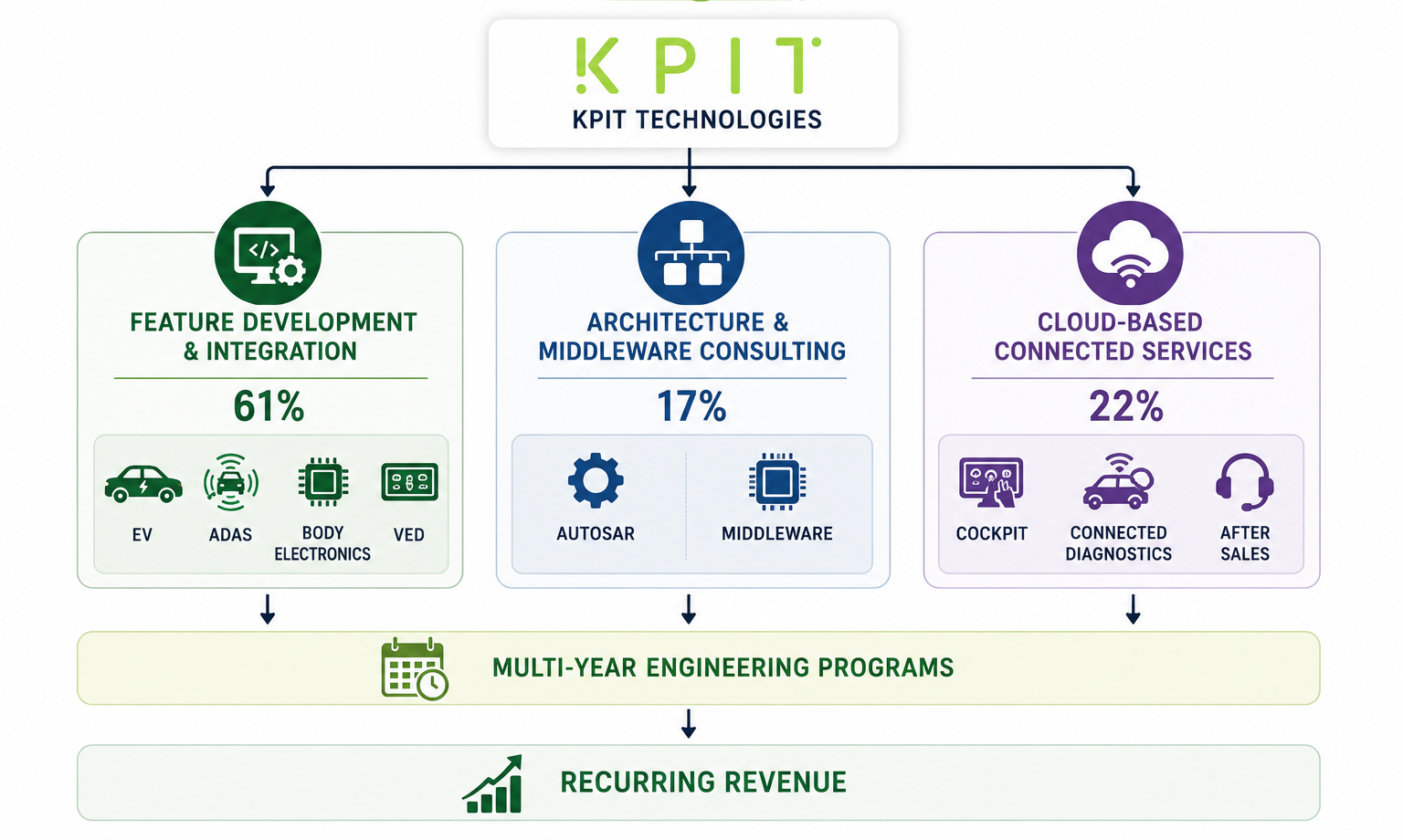
Its revenue is broadly generated from three solution portfolios:
1. Feature Development & Integration (61%)
This is KPIT's largest business segment.
The company develops and integrates software for critical vehicle functions, including:
- Electrification (EV Powertrain)
- Autonomous Driving & ADAS
- Body Electronics
- Vehicle Engineering & Development (VED)
Since these technologies are core to modern vehicles, OEMs typically engage KPIT over multiple years, creating recurring engineering revenue.
2. Architecture & Middleware Consulting (17%)
Modern vehicles contain dozens of electronic control units (ECUs) that must communicate seamlessly.
KPIT helps customers build this software foundation through:
- AUTOSAR development
- Middleware integration
- Vehicle software architecture
- Platform engineering
These services enable OEMs to migrate toward Software-Defined Vehicle architectures while reducing software complexity.
3. Cloud-Based Connected Services (22%)
This segment focuses on software that continues generating value even after a vehicle is sold.
Key offerings include:
- Intelligent Cockpit
- Connected Vehicle Platforms
- Digital Mobility Solutions
- Vehicle Diagnostics
- After-sales software solutions
Management highlighted that Connected Services and After-sales were among the fastest-growing business areas during FY26, reflecting automakers' increasing focus on monetizing vehicles throughout their lifecycle rather than only at the time of sale.
Customer Base
KPIT Technologies primarily serves global Original Equipment Manufacturers (OEMs) and selected Tier-1 suppliers, with a strategic focus on becoming a long-term software engineering partner rather than a project-based IT vendor. Over the years, the company has deliberately increased its exposure to OEMs, as they typically offer larger, multi-year vehicle programs and deeper strategic relationships.
Today, KPIT works with leading automotive companies across Europe, North America, Japan, China, and India, supporting passenger vehicles, commercial vehicles, trucks, off-highway equipment, and emerging mobility platforms. This diversified customer base reduces dependence on a single geography or vehicle category while positioning the company to benefit from multiple automotive trends simultaneously.
Top Clients & Revenue Share
KPIT operates with a highly concentrated client base, deriving the bulk of its revenue from a select group of strategic OEMs. KPIT publicly discloses only those customers who individually account for more than 10% of consolidated revenue (though names are not revealed):
| Period | Number of >10% Clients | Aggregate Revenue | % of Total Revenue |
|---|---|---|---|
| FY25 | 2 customers | ₹1,861.45 Crores. | ~31.9% |
| FY24 | 1 customer | ₹889.473 Crores | ~18.3% |
| FY23 | 1 customer | ₹521.276 Crores | ~15.5% |
Named Strategic Clients (Publicly Disclosed)
While exact revenue percentages for individual clients are not disclosed (beyond the 10% threshold), these are the key named partners mentioned across multiple documents:
| Client | Relationship Highlights |
|---|---|
| Mercedes-Benz (MBRDI) | Collaboration for accelerating SDV journey; announced in April 2025 |
| BMW | Strategic partner across Electrification, ADAS, Digital Connected Solutions, SDV |
| Honda | Long-standing SDV program partnership; ~2,000+ engineers dedicated; recent program cancellations impacted near-term revenue |
| Cummins | 20+ year partnership; received "Best Supplier Award" |
| Renault | Chosen as strategic technology partner for next-gen SDV platform |
| PACCAR | 10+ year partnership in commercial vehicles |
| Navistar | Celebrated 5-year partnership in CV technology |
| ZF Group | Joint venture partner (Qorix middleware company) |
| Panasonic ITS | 8-year collaboration; "Excellent Partner Award" |
| JSW Motors | Partnership for EV software development (announced July 2025) |
| Hero Motors (HMC HIVE) | Micro-mobility / Light EV partnership |
| Volkswagen Group (CARIAD) | Through Cymotive cybersecurity JV |
Key Takeaways
- High concentration: Strategic accounts (T25) contribute ~87% of revenue — the business is heavily reliant on a small number of large OEMs
- Two clients individually exceed 10% of revenue, meaning a single-client loss could be material
- The top client concentration has risen from ~15.5% (FY23) to ~18.3% (FY24) to now two clients at >10% each (FY25)
- KPIT is actively diversifying by adding 13 new clients (including 4 truck OEMs, 6 off-highway OEMs, and 3 new passenger car OEMs) and expanding in India, China, and Southeast Asia
Although customer names for these contracts remain confidential, the diversity of these engagements highlights KPIT's presence across multiple regions and technology domains.
Customer Strategy
Instead of pursuing a large number of short-duration projects, KPIT focuses on building deep, long-term relationships with a relatively concentrated set of global automotive customers.
This strategy offers several advantages:
- Higher customer retention.
- Multi-year engineering revenue.
- Opportunities to expand into additional vehicle programs.
- Cross-selling of AI-led Products & Solutions.
- Stronger participation across the entire vehicle lifecycle.
Management also highlighted increasing opportunities in China, Japan, commercial vehicles, trucks, and off-highway equipment, expanding KPIT's addressable market beyond traditional passenger vehicle manufacturers.
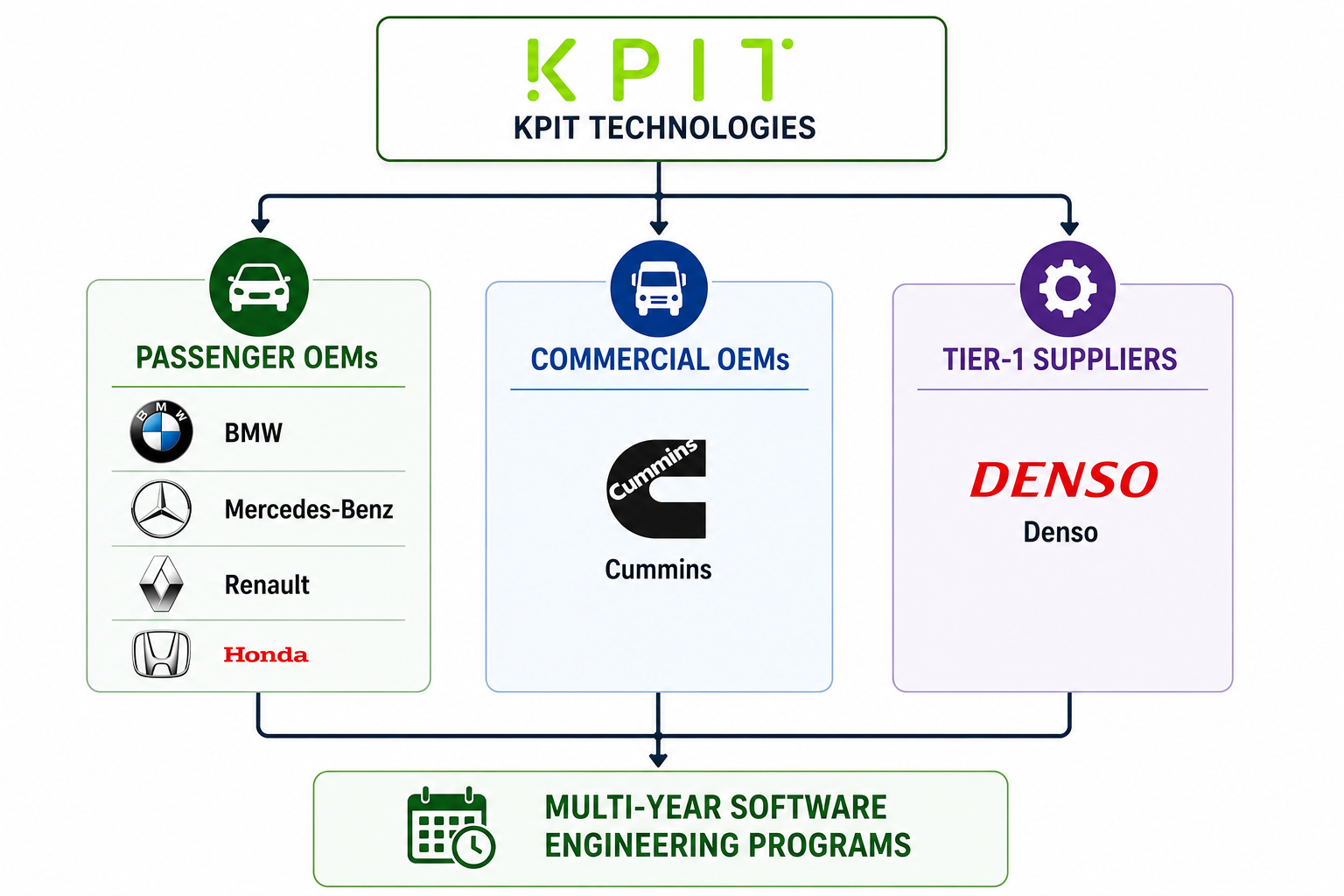
KPIT's customer base consists primarily of large global automotive manufacturers that outsource critical software development to trusted engineering partners. By strengthening direct relationships with OEMs while expanding into commercial vehicles, off-highway equipment, and AI-led mobility solutions, the company is positioning itself to capture a larger share of future automotive software spending.
Competitive Advantages (Moat)
KPIT operates in a highly competitive automotive software market, yet it has built several structural advantages that differentiate it from traditional IT service providers and engineering firms. Its exclusive focus on the automotive industry, long-term customer relationships, and growing investment in AI-led solutions have enabled the company to establish itself as a strategic technology partner for global automakers.
KPIT's competitive advantage lies in its deep automotive specialization rather than its size. By focusing exclusively on mobility, investing heavily in technology, and expanding its AI-led Products & Solutions portfolio, the company has built long-term relationships with global OEMs that are difficult for competitors to replicate.
1. Automotive-Only Specialization
Unlike diversified IT companies such as TCS, Infosys, or Wipro, KPIT focuses exclusively on the automotive and mobility sector.
This singular focus has allowed the company to develop deep expertise in embedded software, vehicle engineering, AUTOSAR, ADAS, electric powertrains, connected vehicles, and digital cockpits. Instead of spreading resources across multiple industries, KPIT concentrates its R&D and engineering talent on solving complex automotive challenges, making it a preferred partner for OEMs undergoing digital transformation.
2. Long-Term Relationships with Global OEMs
Vehicle development programs typically last several years, and software remains integrated throughout a vehicle's lifecycle. Once KPIT becomes part of a customer's engineering program, replacing it midway can be costly and time-consuming.
This creates long-duration customer relationships, recurring engineering revenue, and opportunities to expand into new vehicle programs over time.
3. Strong Investment in Technology
Technology leadership remains a core part of KPIT's strategy.
According to management, the company invests more than 5% of its annual revenue in technology development—well above the industry average of less than 1%. These investments support AI, software platforms, engineering tools, and next-generation mobility technologies, helping KPIT remain competitive as automotive software becomes increasingly complex.
4. Positioned for the AI-Driven Mobility Era
Management believes AI will fundamentally change how automotive software is designed and developed. Rather than focusing on generic AI applications, KPIT is building domain-specific AI solutions that improve engineering productivity, accelerate software development, and shorten vehicle development cycles.
As AI adoption increases across the automotive industry, this strategy could strengthen KPIT's competitive position while creating new opportunities for its Products & Solutions business.
Watch our detailed analysis below to understand why KPIT's stock corrected, what went wrong in Europe, and whether the company is positioned for a recovery.
Risk Factors
1. Heavy Dependence on the Automotive Industry
KPIT earns almost all of its revenue from automobile manufacturers and mobility companies. This gives the company deep industry expertise, but it also means its growth depends on the health of the global automotive industry.
If vehicle sales decline or automakers reduce spending on new software projects due to weak demand or economic uncertainty, KPIT could receive fewer new contracts and slower revenue growth.
2. Dependence on a Few Large Customers
KPIT works with some of the world's largest automobile manufacturers through long-term engineering programs. These relationships provide stable revenue, but they also increase customer concentration.
If a major customer delays a vehicle program, reduces its technology budget, or shifts work to another engineering partner, KPIT's revenue could be affected. Winning new customers while expanding existing relationships is therefore important for the company's long-term growth.
3. Slower Spending on Next-Generation Vehicles
A large part of KPIT's future depends on technologies like Software-Defined Vehicles (SDVs), electric vehicles, connected cars, and autonomous driving.
If automakers slow down investments in these areas because of weak EV demand, economic uncertainty, or changing market conditions, KPIT may see fewer project opportunities. Management has also indicated that customers remain cautious and are prioritizing only the most important technology investments.
4. Global Business and Currency Risk
Most of KPIT's revenue comes from overseas markets such as Europe, North America, and Japan.
This exposes the company to currency fluctuations, geopolitical tensions, and economic slowdowns in these regions. A weaker global economy or reduced technology spending by international customers could affect business growth.
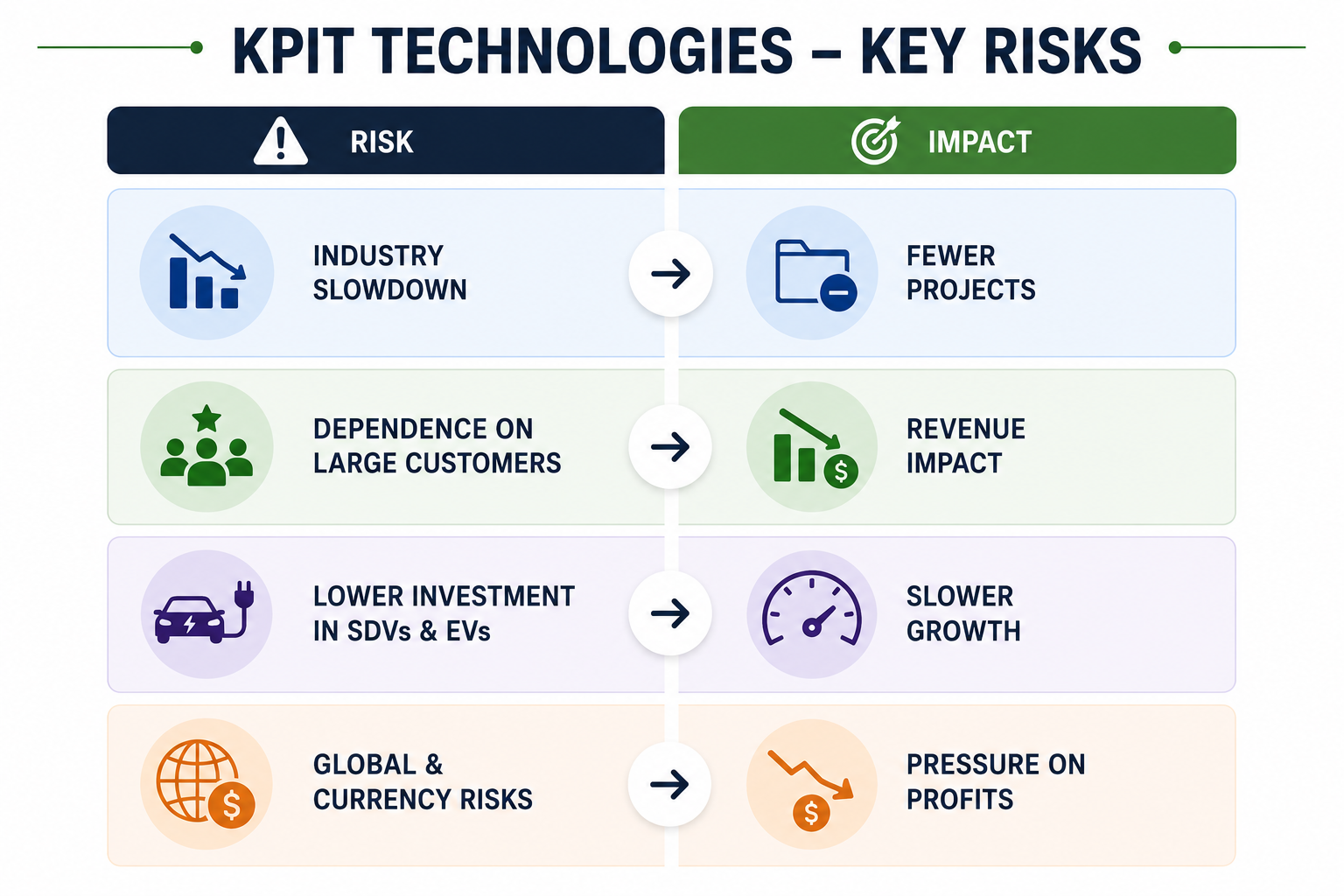
KPIT's biggest advantage is its deep focus on the automotive industry, but this also creates its biggest risks. The company's future growth depends on automakers continuing to invest in software, retaining strong customer relationships, and successfully expanding its higher-value Products & Solutions business. Investors should closely monitor customer spending, new deal wins, and the growth of AI-led solutions over the coming years.
Conclusion
KPIT Technologies has deliberately chosen depth over breadth. Instead of becoming a general-purpose IT services company, it has focused exclusively on the global mobility industry, building deep expertise in software-defined vehicles, electrification, autonomous driving, connected mobility, and vehicle engineering. This specialization has enabled the company to evolve from an engineering service provider into a strategic technology partner for some of the world's leading automotive OEMs.
What makes KPIT's business model particularly compelling is the combination of high-entry barriers, sticky client relationships, and multiple long-term growth drivers. Automotive software programs often span several years, requiring extensive domain expertise, safety compliance, and integration across the vehicle lifecycle. Once embedded into an OEM's engineering ecosystem, replacing KPIT becomes both costly and technically challenging, resulting in strong customer retention and recurring business.
Rather than aggressively expanding its client base, the company continues to follow its T25 strategy—deepening relationships with a select group of strategic OEMs and increasing its share of their engineering spend through new vehicle programs, technologies, and geographies. At the same time, it is expanding beyond passenger vehicles into trucks, off-highway equipment, and adjacent mobility segments, creating additional avenues for long-term growth.
However, the business is not without risks. KPIT remains closely tied to the global automotive industry's R&D cycle. Slowdowns in vehicle development, delayed software programs, geopolitical uncertainty, or reduced engineering budgets at major OEMs can temporarily impact growth. As a focused mobility player, its fortunes are naturally linked to the pace of technological investment within the automotive sector.
Ultimately, KPIT's success will depend on one critical factor: whether the world continues moving toward software-defined, connected, electric, and AI-driven vehicles. If that transformation continues—as industry trends suggest—KPIT appears well-positioned to capture an increasing share of the automotive software value chain through its deep domain expertise, long-standing OEM partnerships, and relentless focus on innovation.