How Does Domino’s Make Money?
When people hear the name Domino's, the first thing that comes to mind is pizza. However, from an investor's perspective, Domino's is not simply a restaurant company.
It is a franchise company, a supply chain company, a technology company, and one of the most efficient asset-light businesses in the global food industry.
This is why Domino's has managed to expand into more than 90 countries while owning very few of its own stores.
Instead of investing billions of dollars to open and operate stores, Domino's lets franchise owners invest their own money. The company then earns revenue through multiple streams that continue for years after a new store opens.
This creates a business model that is scalable, capital efficient, and capable of generating strong cash flows.
Let us understand the complete revenue model of Domino’s in detail and get the answers to our questions.
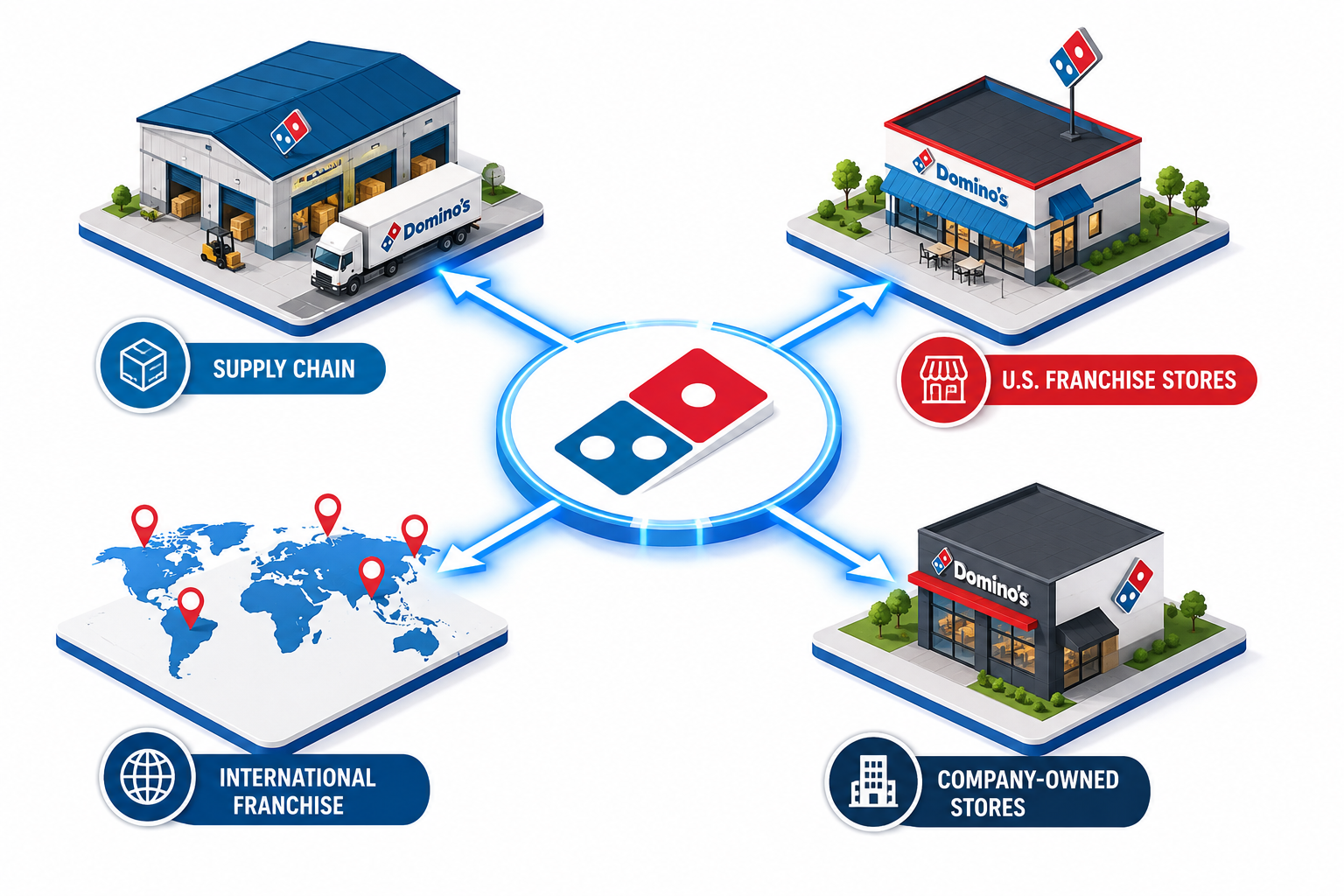
How Domino's Actually Makes Money
Although Domino's sells pizza, investors should understand that the company earns revenue from multiple business segments.
During FY2025, the revenue mix looked approximately like this:
| Revenue Source | Share of Revenue |
| Supply Chain | 68.2% |
| U.S. Franchise Stores | 15.4% |
| International Franchise | 7.7% |
| U.S. Company - Owned Stores | 8.5% |
Source - Annual Reports | Domino's Pizza
This immediately tells us something important. Most of Domino's revenue does not come from selling pizzas directly.
Instead, the largest revenue source comes from supplying ingredients to franchisees.
Let's understand each revenue segment in detail so we can understand these values more properly.
Supply Chain Business (The Largest Revenue Driver)
One of the biggest misconceptions about Domino's is that it primarily makes money by selling pizzas. In reality, its largest source of revenue comes from its supply chain business, which contributed approximately 68.2% of the company's total revenue in FY2025. This means Domino's is not just a pizza company - it is also a large-scale food manufacturing and distribution business that supports its global franchise network.
The company manufactures, procures, stores, and distributes almost everything a franchise restaurant needs to operate on a daily basis. Some of the key products supplied by Domino's include:
- Fresh dough
- Cheese
- Tomato sauce
- Meat toppings
- Baking ingredients
- Pizza boxes
- Packaging materials
- Kitchen supplies
Every Domino's franchise restaurant purchases these products directly from the company's supply chain rather than sourcing them from local suppliers. This allows Domino's to maintain consistent quality and taste across its restaurants while also ensuring efficient inventory management.
For investors, this is where the real strength of the business lies. Every time a franchise sells a pizza, it eventually needs to replenish its inventory, whether it is dough, cheese, sauce, or packaging materials. As a result, franchisees continuously place orders with Domino's supply chain, creating a recurring and predictable revenue stream for the company.
This model also becomes stronger as the business expands. More franchise stores mean higher demand for ingredients and supplies, which directly increases supply chain revenue. Since the same distribution network can support a larger number of stores, Domino's also benefits from economies of scale, making this segment one of the most important drivers of its long-term growth and profitability.
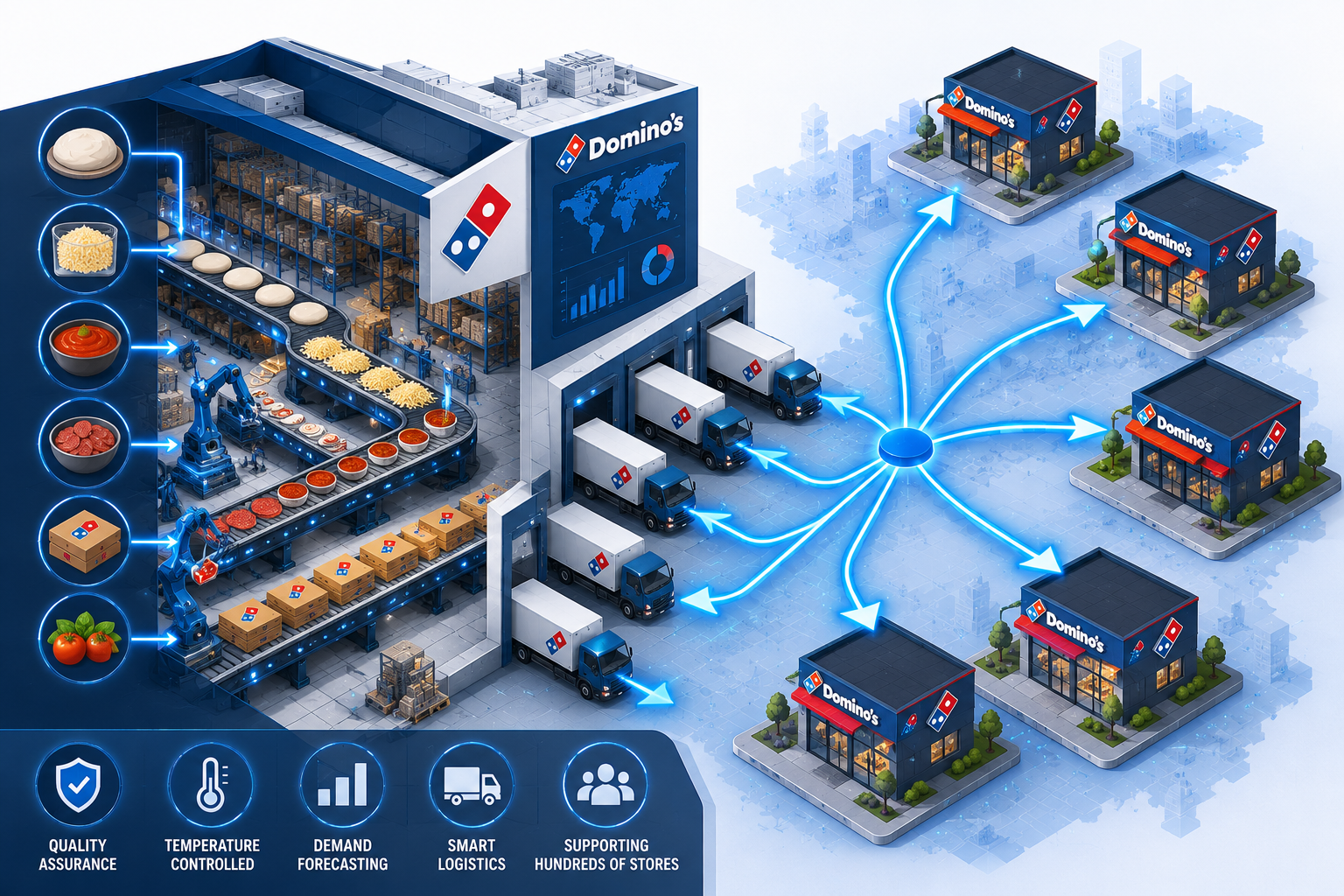
Why Franchisees Buy from Domino's?
A franchise owner cannot simply purchase cheese from any supplier. Instead, Domino's maintains strict quality standards.
Every pizza should taste almost identical whether it is sold in New York, London, Tokyo or Sydney.
To achieve consistency, Domino's controls the ingredients. Benefits include:
- Uniform product quality
- Better food safety
- Bulk purchasing discounts
- Lower logistics costs
- Standardized recipes
- Better inventory management
This system benefits both Domino's and franchisees.
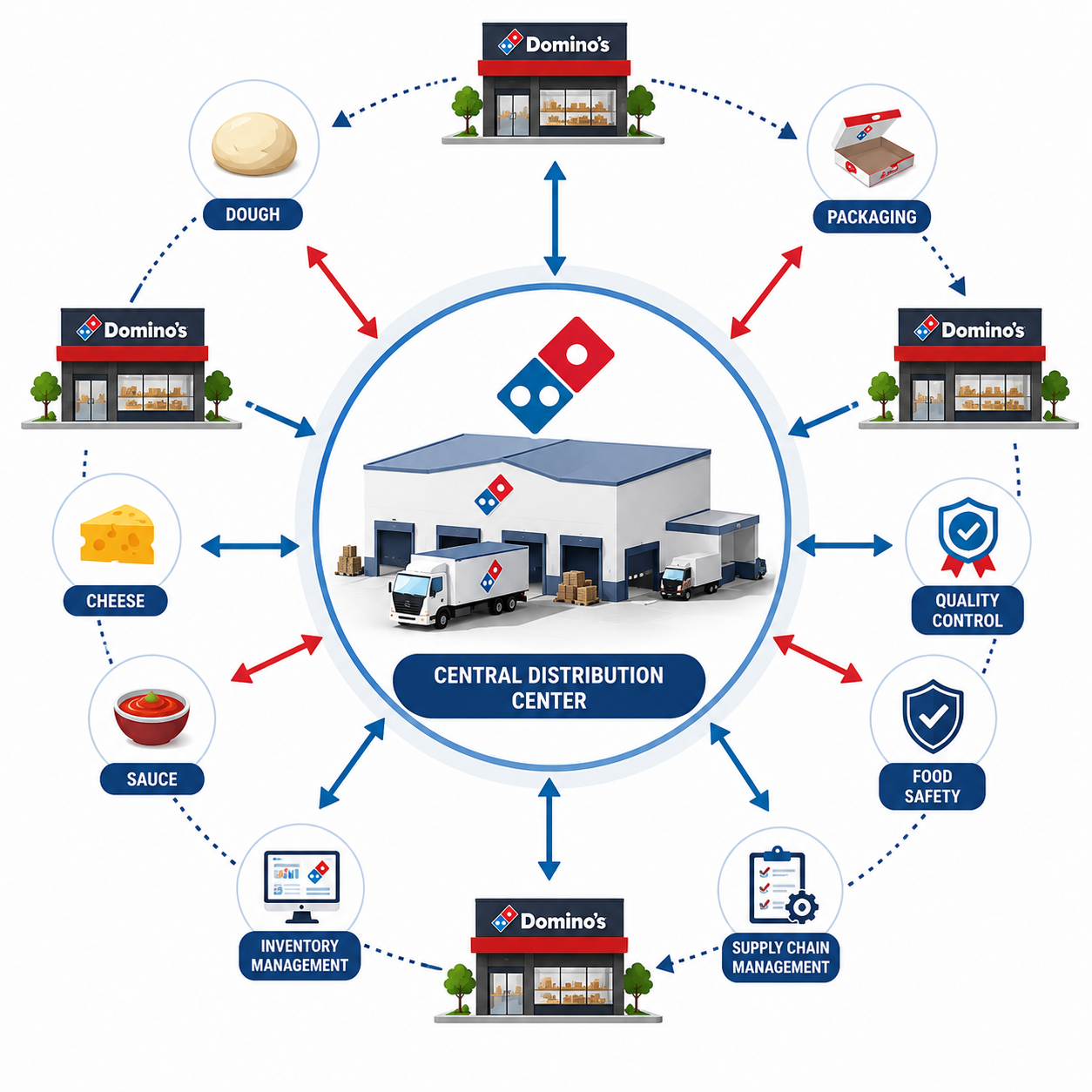
Why This Business Is So Powerful
Think about what happens every day. Every time a franchise sells pizzas: It needs dough - It needs cheese - It needs sauce - It needs packaging.
It orders those supplies from Domino's. That means every pizza sold indirectly generates supply chain revenue for the company.
This creates a recurring business rather than a one-time transaction
U.S. Franchise Revenue
The second-largest source of revenue for Domino's comes from its U.S. franchise business, which contributed approximately 15.4% of the company's total revenue in FY2025. Unlike traditional restaurant companies that own and operate most of their outlets, Domino's expands primarily through franchising.
Anyone who wants to open a Domino's restaurant in the United States must first become an approved franchisee by meeting the company's operational and financial requirements.
Once approved, franchisees enter into an agreement with Domino's and pay various fees for the right to operate under the company's globally recognized brand. One of the first payments made by a new franchisee is the initial franchise fee, which is paid before the restaurant begins operations.
This upfront fee gives the franchise owner access to several valuable assets provided by Domino's, including:
- The right to operate under the Domino's brand
- Access to the company's proven business model and operating system
- A standardized store format and restaurant design
- Domino's technology platform, including ordering and operational systems
- Comprehensive training and operational support
For Domino's, these initial franchise fees create an immediate source of revenue whenever a new store opens. More importantly, every new franchise becomes a long-term revenue-generating asset, as the company continues to earn additional income from that store through royalties, supply chain sales, and other ongoing fees throughout the life of the franchise.
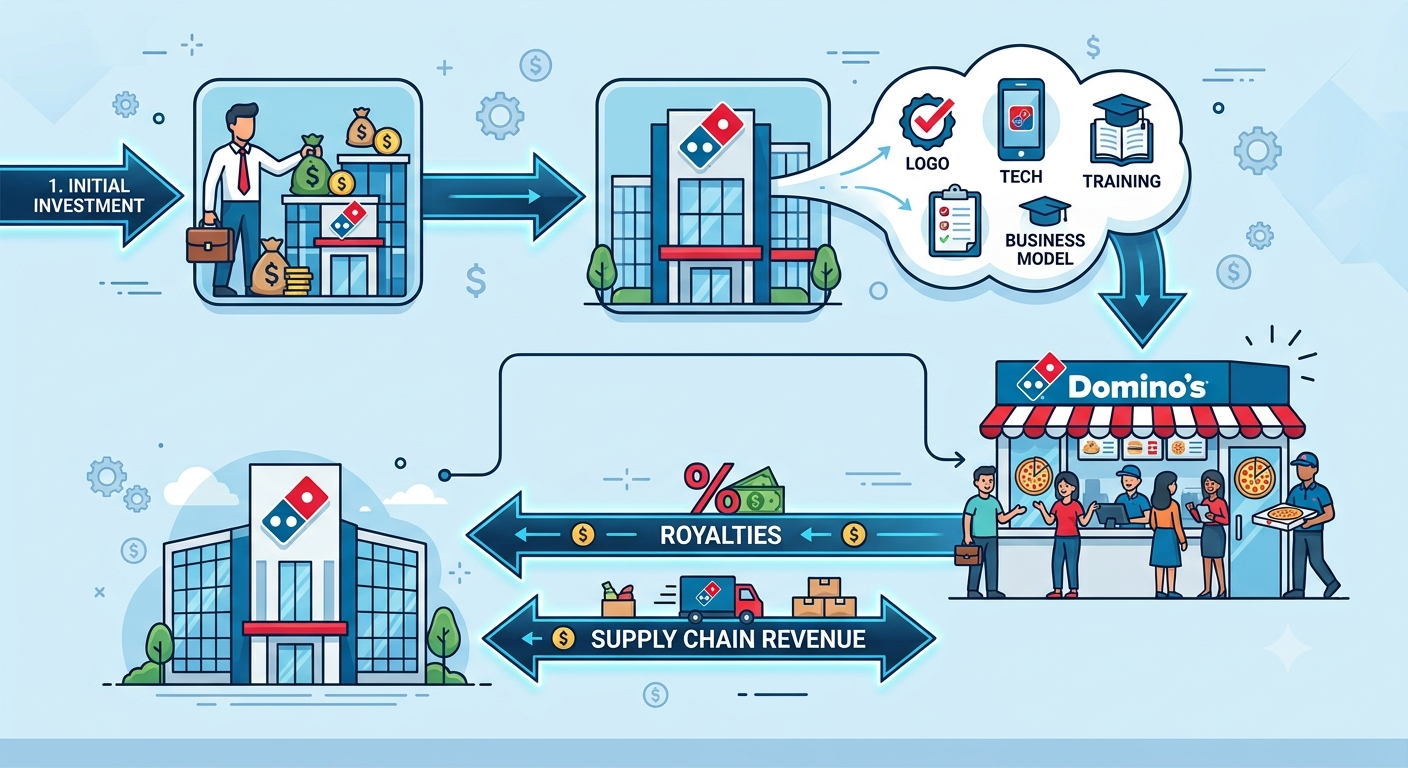
Royalty Fees
Once a franchise restaurant starts operating, the franchise owner is required to pay Domino's an ongoing royalty. Unlike a fixed monthly payment, this royalty is calculated as a percentage of the franchise's sales.
This means Domino's earns more money whenever its franchisees generate higher sales. As the business of the franchise grows, the company's royalty income also grows automatically.
This is one of the biggest strengths of Domino's business model. The company does not have to spend money on hiring employees, paying rent, or managing the day-to-day operations of the restaurant. Those responsibilities remain with the franchise owner.
Instead, Domino's benefits from the success of its franchise network through recurring royalty payments. This creates several advantages for the company:
- Recurring revenue as long as the franchise remains operational.
- High profit margins because there are very few additional costs associated with collecting royalties.
- Scalable growth, as royalty income increases with higher franchise sales.
- Low capital requirements, since the franchise owner invests in and operates the restaurant.
Technology Fees
Technology is one of Domino's biggest competitive advantages. The company has invested heavily in building a digital ecosystem that improves both the customer experience and restaurant operations.
Its technology platform includes:
- Mobile ordering
- Website ordering
- Delivery tracking
- AI-assisted ordering features
- Loyalty program
- Point-of-sale (POS) systems
Franchisees use these platforms in their daily operations and pay certain technology-related fees that help support their development and maintenance. Since a large portion of Domino's orders now comes through digital channels, technology has become an important driver of customer convenience, operational efficiency, and long-term revenue growth.
International Franchise Revenue
The third source of revenue for Domino's is its International Franchise business, which contributed approximately 7.7% of the company's total revenue in FY2025. Outside the United States, Domino's primarily expands through master franchise agreements instead of opening and operating restaurants on its own.
Under this model, Domino's grants exclusive rights to experienced regional partners who are responsible for growing the brand in their respective markets. These master franchisees handle most of the local operations, including:
- Opening new stores
- Recruiting franchisees
- Training restaurant operators
- Expanding the brand within their territory
- Managing day-to-day operations
This business model enables Domino's to expand into new countries with minimal capital investment while benefiting from the local market knowledge and operational expertise of its regional partners. As a result, the company can grow its global presence without taking on the financial and operational risks of directly managing international restaurants.
U.S. Company - Owned Stores
Although Domino's is primarily a franchise business, the company still owns and operates a small number of stores in the United States. In FY2025, these company-owned stores contributed approximately 8.5% of Domino's revenue.
Unlike franchise stores, where Domino's only earns royalties and supply chain revenue, company-owned stores generate revenue directly from selling pizzas and other menu items to customers. Every dollar spent by a customer at these stores is recorded as company revenue because Domino's itself operates these restaurants.
However, unlike the franchise model, Domino's also has to bear all the operating expenses of these restaurants.
As a result, company-owned stores generally have lower profit margins than franchise revenue, because Domino's is responsible for all the costs of running the restaurant.
Why Does Domino's Still Own Restaurants?
Since the franchise model is more profitable and requires less capital, many investors wonder why Domino's continues to operate some stores itself.
The answer is that these stores serve as testing and innovation centers for the company. They allow Domino's to:
- Test new menu items before launching them across the franchise network.
- Trial new kitchen equipment and operational processes.
- Experiment with new technologies and delivery systems.
- Train future franchise owners and store managers.
- Understand day-to-day operational challenges faced by franchisees.
In other words, these company-owned stores act as real-world laboratories where Domino's can refine its products and operations before rolling them out to thousands of franchise locations.
Technology: A Hidden Revenue Enabler
Technology has become one of Domino's strongest competitive advantages. Over the years, the company has invested heavily in building a digital ecosystem that not only improves the customer experience but also helps franchisees run their businesses more efficiently.
Today, Domino's technology platform includes:
- Mobile apps
- Online ordering
- Delivery tracking
- Operational software
These digital tools make ordering faster and more convenient for customers while streamlining restaurant operations for franchisees. This leads to better customer satisfaction, improved order accuracy, and a higher likelihood of repeat purchases.
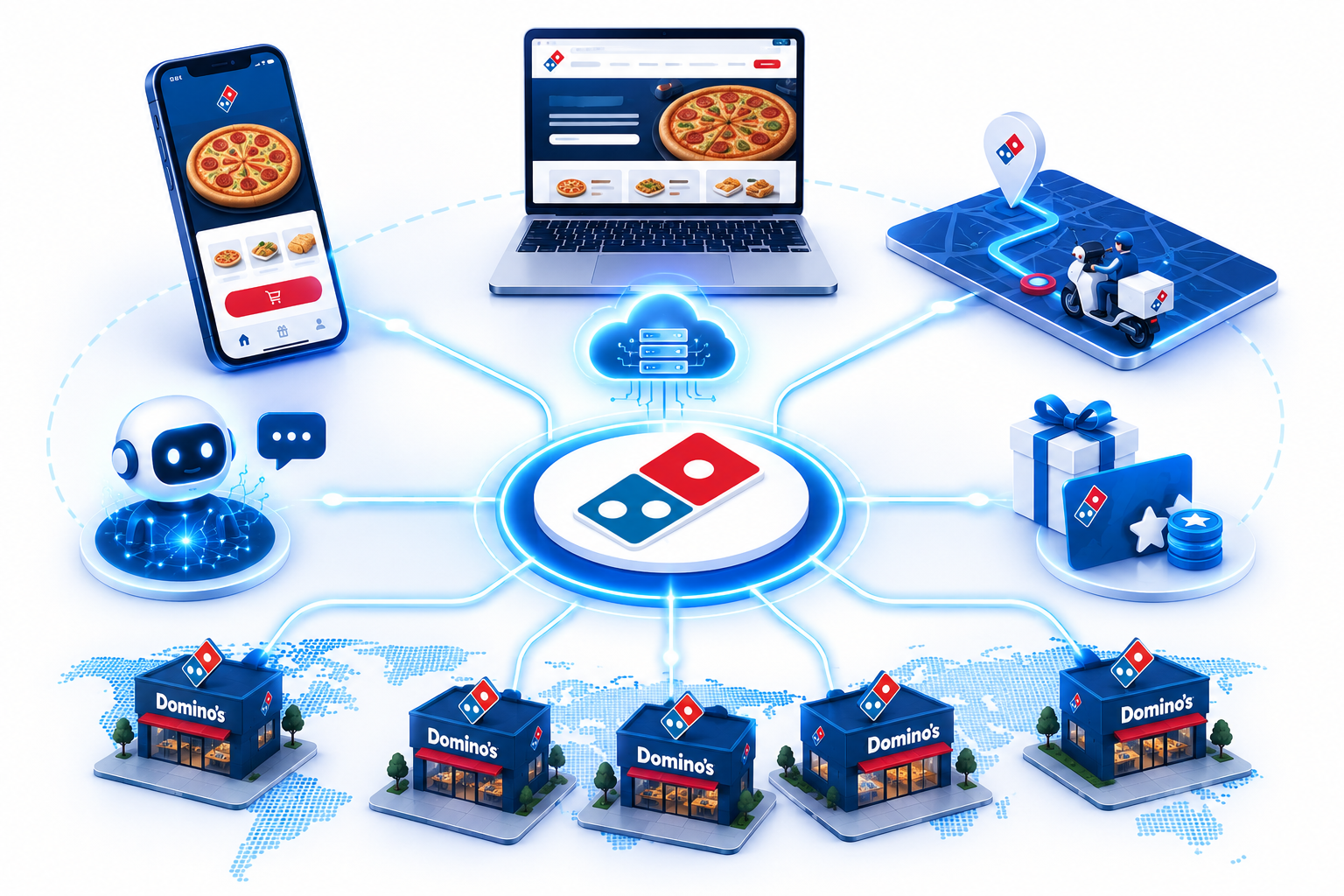
For investors, the real value of these technology investments lies in their indirect impact on revenue. As customer experience improves, stores can generate higher sales and stronger same-store sales growth. This ultimately benefits Domino's by increasing both its royalty income and supply chain revenue, making technology a key driver of the company's long-term growth.
The Flywheel Effect
Domino's business can be viewed as a self-reinforcing flywheel:
- More franchise stores increase the size of the network.
- A larger network drives higher demand for ingredients and packaging.
- Greater purchasing volumes improve economies of scale in the supply chain.
- Improved efficiency can support stronger profitability.
- A stronger brand attracts more franchisees.
- More franchisees open additional stores.
This cycle allows Domino's to grow while keeping capital requirements relatively low. Because a significant portion of revenue depends on franchisee sales and supply chain activity, sustained weakness at the store level could affect multiple revenue streams simultaneously.
Final Thoughts
The biggest mistake investors make is viewing Domino's as just another pizza chain. Its true strength lies in its business model.
With approximately 99% of its stores franchised, Domino's has built an asset-light system that requires relatively little capital to expand while generating recurring revenue from franchise royalties, supply chain operations, technology services, and brand licensing.
The supply chain segment, which contributes around 68.2% of revenue, is the foundation of this model. Every pizza sold by a franchise creates demand for dough, cheese, sauces, packaging, and other supplies, allowing Domino's to earn revenue beyond the restaurant level. Combined with royalties from U.S. and international franchisees, this creates multiple income streams from the same store.
For long-term investors, the key takeaway is that Domino's is not simply selling pizzas - it is monetizing an entire global franchise ecosystem. Its combination of a trusted brand, efficient supply chain, technology leadership, and asset-light expansion strategy has enabled the company to scale globally while maintaining attractive capital efficiency.
Going forward, the most important metrics to monitor are net store growth, same-store sales, franchisee health, and supply chain performance, as these are the primary drivers of Domino's long-term revenue and earnings growth.