How Aarti Industries Makes Money?
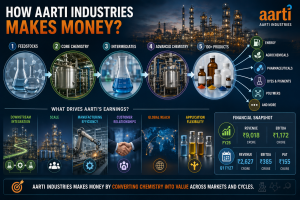
Aarti Industries is easy to misunderstand if it is viewed simply as a “speciality chemicals company”. Its real business model is more interesting: it takes a relatively focused set of feedstocks and converts them through multiple stages of chemistry into more than 100 products used across energy, agrochemicals, pharmaceuticals, dyes, pigments, polymers and other industries.
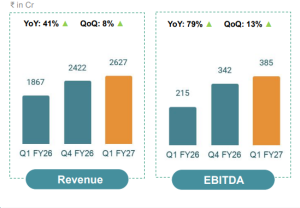
That model generated ₹9018 crore of revenue and ₹1172 crore of EBITDA in FY26. In Q1 FY27, revenue was ₹2,627 crore, EBITDA ₹385 crore and PAT ₹155 crore.
The key to understanding how Aarti makes money is therefore not its product count alone.
It is the combination of downstream integration, scale, manufacturing efficiency, customer relationships and the ability to move products across geographies and applications when market conditions change.
Aarti’s Basic Money-Making Machine
Aarti starts with core chemical feedstocks such as benzene, toluene, sulphuric acid and related inputs, and converts them into increasingly specialised intermediates. Its major value chains include Nitro Chloro Benzenes (NCB), Di-Chloro Benzenes (DCB), Phenylenediamines (PDA), Nitro Toluene derivatives and sulphuric-acid downstream products.
The economic logic is straightforward: Aarti is not primarily selling a commodity feedstock. It is selling the result of several chemistry and manufacturing steps.
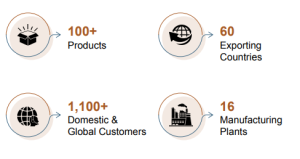
Its current footprint includes 16 manufacturing facilities, 100+ products and more than 1,100 customers across 60+ countries.
This creates multiple monetisation points from its chemistry capabilities:
- NCB and DCB chains feed pharmaceutical, agrochemical and other applications.
- Hydrogenation products add another layer of downstream processing.
- Nitro-toluene and ethylation chains serve chemical applications.
- Fuel additives have become a major revenue engine.
- Speciality products serve dyes, pigments, polymers and other industrial markets.
The important insight is that Aarti’s advantage is less about owning one blockbuster molecule and more about building several businesses around the same underlying chemistry and manufacturing capabilities.
Energy Is Now The Biggest Revenue Engine, But Is It The Best Earnings Engine?
Energy has moved from 36% of FY25 revenue to 43% in FY26, making it Aarti Industries’ largest end-use business.
- Agrochemicals & Fertilisers contributed 18%
- Polymer & Additives 14%
- Dyes/Pigments/Printing Inks 11%
- Pharma 10%
- Others 4%.
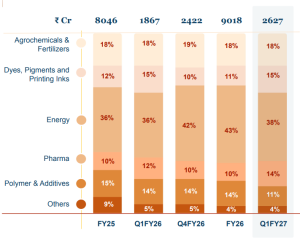
That shift matters because it is changing what drives the company’s topline. More importantly, Aarti has increased fuel-additive capacity from 290 KTPA to 360 KTPA, with the expansion completed in July 2026.
The attraction is scale. Management sees strong demand for octane-booster fuel additives and expects the expanded capacity to support volume growth. Q1 FY27 also showed the value of having multiple markets: West Asia’s contribution fell to 2% from about 15%, but Aarti redirected volumes elsewhere.
But a larger Energy mix does not automatically mean higher-quality earnings. The business remains sensitive to feedstock prices, refining margins and gasoline–naphtha cracks. Management also describes it as being in a market-development phase, with competition from Indian and Chinese players.
The real test is therefore utilisation and spreads. If the new 360 KTPA capacity fills at attractive margins, Energy can become Aarti’s largest incremental EBITDA driver. If volumes grow while spreads compress, its 43% revenue share could overstate its contribution to profits.
Vertical Integration: Where Aarti Tries To Capture More Of The Chemistry Dollar
Aarti’s value-chain strategy is not simply about producing more chemicals. It is about processing the same chemistry further downstream and participating in multiple stages of the value chain.
Its core chains include NCB, DCB, hydrogenation, PDA and Nitro Toluene. The company’s FY25-FY28 plan specifically identifies the Acid, DCB and NCB chains, Ethylation, MMA, Fluorination and speciality chemicals as part of its volume and margin ramp-up opportunity.
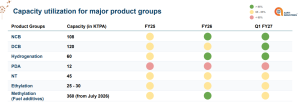
The economic advantage is straightforward: selling an intermediate creates one revenue event; converting that intermediate into a downstream speciality product creates another opportunity to earn on processing, product differentiation and customer qualification.
However, Aarti does not disclose EBITDA margins for each individual processing stage, so assigning a precise rupee margin benefit to vertical integration would create false precision.
There is nevertheless a hard number for the overall opportunity: management expects ₹350-550 crore of EBITDA from volume and margin ramp-up over its FY25-FY28 plan.
That makes integration valuable not because every downstream product automatically carries a higher margin, but because it gives Aarti more choices over where in the value chain it wants to compete and where it can potentially earn the better spread.
Why Higher Raw Material Prices Can Actually Increase Revenue?
Aarti’s revenue growth can sometimes look stronger than its underlying volume growth because its selling prices can move with raw-material prices.
That distinction became particularly important in Q1 FY27. Revenue reached ₹2,627 crore, up 41% year-on-year, but management said the increase was primarily driven by higher input prices being passed through to customers.
This means a higher revenue number does not necessarily mean Aarti sold proportionately more chemicals.
The more important measure is the spread between input costs and selling realisations.
Q1 FY27 demonstrated this clearly. Sequential volumes fell, with Energy down 17% and Non-Energy down 7%, yet consolidated EBITDA increased 79% year-on-year to ₹385 crore. Management attributed the improvement to product-mix optimisation, low-cost inventory monetisation, improved realisations in select products and FX gains.
This is why analysing Aarti purely through revenue growth can be misleading.
Aarti makes money when it can pass through input inflation, protect its spread and direct production toward products and markets offering better economics.
Revenue tells us how much chemical value passed through the company. EBITDA tells us how much of that value Aarti actually retained
Customer Diversification Gives The Model Another Layer Of Resilience
Aarti’s diversification is not just about having several products. It also has several markets in which to sell them.
The company serves 1,100+ domestic and global customers and exports to 60 countries.
Its products reach energy, agrochemicals, pharmaceuticals, polymers, dyes and other applications. That matters because these industries do not necessarily experience their downturns at the same time.
Q1 FY27 provided a practical demonstration. The West Asia conflict disrupted Energy exports and reduced the region’s contribution sharply. Instead of allowing the disruption to fully translate into lost sales, Aarti redirected volumes to other international markets.
This makes geographic flexibility part of the earnings model.
It also explains why long-term customer relationships matter. A chemical producer with qualified products and established relationships has more options when one geography becomes temporarily unattractive.
The benefit is not that diversification eliminates volatility. It does not. Q1 volumes still declined sequentially.
Its value is that diversification can reduce the earnings impact of a shock in any one market and give Aarti more flexibility in placing available production.
The Other Profit Lever: Making Existing Plants Earn More
Aarti does not need every rupee of EBITDA growth to come from new factories. A significant part of its stated opportunity comes from making existing operations more efficient.
For FY25-FY28, management has identified ₹150-200 crore of EBITDA potential from cost optimisation. The initiatives include yield improvement, energy efficiency, waste-energy utilisation, fixed-cost optimisation and improvements in cogeneration. Aarti also said 70% of identified cost-saving ideas had been implemented and were generating value by Q1 FY27.
This matters because speciality chemicals are manufacturing-intensive businesses. A plant’s fixed costs do not necessarily rise in proportion to every additional tonne produced. Improving yield or energy consumption can therefore increase the amount of saleable product generated from the same asset base.
There is another benefit: cost savings can protect margins when selling prices are under pressure.
This makes operational efficiency a different kind of growth from capacity expansion. New plants increase the potential revenue pool; better yields and lower conversion costs can increase the profit captured from the existing pool.
For investors, that distinction matters. Aarti’s earnings growth does not depend solely on selling more chemicals. It also depends on how efficiently the company converts raw materials, energy and installed capacity into EBITDA.
New Projects Are Designed To Create The Next Revenue Pools
Aarti’s next growth phase is built around converting its chemistry capabilities into new products and applications.
Zone IV at Jhagadia contains multiple chemistry blocks, including the Multipurpose Plant and other projects aimed at agrochemical, pharmaceutical, coatings and polymer applications. The projects are being commissioned in phases during FY27, with ramp-up expected across FY28 and FY29.
There are other growth avenues too:
- DCB debottlenecking is being pursued toward 140 KTPA.
- PEDA is moving through market seeding.
- Augene, the 50:50 JV with UPL, is targeted for commercialisation in FY27.
- Aarti Circularity is developing chemical recycling of hard-to-recycle plastics.
The important point is that these projects are not simply additions to a capacity spreadsheet.
Aarti is attempting to create new revenue pools around its existing chemistry, manufacturing and customer capabilities.
But the economic benefit arrives only after commissioning, customer qualification, utilisation and margin ramp-up. That makes the next two years less about announcing projects and more about proving that those projects can earn. Check our latest video for more details.
The ₹1,172-Crore Question: What Has To Happen To Reach ₹1800-2200 Crore?
Aarti ended FY26 with ₹1,172 crore of EBITDA and is targeting ₹1,800-2,200 crore by FY28.
The arithmetic first:
- Lower end: ₹1,800 crore - ₹1,172 crore = ₹628 crore incremental EBITDA
- Upper end: ₹2,200 crore - ₹1,172 crore = ₹1,028 crore incremental EBITDA
Management’s stated three-year growth framework is:
| EBITDA Driver | Management Opportunity |
| Cost Optimisation | ₹150-200 crore |
| Volume | ₹350-550 crore |
| CAPEX-led growth | ₹300-450 crore |
| Total | ₹800-1200 crore |
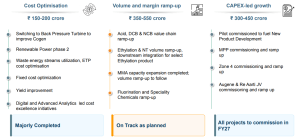
On paper, that opportunity is larger than the ₹628 crore required to reach the lower end of the target.
But it should not be treated as a guaranteed mathematical bridge. The buckets can overlap, and actual EBITDA will depend on utilisation, pricing, spreads, project timing and customer demand.
The central execution challenge is therefore simple: Aarti must convert its planned capacity and efficiency improvements into sustainable incremental EBITDA, not merely incremental production.
What Could Prevent Aarti From Reaching the Target?
The biggest risks to the FY28 EBITDA ambition are not necessarily a lack of capacity. They are utilisation, margins and execution.
- Capacity may arrive before demand.
New assets only create EBITDA after customers absorb the output at viable prices. A weak demand environment could leave additional capacity underutilised.
- Spreads can compress.
Aarti’s Q1 FY27 revenue growth was heavily influenced by raw-material price pass-through, while sequential volumes declined. If selling prices fall faster than input costs, revenue can remain large while EBITDA weakens.
- Projects can be delayed.
Zone IV projects have faced delays from labour constraints and war-related issues. Every delay pushes the contribution from new assets further out.
- Growth consumes working capital.
Q1 FY27 working capital increased because of higher feedstock prices and exports, contributing to higher debt and finance costs.
There is therefore a crucial difference between building capacity and monetising capacity.
For Aarti to reach ₹1,800-2,200 crore, the new assets must come online on time, customer demand must materialise and the resulting volumes must earn adequate spreads.
The Four Numbers That Will Tell the Aarti Story
Aarti’s investment story is now moving from capacity creation to capacity monetisation. The company has already built a sizeable manufacturing platform; the next test is how efficiently that platform generates sustainable EBITDA.
Investors should track four numbers:
- EBITDA margin
This shows whether revenue growth is actually translating into better profitability rather than merely reflecting higher input prices.
- Capacity utilisation
The ramp-up of the 360 KTPA fuel-additive capacity, DCB expansion and Zone IV assets will show whether capital expenditure is turning into productive earnings capacity.
- Volume growth versus realisation growth
This separates genuine demand-led expansion from growth caused by raw-material price pass-through.
- Debt and working capital
Growth funded by increasingly large inventories or debt can weaken cash economics even when revenue and EBITDA are rising. Q1 FY27 already saw working-capital pressure from higher input prices and exports.
The bigger test is whether these indicators improve together.
If utilisation rises, volumes grow, margins hold and leverage remains controlled, the FY28 EBITDA target becomes increasingly credible.
If revenue rises without those improvements, Aarti could look much bigger without becoming proportionately more profitable.
That is the real economics of Aarti Industries: the company has already built the chemical platform. The next phase is proving how much sustainable EBITDA that platform can produce.
Conclusion
Aarti Industries’ next phase is not primarily a story of adding more products. It is a story of turning its existing chemistry platform and new capacity into higher, sustainable earnings.
The company has several levers working in its favour: a larger Energy business, downstream integration, cost optimisation, new capacity and new applications. But the FY28 EBITDA target of ₹1,800-2,200 crore ultimately depends on whether these investments translate into profitable volumes and protected spreads.
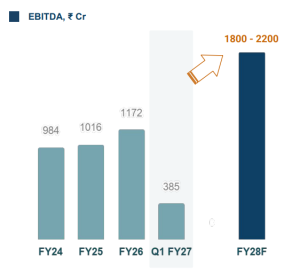
That makes the distinction between capacity and utilisation critical. Aarti can build plants, but shareholder value will depend on how effectively those plants generate EBITDA and cash.
For investors, the next phase should therefore be judged less by announcements and more by execution: rising utilisation, healthy margins, genuine volume growth and disciplined leverage.
If those four pieces fall into place, the jump from ₹1,172 crore of FY26 EBITDA to the FY28 target has a credible operational pathway. If they do not, higher revenue alone will not be enough.