Godrej Properties: How the Premium Segment Beats Real Estate Slowdowns?
Every time India's real estate market slows down, investors tend to make the same assumption: every developer will struggle.
But if that were true, developers wouldn't continue launching and selling ₹5 crore, ₹10 crore, or even ₹20 crore apartments during periods when affordable housing demand is weakening.
That raises a far more interesting question than whether luxury housing is expensive.
Why does premium housing often follow a completely different economic cycle?
The answer isn't just important for understanding India's real estate market. It also explains why Godrej Properties has steadily shifted its project pipeline toward premium housing across India's largest cities.
If management is allocating more capital to luxury projects, investors should understand what they see that the market may be overlooking.
Premium Housing Doesn't Follow the Normal Real Estate Cycle
Most people think the housing market moves as one. In reality, India has multiple housing markets operating simultaneously.
A slowdown affecting ₹50 lakh apartments doesn't necessarily impact ₹5 crore luxury homes because the buyers themselves are completely different.
| Affordable Housing | Premium Housing |
| Salaried families | Business owners |
| First-time buyers | Existing homeowners |
| High dependence on loans | Larger self-funded component |
| EMI sensitive | Wealth sensitive |
| Purchase for necessity | Purchase for lifestyle and wealth |
This distinction is more than a demographic difference - it changes how a real estate company performs through an economic cycle. Developers focused on first-time homebuyers often experience sharper swings in bookings because affordability deteriorates quickly when borrowing costs rise.
Developers with greater exposure to premium housing, however, are serving customers whose purchasing decisions depend more on wealth creation than monthly EMIs.
This is one reason Godrej Properties has gradually increased its presence in premium micro-markets such as Mumbai, Bengaluru and Delhi NCR.

The company is increasingly targeting the customer segment whose buying decisions depend more on wealth creation than interest-rate movements.
These two customer groups react differently to economic conditions. That's why premium housing often behaves almost like a separate market.
To understand why premium housing often outperforms during market slowdowns, we need to examine the key factors that shape demand in this segment.
Premium Buyers Don't Depend Entirely on Home Loans
This is probably the biggest reason premium housing remains resilient. For a middle-income family, buying a home is largely an EMI decision.
Even a small increase in interest rates can significantly increase monthly payments, forcing many buyers to postpone purchases.
Luxury buyers operate differently. Many luxury buyers already own multiple properties and that's the reason why they fund their purchases through - Business income, Existing investments, Capital gains, Sale of older properties and Higher upfront down payments.
Since debt forms a smaller part of the transaction, higher interest rates don't hurt purchasing decisions as much.
Think of it like this
Imagine two people buying a ₹1 crore asset. One needs an 85% loan and on the other hand the other one only needs a loan of 20%.
If interest rates rise by 1%, whose buying decision changes more?
Obviously the first buyer who is having a loan of 85% and that's exactly what happens in premium housing.
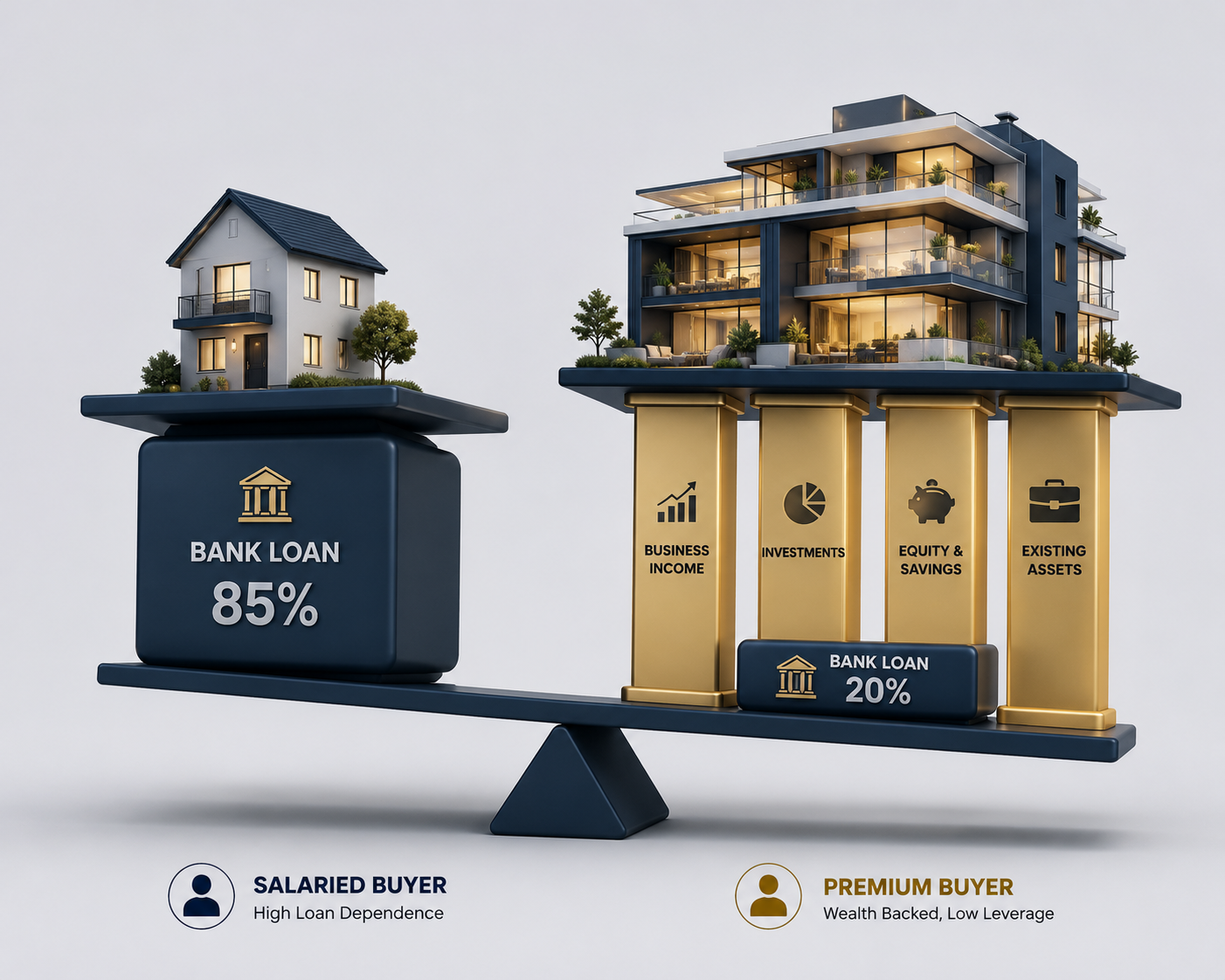
The more interesting observation is that premium housing demand isn't primarily driven by affordability - it is driven by wealth accumulation.
A family buying its first apartment evaluates whether it can afford the monthly EMI.
A wealthy entrepreneur buying a ₹7 crore apartment often evaluates whether allocating capital to real estate makes more sense than leaving it entirely in financial assets.
Those are fundamentally different investment decisions.
Wealth Creation Often Continues Even During Slowdowns
An economic slowdown doesn't destroy wealth equally across society. While discretionary consumption may weaken, entrepreneurs, listed-company promoters, investors and professionals linked to fast-growing industries can continue creating substantial wealth.
In fact, luxury housing demand is often influenced more by the pace of wealth creation than by GDP growth itself. This leads to an important insight that many investors overlook: premium housing is often cyclical to wealth creation rather than employment.
When financial assets appreciate and businesses generate capital, a portion of that wealth frequently finds its way into premium real estate.
That creates a demand cycle which can look very different from the broader housing market.
Luxury Homes Face Limited Supply
Demand is only one side of the equation. The other is supply.
One of the biggest reasons premium housings remain resilient is that developers simply cannot build luxury projects wherever they want.
Unlike affordable housing, where large land parcels are available on city outskirts, premium developments require highly desirable locations. Buyers paying several crores are not just purchasing a home - they are purchasing an address.
This limits new supply to a handful of micro-markets, such as:
- South Mumbai
- South Delhi
- Golf Course Road, Gurugram
- Central Bengaluru
- Prime locations in Hyderabad

The challenge is that land in these areas is extremely scarce. Most prime plots have already been developed, while the few available parcels attract intense competition from multiple developers.
As a result, even if demand slows temporarily, developers cannot suddenly flood the market with new luxury projects. The supply pipeline remains naturally constrained.
This is very different from affordable housing, where developers can launch similar projects across numerous suburban locations where land is more easily available. If demand rises, supply can also increase relatively quickly.
Premium housing doesn't have that flexibility.
Since supply grows slowly while affluent buyers continue entering the market, demand and supply remain better balanced. This helps premium property prices remain more stable during downturns and often allows them to recover faster when market sentiment improves.
This supply constraint is one reason leading developers continue launching projects in the same premium micro-markets despite higher land acquisition costs.
For Godrej, securing land in these locations creates a competitive advantage because replicating that project later becomes increasingly difficult as prime land parcels disappear.
Premium Buyers Think Long-Term
Premium buyers usually evaluate a property very differently from first-time homebuyers.
Their primary question is rarely whether they need another house. Instead, they ask whether the property will remain desirable ten or twenty years from now.
They are effectively buying a scarce location, a trusted developer and long-term pricing power rather than simply purchasing additional living space.
This explains why premium buyers are often willing to postpone purchases until the right project becomes available instead of compromising on quality or location.

Premium buyers, however, approach real estate from a completely different perspective. Instead of focusing only on today's needs, they evaluate whether the property will remain valuable over the next 10 - 20 years. Their decision is influenced by factors such as:
- Prime location with limited future supply
- The developer's brand and execution track record
- An exclusive community and better lifestyle
- Wealth preservation
- Long-term capital appreciation
For these buyers, purchasing a luxury home is often as much an investment decision as it is a lifestyle decision.
As a result, temporary economic uncertainty rarely causes them to abandon their plans altogether. Instead, many simply postpone the purchase until they find the right project from a trusted developer.
This is why established brands like Godrej Properties often continue attracting premium buyers even during slower phases of the real estate cycle. When investing several crores, buyers are generally more willing to wait for a reputable developer than compromise on quality or location.
Brand Trust Becomes More Valuable During Slowdowns
During a booming real estate market, buyers often have plenty of options and may even be willing to take a chance on a lesser-known developer if the pricing is attractive.
However, the situation changes when the market slows down.
In periods of uncertainty, purchasing decisions are no longer driven by discounts alone. Buyers begin prioritizing certainty over cost and prefer developers with a proven track record.
Some of the key factors they look for include:
- Timely project delivery
- Strong financial position
- High construction quality
- Transparent business practices
- A history of delivering what was promised
Why Trust Matters More in Premium Housing
For someone investing several crores in a luxury home, execution risk can be just as important as the property itself.
A project delayed by even one or two years can:
- Lock up a significant amount of capital
- Delay possession and rental income
- Increase uncertainty around the investment
- Affect the buyer's overall financial planning
As a result, many premium buyers are willing to pay a premium for a developer they trust rather than save money with an unproven builder.
Why This Strategy Works Specifically for Godrej Properties
Understanding why premium housing is resilient is only half the story. The more important question for investors is: How does Godrej Properties benefit from this trend?
Over the past few years, the company has increasingly focused on launching projects in premium micro-markets across India's largest cities. This strategy offers several long-term advantages.

Key Benefits of the Premium Strategy
- Higher realization per square foot, leading to stronger revenue from each project.
- Better operating margins, as premium projects generally command higher pricing.
- Stronger pricing power, with less pressure to offer discounts.
- Lower dependence on affordable housing demand, which is more sensitive to interest rates and economic slowdowns.
- Attracts affluent buyers, who are typically more financially resilient.
- Strengthens the Godrej brand in the luxury housing segment.
Instead of selling thousands of lower-priced apartments, Godrej Properties can generate significant booking value from a relatively smaller number of premium units. Over time, this improves capital efficiency and supports stronger profitability.
Whether you're a long-term investor or someone who prefers short-term opportunities, understanding different investing styles can improve your overall returns. If swing trading interests you, here is my video you can watch it.
Final Verdict
The future winners in Indian real estate may not be the companies that sell the largest number of homes.
Instead, they could be the developers that control the most desirable locations, command the strongest pricing power and consistently attract India's growing affluent population.
Godrej Properties appears to be positioning itself for exactly that outcome. By steadily increasing its exposure to premium housing across multiple metropolitan markets, the company is not simply chasing higher selling prices - it is attempting to build a business with stronger margins, healthier cash flows and better returns on capital.
If India's wealthy population continues expanding faster than the supply of prime residential projects, premium housing could become a structural competitive advantage rather than just another segment of the market.
Perhaps the biggest insight is this: affordable housing depends largely on monthly income, while premium housing depends on accumulated wealth.
Those may sound similar, but they are powered by entirely different economic engines. Investors who understand this distinction are likely to understand why companies like Godrej Properties are reshaping their strategy long before the financial statements fully reflect the change.