Complete Guide to Debt Mutual Funds in India – All Different Types Explained
When people hear the word mutual fund, they often think only of equity funds. However, not every investment needs to take high risks. Sometimes, your goal is simply to keep your money safe, earn a reasonable return, and have it available when you need it. This is where debt mutual funds come into the picture.
Debt mutual funds invest in fixed-income securities such as Treasury Bills (T-Bills), Government Securities (G-Secs), Commercial Papers (CPs), Certificates of Deposit (CDs), Corporate Bonds, and Repo instruments. Instead of buying shares of companies, these funds lend money to governments, banks, financial institutions, or companies, which pay interest in return.
Unlike equity funds, the biggest difference between debt funds is how long the underlying securities take to mature. Some funds invest in securities that mature in just one day, while others invest in government bonds that can mature after several months.
As a result, each debt fund category serves a different purpose. Some are ideal for parking money for a few days, while others are better suited for investors with longer investment horizons.
In this guide, we'll explore the six most popular debt fund categories - Overnight Funds, Liquid Funds, Money Market Funds, Ultra Short Duration Funds, Arbitrage Funds, and Gilt Funds - to help you understand where each one fits in your investment journey.
1) Overnight Funds
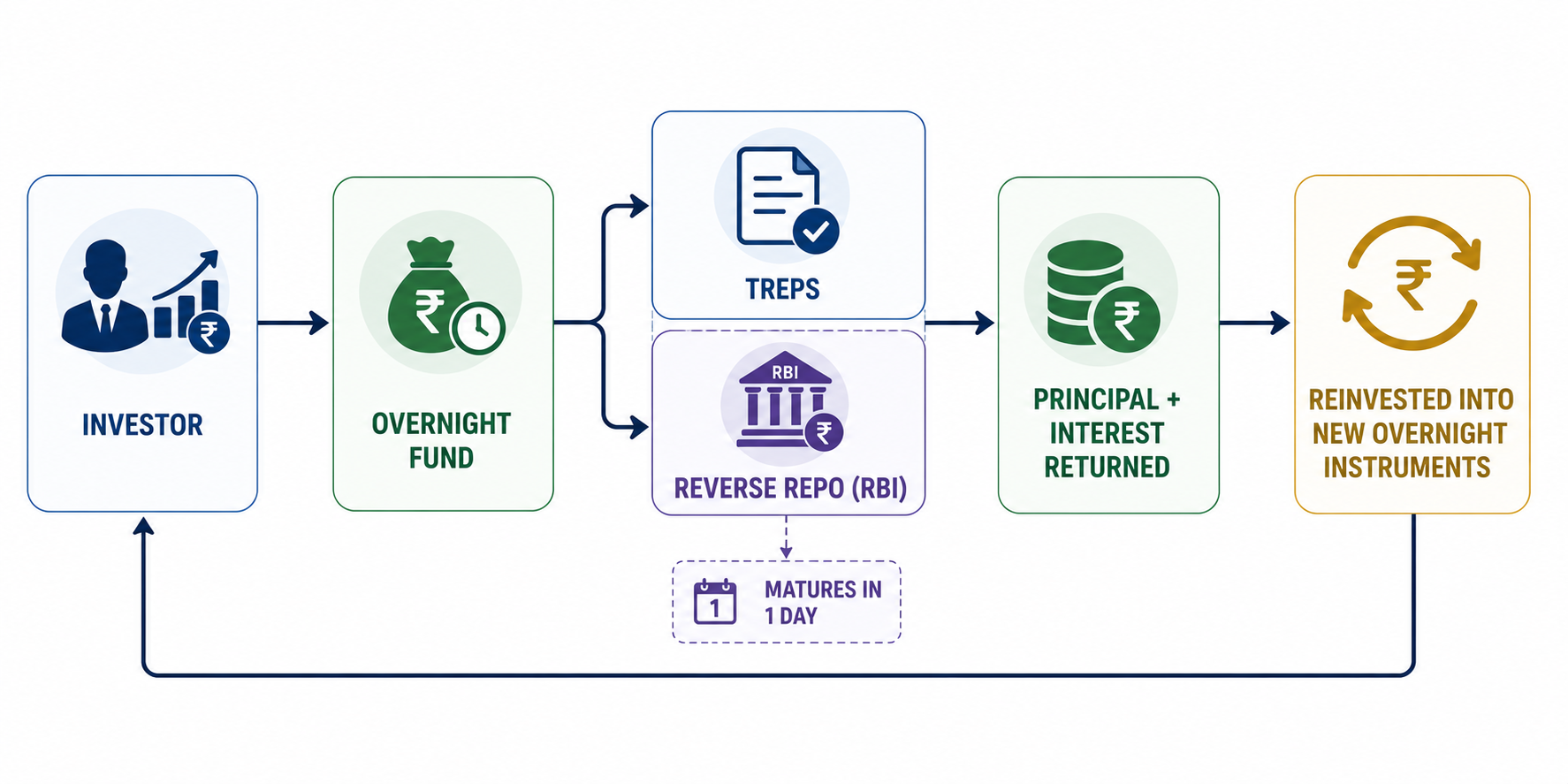
As the name suggests, Overnight Funds invest only in debt securities that mature in one business day. This means the money invested by the fund is repaid the very next day and is then reinvested into new one-day securities.
Since the portfolio is renewed every day, these funds have the shortest maturity among all debt mutual funds. This significantly reduces the impact of interest rate movements and credit-related risks, making Overnight Funds one of the safest mutual fund categories.
They are primarily designed for investors who want to park their money for a very short period without taking unnecessary risk.
Where Do Overnight Funds Invest?
Overnight Funds invest only in overnight money market instruments, such as:
- TREPS (Triparty Repo): A secured lending arrangement backed by government securities, where one party borrows money overnight by providing government securities as collateral.
- Reverse Repo: A transaction where the fund lends money to the Reserve Bank of India (RBI) for one day and earns a small amount of interest in return.
Since these instruments mature within one day and are backed by highly creditworthy counterparties, they carry minimal credit and default risk.
Investment Horizon
Ideal Investment Duration: 1 day to 1 week
Overnight Funds are specifically designed for very short-term parking of money. Since the underlying securities mature every business day, these funds are most suitable when you need a safe place to temporarily hold your cash without exposing it to significant market risk.
Risk & Return
Since the underlying securities mature every day:
- Interest rate risk is almost negligible.
- Credit risk is extremely low.
- Returns are generally modest but stable, reflecting prevailing short-term interest rates.
These funds focus on capital preservation and liquidity rather than generating high returns.
Who Should Invest?
Overnight Funds may be suitable for:
- Investors parking surplus cash for a few days.
- Individuals building an emergency fund.
- Investors waiting to deploy money into equity or other investments.
- Businesses managing temporary cash balances.
Don't choose this if:
You are investing for months or years and looking for meaningful return generation. Overnight Funds are only for temporary cash parking.
Investor Insight:
Overnight Funds are not meant for wealth creation; they are meant for capital protection and liquidity. For money needed within days, safety matters more than chasing extra returns.
2) Liquid Funds
Liquid Funds take slightly more maturity exposure compared to Overnight Funds, allowing them to generate slightly better return potential.
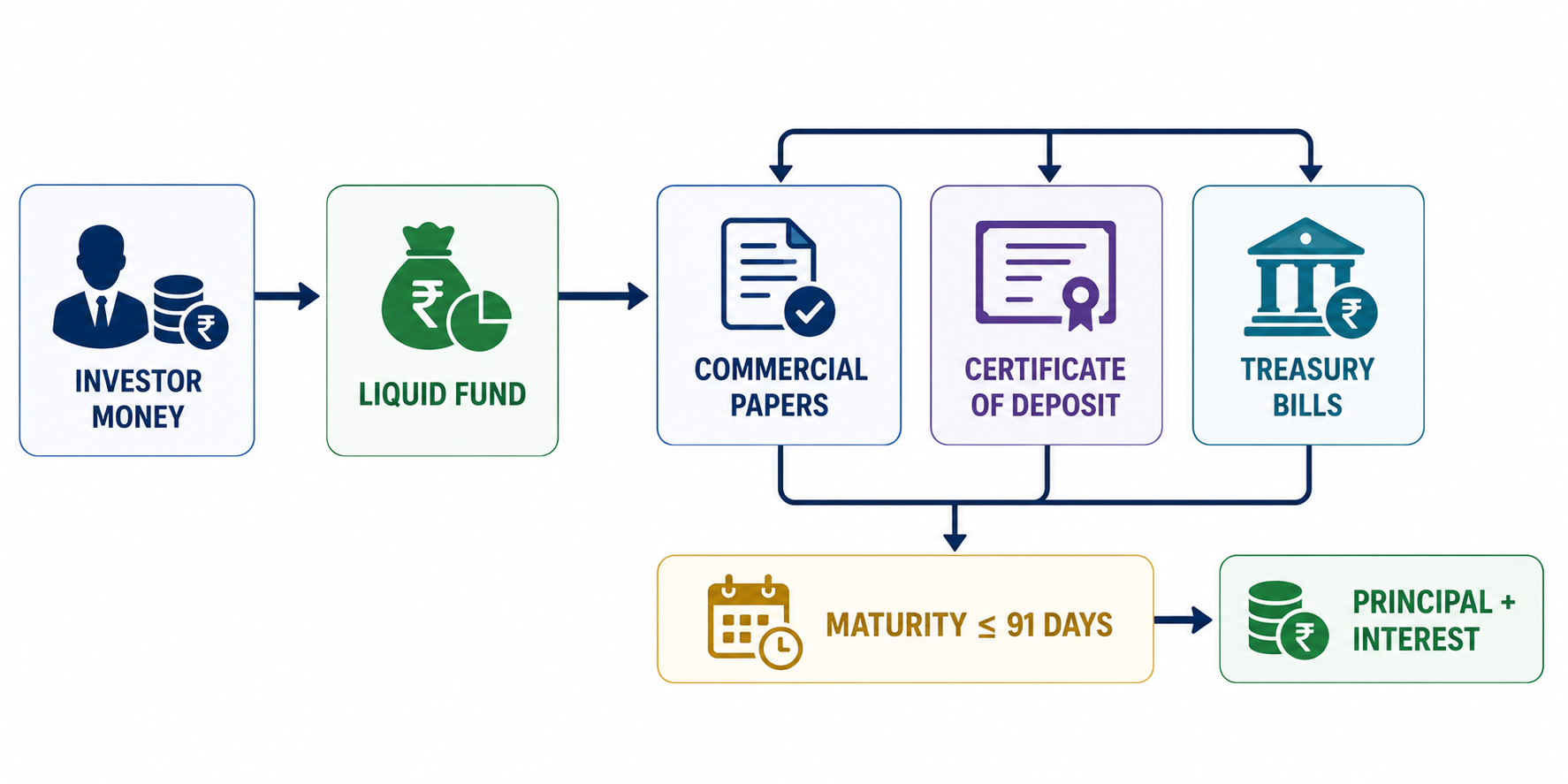
Liquid Funds are a category of debt mutual funds that invest in short-term money market instruments with a maturity of up to 91 days.
They are designed for investors who want to park their money for a few weeks or months while maintaining high liquidity and relatively low risk.
Compared to Overnight Funds, Liquid Funds invest in securities with a slightly longer maturity. This allows them to potentially generate marginally higher returns, but it also introduces a small increase in interest rate and credit risk.
In simple terms:
Overnight Funds → Money needed in days
Liquid Funds → Money needed in weeks or months
Where Do Liquid Funds Invest?
Liquid Funds primarily invest in high-quality short-term debt instruments such as:
- Commercial Papers (CPs)
Commercial Papers are short-term unsecured debt instruments issued by companies to raise funds for working capital and other short-term requirements.
For example, a large company may issue Commercial Papers to borrow money for a few months instead of taking a traditional bank loan.
- Certificates of Deposit (CDs)
Certificates of Deposit are short-term instruments issued by banks and financial institutions to raise funds.
They work similarly to fixed deposits but are issued in a marketable format and are usually purchased by institutional investors and mutual funds.
- Treasury Bills (T-Bills)
Treasury Bills are short-term government securities issued by the Government of India to meet temporary funding requirements.
Since they are backed by the government, they carry minimal credit risk.
Investment Horizon
Ideal Investment Duration: 1 week to 3 months
Liquid Funds are suitable for investors who want to park money for a short period while keeping it easily accessible.
You may consider Liquid Funds if you:
- Have money that you will need within the next few weeks or months.
- Want an alternative to keeping excess cash in a savings account.
- Are waiting before making a major investment decision.
- Need a temporary parking option for upcoming expenses.
For example, if you have saved money for a house down payment, education fees, or a planned purchase that is due after two or three months, a Liquid Fund can help your money earn returns while remaining relatively accessible.
However, Liquid Funds may not be ideal for investors with a horizon of several years. For longer durations, other debt fund categories may provide better return potential by taking slightly higher duration exposure.
Risk & Return
Liquid Funds are considered one of the lower-risk debt fund categories because:
- The maturity of investments is limited to 91 days.
- They primarily invest in high-quality instruments.
- They have limited sensitivity to interest rate changes.
However, they are not completely risk-free.
Potential risks include:
- Credit Risk: The possibility that an issuer may fail to repay.
- Market Risk: Small fluctuations due to changes in interest rates.
Returns are generally higher than Overnight Funds but lower than longer-duration debt funds.
Who Should Invest?
Liquid Funds may be suitable for:
- Conservative investors with short-term goals.
- Investors looking for temporary cash parking.
- People building an emergency fund.
- Investors waiting for the right opportunity to deploy money.
Don't choose this if:
You don't need the money for several years and are looking for higher wealth creation. Liquid Funds are designed for short-term needs, not long-term growth.
Investor Insight:
Liquid Funds are useful for managing idle cash efficiently.
The goal is not high returns but keeping money accessible while earning a better return than leaving it unused.
3) Money Market Funds
Both liquid and money market funds invest in similar money market instruments, but Money Market Funds invest for a longer duration (up to 1 year).
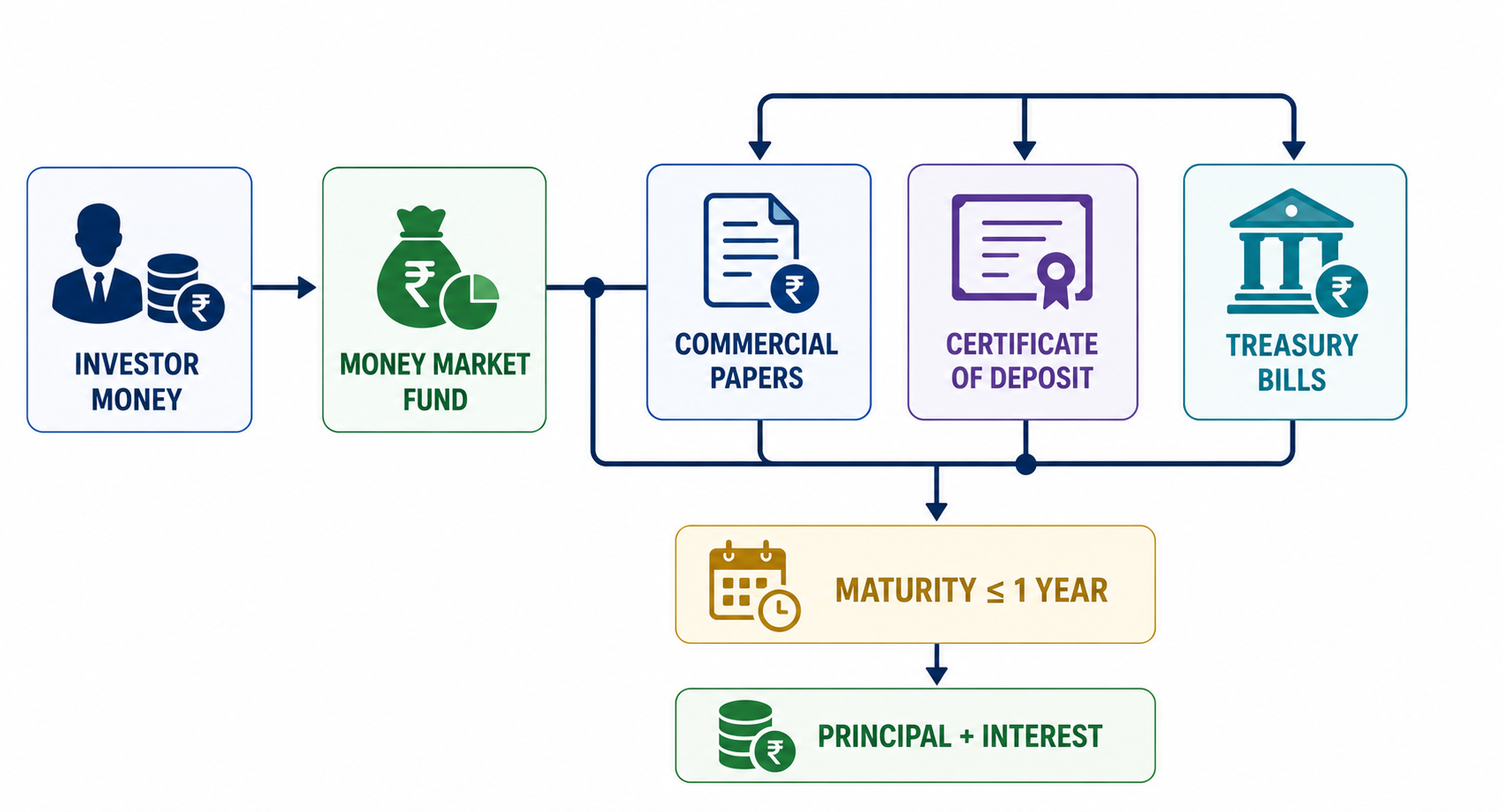
Money Market Funds are a category of debt mutual funds that invest in money market instruments with a maturity of up to 1 year.
They are designed for investors who have a slightly longer investment horizon compared to Liquid Funds and want to earn potentially better returns by taking slightly higher maturity exposure.
In simple terms:
Overnight Funds → Money needed for a few days
Liquid Funds → Money needed for a few weeks to months
Money Market Funds → Money needed for around 6–12 months
If Liquid Funds and Money Market Funds Invest in the Same Assets, How Are They Different?
This is one of the most common questions among investors.
Both Liquid Funds and Money Market Funds invest in similar instruments such as:
- Commercial Papers (CPs)
- Certificates of Deposit (CDs)
- Treasury Bills (T-Bills)
So, what makes them different?
The answer is the maturity period of the securities they hold.
A fund manager can choose different maturity securities within the same asset class. For example:
- A Liquid Fund may invest in a Commercial Paper that matures in 30–60 days.
- A Money Market Fund may invest in a similar Commercial Paper that matures closer to 6–12 months.
Although the investment instruments are similar, the time until repayment changes the risk and return profile.
A shorter maturity means:
- Money comes back faster.
- Lower impact from interest rate changes.
- Lower return potential.
A longer maturity means:
- Money remains invested for a longer period.
- Slightly higher sensitivity to interest rate movements.
- Potentially better return potential.
Therefore, the difference between Liquid Funds and Money Market Funds is not what they buy, but how long they invest in those securities.
Investment Horizon
Ideal Investment Duration: 6 months to 12 months
Money Market Funds are suitable for investors who have a short-term goal but do not need immediate access to their money.
You may consider Money Market Funds if you:
- Need money after 6–12 months.
- Are saving for a planned expense.
- Want an alternative to keeping excess cash idle.
- Prefer stability over equity market volatility.
For example, if you need ₹5,000 after 9 months for a planned expense, a Money Market Fund may allow your money to earn returns while keeping the risk relatively controlled.
However:
- If you need money within a few weeks → Liquid Funds may be more suitable.
- If you need money for several years → Longer-duration debt funds may be considered.
Risk & Return
Money Market Funds are relatively low-risk debt funds, but they are not completely risk-free.
The main risks include:
Interest Rate Risk
Since Money Market Funds hold securities with longer maturity compared to Liquid Funds, changes in interest rates can have a slightly larger impact on their NAV.
Credit Risk
If any issuer of a debt security faces financial difficulties, it can impact the fund's performance.
Compared to Liquid Funds, Money Market Funds generally offer:
- Slightly higher return potential
- Slightly higher interest rate risk
- Slightly higher NAV movement
Who Should Invest?
Money Market Funds may be suitable for:
- Conservative investors with a 6–12 month investment horizon.
- Investors planning short-term financial goals.
- Investors who want better return potential than Liquid Funds without entering equity markets.
Don't choose this if:
You need your money within days or weeks. The additional maturity exposure only makes sense when you can stay invested for several months.
Investor Insight:
The difference between Liquid and Money Market Funds is mainly duration, not investment instruments.
By accepting slightly longer maturity, investors aim for slightly better return potential.
4) Ultra Short Duration Funds
Ultra Short Duration Funds can invest beyond money market instruments and include short-term bonds.
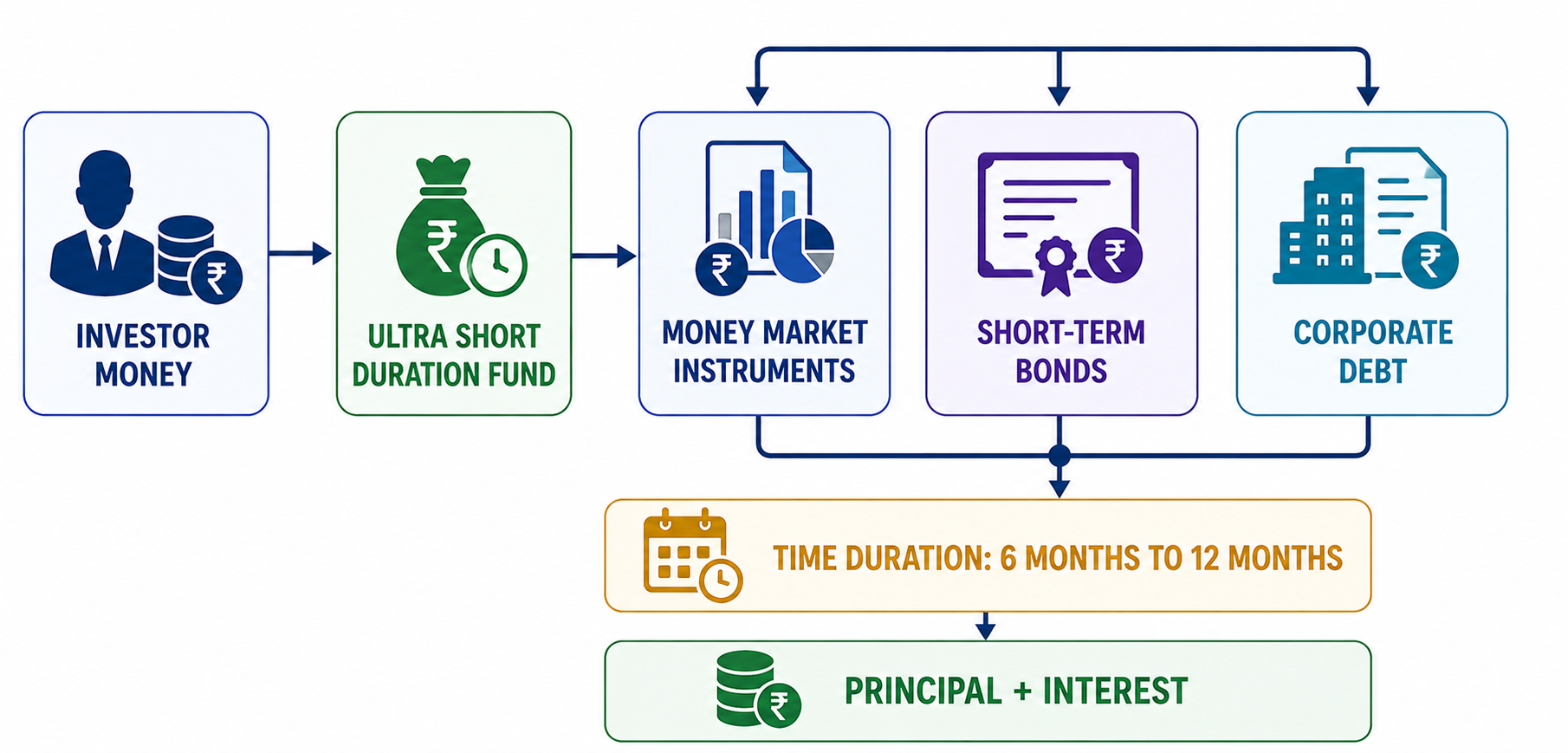
Ultra Short Duration Funds are a category of debt mutual funds that invest in a portfolio of short-term debt and money market instruments.
In simple terms, they invest for a slightly longer period compared to Liquid Funds and Money Market Funds, allowing them to earn potentially higher returns by taking slightly more duration exposure.
The objective of these funds is to provide a balance between:
- Better return potential than very short-term debt funds.
- Lower volatility compared to longer-duration debt funds.
How Are Ultra Short Duration Funds Different From Money Market Funds?
At first glance, Ultra Short Duration Funds and Money Market Funds may look similar because both invest in short-term debt instruments.
However, the key difference lies in their portfolio composition and duration.
Money Market Funds primarily focus on instruments with maturity of up to 1 year.
Ultra Short Duration Funds have a slightly broader investment approach and can invest in:
- Money market instruments.
- Short-term corporate bonds.
- Other fixed-income securities.
This allows fund managers more flexibility to generate returns but also introduces slightly higher risk.
In simple terms:
Money Market Funds → Mostly short-term money market instruments
Ultra Short Duration Funds → Money market instruments + short-term bonds
Where Do Ultra Short Duration Funds Invest?
Ultra Short Duration Funds may invest in:
- Commercial Papers (CPs)
- Treasury Bills (T-Bills)
- Certificates of Deposit (CDs)
- Short-term Corporate Bonds
- Other high-quality debt securities
The fund manager selects securities based on factors such as:
- Credit quality of the issuer.
- Interest rate environment.
- Expected returns.
Investment Horizon
Ideal Investment Duration: 6 months to 12 months
Ultra Short Duration Funds are suitable for investors who can keep their money invested for at least a few months and want slightly higher return potential than Liquid or Money Market Funds.
You may consider Ultra Short Duration Funds if you:
- Have a financial goal after 6–12 months.
- Want better return potential than savings accounts or Liquid Funds.
- Can tolerate small fluctuations in the value of your investment.
- Do not want to take equity market risk.
For example, if you are saving for a major expense expected after 8–10 months, an Ultra Short Duration Fund can provide an opportunity to earn returns while keeping the investment relatively stable.
However:
- For money needed within a few weeks → Liquid Funds may be more suitable.
- For investment periods of several years → Longer-duration debt funds may be more appropriate.
Risk & Return
Ultra Short Duration Funds carry slightly higher risk compared to Liquid and Money Market Funds.
The major risks include:
Interest Rate Risk
Since these funds invest in securities with longer duration, changes in interest rates can impact their NAV.
When interest rates fall:
- Bond prices generally rise.
- Debt funds may benefit.
When interest rates rise:
- Bond prices generally fall.
- Debt funds may face short-term volatility.
Credit Risk
Since Ultra Short Duration Funds can invest in corporate bonds, the financial health of issuers becomes an important factor.
A lower-quality issuer may offer higher interest rates but carries greater risk of repayment issues.
Who Should Invest?
Ultra Short Duration Funds may be suitable for:
- Conservative investors with a 6–12 month horizon.
- Investors looking for better returns than Liquid Funds.
- Investors who can accept small NAV fluctuations.
- Investors avoiding equity market volatility.
Don't choose this if:
You cannot tolerate small fluctuations in your investment value. The extra return potential comes with slightly higher duration and credit risk.
Investor Insight:
Higher return potential in debt funds usually comes with slightly higher duration risk.
Ultra Short Duration Funds suit investors looking for a balance between stability and returns.
5) Arbitrage Funds
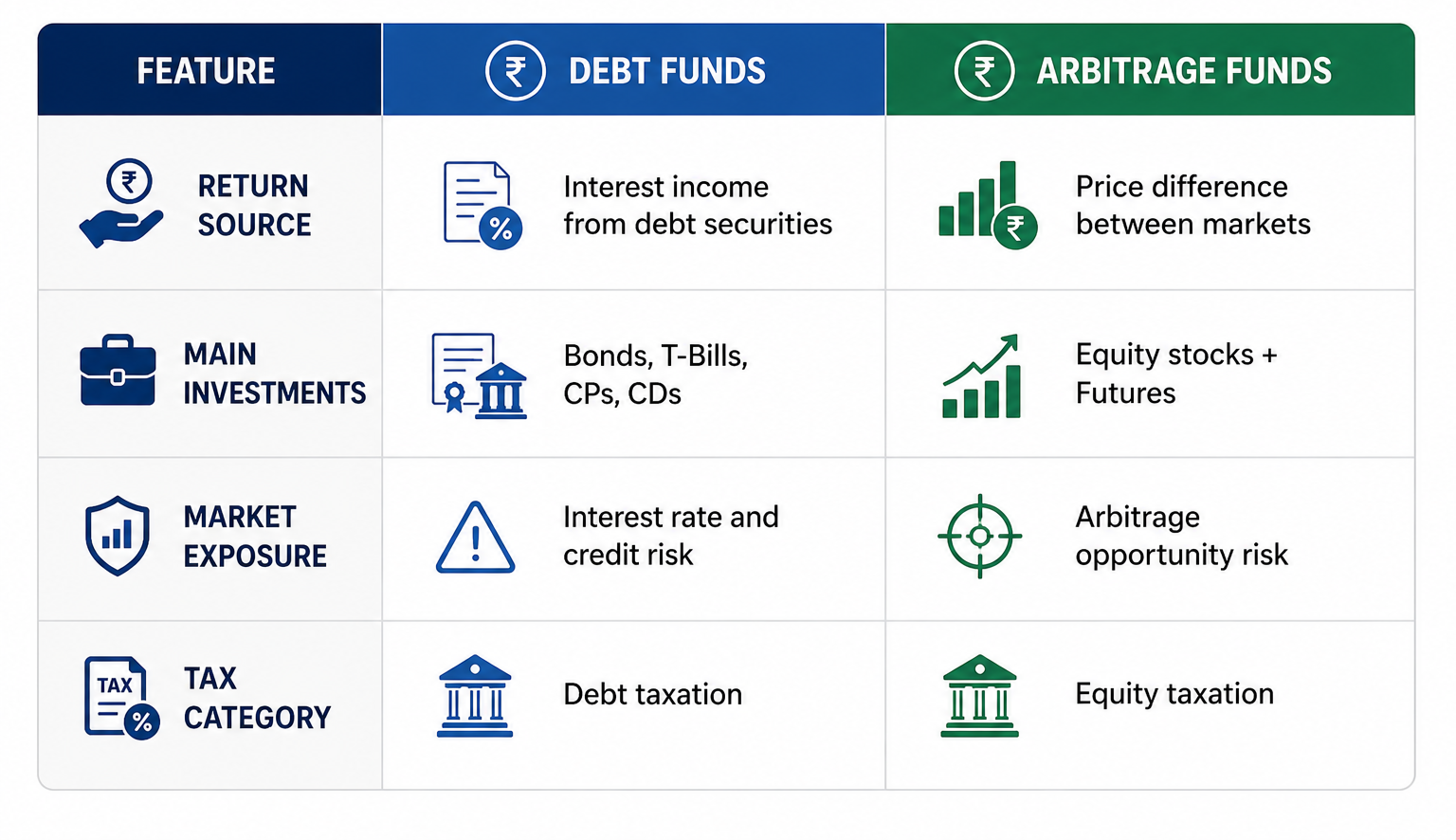
Liquid Funds earn returns through interest income, while Arbitrage Funds generate returns from cash and futures market price differences.
Arbitrage Funds are equity mutual funds that generate returns by taking advantage of price differences of the same asset in different markets.
Unlike debt funds that earn returns through interest income, Arbitrage Funds generate profits by exploiting differences between the cash market and futures market.
In simple terms:
If an asset is available at a lower price in one market and a higher price in another market, an arbitrage fund captures this price difference as profit.
How Do Arbitrage Funds Work?
Arbitrage Funds primarily use the difference between:
- Cash Market: Where stocks are bought and sold immediately.
- Futures Market: Where contracts are made to buy or sell stocks at a future date.
For example:
Stock Price in Cash Market ₹1,000
Stock Price in Futures Market ₹1,020
Difference (Arbitrage Opportunity) ₹20
The fund manager can:
- Buy the stock in the cash market at ₹1,000.
- Sell the same stock in the futures market at ₹1,020.
- When both prices converge, the ₹20 difference becomes the fund's return.
Since the fund has both a buy position and a sell position simultaneously, the impact of market movement is significantly reduced.
How Are Arbitrage Funds Different From Debt Funds?
Investment Horizon
Ideal Investment Duration: 12 months or more
Arbitrage Funds are generally suitable for investors who want to park money for a few months while seeking relatively stable returns.
You may consider Arbitrage Funds if you:
- Have money that you need after 1 year.
- Want a low-volatility alternative to equity funds.
- Are looking for tax-efficient short-term investment options.
- Are comfortable with returns varying based on market conditions.
For example, if you have money that you may need after 12 months and want an alternative to keeping it idle, an Arbitrage Fund can be considered.
However, for extremely short periods like a few days or weeks, Overnight or Liquid Funds may be more suitable.
Taxation Advantage
One of the biggest attractions of Arbitrage Funds is their taxation structure.
Unlike debt mutual funds, Arbitrage Funds are treated as equity mutual funds for taxation purposes.
This means:
- Short-term capital gains (holding period below 12 months) are taxed as per equity fund rules.
- Long-term capital gains (holding period above 12 months) receive equity taxation benefits.
This can make Arbitrage Funds attractive for investors in higher tax brackets compared to traditional debt funds, depending on their investment duration and tax situation.
Who Should Invest?
Arbitrage Funds may be suitable for:
- Investors looking for 1 year parking options.
- Investors seeking equity taxation benefits.
- Conservative investors who want lower volatility than equity funds.
- Investors with a horizon of 12 months or more.
Don't choose this if:
You expect guaranteed returns or need complete certainty. Their performance depends on the availability of arbitrage opportunities in the market.
Investor Insight:
Arbitrage Funds reduce market direction risk but returns are not guaranteed.
They work best as a short-term, tax-efficient parking option when arbitrage opportunities are available.
6. Guilt Funds
Liquid Funds focus on short-term instruments, while Gilt Funds invest in long-term government securities.
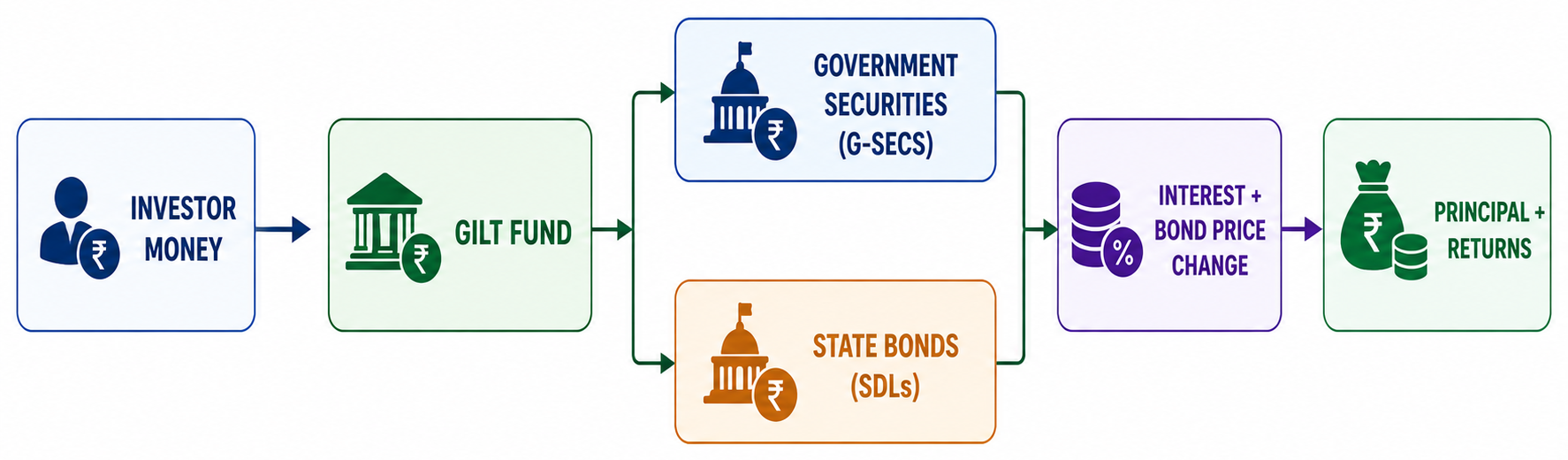
Gilt Funds are a category of debt mutual funds that invest primarily in Government Securities (G-Secs) issued by the Central and State Governments.
Unlike other debt funds that invest in a mix of corporate and money market instruments, Gilt Funds focus on government-backed securities.
Since these securities are backed by the government, they carry very low credit risk. However, they are not risk-free because their returns are highly influenced by changes in interest rates.
In simple terms:
Short-term debt funds → Lower interest rate impact
Gilt Funds → Higher interest rate sensitivity due to long-term bonds
Where Do Gilt Funds Invest?
Gilt Funds invest mainly in:
- Government Securities (G-Secs)
- State Development Loans (SDLs)
These securities are issued by governments to borrow money for various financial requirements.
Since the government is the borrower, the risk of default is considered extremely low.
However, the prices of these securities change depending on the interest rate environment.
Why Are Gilt Funds Different From Other Debt Funds?
The major difference is the type of risk involved.
Most debt funds face two major risks:
- Credit Risk - Risk that the borrower may not repay.
- Interest Rate Risk - Risk that bond prices change due to interest rate movements.
Gilt Funds have:
- Very low credit risk because they invest in government securities.
But they have:
- Higher interest rate risk because they usually invest in longer-duration bonds.
This makes Gilt Funds different from short-term debt funds like Liquid or Money Market Funds.
Investment Horizon
Ideal Investment Duration: 3 years or more
Gilt Funds are generally suitable for investors who can remain invested for a longer period and understand interest rate cycles.
You may consider Gilt Funds if you:
- Have a long-term debt allocation in your portfolio.
- Expect interest rates to decline in the future.
- Want exposure to government securities without directly buying bonds.
- Prefer avoiding corporate credit risk.
For example, if an investor believes interest rates may fall over the next few years, Gilt Funds can potentially benefit as existing government bond prices increase.
However, investors with short-term goals should avoid Gilt Funds because interest rate movements can create significant short-term volatility.
Risk & Return
Gilt Funds have a unique risk profile:
- Credit Risk - Very Low
Since they invest in government securities, the possibility of default is extremely low.
- Interest Rate Risk - Higher
Because Gilt Funds usually invest in long-duration government bonds, changes in interest rates can significantly impact their NAV.
Therefore, Gilt Funds can deliver strong returns during falling interest rate cycles but may underperform when interest rates rise.
Who Should Invest?
Gilt Funds may be suitable for:
- Investors with a long investment horizon.
- Investors who understand interest rate cycles.
- Investors wanting government security exposure.
- Investors looking to diversify their portfolio beyond equity.
Don't choose this if:
You have a short-term goal or cannot handle volatility. Gilt Funds can fluctuate significantly due to interest rate movements despite having low credit risk.
Investor Insight:
Low credit risk does not mean low volatility.
Gilt Funds depend heavily on interest rate movements and work best for investors with a longer horizon.
Investor Example: Choosing the Right Debt Fund
Imagine Rahul has surplus money but different financial goals.
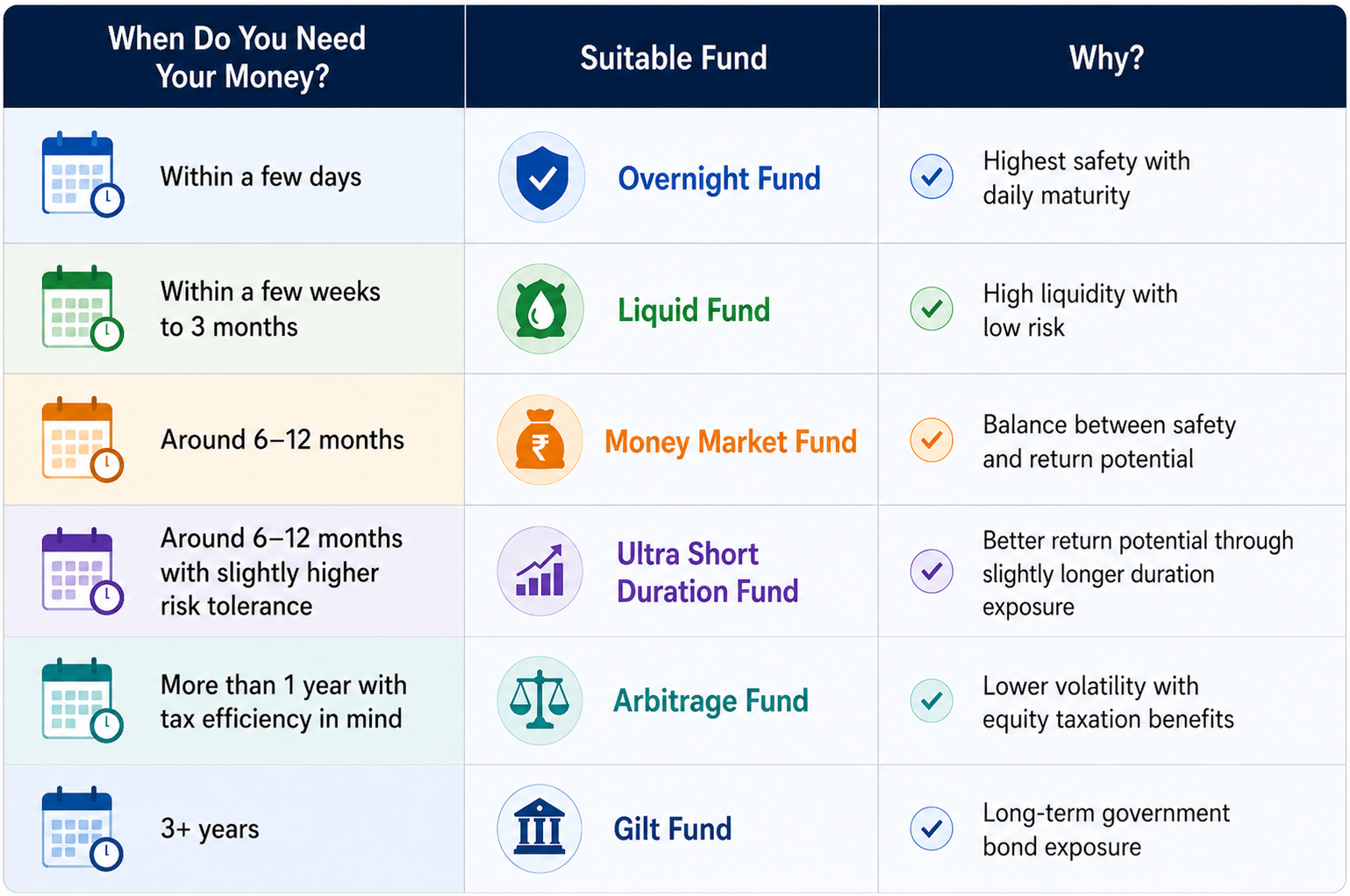
- Need money after a few days → He chooses an Overnight Fund because safety and liquidity are the priority.
- Need money after a few months → He chooses a Liquid Fund to keep his cash accessible while earning returns.
- Need money after 6 - 12 months → He considers Money Market or Ultra Short Duration Funds for slightly better return potential by accepting slightly higher risk.
- 1 year parking with tax efficiency → He considers an Arbitrage Fund, which earns from cash and futures market differences.
- Investing for the long term and expecting falling interest rates → He considers a Gilt Fund for government bond exposure.
Which Debt Fund Should You Choose?
Choosing the right debt fund is not about finding the fund with the highest return. It is about matching the investment duration, risk level, and purpose of your money.
A common mistake investors make is selecting debt funds based only on past returns. However, every debt fund category is designed for a different purpose.
The right question is:
"When will I need this money?"
Your investment horizon should determine the type of debt fund you choose.
Conclusion
Debt funds are not a single investment category; each fund is designed for a different purpose.
Overnight Funds focus on safety and liquidity for very short periods, Liquid Funds help manage short-term cash, Money Market and Ultra Short Duration Funds provide a balance between stability and return potential, Arbitrage Funds offer a different strategy with tax advantages, while Gilt Funds provide exposure to government securities and interest rate cycles.
The biggest mistake investors make is choosing a debt fund based only on returns. The right choice depends on when you need the money and how much risk you can accept.
The Debt Fund Principle:
"Your investment horizon should decide your fund, not your return expectations."
Short-term money needs stability.
Longer-term money can take duration risk.
The best debt fund is not the one that earns the highest return — it is the one that matches your financial goal.