DLF India Growth Drivers for FY27 and FY28
India’s real estate market has entered a new phase where growth is increasingly favouring large, branded developers with strong execution capabilities and healthy balance sheets. Rising demand for premium housing, industry consolidation, and improving buyer confidence have created a more supportive environment than the sector experienced over much of the previous decade.
DLF has been one of the biggest beneficiaries of this shift. The company has strengthened its residential business while simultaneously building a sizeable portfolio of recurring rental assets, giving it a more balanced business model than in previous cycles. As a result, the investment case is gradually evolving from one driven primarily by successful project launches to one centred on execution, cash flow generation, and long-term earnings visibility.
Looking ahead, FY27 and FY28 could mark the next phase of DLF’s growth story. With a robust launch pipeline, expanding annuity business, disciplined capital allocation, and favourable industry trends, the company is well positioned to build on the momentum of recent years. Understanding these structural growth drivers will be key to assessing DLF’s long-term growth potential.

Strong Pipeline Provides Multi-Year Earnings Visibility
DLF enters FY27 and FY28 with one of the strongest growth pipelines in the Indian real estate sector. Rather than depending on one or two flagship projects, the company has built a diversified portfolio of launches across Gurugram, Mumbai, and Goa, providing greater visibility into future bookings, cash flows, and earnings.
Key growth drivers include:
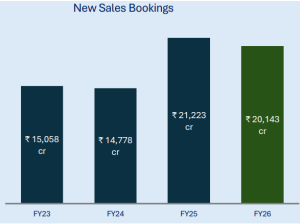
- Record FY26 pre-sales of ₹20,143 crore, creating a strong foundation for future revenue recognition.
- A launch pipeline of nearly 29 million sq. ft., with an estimated sales potential of around ₹74000 crore.
- Flagship projects including The Dahlias, Privana North, Westpark, and multiple upcoming developments across premium markets.
- Strong customer collections supporting construction progress and improving cash flow generation.
- Phased launches allowing DLF to maintain pricing discipline while aligning supply with market demand.
Unlike previous cycles, DLF’s near-term growth is supported not only by future launches but also by the execution of projects that have already been successfully sold. This provides greater earnings visibility while reducing dependence on achieving record bookings every year.
DCCDL Is Emerging As DLF’s Biggest Long-Term Earnings Stabiliser
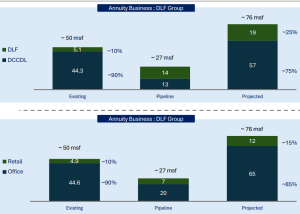
While DLF’s residential launches often dominate headlines, the company’s annuity business is steadily becoming one of its most important long-term growth drivers. Through DLF Cyber City Developers Limited (DCCDL), DLF owns one of India’s largest portfolios of Grade A office and retail assets, generating recurring rental income that is largely insulated from the cyclicality of residential real estate.
This business has continued to perform well despite concerns around hybrid work. Demand from Global Capability Centres (GCCs), multinational corporations, and technology firms has remained robust, supporting healthy occupancy across DLF’s commercial portfolio.
During FY26, DCCDL reported record annual rental income of around ₹6,448 crore, while office occupancy remained at approximately 95%. The business also benefited from strong leasing activity and contractual rental escalations, providing a stable and predictable stream of cash flows. In addition, DLF has multiple commercial projects under development that are expected to become operational over the next few years, further expanding its annuity income base.
The significance of this business extends beyond revenue diversification. Unlike residential earnings, which fluctuate depending on the timing of project launches and deliveries, rental income is recurring and backed by long-term lease agreements. This improves earnings visibility, strengthens operating cash flows, and reduces the company’s dependence on the residential cycle.
As the commercial portfolio continues to expand, recurring rental income is likely to account for a larger share of DLF’s consolidated earnings. This gradual shift is important because companies with growing annuity businesses generally command higher valuation multiples due to the stability and predictability of their cash flows. Over FY27 and FY28, DCCDL is therefore expected to remain a key contributor not only to earnings growth but also to the overall quality of DLF’s business model.
Net Cash Strength Fuels Growth
DLF’s financial strength has become one of its biggest competitive advantages, providing the flexibility to expand without placing pressure on its balance sheet.
The company’s strong financial position enables it to:
- Fund future residential and commercial projects largely through internal cash generation.
- Pursue selective land acquisitions without relying heavily on external borrowing.
- Maintain disciplined capital allocation instead of chasing volume-led growth.
- Accelerate construction across ongoing developments while preserving financial flexibility.
- Continue rewarding shareholders while investing in future growth opportunities.
- Navigate industry downturns more comfortably than highly leveraged peers.
With one of the strongest balance sheets in the sector, DLF can focus on long-term value creation rather than short-term funding requirements, strengthening its ability to capitalise on emerging opportunities.
Gurugram Remains DLF’s Biggest Growth Engine
While DLF is gradually expanding into new markets, its growth story over FY27 and FY28 remains firmly anchored in Gurugram. The company’s flagship projects including The Dahlias, Privana North, Privana West, and The Arbour are concentrated along high-value micro-markets such as Golf Course Extension Road, Southern Peripheral Road (SPR), and sectors 63, 76, and 77. These locati
ons have evolved into some of India’s most sought-after residential corridors, supported by improving infrastructure, proximity to major employment hubs, and a growing concentration of affluent homebuyers.
Unlike broad discussions around India’s luxury housing market, DLF’s performance is closely tied to these micro-markets. Demand has been supported by professionals working in Global Capability Centres (GCCs), business owners, startup founders, and non-resident Indians seeking premium homes from established developers. Limited availability of large land parcels and a preference for branded developments have also strengthened pricing power, allowing DLF to command premium valuations without relying on aggressive discounts.
The company is also taking measured steps towards geographical diversification. Through Westpark, its joint venture residential project in Mumbai, and upcoming developments in Goa, DLF is expanding beyond its traditional NCR stronghold. While these projects broaden its long-term opportunity set, Gurugram is expected to remain the primary contributor to bookings and earnings over the next two years.
This concentration creates both an advantage and a risk. DLF possesses unmatched brand recognition and execution capabilities in Gurugram, but its near-term growth remains closely linked to the continued strength of this market. Consequently, factors such as infrastructure development, regulatory approvals, and sustained premium housing demand within these corridors will have a meaningful influence on the company’s performance during FY27 and FY28.
The Dahlias Could Define the Next Phase of Growth
Among DLF’s upcoming projects, The Dahlias stands out as the company’s most significant earnings catalyst. Positioned in Gurugram’s Golf Course Road corridor, the ultra-luxury development targets India’s fastest-growing segment of ultra-high-net-worth individuals (UHNIs), with residences reportedly priced well above ₹50 crore. Early sales have been encouraging, reinforcing DLF’s ability to attract affluent buyers even at record price points.
However, the project’s scale also introduces a structural question for investors. Unlike premium housing, where the addressable market continues to expand, the pool of buyers capable of purchasing ₹50 crore-plus residences remains relatively limited. Sustaining sales momentum over multiple phases will therefore depend on continued wealth creation among entrepreneurs, corporate promoters, senior professionals, and NRIs, as well as DLF’s ability to maintain the project’s exclusivity.
At the same time, DLF’s phased launch strategy helps mitigate this risk. Rather than releasing the entire inventory at once, the company can calibrate future launches based on prevailing demand and pricing conditions. This approach reduces the likelihood of a significant inventory overhang while preserving pricing discipline.
If The Dahlias continues to achieve healthy absorption without compromising prices, it could establish a new benchmark for India’s ultra-luxury housing market and significantly strengthen DLF’s earnings profile over the medium term. Conversely, any slowdown in absorption would be closely watched, given the project’s importance within the company’s launch pipeline.
DLF’s Competitive Advantage
DLF has built several structural advantages that are difficult for competitors to replicate. Beyond its scale, the company’s leadership is supported by premium land ownership, strong brand equity, disciplined execution, and financial strength, enabling it to maintain its leadership in India’s organised real estate sector.
Key competitive advantages include:
- Prime land bank: A dominant presence across Gurugram’s most valuable residential corridors, including Golf Course Extension Road, SPR, and key sectors, where large land parcels are increasingly scarce.
- Strong brand equity: Decades of credibility and a proven delivery record allow DLF to command premium pricing, attract repeat buyers, and launch projects with greater customer confidence.
- Pricing power: A strong position in the premium and luxury housing segment enables the company to maintain pricing discipline rather than relying on discounts to drive sales.
- Financial strength: One of the healthiest balance sheets in the industry provides the flexibility to fund growth, acquire land selectively, and navigate market cycles without excessive leverage.
- Execution capabilities: Extensive experience in developing large integrated townships and premium projects reduces execution risk and strengthens buyer trust.
- Diversified earnings base: A combination of residential development and recurring rental income provides more stable cash flows than developers that rely solely on project sales.
These structural strengths create high entry barriers and position DLF to benefit from the ongoing consolidation of India’s organised real estate market, making it well placed to sustain long-term growth despite increasing competition.
Margins Will Matter As Much As Sales Growth
Strong sales growth will only translate into higher earnings if DLF can sustain healthy profitability during project execution.
Key factors influencing margins include:
- Premium housing continues to support strong pricing power.
- Healthy embedded project margins provide a buffer against moderate cost inflation.
- Cement, steel, labour, and finishing costs remain important variables.
- Timely project execution will be critical to protecting profitability.
- Strong operating cash flows reduce financing costs compared with leveraged peers.
- Investors should monitor EBITDA margins alongside pre-sales and collections.
DLF’s premium positioning gives it greater pricing flexibility than mass-market developers. However, maintaining margins through efficient execution and disciplined cost management will remain equally important over FY27 and FY28.
Is The Growth Already Priced In?
DLF has witnessed a significant re-rating over the past few years, supported by stronger pre-sales, a healthier balance sheet, and the expanding contribution of its annuity business. As a result, investors are now assessing whether its current valuation still offers meaningful upside.
| Company | Market Cap (₹ Cr) | P/E | P/B | Key Differentiator |
| DLF | 1,59,397 | 38.1x | 3.51x | Residential+ Recurring annuity income (DCCDL) |
| Macrotech Developers (Lodha) | 1,14,539 | 34.1x | 4.92x | Faster residential growth |
| Godrej Properties | 61,644 | 38.3x | 3.22x | Asset-light expansion model |
| Prestige Estates | 70,294 | 58.8x | 4.32x | Diversified residential & commercial portfolio |
| Oberoi Realty | 66,108 | 25x | 3.69x | Luxury Mumbai Developer |
Source: Screener.in as on 23 July,2026
The comparison shows that DLF trades broadly in line with its listed peers. While Macrotech Developers commands a higher P/B due to its faster residential growth and Prestige Estates trades at a richer P/E, DLF’s valuation is supported by a unique combination of premium residential projects and recurring rental income through DCCDL. Meanwhile, Godrej Properties follows an asset-light model, while Oberoi Realty remains focused on Mumbai’s luxury market.
Based on the current valuation comparison, DLF appears fairly valued rather than undervalued. While the stock no longer offers the deep value seen a few years ago, its premium is supported by a differentiated business model, recurring annuity income through DCCDL, a strong balance sheet, and a robust growth pipeline. Compared with peers, DLF offers a balanced mix of earnings visibility and financial strength, making it an attractive long-term investment for investors seeking quality and stability rather than purely valuation-driven upside. However, sustaining this premium will depend on continued execution, healthy absorption across upcoming launches, and steady growth in its commercial portfolio.
Risks To Watch
Despite its favourable outlook, investors should closely monitor several factors that could influence DLF’s growth trajectory.
Key risks include:
- Execution Risks
- Delays in project launches or construction.
- Regulatory approvals and environmental clearances.
- Market Risks
- Slower absorption of ultra-luxury projects such as The Dahlias.
- Weakening demand across premium housing markets.
- Macroeconomic Risks
- Prolonged high interest rates affecting housing demand.
- Inflation in construction materials and labour costs.
- Commercial Risks
- Slower-than-expected office leasing.
- Moderation in GCC expansion affecting rental growth.
While these risks warrant attention, DLF’s financial strength, diversified business model, and disciplined execution provide it with greater resilience than many of its peers.
Investment Thesis
Why Buy DLF?
DLF offers a balanced growth story driven by a strong residential launch pipeline, expanding recurring rental income through DCCDL, and one of the healthiest balance sheets in the sector. Its leadership in Gurugram’s premium housing market, disciplined capital allocation, and proven execution capabilities position it well to benefit from India’s long-term premium real estate demand.
Biggest Risk
The biggest risk is execution. Delays in project launches or deliveries, weaker-than-expected absorption in ultra-luxury projects such as The Dahlias, rising construction costs, or slower commercial leasing could affect earnings growth and limit further valuation upside.
Key Metrics to Track
Investors should monitor quarterly pre-sales, customer collections, project deliveries, rental income growth, commercial occupancy, EBITDA margins, and the company’s net cash position. Consistent improvement across these metrics will be key to assessing whether DLF can sustain its growth momentum through FY27 and FY28.