The Silent Space Race: BEL’s Hidden Ascent in Space Electronics and Micro-Satellites
India’s defence and space spending is entering a new phase. Alongside record defence modernisation, the government is increasing investments in satellite infrastructure. It is also expanding military space capabilities and indigenous electronics. Most attention remains on rockets and launch vehicles. Meanwhile, Bharat Electronics Ltd. (BEL) is quietly building capabilities in a less visible but increasingly strategic part of the value chain.
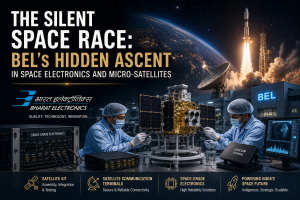
Through its collaboration with ISRO, BEL is strengthening its capabilities in satellite Assembly, Integration and Testing (AIT). It is also expanding into satellite communication terminals and space-grade electronics. While these businesses contribute only a small share of revenue today, they position BEL at the intersection of two of India’s most important strategic sectors, defence and space. As the country’s space ambitions accelerate, this overlooked business could become one of BEL’s most significant long-term growth opportunities.
India’s Space Economy Needs Electronics, Not Just Rockets
India’s space ambitions are expanding rapidly, with the government targeting growth of the domestic space economy from around $8.4 billion today to $44 billion by 2033. Rocket launches dominate the headlines. The real value chain extends far beyond launch vehicles. Every satellite depends on mission-critical electronics, communication systems, power modules, payloads, and ground infrastructure throughout its lifecycle.
This creates a significant opportunity for companies specialising in high-reliability electronics. Rocket manufacturing is only one part of the value chain. Satellite deployments are increasing across defence, communication, navigation, and Earth observation. Demand for indigenous electronic systems is expected to grow alongside them.
For BEL, this is where the opportunity begins. BEL is not entering the launch business. Instead, it is leveraging decades of expertise in defence electronics to become a key supplier of satellite electronics, Assembly, Integration & Testing (AIT), SATCOM systems, and other strategic technologies. As India’s space ecosystem expands, BEL is well positioned to benefit from one of the fastest-growing segments of the value chain.
BEL’s Expanding Role in India’s Space Ecosystem
BEL’s role in India’s space programme has evolved well beyond supplying electronic components. Today, the company is positioning itself as a system integrator. It supports satellite manufacturing, testing, communication, and mission-critical electronics through long-standing collaborations with ISRO and its centres.
One of BEL’s most notable achievements is its participation in the Assembly, Integration and Testing (AIT) of three RISAT (Radar Imaging Satellite) missions under ISRO’s supervision. AIT is one of the most critical phases of satellite manufacturing. During this stage, individual subsystems are integrated, tested under simulated launch and space conditions, and certified for deployment. Success at this stage requires exceptionally high reliability, making it a capability possessed by only a handful of organisations.
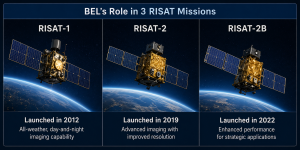
BEL has steadily expanded its portfolio of indigenous space technologies. This growth has come through ISRO technology transfers and internal R&D.
Its capabilities include:
- Travelling Wave Tube Amplifiers (TWTAs) developed with ISRO’s Space Applications Centre (SAC)
- Satellite communication (SATCOM) terminals and ground communication systems
- IRNSS/NavIC navigation receivers
- C/Ku-band receivers and RF subsystems
- Low Temperature Co-fired Ceramic (LTCC) substrates
- Transmit/Receive Modules (TRMs) and other mission-critical electronic assemblies
Beyond ISRO programmes, BEL is also well positioned to participate in India’s proposed defence-focused Low Earth Orbit (LEO) satellite constellation. The network is expected to strengthen real-time battlefield surveillance, secure communications, and intelligence gathering for the armed forces. Given BEL’s expertise in military communication systems, encryption technologies, and satellite integration, the company is well placed to support the electronics and ground infrastructure required for such strategic programmes.
The company is also working on technologies supporting India’s future Low Earth Orbit (LEO) satellite constellations for defence applications. As satellite deployments increase, BEL is positioning itself not merely as a component supplier but as an integrated electronics partner across the satellite value chain.
Why BEL’s Defence DNA Creates a Space Moat?
Unlike many companies entering the space sector, BEL is not building its capabilities from scratch. The same engineering expertise that underpins its defence business: high-reliability electronics, secure communications, radar systems, RF technologies, and embedded electronics is directly applicable to space programmes. Both industries demand products that can operate flawlessly in harsh environments, meet stringent qualification standards, and deliver near-zero failure rates over long operating lives.
This creates a structural competitive advantage. BEL already possesses specialised testing infrastructure, clean-room manufacturing capabilities, robust quality assurance processes, and decades of experience executing strategic national programmes. More importantly, it has built long-standing relationships with organisations such as ISRO, DRDO, and the Ministry of Defence, where reliability and execution often matter more than cost.
While private companies may innovate faster in niche technologies, replicating BEL’s institutional trust, manufacturing ecosystem, and mission-critical engineering expertise will take years. As defence and space increasingly converge through satellite communications, surveillance, and navigation systems, BEL’s defence DNA becomes more than a legacy strength, it becomes one of its strongest competitive moats.
Why The Market Is Understanding This Business?
BEL’s space business receives little attention because it contributes only a small fraction of revenue today. Most investors continue to value the company primarily on defence orders, overlooking the strategic optionality embedded within its space electronics portfolio.
This perception stems from three factors:
- BEL does not separately disclose revenue from its space business, making its contribution difficult to quantify.
- Most space-related work is embedded within broader defence or strategic electronics contracts rather than reported as a standalone segment.
- The market tends to focus on large defence order announcements, while the long-term value of satellite electronics, AIT, and communication infrastructure remains underappreciated.
However, this is precisely where the opportunity lies. Unlike one-time platform sales, space infrastructure creates recurring demand through satellite replacements, constellation expansion, upgrades, maintenance, and ground systems. As India increases investments in military and commercial satellites, BEL can benefit from a multi-year technology cycle that investors have not yet fully priced in.
For long-term investors, the space business should be viewed less as a current earnings driver and more as a strategic growth option that could become increasingly valuable over the next decade.
BEL Isn’t Entering a New Industry, It’s Expanding an Existing One
BEL’s space business is often seen as a diversification strategy, but it is better viewed as an extension of its existing strengths. The technologies used in satellites- RF and microwave electronics, secure communications, embedded systems, and mission-critical testing, closely overlap with the capabilities BEL has developed over decades for India’s defence sector.
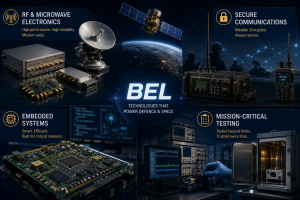
This gives BEL a significant execution advantage. Instead of building new capabilities from scratch, the company can leverage its existing engineering expertise, manufacturing infrastructure, testing facilities, and long-standing relationships with ISRO, DRDO, and the Ministry of Defence. The same technology platforms can serve both defence and space applications, improving returns on R&D and reducing execution risk.
For investors, this is an important distinction. BEL is not making a speculative entry into a new industry; it is leveraging proven capabilities to address a fast-growing adjacent market, strengthening its competitive position as India’s defence and space ecosystems continue to converge.
Why Is BEL's Space Business Difficult to Replicate?
Most companies can manufacture electronic components, but very few possess the infrastructure, certifications, and institutional relationships required to build electronics for space missions. Unlike commercial electronics, space hardware must withstand extreme temperatures, radiation, vibration during launch, and years of uninterrupted operation without the possibility of repairs.
BEL has spent decades developing these capabilities through strategic defence programmes. The same expertise in radar systems, RF electronics, secure communications, and embedded systems now provides a strong foundation for manufacturing space-grade electronics. More importantly, the company already possesses specialised infrastructure, including clean-room manufacturing, advanced testing facilities, and stringent quality assurance processes required for mission-critical applications.
Compared with many private aerospace companies, BEL also benefits from long-standing relationships with organisations such as ISRO, DRDO, and the Ministry of Defence. These relationships, combined with its proven execution record, create significant barriers to entry for new competitors.
| Metric / Capability | BEL (Navratna PSU) | Data Patterns | Astra Microwave |
| Core Space Niche | AIT, Ground SATCOM, TWTAs, LEO Constellations | Small Sat Bus, Nano-sat payloads, Avionics | Microwave/RF Subsystems, TR Modules |
| Infrastructure | CMMI Level-5, Class 100K Cleanrooms, Autoclaves | In-house environmental testing chambers | Cleanroom assembly, automated test beds |
| Strategic Advantage | Monopoly access to defence LEO satellite orders | High agility, nimble R&D cycles | Strong export exposure, niche RF components |
Rather than competing directly across every segment, these companies occupy different positions within India’s growing space ecosystem. BEL’s strength lies in integrating mission-critical electronics with strategic national programmes, giving it a differentiated role that is difficult to replicate.
Financial Opportunity: How Big Could This Become?
Today, BEL’s space business remains too small to materially influence its financial performance. With FY26 revenue exceeding ₹27,480 crore and an order book of over ₹74,000 crore, defence electronics continue to drive the company’s earnings. However, the strategic value of the space vertical lies in how it can enhance BEL’s revenue mix rather than simply increase revenue.
Unlike conventional defence manufacturing, space electronics involve higher engineering complexity, stringent qualification standards, and longer product life cycles. Products such as Travelling Wave Tube Amplifiers (TWTAs), SATCOM terminals, satellite AIT, and mission-critical RF systems are specialised technologies with limited domestic competition, strengthening BEL’s pricing power and long-term customer stickiness.
The next growth phase is likely to come from defence LEO satellite constellations, satellite communication infrastructure, and indigenous payload electronics. While BEL does not disclose separate guidance for this business, even a 3-5% share of its future order book from space-related programmes would represent a multi-thousand-crore opportunity over time. More importantly, because BEL can leverage its existing engineering talent, manufacturing facilities, and testing infrastructure, this growth is unlikely to require a proportional increase in capital expenditure.
For investors, the opportunity is therefore less about the size of today’s revenue and more about BEL steadily moving into higher-value, technology-intensive programmes that strengthen its competitive position and improve the quality of its long-term order book. This has also been explained in detail in our latest video.
The Next Order Catalysts For BEL
BEL’s space business is still in its early stages, but several structural catalysts could drive meaningful order inflows over the next few years. Unlike traditional defence programmes, these opportunities span both government-led strategic projects and India’s emerging commercial space ecosystem.
- Defence LEO Satellite Constellations
India is accelerating the development of dedicated Low Earth Orbit (LEO) satellite constellations to strengthen battlefield surveillance, intelligence gathering, and secure military communications. BEL’s expertise in encrypted communication systems, satellite electronics, RF technologies, and Assembly, Integration & Testing (AIT) positions it as a strong contender for these strategically important programmes.
- ISRO’s Shift Towards Industry Participation
As ISRO focuses increasingly on research and deep-space missions, a larger share of satellite manufacturing, testing, and subsystem production is expected to be executed by industry partners. BEL’s proven experience in satellite AIT, mission-critical electronics, and long-standing relationship with ISRO place it in a favourable position to benefit from this transition.
- Import Substitution and Indigenisation
The Ministry of Defence’s Positive Indigenisation Lists continue to expand the range of strategic electronic systems that must be sourced domestically. This policy push creates sustained demand for indigenous satellite communication equipment, RF systems, and other space-grade electronics; areas where BEL already has established capabilities.
- India’s Commercial Space Ecosystem
The opening of India’s space sector through IN-SPACe has encouraged private companies to build satellites and space-based applications. However, many lack the capital-intensive infrastructure required for clean-room manufacturing, environmental testing, and satellite AIT. BEL can leverage its existing facilities and engineering expertise to become a manufacturing and technology partner, creating opportunities beyond traditional government contracts.
Together, these catalysts suggest that BEL’s space business is unlikely to grow through a single large order. Instead, it could benefit from multiple long-term demand drivers that gradually increase the strategic importance of this vertical within the company’s broader defence electronics portfolio.
Risks Investors Should Watch
Despite the long-term opportunity, BEL’s space business is not without challenges. While the company possesses strong technical capabilities, the pace at which this vertical scales will depend on policy support, project execution, and the evolution of India’s commercial space ecosystem.
The key risks include:
- Limited revenue visibility: BEL does not separately disclose revenue from its space business, making it difficult for investors to assess its current financial contribution or track its growth.
- Long project cycles: Satellite programmes often involve lengthy design, testing, and qualification phases, which can delay revenue recognition and create uneven order inflows.
- Increasing competition: Private players such as Data Patterns, Astra Microwave Products, and Tata Advanced Systems are expanding their presence in aerospace and space electronics, intensifying competition for future contracts.
- Execution risk: Space-grade electronics demand extremely high reliability, as even minor defects can jeopardise an entire satellite mission. Maintaining these quality standards consistently is critical.
- Manufacturing yield risk: Space-grade electronics undergo stringent qualification and clean-room testing, where even minor defects can result in component rejection. As production scales, maintaining high manufacturing yields while controlling quality costs will remain an important operational challenge.
While these risks are worth monitoring, they are balanced by BEL’s long-standing relationships with government agencies, proven expertise in mission-critical electronics, and strong execution record in strategic programmes. Investors should therefore view the space business as a long-term optionality rather than a near-term earnings driver.
Key Investor Takeaways
- BEL is moving up the value chain. The company is evolving from a supplier of defence electronics to a strategic systems integrator in India’s space ecosystem through capabilities such as Satellite Assembly, Integration & Testing (AIT), SATCOM, and space-grade electronics.
- The opportunity extends beyond ISRO. Defence LEO satellite constellations, private satellite operators, and India’s expanding commercial space ecosystem could create a broader and more diversified order pipeline over the next decade.
- Space strengthens BEL’s competitive moat. Decades of expertise in mission-critical electronics, secure communications, and government partnerships create high barriers to entry that are difficult for new competitors to replicate.
- Near-term earnings, long-term optionality. Space contributes only a small share of revenue today, but its strategic importance could grow meaningfully as India’s investments in defence and space infrastructure accelerate.
- The real story isn’t rockets, it’s the electronics behind them. As India scales its space ambitions, BEL is quietly positioning itself in the critical layer of the value chain where reliability, indigenous capability, and long-term customer relationships matter most.
Conclusion
BEL’s space business may still be small, but its strategic importance is growing rapidly. By leveraging decades of expertise in mission-critical electronics, secure communications, and systems integration, the company is steadily expanding its role in India’s evolving space ecosystem.
As satellite deployments increase and the lines between defence and space continue to blur, BEL is well positioned to benefit from both sectors. While this business is unlikely to materially impact earnings in the near term, it represents a high-quality, long-term growth opportunity that many investors may be overlooking.
In the silent space race, BEL may not be launching rockets but it is helping build the technology that makes those missions possible.