IHCL Stock FY27 Guidance: Revenue Targets and Strategic Hotel Acquisitions
India’s hospitality sector is entering a strong growth phase, supported by rising domestic tourism, business travel recovery, and limited premium hotel supply. IHCL has positioned itself as one of the biggest beneficiaries through its FY27 growth guidance, expansion pipeline, and strategic acquisitions.
However, the investment case now depends on whether these initiatives can translate into sustainable earnings growth rather than just increase the company’s scale.
The real question is not whether India’s hotel industry will grow. It is whether IHCL can grow fast enough to justify its premium valuation.
Can IHCL Deliver Its FY27 Revenue Target?
IHCL enters FY27 with a strong growth outlook, supported by continued demand momentum, an expanding hotel portfolio, and strategic acquisitions. The company ended FY26 with consolidated revenue of ₹9,971 crore, and its ability to sustain double-digit growth will depend on RevPAR expansion, new hotel openings, and the contribution from its asset-light businesses and acquired properties.
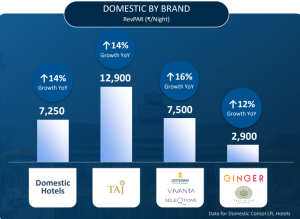
Unlike the post-pandemic recovery phase, where higher Average Room Rates (ARRs) were the primary growth driver, FY27 is expected to be supported by multiple revenue engines. Management expects continued growth in RevPAR (Revenue Per Available Room) through a combination of healthy occupancy and disciplined pricing, although ARR growth is likely to normalize from the exceptional levels witnessed over the last two years. This means incremental revenue will increasingly depend on network expansion, high-margin management fees, and recently acquired assets rather than pricing alone.
What’s Driving the FY27 Revenue Target?
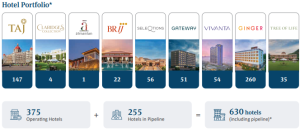
- 11 hotels have opened in Q1FY27 and 49 hotels are expected to open in the next 3 quarters of FY27
- More than ₹250 crore in revenue expected from recently acquired hotel assets, providing an immediate boost to the top line.
- Continued growth in management and franchise income, one of IHCL’s highest-margin businesses, as the company expands its asset-light portfolio.
- Sustained demand from business travel, weddings, MICE events, and leisure tourism, supporting occupancy across premium brands such as Taj, SeleQtions, and Vivanta.
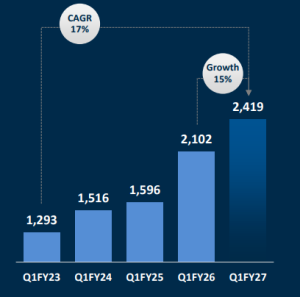
The early indicators are encouraging. In Q1 FY27, IHCL reported 15% YoY revenue growth to ₹2,419 crore, already running ahead of its full-year guidance. However, maintaining this pace will depend on the successful execution of new hotel openings and acquisitions, especially as room rate growth begins to normalize. If management delivers on both fronts, the company’s FY27 revenue target appears achievable rather than overly ambitious.
Has IHCL Historically Beaten Guidance?
Management guidance becomes more meaningful when evaluated against past execution. Over the last few years, IHCL has benefited from a strong hospitality recovery, but its ability to consistently deliver above expectations has strengthened investor confidence in its execution capabilities.
During FY23-FY26, the company moved from a recovery phase into a high-growth cycle, driven by improving occupancy, strong Average Room Rates (ARRs), and expansion of its asset-light portfolio. FY26 consolidated revenue reached ₹9,971 crore, reflecting the company’s ability to capitalize on favourable demand conditions while improving profitability.
| Year | Management Guidance (Cr) | Actual Revenue (Cr) | Beat/Miss |
| FY23 | ~₹5,500-5,650 | ₹5,949 | Beat |
| FY24 | ~₹6,700-6,800 | ₹6,922 | Beat |
| FY25 | ~₹8,200-8,400 | ₹8,565 | Beat |
| FY26 | ~₹9,600-9,700 | ₹9,971 | Beat |
The key takeaway is that IHCL’s recent performance has not only been driven by industry tailwinds but also by operational execution. However, FY27 will be a different test. With room rate growth expected to normalize, the company will need its hotel pipeline, acquisitions, and fee-based businesses to contribute meaningfully to maintain its growth trajectory.
Strategic Hotel Acquisitions: Scale or Value Creation?
Acquisitions have become a key pillar of IHCL’s FY27 growth strategy, but their significance extends beyond simply adding more hotels. Unlike traditional expansion, which can take years from land acquisition to commercial operations, acquiring established hospitality assets enables IHCL to accelerate market entry, broaden its brand portfolio, and generate revenue almost immediately. The critical question, however, is whether these acquisitions will improve profitability and returns or merely increase the company’s scale.
Importantly, IHCL has the financial flexibility to pursue inorganic growth without stretching its balance sheet. The company ended FY26 with a gross cash balance of ₹4,345 crore, providing ample firepower to fund strategic acquisitions while maintaining a net cash position. This significantly reduces financing risk and allows IHCL to capitalize on attractive acquisition opportunities without relying on expensive debt.
Over the past year, IHCL has strengthened its portfolio through acquisitions and strategic partnerships, including Atmantan Wellness Centre, Brij Hotels, and the Pride Hotels collaboration. Each targets a different segment of the hospitality market. Atmantan expands IHCL’s presence in the fast-growing luxury wellness space, Brij Hotels enhances its experiential heritage offering, while the Pride partnership significantly strengthens its reach in the upscale and mid-market categories. Rather than competing with the Taj brand, these assets help IHCL address customer segments where it previously had limited presence.
Why These Acquisitions Matter
- Immediate revenue contribution: Management expects over ₹250 crore in FY27 revenue from recently acquired assets.
- Portfolio diversification: Expands IHCL beyond traditional luxury hotels into wellness, heritage, and premium mid-market hospitality.
- Cross-selling opportunities: Newly acquired properties can leverage Taj InnerCircle, IHCL’s loyalty ecosystem, and its global sales and reservation network to improve occupancy.
- Capital-efficient expansion: Acquiring operational assets shortens the time required to generate cash flows compared with developing greenfield hotels.
However, the success of these acquisitions should not be measured by the number of hotels added but by their ability to improve earnings and returns. Investors should closely monitor occupancy, operating margins, and integration progress over the next few quarters. If these assets successfully leverage IHCL’s distribution platform and brand ecosystem, they could become a meaningful contributor to long-term earnings rather than simply expanding the company’s footprint.
Why Buy Instead Of Build?
Strategic acquisitions have become a key pillar of IHCL’s expansion strategy, enabling the company to enter new hospitality segments and markets faster than developing hotels from the ground up. Unlike greenfield projects, which typically require significant capital investment and several years before generating returns, acquiring operational assets allows IHCL to scale immediately while leveraging its established brands, distribution network, and operational expertise.
Recent acquisitions, including Atmantan Wellness Centre, Brij Hotels, and the strategic partnership with Pride Hotels, are aimed at strengthening IHCL’s presence across luxury wellness, experiential hospitality, and the upscale and mid-market segments. Importantly, the company ended FY26 with a gross cash balance of approximately ₹4,345 crore, giving it the financial flexibility to pursue inorganic growth without relying on expensive debt.
However, the success of these acquisitions will ultimately depend on execution rather than scale. Acquired properties can benefit from Taj InnerCircle, IHCL’s corporate sales network, centralized procurement, and revenue management systems, creating opportunities to improve occupancy, increase direct bookings, and enhance operating margins over time. At the same time, centralized operations and technology platforms could generate cost efficiencies and strengthen profitability.
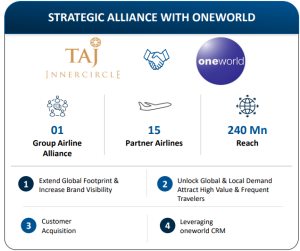
That said, investors should closely monitor whether these acquisitions become earnings-accretive within a reasonable timeframe. Delays in integration, weaker-than-expected occupancy, or difficulties in maintaining brand standards could dilute returns despite higher reported revenue. Ultimately, the true measure of IHCL’s acquisition strategy will not be the number of hotels it adds, but its ability to convert these assets into sustainable earnings growth and higher returns on capital, reinforcing the company’s long-term investment case.
What Is The Market Missing?
The market often values IHCL primarily as a hotel owner, but the company’s business model is gradually evolving into a broader hospitality platform. While owned hotels remain important, an increasing share of future growth is expected to come from businesses requiring lower capital intensity and offering greater scalability.
The shift towards management contracts and franchise-led expansion changes the earnings profile of the company. Unlike owned hotels, where growth requires significant capital investment, asset-light properties allow IHCL to expand its network while generating recurring fee income. This improves capital efficiency and supports higher returns on capital.
Key Factors The Market May Be Underestimating
- Fee Income Growth: Management and franchise fees can grow faster than room revenue because they are driven by hotel additions rather than only occupancy and pricing.
- New Business Growth: Businesses such as Ginger, amã Stays & Trails, Qmin, and TajSATS provide additional revenue streams and reduce dependence on luxury room cycles.
- Balance Sheet Advantage: IHCL’s strong cash position provides flexibility to pursue acquisitions without increasing leverage.
As IHCL transitions from a traditional hotel company into a hospitality ecosystem, its valuation framework may increasingly depend on earnings quality rather than just room inventory growth.
Risks To The FY27 Outlook
IHCL’s FY27 guidance is backed by favourable industry trends and a growing hotel portfolio, but execution risks remain. While the company has started the year on a strong note, sustaining double-digit revenue growth will depend on maintaining pricing power, integrating recent acquisitions, and executing its expansion plans without compromising profitability.
Key Risks to Monitor
- RevPAR Normalisation: The sharp post-pandemic recovery was driven by exceptional growth in Average Room Rates (ARRs). As new hotel supply enters major markets, pricing power could moderate, making future revenue growth more dependent on occupancy and operational execution.
- Acquisition Integration: While acquisitions are expected to contribute over ₹250 crore in FY27 revenue, delays in integration or weaker-than-expected performance could reduce their earnings contribution and pressure margins.
- Execution of Hotel Openings: IHCL plans to open more than 60 hotels during FY27. Any delays in project completion or slower ramp-up of newly opened properties could impact the company’s ability to meet its revenue target.
- Cost Inflation: Rising employee costs, utilities, and maintenance expenses remain a challenge for the hospitality industry. If these costs increase faster than room rates, operating margins could come under pressure.
Although these risks warrant close monitoring, IHCL’s diversified brand portfolio, strong balance sheet, and asset-light expansion strategy provide a degree of resilience. The company’s ability to execute its pipeline and integrate acquisitions efficiently will be the key determinant of whether it can deliver on its FY27 guidance. Check our latest video for more detail.
Is IHCL’s Premium Valuation Still Justified?
Compared with listed hospitality peers, IHCL continues to trade at higher valuation multiples, reflecting the market’s confidence in its superior execution, diversified revenue streams, and asset-light growth strategy.
| Company | EV/EBITDA | P/E | Key Takeaway |
| IHCL | 29.4x | 53.8x | Premium reflects strong execution and diversified growth |
| Chalet Hotels | 28.5x | 16.6x | Attractive valuation but asset-heavy model |
| Lemon Tree Hotels | 15.3x | 35.3x | Mid-market growth with improving profitability |
Source: Screener.in as on 28 July, 2026
A closer look at IHCL’s business model explains why investors continue to assign the company a premium valuation. The key drivers include:
- Brand Premium
The Taj brand remains one of India’s strongest hospitality franchises, providing pricing power, customer loyalty, and a competitive advantage in the luxury segment.
- Asset-Light Premium
A growing share of management contracts and franchise properties allows IHCL to expand with limited capital deployment. This improves return ratios and creates a more resilient earnings profile.
- Balance Sheet Premium
IHCL ended FY26 with a gross cash balance of approximately ₹4,345 crore, giving the company significant financial flexibility. A net cash position allows IHCL to pursue strategic acquisitions without depending heavily on debt financing.
- Capital Allocation Premium
The key question is whether IHCL’s acquisitions and expansion strategy generate attractive returns. Successful integration of acquired properties and disciplined investment decisions will determine whether growth translates into shareholder value.
- Earnings Visibility Premium
A strong hotel pipeline, growing fee income, new businesses, and strategic acquisitions provide better earnings visibility compared with traditional hotel operators.
Investment View: Accumulate on Dips
IHCL remains one of India’s highest-quality hospitality businesses, but its premium valuation leaves limited room for execution mistakes. While the long-term growth story remains intact, future returns will depend more on earnings delivery, acquisition integration, and sustained RevPAR growth rather than further valuation expansion.
Conclusion
IHCL enters FY27 with a well-defined growth strategy supported by ambitious revenue targets, an expanding hotel pipeline, and a series of strategic acquisitions. While recent acquisitions are expected to strengthen the company’s presence across new hospitality segments and provide an incremental boost to revenue, the bulk of its growth will still depend on the sustained performance of its core hotel portfolio. This makes execution through healthy RevPAR growth, timely hotel openings, and successful integration of acquired assets, the key factor in achieving management’s guidance.
Although the stock continues to trade at a premium to most listed hospitality peers, that premium reflects IHCL’s strong brands, diversified revenue streams, disciplined capital allocation, and proven execution track record. Going forward, investors should focus less on the headline revenue target and more on the quality of growth underpinning it. If IHCL successfully delivers on its FY27 guidance while extracting meaningful value from its acquisition strategy, it is likely to strengthen its leadership in India’s hospitality sector and reinforce its long-term investment case.