Ddev Plastiks’ 5 GW Ambition: De-risking Corporate Value via the Battery Energy Storage Systems (BESS) Pivot
Building a More Diversified BusinessFor years, Ddev Plastiks has built its business around polymer compounds that serve critical industries such as power, infrastructure, and automotive. While this business has established the company as a leading manufacturer, it also leaves long-term growth closely linked to industrial demand cycles and raw material volatility.
Its planned entry into the Battery Energy Storage Systems (BESS) market marks a strategic shift that could reshape that narrative. Rather than simply expanding into another product category, the company is positioning itself in one of India’s fastest-growing clean energy segments, where demand is expected to accelerate alongside renewable power capacity.
The real significance of the proposed 5 GWh BESS platform lies beyond the headline capacity. If executed successfully, it could diversify Ddev Plastiks’ revenue base, reduce reliance on its traditional polymer business, and create a new long-term growth engine. The key question for investors is whether this pivot can strengthen the company’s business model and support sustainable value creation over the coming decade.
Why Battery Energy Storage Systems Are Becoming India’s Next Infrastructure Opportunity?
India’s renewable energy capacity has expanded rapidly over the past decade, led by large-scale investments in solar and wind power. However, as the share of renewable energy in the electricity mix increases, a new challenge is becoming more apparent: renewable power generation is inherently intermittent. Solar plants generate electricity only during daylight hours, while wind output varies with weather conditions, making it difficult for the grid to maintain a stable and reliable power supply.
This is where Battery Energy Storage Systems (BESS) become critical. By storing excess electricity during periods of high renewable generation and releasing it when demand rises or renewable output declines, BESS helps balance the grid, improve power reliability, and reduce renewable energy curtailment. As India moves toward a cleaner energy mix, energy storage is increasingly shifting from a complementary technology to an essential part of the country’s power infrastructure.
Recognising this need, the Indian government has introduced policy support and storage-linked tenders to accelerate BESS deployment. Utilities, renewable energy developers, commercial and industrial consumers, and transmission operators are all beginning to integrate battery storage into their projects to improve grid flexibility and ensure round-the-clock power availability. As a result, industry forecasts point to a multi-year expansion in India’s energy storage market, creating opportunities across manufacturing, system integration, engineering, and long-term service contracts.
For companies willing to enter the sector early, the opportunity extends beyond supplying battery systems. As storage becomes a fundamental component of the energy transition, participants that establish manufacturing capabilities, execution expertise, and customer relationships could benefit from a structural demand cycle that is expected to last for years. It is this long-term shift, not just the immediate order pipeline that makes the BESS market strategically attractive for companies looking to diversify beyond their traditional businesses.
Why is Ddev Plastiks Entering the BESS Market?
Leveraging Existing Industry Expertise
At first glance, polymer compounds and battery energy storage systems may appear to belong to entirely different industries. However, Ddev Plastiks’ expansion into BESS is not as disconnected from its existing business as it seems. The company has spent decades serving the power and electrical ecosystem, supplying specialised polymer compounds used in cables, electrical insulation, and other critical applications. This provides an established understanding of the infrastructure sector, industrial customers, and project execution requirements.
Management’s strategy is not to manufacture battery cells, an area dominated by global players and characterised by rapid technological change. Instead, Ddev Plastiks is positioning itself as a Battery Energy Storage System integrator, focusing on designing, assembling, and delivering complete energy storage solutions. This approach allows the company to participate in the fast-growing BESS market while avoiding the significant capital intensity, technological risks, and supply chain complexities associated with cell manufacturing.
A Capital-Efficient Expansion Strategy
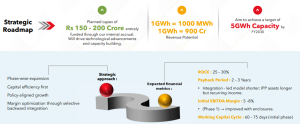
The company is backing this strategy with a clearly defined investment plan rather than an open-ended expansion. Management has guided for a ₹150-₹200 crore greenfield investment for the first phase of its 5 GWh Battery Energy Storage Systems (BESS) facility in Ahmedabad. Importantly, this capital expenditure is expected to be funded entirely through internal accruals, avoiding equity dilution or meaningful incremental leverage. Management has also outlined an ambitious target of 25-30% return on capital employed (ROCE) with a projected 2-3 year payback period, suggesting that the project is being evaluated against strict capital efficiency metrics rather than revenue growth alone.
However, entering a new industry does not automatically create shareholder value. The success of this strategy will depend on whether Ddev Plastiks can secure meaningful orders, execute projects efficiently, and generate attractive returns on the capital invested.
Ultimately, the investment case is not about announcing a 5 GWh capacity, it is about converting that capacity into a scalable and profitable business that strengthens the company’s overall earnings profile.
A Clearly Defined Execution Roadmap
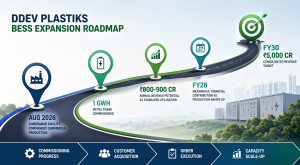
Unlike many long-term clean energy announcements that lack execution visibility, Ddev Plastiks has outlined a relatively clear roadmap for its BESS expansion. The company’s Ahmedabad facility is expected to commence commercial production by August 2026, with the initial 1 GWh phase forming the foundation for future capacity additions.
Management has indicated that the first phase alone has the potential to generate approximately ₹800-900 crore in annual revenue once utilisation stabilises, with a more meaningful financial contribution expected during FY28 as production ramps up. This expansion also aligns with the company’s broader objective of reaching ₹5,000 crore in consolidated revenue by FY30, positioning BESS as one of the key drivers of incremental growth over the coming years.
The execution timeline matters because it gives investors measurable milestones to track. Rather than focusing on the ultimate 5 GWh ambition, quarterly progress on commissioning, customer acquisition, and order execution will provide a better indication of whether the business is scaling according to plan.
Can the BESS Business De-Risk Ddev Plastiks’ Corporate Value?
Building a More Diversified Business
For most of its history, Ddev Plastiks’ growth has been closely linked to demand from industries such as power cables, electrical equipment, infrastructure, and automotive. While these sectors offer long-term growth opportunities, they also expose the company to fluctuations in industrial activity, raw material prices, and customer spending cycles. As a result, earnings growth has traditionally remained tied to the performance of a single core business.
The planned BESS business has the potential to change that dynamic. Instead of relying on one primary revenue engine, Ddev Plastiks could gradually build a more diversified business model with exposure to both industrial manufacturing and the rapidly expanding clean energy ecosystem. A broader revenue mix generally makes businesses more resilient, as growth in one segment can help offset weakness in another during industry downturns.
Why the Business Model Matters?
Ddev Plastiks is also pursuing a different business model from several larger players entering India’s energy storage ecosystem. Companies such as Tata Power, JSW Energy, Reliance Industries, and Exide Industries are investing across various parts of the battery value chain, including manufacturing, storage projects, and integrated energy solutions. Ddev Plastiks, by contrast, intends to operate primarily as a system integrator, assembling utility-scale 5 MWh BESS containers using sourced battery cells and proprietary integration capabilities. This asset-light approach significantly reduces technology risk associated with battery chemistry while allowing the company to focus on engineering, automation, and project execution.
What Investors Should Monitor?
The opportunity also extends beyond diversification. Battery Energy Storage Systems are expected to become an increasingly important part of India’s energy infrastructure as renewable energy capacity expands. If Ddev Plastiks establishes itself as a credible system integrator and executes projects efficiently, the company could gain exposure to a structural growth market that is likely to grow faster than many traditional manufacturing segments over the coming decade.
However, investors should avoid judging the success of this strategy solely by the announced 5 GWh capacity or the initial revenue contribution. The more meaningful indicators will be the pace of order wins, execution quality, operating margins, return on capital employed, and the ability of the business to generate sustainable cash flows without placing excessive pressure on the balance sheet.
These metrics will determine whether the BESS venture becomes a value-accretive growth engine or simply another expansion project.
Ultimately, the significance of the BESS pivot lies in its potential to improve the quality of Ddev Plastiks’ business rather than just its size. If management can execute with capital discipline while building a competitive position in energy storage, the company could evolve from a manufacturer primarily linked to polymer demand cycles into a more diversified infrastructure solutions business with stronger long-term growth prospects. That transformation, rather than the headline capacity target, is what investors should watch most closely.
Key Risks Investors Should Monitor
The largest execution challenge may not be the construction of the manufacturing facility but scaling operations after commissioning. Although the planned ₹150-200 crore capital expenditure is expected to be funded internally, assembling large-scale BESS platforms requires significant inventories of imported lithium-ion cells and power electronics. As production ramps up, the business could require an estimated ₹200-250 crore of additional working capital to support procurement, inventory, and project execution. Efficient working capital management will therefore be critical to maintaining healthy cash flows.
Execution capability represents another important risk. Unlike polymer compounding, utility-scale BESS integration requires specialised expertise in battery management systems, power electronics, thermal management, automation, and grid integration. To strengthen these capabilities, Ddev Plastiks has appointed Dr. Rakesh Kumar Tiwari as CEO of its renewable energy business. The success of the BESS strategy will depend not only on market demand but also on the ability of this newly assembled engineering team to commission a fully automated production line on schedule and execute projects reliably.
Competitive pressure should also be monitored closely. While Ddev Plastiks is not directly competing with battery cell manufacturers, it will operate in a market where established engineering companies, power equipment manufacturers, and industrial EPC firms are all pursuing opportunities in utility-scale energy storage. Maintaining cost competitiveness, execution quality, and customer confidence will be essential as the market matures.
Conclusion
Ddev Plastiks’ proposed 5 GWh BESS platform represents more than an entry into a new product category, it reflects an effort to position the company alongside one of India’s most important long-term infrastructure themes. As renewable energy capacity continues to expand, energy storage is expected to play an increasingly critical role in ensuring grid stability and reliable power supply, creating a structural growth opportunity for companies with strong execution capabilities.
Whether this ambition ultimately enhances shareholder value, however, will depend less on the announced capacity and more on the company’s ability to execute. Securing meaningful orders, delivering projects efficiently, maintaining capital discipline, and generating attractive returns on invested capital will determine whether the BESS business evolves into a sustainable growth engine or remains an ambitious diversification initiative.
For investors, the investment case should be evaluated through execution rather than ambition. The commissioning of the Ahmedabad facility, the pace of order inflows, working capital discipline, and the ability to achieve management’s targeted 25-30% ROCE will determine whether the BESS venture becomes a value-accretive business. If these milestones are delivered over the next few years, Ddev Plastiks’ 5 GWh platform could represent far more than a diversification initiative, it could fundamentally reshape the company’s earnings profile and support a higher long-term valuation multiple.