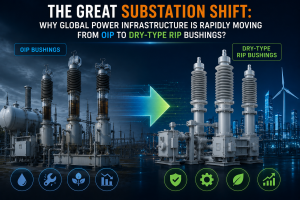
The Great Substation Shift: Why Global Power Infrastructure is Rapidly Moving from OIP to Dry-Type RIP Bushings?
Power transformers are among the most critical assets in the electricity grid, but one of their smallest components is undergoing a major technological shift. For decades, oil-impregnated paper (OIP) bushings have been the industry standard for safely carrying high-voltage current through transformers. Today, utilities and transmission operators are increasingly replacing them with resin-impregnated paper (RIP) bushings, a dry-type alternative that offers improved reliability, lower maintenance and enhanced fire safety.
This transition is being driven by aging grid infrastructure, stricter environmental and safety standards, and rising investments in renewable energy and transmission networks. As the replacement cycle gains momentum, manufacturers with expertise in RIP technology, including Yash Highvoltage, are well positioned to benefit from what could become a multi-decade upgrade across global power infrastructure.
Why One of the Smallest Transformer Components Matters So Much?
Power transformers are among the most expensive assets in a transmission network, often remaining in service for 30 to 50 years. While bushings typically account for only a small share of a transformer’s total cost around 3% to 5% depending on the voltage class, their reliability is critical. Industry studies have consistently identified bushings as one of the leading causes of transformer failures, with a single fault capable of damaging equipment worth several crores, triggering prolonged outages and increasing maintenance costs.
This is why utilities evaluate bushings differently from most industrial components. Instead of focusing solely on purchase price, they prioritize lifecycle reliability, failure rates and long-term operating costs. Even a modest improvement in bushing performance can significantly reduce maintenance expenses and improve network availability over the transformer’s operating life.
Why The Industry Is Moving Beyond OIP Bushings?
Oil-impregnated paper (OIP) bushings have been the industry standard for decades because they offer proven electrical insulation and long operational life. However, as many installed assets approach the end of their service life, utilities are reassessing whether conventional oil-based insulation remains the best long-term solution.
The primary challenge with OIP bushings is that their insulation system depends on transformer oil and cellulose paper remaining in good condition throughout decades of operation. Repeated thermal cycling, ageing seals and moisture ingress can gradually reduce dielectric strength, increasing the risk of partial discharge and insulation failure. To manage these risks, utilities must conduct periodic maintenance such as oil sampling, dissolved gas analysis (DGA) and insulation testing, adding to lifecycle operating costs.
RIP bushings replace the liquid insulation system with a solid epoxy-resin-impregnated paper core, eliminating the need for insulating oil inside the bushing. Besides removing leakage and fire risks associated with oil-filled designs, the solid insulation structure offers greater mechanical strength and requires less routine maintenance.
As utilities increasingly prioritize asset reliability and total cost of ownership over upfront procurement costs, RIP technology is becoming the preferred choice across many new transmission projects and equipment replacement programmes.
RIP Isn’t Without Challenges
Despite its advantages, RIP technology is not without engineering challenges. Unlike oil-filled bushings, the insulation system relies on cellulose paper impregnated with epoxy resin. Before installation, this paper remains highly hygroscopic, meaning it can absorb moisture from the atmosphere if storage or handling conditions are not properly controlled.
Even small amounts of trapped moisture can reduce dielectric performance and increase the likelihood of partial discharge once the bushing is energized. As a result, manufacturers, logistics providers and utilities must maintain strict packaging, transportation and storage standards to preserve insulation integrity until installation. These requirements help explain why high-voltage bushings remain a specialized product category despite growing demand.
Is RIP the Final Destination?
While RIP bushings are becoming the preferred solution across much of the transmission industry, innovation has not stopped. Manufacturers are increasingly exploring Resin Impregnated Synthetic (RIS) bushings, which replace cellulose paper with synthetic fibres that are significantly less sensitive to moisture absorption.
The use of synthetic insulation can improve mechanical strength, simplify handling and reduce some of the moisture-related risks associated with RIP technology. However, commercial adoption remains limited compared with RIP, particularly in large-scale transmission projects where utilities continue to favour proven technologies with established operating records.
For companies such as Yash Highvoltage, the immediate commercial opportunity continues to lie in expanding RIP adoption across domestic and export markets. At the same time, the gradual emergence of RIS highlights that continuous product development will remain important as utilities seek even higher reliability over the coming decades.
The Global Demand Drivers Behind The Shift
The transition from OIP to RIP bushings is being supported by several long-term trends that are reshaping electricity networks worldwide.
The first is the modernization of aging transmission infrastructure. Utilities across Europe, North America and parts of Asia are replacing transformers and substation equipment that have operated for several decades. Rather than reinstalling legacy technologies, many are adopting dry-type insulation systems that offer lower maintenance requirements and improved operational reliability.
A second driver is the rapid expansion of renewable energy. Large-scale solar parks, offshore wind farms and cross-border interconnections require significant investment in substations, transformers and transmission equipment capable of operating reliably under demanding environmental conditions.
At the same time, countries are investing heavily in high-voltage alternating current (HVAC) and high-voltage direct current (HVDC) transmission corridors to transport renewable electricity over longer distances, further increasing demand for advanced insulation technologies.
However, adoption is not uniform across all voltage levels. RIP bushings have become increasingly common in the 72.5 kV to 420 kV range, where utilities value their maintenance and safety advantages. At ultra-high voltages such as 765 kV and above, OIP technology continues to hold a significant position because manufacturing large resin-impregnated insulation cores without internal stresses or curing defects remains technically challenging.
This suggests the industry transition is likely to be gradual, with both technologies coexisting across different voltage classes for years to come.
The Regulatory Shift is Accelerating Adoption
The transition from OIP to dry-type bushings is no longer being driven solely by technological preference. In several markets, it is increasingly shaped by utility procurement standards and stricter safety requirements. In India, central transmission and power generation companies have progressively shifted towards RIP and RIS bushings for applications up to the 245 kV voltage class, citing lower fire risk, reduced maintenance requirements and improved operational reliability.
This shift has altered the competitive landscape. Winning business is no longer just about manufacturing capability, it depends on meeting rigorous qualification standards and being included in approved vendor lists. Utilities typically require extensive electrical, thermal and mechanical testing before qualifying a supplier, and once approved, they rarely switch vendors without compelling technical or commercial reasons.
These long qualification cycles create a significant competitive moat. As India’s transmission network expands and utilities increasingly standardize dry-type insulation systems, established manufacturers are well positioned to benefit from repeat orders while new entrants face high barriers to entry.
Why Yash Highvoltage Could Benefit?
Yash Highvoltage has spent years building capabilities in one of the most specialized segments of the power equipment industry. Today, the company derives approximately 83% of its revenue from RIP bushings, indicating that its business has already transitioned toward the segment experiencing the strongest structural demand.
Its position extends beyond product manufacturing. According to management, the company commands a leading share of India’s RIP bushing market for applications up to 245 kV, reflecting years of product qualification, customer approvals and engineering expertise. In the transmission industry, these approvals are often more valuable than manufacturing capacity itself, as utilities prioritize proven reliability over marginal price differences.
The combination of increasing domestic transmission investments, replacement demand and expanding export opportunities provides the company with multiple growth drivers. However, sustaining this momentum will depend on successfully scaling manufacturing capacity while maintaining the quality standards required for critical grid infrastructure.
Financial Performance Reflects Operating Leverage
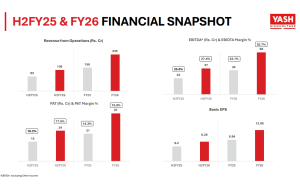
FY26 marked a step change in Yash Highvoltage’s financial performance. Revenue from operations increased 57% year-on-year to ₹235 crore, while EBITDA rose even faster to ₹60 crore, resulting in EBITDA margin expansion from 23.1% to 25.7%.
The improvement continued at the bottom line. Net profit increased 76% to ₹37 crore, with PAT margin expanding from 14.3% to 15.9%, while Basic EPS rose to ₹13.08 from ₹8.94 in FY25.
The faster growth in earnings than revenue suggests that the company is benefiting from operating leverage rather than simply shipping higher volumes. As production scales, fixed manufacturing costs are spread across a larger revenue base, allowing profitability to improve. The increasing contribution of higher-value RIP bushings which now account for roughly 83% of revenue has likely also supported margin expansion, highlighting the financial benefits of moving toward more technologically advanced products.
Order Book Signals That Growth Is NOt One-Off
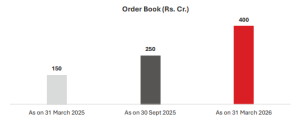
Strong financial performance is encouraging, but order visibility often provides a better indication of future growth. Yash Highvoltage ended FY26 with an order book exceeding ₹400 crore, compared with approximately ₹150 crore a year earlier.
For a company that generated ₹235 crore in FY26 revenue, this represents an order book worth well over one year’s sales. Such visibility reduces earnings uncertainty and indicates that demand is supported by multi-year transmission and transformer projects rather than isolated contracts.
More importantly, the growing backlog reflects structural demand drivers including transmission expansion, renewable energy integration and the accelerating replacement of conventional OIP bushings with dry-type technologies.
From Component Supplier to Integrated Manufacturer
While recent growth has been driven by rising demand, the company’s next phase of value creation could come from deeper manufacturing integration. Yash Highvoltage is investing approximately ₹153 crore in a greenfield manufacturing facility at Savli, Vadodara, which is expected to localize the production of critical RIP and, eventually, RIS insulation cores.
Today, specialized insulation cores represent one of the highest-value inputs in a bushing. Localizing their production would reduce dependence on imported components, improve supply chain resilience and enable the company to capture a larger share of the value chain.
Beyond cost savings, vertical integration could also improve product development capabilities and manufacturing flexibility, positioning Yash to respond more quickly as utilities gradually adopt next-generation insulation technologies.
A Global Supply Shortage Is Strengthening Pricing Power
The investment case extends beyond India’s transmission sector. Globally, the market for high-voltage bushings remains concentrated among a limited number of qualified manufacturers. Many of the industry’s largest players prioritize supplying bushings for their own transformer businesses, leaving relatively limited capacity available for independent customers.
At the same time, transmission investment is accelerating across Europe, North America, the Middle East and Asia as countries modernize aging grids and expand renewable energy infrastructure. The combination of rising demand and constrained manufacturing capacity has created longer delivery schedules across the industry, improving pricing conditions for qualified suppliers.
For an independent manufacturer such as Yash Highvoltage, this presents an attractive opportunity. Rather than competing solely on price, the company can benefit from a market where technical capability, delivery reliability and qualification status are becoming increasingly valuable competitive advantages.
Risks to the Investment Thesis
While the long-term outlook for RIP bushings is encouraging, the transition is unlikely to happen overnight. Utilities are generally conservative when adopting new equipment, particularly for critical transmission assets that are expected to operate reliably for decades. Product qualification, field testing and customer approvals can take several years, slowing the pace at which new technologies gain widespread acceptance.
Competition is another key factor. The global high-voltage bushing market includes well-established international players with decades of experience, broad product portfolios and long-standing relationships with utilities and transformer manufacturers. To expand its market share, Yash Highvoltage will need to continue investing in technology, quality certifications and manufacturing capacity while maintaining competitive pricing.
The company is also exposed to execution risks. Delays in customer orders, fluctuations in raw material prices or slower-than-expected transmission investments could affect near-term growth. Since the business operates in a specialized niche, sustaining growth will depend not only on rising industry demand but also on the company’s ability to consistently execute and secure repeat business.
Conclusion
The global migration from OIP to RIP bushings represents a structural upgrade in power infrastructure rather than a routine equipment replacement cycle. As utilities focus on improving grid reliability, enhancing safety and reducing lifecycle costs, demand is gradually shifting toward dry-type insulation technologies.
For Yash Highvoltage, this trend aligns with its expertise in high-voltage bushings and provides access to a growing niche within the broader transmission equipment market. Although adoption will likely be gradual and competition remains intense, the transition could create a multi-year growth opportunity for manufacturers capable of meeting the power sector’s evolving technical and reliability requirements.