Enviro Infra’s Growth Strategy Explained
Enviro Infra Engineers is no longer positioning itself as only a water and wastewater EPC company. It is building a broader environmental-infrastructure platform spanning water, HAM, O&M, solar, wind, BESS and IPP assets.
The strategic logic is clear. Water provides the established execution base, while renewables and asset ownership could create new growth and longer-duration cash flows.
But there is already evidence that this transition comes with a cost.
Enviro’s consolidated EBITDA margin was 24.16% in FY26. In Q1 FY27, when renewable revenue rose to 29% of quarterly revenue, EBITDA margin fell to 21.07%.
That does not prove diversification caused the margin decline. But it is an important warning against assuming that a more diversified revenue mix automatically means a better business.
The real test now is whether Enviro can turn this diversification into:
- higher ROCE;
- stronger operating cash flow;
- better asset utilisation;
- controlled working capital;
- attractive IPP returns; and
- sustainable project margins.
The strategy is promising, but still unproven.
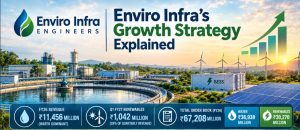
The Margin Decline Is the First Test of the Strategy
The strongest evidence that diversification has a cost is already visible in the financials.
Enviro reported an EBITDA margin of 24.16% in FY26, compared with 21.07% in Q1 FY27. That is a 3.09-percentage-point decline.
At the same time, the revenue mix changed sharply. Renewable revenue was ₹1,042 million in Q1 FY27, or 29% of quarterly revenue, compared with ₹1,292 million, or 11% of FY26 revenue.
This creates an important investor question:
Is the lower margin temporary, or is Enviro’s new business mix structurally less profitable?
The answer cannot yet be established from one quarter.
Renewable revenue in Q1 FY27 was already 80.65% of the entire FY26 renewable revenue, which is unusually high relative to the previous full-year contribution. That makes project timing a credible alternative explanation to a permanent change in mix.
So the 29% figure should not yet be extrapolated into a full-year structural mix.
Investor test: over the next few quarters, does renewable revenue remain meaningful while consolidated EBITDA margin recovers?
If yes, diversification may be working. If margins remain compressed, Enviro may simply be exchanging higher-margin water EPC for lower-return growth.
Enviro’s Water Strategy Is to Move Up, Not Move Away
Already happening: Water remains the foundation of the business.
Enviro has executed 57 water and wastewater projects with cumulative capacity of 958 MLD. Its strategy is now to qualify for significantly larger projects: STPs of up to 200 MLD, compared with the current 50 MLD level, and CETPs of up to 50 MLD, compared with 20 MLD.
This is strategically more important than simply increasing the order book.
Larger projects can improve revenue per contract and potentially provide better operating leverage. But the company itself says the objective of larger projects is to earn better margins.
That is a management objective, not yet a proven outcome.
The investor should therefore track:
- EBITDA margin by project category;
- execution time versus original schedules;
- cost overruns;
- working-capital intensity;
- ROCE on larger projects.
If project size rises but project-level returns do not, scaling will increase revenue without necessarily increasing shareholder value.
The water strategy therefore succeeds only if larger projects improve economics, not just absolute turnover. To know more, check our latest video.
HAM Changes the Capital Requirement, Not Just the Revenue Model
HAM is one of the clearest examples of why Enviro’s strategy needs to be evaluated through capital efficiency.
Enviro’s HAM contracts operate on a fundamentally different cash-flow structure. For the Mathura and Saharanpur projects, 40% of the bid project cost is recoverable during construction, while the remaining 60% is recovered through quarterly annuity payments over 15 years.
The contracted project costs are substantial:
- Mathura: ₹150.15 crore
- Saharanpur: ₹232.1119 crore
- Bareilly: ₹182.20 crore
That means the three disclosed projects together represent a BPC cost of ₹564.4619 crore.
The 60% deferred component alone corresponds to ₹338.67714 crore across these three projects.
This is the capital-allocation challenge.
HAM can provide long-duration contracted cash flows, but capital is tied up before the entire economic return is realised.
The accounting also matters: service-concession receivables affect working capital and cash conversion. In FY26, consolidated cash flow from operations was negative ₹63.0917 crore, despite profit before tax of ₹249.6242 crore. The company also recorded ₹66.669 crore of increase in service-concession receivables and ₹345.1357 crore movement in other financial assets.
HAM therefore has to be judged on IRR and cash recovery, not simply reported EBITDA.
IPP Is an Even Bigger Capital-Allocation Test
IPP is where Enviro’s diversification becomes materially different from its traditional EPC model.
An EPC project converts engineering capability into revenue. An IPP asset requires Enviro to put capital into an asset and wait for operating cash flows over its life.
The annual report explicitly says its IPP portfolio is evaluated on long-term IRR, energy-sale revenue and lease rental income, rather than the EBITDA framework used for the EPC business.
The current IPP portfolio includes 79 MW of solar and 150 MWh of BESS.
This is where investors need much more disclosure.
The question is not whether these assets produce revenue. It is:
What return does Enviro earn on the equity and debt deployed into each IPP asset?
That distinction matters because Enviro’s consolidated FY26 ROCE had already declined to 17.3%, from 33.1% in FY25, while debt increased to ₹4,223 million.
Management is targeting growth while maintaining a 0.3x debt-to-equity ratio and has stated a 75:25 EPC-to-HAM mix target.
But low leverage today does not guarantee attractive incremental returns tomorrow.
Every new IPP project should therefore clear a simple hurdle: its project IRR must justify the additional capital, financing risk and lower liquidity compared with keeping the money in the core EPC business.
The ₹311 Crore Suyog Acquisition: Strategic, But Not Cheap Enough to Ignore
The ₹311 crore Suyog Urja acquisition is strategically sensible, but investors should not stop at the strategic rationale.
Suyog brings 1,200 MW of completed wind-project experience, a 1,702 MW active pipeline and ₹777 crore of order book, according to Enviro’s annual report.
The acquisition also gives Enviro access to private-sector energy developers and industrial groups, diversifying its traditionally government-heavy customer base.
But ₹311 crore is a meaningful allocation.
It equals roughly 40% of Suyog’s stated ₹777 crore order book. That does not mean Enviro paid 40% of the business’s value, the order book is not profit but it illustrates why the acquisition needs to generate substantial returns.
The assessment is therefore positive on strategic fit, but conditional on return generation.
The acquisition makes sense if Suyog enables Enviro to:
- win larger hybrid renewable projects;
- cross-sell wind with solar and BESS;
- utilise its technical team more efficiently;
- generate attractive EPC margins; and
- eventually create an asset-light wind platform.
It becomes questionable if Enviro has effectively paid ₹311 crore simply to acquire another order book.
Proven: capability and customer access.
Not yet proven: acquisition-level ROCE and earnings accretion.
That is what investors should demand from the deal.
BESS Has a Real Strategic Edge but Ownership Changes the Economics
BESS is probably Enviro’s most interesting new capability.
Already happening: Enviro has secured four NTPC BESS EPC contracts aggregating 930 MWh and has a 150 MWh BESS IPP asset, giving it a 1,080 MWh portfolio.
Its potential edge is not manufacturing batteries. It is project execution and early qualification.
The company entered utility-scale BESS early and secured technical pre-qualifications for large tenders. That gives Enviro an entry advantage while the market is still developing.
But there is a crucial distinction:
930 MWh of EPC contracts does not require the same capital as owning 150 MWh of BESS.
EPC generates construction revenue and margin. IPP ownership requires capital and exposes Enviro to utilisation, tariff, degradation, financing and operating risks.
That makes the 150 MWh asset the more important number for investors assessing capital allocation.
The company itself says IPP assets are evaluated on IRR rather than EBITDA.
So the question should be:
Is the BESS IPP generating a return high enough to compensate Enviro for owning the asset instead of simply building it for someone else?
Until project-level IRRs and capital deployed are disclosed consistently, BESS is a promising capability, not yet a proven value creator.
O&M Is Useful, but It Is Still Too Small to Change the Economics
Management presents O&M as an important part of the transition toward recurring revenue. The company’s O&M contracts can run for 1 to 15 years, and the O&M order book stood at ₹9,506 million.
But the revenue numbers provide a necessary reality check.
FY26 O&M revenue was only ₹411.382 million, or about 3.59% of consolidated revenue.
That means O&M is strategically interesting but not yet financially large enough to transform the business.
This distinction matters.
A ₹950.6 crore O&M order book sounds substantial, but order-book value is not the same as current-year revenue. What matters is:
- annual revenue recognised from the contracts;
- EBITDA margin;
- cash collection;
- contract duration;
- renewal rates;
- capital required to service the contracts.
The business has demonstrated that it can convert completed projects into O&M contracts. Bareilly, for example, had completed construction and received six annuity payments by March 2026.
Already proven: O&M exists and produces revenue.
Not yet proven: O&M is large enough to materially change Enviro’s consolidated earnings quality.
Investors should therefore treat it as a future margin and visibility lever, rather than today’s main growth engine.
The Biggest Red Flag Is Cash Conversion
This is where the diversification thesis becomes much more demanding.
FY26 consolidated profit before tax was ₹249.6242 crore, but net cash flow from operating activities was negative ₹63.0917 crore.
The gap was heavily influenced by working-capital and financial-asset movements.
Trade receivables improved by ₹43.8511 crore, but receivables from service concession arrangements absorbed ₹66.669 crore, while other financial assets absorbed ₹345.1357 crore in the operating cash-flow calculation.
The balance sheet also shows trade receivables of ₹165.3 crore at March 2026, down from ₹205.7 crore a year earlier, while other financial assets were ₹691.3 crore.
This makes cash conversion more important as Enviro expands into HAM and IPP.
A company can comfortably carry 0.3x debt-to-equity today, but if growth requires increasingly large amounts of cash to sit inside receivables, service-concession assets and operating projects, leverage can rise quickly.
Investor test: revenue growth should increasingly translate into operating cash flow without a proportionate rise in working-capital absorption.
That will tell investors whether Enviro’s diversification is actually self-funding.
What Has Been Proven and What Still Needs to Be Proven?
The distinction between execution and strategy is critical.
Already happening
- 57 water and wastewater projects executed, with 958 MLD capacity.
- Renewable revenue reached ₹1,042 million in Q1 FY27.
- Four NTPC BESS EPC contracts totalling 930 MWh secured.
- 150 MWh BESS IPP asset commissioned.
- ₹311 crore Suyog acquisition completed.
- O&M revenue reached ₹411.382 million in FY26.
Still management’s thesis
- Larger projects will generate better margins.
- HAM can be scaled while maintaining financial discipline.
- IPP assets will generate attractive long-term IRRs.
- O&M will become a meaningful annuity-style earnings stream.
- BESS will create a durable early-mover advantage.
- Diversification will ultimately support margin expansion.
This distinction is important because a strategy can be logical without yet being economically proven.
The Investor Scorecard for Enviro’s Next Phase
Enviro’s next stage should be judged using a much narrower set of metrics than revenue growth.
| What to track | Why it matters |
| ROCE | Shows whether expansion creates value on incremental capital |
| Operating cash flow | Tests whether accounting profits become cash |
| Working-capital days | Critical as HAM and project execution scale |
| Debt/EBITDA | Shows whether diversification is increasing financial risk |
| Project-level margins | Tests whether larger projects actually improve economics |
| IPP IRR | Determines whether ownership is better than EPC |
| BESS asset utilisation | Determines whether owned storage earns adequate returns |
| O&M revenue and margin | Shows whether recurring revenue is becoming financially meaningful |
| Suyog profitability | Determines whether ₹311 crore created value |
This is the framework I would use to assess Enviro from FY27 onward.
The order book tells us that there is work to execute. These metrics will tell us whether that work deserves the capital being deployed.
Verdict: Promising, But Not Yet Proven
The strategic direction makes sense: retain the water EPC advantage while adding wind, solar, BESS, O&M and IPP capabilities.
But the early financial evidence is not strong enough to call it value-creating yet.
The biggest concern is that ROCE has fallen to 17.3%, FY26 operating cash flow was negative ₹63.09 crore, and EBITDA margin declined from 24.16% to 21.07% in Q1 FY27.
That does not invalidate the strategy. It raises the hurdle.
If Enviro can demonstrate stronger cash conversion, stable or improving project margins, disciplined HAM leverage and attractive IRRs on IPP assets, diversification could genuinely improve the quality of the business.
If revenue grows but ROCE falls further and cash remains trapped in projects and financial assets, the strategy will have created a larger company, not a better one.
For now, the thesis is worth watching but returns, not order-book growth, should decide the verdict.