Why Enviro Infra Entered the Renewable Sector? Was it a good decision?
Enviro Infra entered renewables when its water business was already scaling rapidly. The decision therefore needs to be judged on a harder question: does renewable infrastructure improve the quality of growth, or simply increase the amount of capital the company has to deploy?
By FY26, renewables had already contributed ₹129.2 crore of revenue, or 11% of consolidated revenue. In Q1 FY27, the contribution increased to ₹104.2 crore, or 29% of quarterly revenue. More importantly, the renewable order book had reached ₹3,027 crore, compared with ₹3,693.8 crore for water infrastructure.
That makes the expansion too large to dismiss as an experiment. But it also makes the capital-allocation question more important.
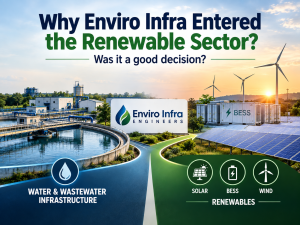
Why Did Enviro Need A Second Growth Engine?
Enviro’s original business is heavily dependent on water and wastewater infrastructure. Its track record is strong: the company has delivered 57 water and wastewater treatment plants with 958 MLD capacity.
The renewable entry gives Enviro access to a much broader infrastructure opportunity, but the more interesting rationale is business-model diversification.
In FY26, 80% of consolidated revenue came from EPC, 13% from HAM, 4% from O&M and 1% from IPP. In Q1 FY27, EPC still accounted for 84% of revenue.
This matters because water EPC is largely project-led. Renewable energy allows Enviro to participate in:
- EPC execution
- BESS projects
- Solar and BESS IPP assets
- Wind EPC
- O&M
So the strategy is not simply “enter a growing sector.” It is an attempt to reuse Enviro’s project-execution capabilities while adding businesses with longer-duration revenue potential.
That is a sensible strategic objective. Whether it creates better returns is a separate question.
Water EPC vs Renewable EPC vs IPP: The Economics Are Different
The mistake would be to treat all renewable revenue as economically identical to water EPC.
Water EPC: Enviro builds treatment infrastructure and recognises project revenue as execution progresses. It can scale without owning the completed asset, although working capital remains important.
Renewable EPC: Solar, wind and BESS EPC similarly provide project revenue without requiring Enviro to own the entire operating asset. This makes EPC the lower-capital-intensity route into renewables.
IPP: This is fundamentally different. Enviro retains ownership or economic interest in assets and earns returns over their operating life. The annual report explicitly says IPP assets are evaluated through long-term IRR and sustained energy-sales revenue rather than simply EBITDA.
That creates a trade-off:
- EPC → faster revenue recognition but project execution and working-capital risk.
- IPP → potentially more predictable long-term cash flows but substantially greater capital commitment.
- BESS IPP → potentially attractive recurring economics, but technology, financing, utilisation and contracting become critical.
The provided financials do not disclose separate EBITDA or ROCE for water EPC, renewable EPC and IPP, so claiming that renewables are already more profitable would go beyond the evidence.
Why BESS Changes The Renewable Thesis?
Solar and wind EPC are competitive businesses with established players. Enviro is therefore not entering an empty market.
For example, Sterling and Wilson already operates across utility-scale solar, hybrid energy and energy storage, while Waaree has expanded across solar EPC, energy storage and other clean-energy infrastructure.
BESS is more interesting.
Enviro’s Q1 FY27 presentation shows a 1,080 MWh BESS portfolio, alongside 91 MW of solar and 1,804 MW of wind. It also highlights entry into thermal-linked BESS and its NTPC partnership for grid-scale storage.
The order book reinforces the point:
- BESS EPC: ₹1,108 crore
- BESS/Solar IPP: ₹960 crore
- BESS/Solar O&M: ₹119 crore
That means BESS is not a side project within the renewable strategy. It is one of the largest components of the renewable order book.
This is where Enviro’s renewable strategy can become differentiated. If it remains just another solar EPC contractor, the strategic advantage is limited. If it builds execution credentials in BESS and combines storage with solar and wind, the opportunity becomes materially different.
₹75 Crore Investment: What Was Enviro Actually Funding?
The investment in EIE Renewables deserves more scrutiny than simply calling it a “new subsidiary.”
The FY26 annual report records ₹75 crore of investment in EIE Renewables as of 31 March 2026. It also states that the company initially invested ₹10 lakh and subsequently invested ₹49.90 crore through fresh allotment.
Importantly, this was not debt funding. The annual report shows no loan to EIE Renewables as of 31 March 2026, while the investment was recorded as equity.
But the subsidiary was already generating activity. During FY26, EIE Renewables was developing 79 MW of solar IPP capacity and 12 MW of solar EPC projects. It also secured four NTPC BESS EPC projects totalling 930 MWh and was developing a 150 MWh BESS IPP.
The key investor question is therefore not whether ₹75 crore was “large.” It is whether this equity investment eventually produces returns materially above Enviro’s cost of capital.
That has not yet been demonstrated. Check our latest video to know more.
Was Paying ₹311 Crore For Suyog Urja Justified?
Suyog is a different type of bet because Enviro paid ₹311 crore for an operating wind-energy business in April 2026. The acquisition added wind EPC capability with execution experience across 1,200 MW and an active execution pipeline of 1,702 MW.
But these numbers need to be separated carefully.
1,200 MW = execution experience.
It is not current order book.
1,702 MW = active execution pipeline.
It is not confirmed order book.
₹777 crore = order book.
The annual report describes this figure as approximately ₹777 crore, so it should not be treated as an exact number under a strict hard-number framework.
The strategic logic is nevertheless clear: buying Suyog gave Enviro an established wind EPC capability rather than building one from scratch.
The harder question is the ₹311 crore acquisition price. The acquisition can be justified only if Suyog converts its execution experience and pipeline into profitable orders and cash generation.
The acquisition is therefore a bet on future execution, not simply the purchase of ₹777 crore of orders.
The ROCE Problem Cannot Be Ignored
This is the biggest weakness in the renewable-expansion story.
Enviro’s consolidated ROCE fell from 44.4% in FY23 to 33.1% in FY24, 17.6% in FY25 and 17.3% in FY26. During the same period, net worth increased from ₹128.6 crore to ₹1,232.7 crore, while debt increased from ₹64.5 crore to ₹422.3 crore.
The decline cannot automatically be blamed on renewables because the renewable business was still relatively young. But it does establish the baseline against which future renewable investments must be judged.
The concern is straightforward: if Enviro keeps adding capital-intensive IPP assets and acquisitions while returns remain around current levels, revenue growth could come at the expense of capital efficiency.
On the other hand, renewable EPC can potentially improve asset utilisation without requiring the same level of asset ownership as IPP.
Therefore, renewables could reverse the ROCE decline only if EPC scales faster than capital employed and IPP investments generate sufficiently high returns.
The next few years should tell investors whether renewable expansion is increasing returns or merely increasing the denominator.
Order Book, Pipeline, Portfolio and Experience Are Not The Same
This distinction is essential because renewable presentations can make these four numbers look interchangeable.
| Metric | Enviro’s Position |
| Renewable order book | ₹3,027 crore |
| Solar portfolio | 91 MV |
| BESS portfolio | 1,080 MWh |
| Wind portfolio | 1,804 MW |
| Suyog execution experience | 1,200 MW |
| Suyog active execution pipeline | 1,702 MW |
The ₹3,027 crore figure represents renewable orders. The 91 MW, 1,080 MWh and 1,804 MW figures describe the company’s renewable portfolio. Suyog’s 1,200 MW represents past execution experience, while its 1,702 MW represents an active pipeline.
This distinction changes how the expansion should be valued.
An order book can support near-term revenue visibility. A pipeline can support future growth but can still fail to convert. A portfolio can refer to projects at different stages. Execution experience proves capability but does not guarantee future profitability.
For Enviro, the ₹3,027 crore order book is the strongest evidence of near-term renewable traction. The 1,702 MW pipeline is an opportunity, not revenue visibility.
Is Enviro Actually Differentiated?
Against established renewable EPC players, Enviro does not have an obvious advantage in conventional solar EPC.
Sterling and Wilson, for example, has a global solar EPC portfolio of 21.7 GWp and also operates in energy storage. Waaree combines solar manufacturing, EPC and energy storage, giving it significantly broader vertical integration.
Enviro’s differentiation is therefore narrower but potentially more interesting:
water infrastructure + solar + wind + BESS + IPP.
Its water relationships and EPC capabilities can provide a base for entering adjacent infrastructure markets, while BESS gives it exposure to the shift from standalone renewable generation towards dispatchable and hybrid power systems.
The annual report itself identifies BESS as an early-mover opportunity and says Enviro had secured 1,080 MWh of storage capacity through early technical qualifications.
That is the part of the strategy worth watching.
Enviro does not need to become India’s largest renewable EPC company. It needs to become a credible BESS-led infrastructure player without destroying its existing capital efficiency.
What Does The Valuation Say?
This article is primarily evaluating whether entering renewables was a good business decision, not whether the stock is a buy or sell.
That distinction matters because valuation can change even if the underlying business decision remains correct.
As of 11 September 2026, Enviro’s market capitalisation was around ₹3,635 crore, with a trailing P/E of 20.13x.
That valuation does not look like the market is treating Enviro as a distressed water EPC company. Investors are already assigning value to its future earnings potential.
Therefore, the renewable expansion has to eventually justify that expectation through higher-quality earnings, cash generation and returns on capital.
The stock valuation is useful as context, but it should not be used to prove that the renewable entry was right or wrong.
The business decision should be judged first. The stock becomes attractive only if the future returns justify the price investors are paying for them.
So, Was Entering Renewables A Good Decision?
Strategically, yes. Financially, it is still unproven.
The strongest part of the decision is not generic solar or wind EPC. It is the combination of BESS, renewable EPC and selective IPP exposure. The ₹3,027 crore renewable order book and 1,080 MWh BESS portfolio show that the company has moved beyond a symbolic entry.
Suyog also gives Enviro immediate wind EPC capabilities, while the ₹75 crore investment in EIE Renewables established the platform for solar, BESS and IPP activities.
But the expansion comes at an important point in the company’s financial evolution. ROCE has already fallen from 44.4% in FY23 to 17.3% in FY26, while debt has increased to ₹422.3 crore.
So the decision should not be judged by renewable revenue growth alone.
The measurable tests are now clear:
- Renewable ROCE: does it exceed the group’s current 17.3%?
- Operating cash flow: does reported renewable growth convert into cash?
- Working-capital days: do they remain controlled as EPC execution scales?
- IPP economics: what capital is deployed and what IRR does it generate?
- BESS profitability: does storage produce attractive returns rather than just large order values?
- Suyog profitability: does the ₹311 crore acquisition generate sufficient earnings and cash to justify the purchase?
If these metrics improve, renewables will have been a value-creating second engine. If revenue grows while ROCE and cash conversion deteriorate, the expansion will have increased the size of Enviro’s business without improving its quality.
That is the real test of whether the decision was good.