Polycab: Data Center Business, Revenue Mix & Growth Guidance
India’s data-center boom is creating a powerful new demand pool for the cable industry, and Polycab is well placed to capture it. As data centers scale, their need for reliable power and connectivity infrastructure rises sharply. This makes cables a more valuable part of each project.
Polycab is already supplying cables to data-center installations and sees a potential ₹20,000-25,000 crore addressable cable market over the next six to eight years. Wires & Cables already contributes around 87% of Polycab’s revenue. The opportunity is therefore not about entering an unfamiliar market. It is about using an existing strength to participate in one of India’s fastest-growing infrastructure cycles.

Data Centers Could Become Polycab’s Next High-Value Growth Engine
India’s data-center boom is creating an unusual opportunity for Polycab: the company does not need to build a single data center to benefit from the industry’s expansion. It only needs to supply the cables that make these facilities possible.
That distinction matters. Data centers are unusually cable-intensive projects. Management estimates that 1 MW of data-center capacity requires around ₹3.5 crore of cables. Cables account for 8-10% of data-center capex, compared with roughly 3% in standard infrastructure projects. In other words, as India adds computing capacity, the amount of electrical infrastructure required per project rises disproportionately.
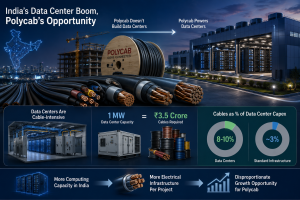
Polycab is already participating in this ecosystem. It has supplied cables to Vodafone Idea’s data centers in Mohali, Pune and South India through Vertiv, and management says its distribution network has supplied a majority of the conventional cabling used in existing installations. The opportunity, therefore, is not purely theoretical. The bigger question is how quickly this early presence can translate into a meaningful new growth vertical.
The Opportunity Is Bigger Than the Revenue Line Suggests
Data centers are not yet a separately reported revenue stream for Polycab, so the ₹20,000-25,000 crore addressable market should be viewed as an industry opportunity rather than a forecast for the company. The more useful question is how much of this pool Polycab could realistically capture.
A 5% share of the estimated market would translate into roughly ₹1,000-1,250 crore of cumulative revenue, while a 10% share would imply ₹2,000-2,500 crore over six to eight years. These are scenario estimates, not company guidance, but they provide a useful scale for the opportunity. Even the lower end would represent a meaningful incremental business, while the upper end could become a sizeable contributor to Polycab’s existing Wires & Cables franchise.
The case for a mid-single-digit or potentially higher share rests on Polycab’s starting position. The company already supplies data-center installations, has a large domestic distribution network and operates at a significant W&C scale. It is also pursuing approvals and certifications from large EPCs involved in global data-center projects.
The key point, however, is that market share will be earned project by project. Polycab does not need to dominate the entire data-center cable market for the opportunity to matter. Consistently winning a modest share while growing the underlying W&C business could create a meaningful second engine of institutional demand.
Why Polycab’s Existing Business Model Matters?
Polycab enters the data-center market from a position of scale rather than from scratch. In FY26, Wires & Cables generated ₹2,51,78.9 crore, accounting for roughly 87% of revenue. FMEG contributed around 7%, while EPC contributed around 6%. W&C also grew 33% during the year.
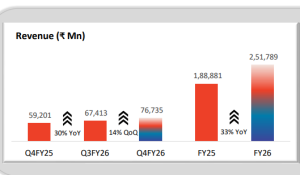
This revenue mix is important because the data-center opportunity is effectively an extension of Polycab’s core business.
The company already operates a predominantly domestic business. 94.6% of revenue comes from India, while around 90% of sales flow through distribution. At the same time, roughly 70% of revenue is B2B, giving Polycab exposure to institutional and industrial demand alongside its large retail network.
That combination creates an interesting second-order advantage. Data-center developers and EPC companies need reliable suppliers capable of delivering at scale, while Polycab’s distribution and manufacturing infrastructure gives it a broad base from which to deepen institutional relationships.
The opportunity is therefore not simply about selling more cable. It is about gradually shifting the company toward higher-value, specification-driven B2B demand.
Data Centers Could Improve the Quality of Growth
Polycab’s recent numbers already show strong momentum. FY26 revenue increased 29%, EBITDA grew strongly, PAT rose 32%, and RoCE improved to 31.5%. The company also ended FY26 with approximately ₹4190 crore of net cash, giving it considerable financial flexibility.
Data centers could strengthen this growth profile in a different way: by increasing the importance of projects where cable intensity is structurally high.
This matters because the value of the opportunity is not determined only by how many data centers are built. It also depends on how much cable each facility requires and how technically demanding those installations become. A data center that needs more power capacity, redundancy and sophisticated connectivity can create more cable demand without an equivalent increase in the number of facilities.
That gives Polycab a potential volume-plus-intensity growth model: industry capacity expands, while cable consumption per project remains elevated.
The company is also pursuing product approvals and certifications from large EPCs involved in global data-center construction. If successful, this could create a second benefit, moving Polycab deeper into the vendor ecosystem and potentially increasing the stickiness of institutional relationships.
Project Spring: The Bigger Growth Story
Data centers are only one part of Polycab’s larger opportunity. Project Spring targets Wires & Cables growth at around 1.5 times industry growth, while the company is simultaneously expanding its presence across renewable energy, power transmission and distribution, defence, EV charging and BharatNet.
The important implication is diversification without major business-model diversification. These markets look different from the outside, but they all require more electrical infrastructure. This gives Polycab multiple ways to benefit from India’s rising electricity consumption and infrastructure spending without becoming dependent on the success of any one theme.
There is also an operating advantage. Polycab can spread its manufacturing base, procurement network and distribution infrastructure across several end markets. That can make incremental capacity more productive as demand shifts between sectors.
A less obvious benefit is that data centers could raise the strategic value of Polycab’s B2B franchise even before they become a meaningful revenue contributor. Large infrastructure customers can generate repeat orders across multiple projects, potentially making institutional relationships more valuable than the initial data-center contract suggests.
The result is a business increasingly positioned as a picks-and-shovels play on India’s electrification and digitalisation cycle rather than a pure data-center proxy.
Competitor Analysis: Polycab vs KEI
Polycab and KEI are both positioned to benefit from the data-center build-out, but their strengths are different. On balance, Polycab appears better positioned to capture the broader opportunity, while KEI has a more specialised edge in high-voltage applications and the US market.
Polycab’s biggest advantage is scale. Its Wires & Cables business generated ₹2,51,78.9 crore in FY26, more than twice KEI’s roughly ₹11,200 crore W&C revenue. Polycab also combines conventional cables with optical fibre and already has data-center installations through Vertiv.
KEI, however, has a strong product fit for the power-intensive side of data centers. Its portfolio covers EHV, HT, MV, LT, copper flexible and control cables, while management has specifically identified US data centers as an opportunity for HT cables.
Polycab’s advantage is therefore less about having a unique product and more about scale plus execution infrastructure. Its large domestic distribution network, established W&C franchise and ability to serve multiple end markets provide a broader platform for absorbing incremental demand. Its 31.5% FY26 RoCE also suggests that this scale is currently being converted into strong capital returns.
KEI could outperform in selected high-voltage or export-led projects, but Polycab has the stronger all-round position to capture the volume of the opportunity while maintaining diversification across end markets. The competitive battle is therefore unlikely to be decided by one superior cable; it will be decided by who can secure specifications early, execute large orders reliably and turn project wins into repeat institutional relationships.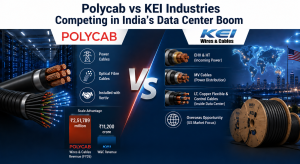
The Execution Moat Could Matter More Than the Product
In a market where several cable manufacturers can supply broadly similar products, the real competitive advantage may come from being selected before the order is placed.
Data-center projects involve EPC contractors, developers and technical specifications, making approvals and certifications important entry barriers. Polycab is already pursuing certifications from large EPCs involved in global data-center construction, while its existing relationship with Vertiv has given it exposure to operating installations.
Its distribution network adds another layer. Around 90% of Polycab’s sales flow through distribution, while approximately 70% of revenue is B2B. This gives the company an unusual combination of reach and institutional exposure.
The potential moat is therefore built from several pieces: manufacturing scale, product breadth, distribution reach, certifications and customer relationships. None is impossible for a competitor to replicate individually. The advantage comes from having all of them together.
There is also a compounding effect. A supplier that executes reliably on one data-center project has a better chance of being considered for the next project by the same EPC or developer. Over time, this can reduce the cost of winning new business and make customer relationships increasingly valuable.
That means Polycab’s strongest competitive advantage may not be its ability to manufacture cable. It is the ability to convert manufacturing capacity into repeat, specification-led institutional orders at scale.
Growth Guidance Points to a Broader Earnings Upside
Polycab’s near-term targets are already ambitious. Management is targeting 20%+ revenue growth in FY27, while maintaining a medium-term 20%+ CAGR ambition. W&C volume growth is expected to remain around 1.5 times the market, supporting continued market-share gains.
The margin picture is equally important. FY26 EBITDA margin was 13.9%, while Q1 FY27 remained at around 13.8%. RoCE reached 31.5% in FY26, suggesting the company is generating strong returns while expanding.
This creates a potentially powerful combination: high growth without requiring a major deterioration in capital efficiency.
If data centers become a larger part of the institutional mix, the benefit could extend beyond revenue. Large, technically specified projects can deepen Polycab’s relationships with EPCs and infrastructure customers, potentially creating repeat business across other high-growth sectors.
The bigger earnings story, therefore, may not be “data-center revenue” in isolation. It is whether the data-center opportunity helps accelerate Polycab’s transition toward a larger, more diversified and more institutionally anchored W&C franchise. Check our latest video for more details.
The Risks: A Large Market Does Not Guarantee Large Returns
- Addressable market ≠ Revenue: The ₹20,000-25,000 crore figure represents the industry's addressable market, not Polycab's future revenue or order book.
- Execution Risk: Winning data-center projects depends on timely product approvals, technical qualifications and strong EPC relationships. Having the right products alone does not guarantee orders.
- Capacity Utilisation Risk: Polycab is expanding capacity to support long-term growth. If infrastructure spending slows, utilisation could lag, affecting returns on invested capital.
- Commodity & Competitive Risk: Fluctuations in copper and aluminium prices, along with increased competition and new industry capacity, could pressure margins despite higher demand.
- Expectation Risk: The biggest risk may be valuation rather than demand. If investors already price in sustained above-market growth from multiple infrastructure themes, even strong operational performance may not translate into superior shareholder returns.
Valuation: What Would Justify the Premium?
Polycab’s 51.2x FY26 P/E and 25.5x EV/EBITDA show that investors are paying a premium for the company’s growth, balance sheet and execution quality. The valuation therefore needs to be assessed against operating milestones rather than in isolation.
The first metric to watch is W&C market-share growth. Polycab has already been growing volumes faster than the market, and sustaining that gap would provide evidence that its premium reflects genuine competitive gains rather than simply industry growth.
Second is margin expansion. FY26 EBITDA margin was 13.9%, so future growth becomes more valuable if it is accompanied by stable or improving margins rather than being driven purely by volume.
Third is RoCE. At 31.5% in FY26, returns are already strong; maintaining that level as the company expands would demonstrate that growth is not requiring excessive capital.
The fourth indicator is the B2B mix. If data centers and other institutional infrastructure projects increase the importance of B2B sales, investors should look for evidence that Polycab is becoming more deeply embedded in higher-value project demand.
Finally, data-center progress itself should be measured through actual project wins, EPC approvals, order conversion and revenue contribution, rather than industry announcements.
In short, the premium is easier to justify if Polycab can deliver market-share gains + stable/improving margins + high RoCE + deeper B2B penetration simultaneously. If those metrics weaken, the data-center narrative alone is unlikely to support the current premium.
What Could Change Over the Next 5-8 Years?
The biggest change may not be the emergence of data centers themselves, but the increasing electrical intensity of the digital economy.
As AI and cloud computing require more computing power, data-center operators need larger and more reliable power systems. That increases the amount of electrical infrastructure required around each facility. For cable manufacturers, this creates an unusual growth dynamic: demand can rise not only because more facilities are being built, but because each new facility can become more infrastructure-intensive.
This creates a potential second-order demand cycle for Polycab. More data centers mean greater power requirements; greater power requirements can drive investment in transmission and distribution infrastructure; and that additional grid investment creates another source of cable demand beyond the data center itself.
Polycab’s diversified end-market exposure makes this particularly relevant. The company can potentially participate at several points in the chain rather than depending solely on direct data-center orders.
The bigger opportunity, therefore, is not simply moving from a ₹20,000–25,000 crore addressable market to a larger number. It is the possibility that one infrastructure cycle creates another.
For Polycab, the strongest outcome would be a reinforcing loop in which data centers increase electrical demand, broader power infrastructure expands, and the company captures both through the same W&C manufacturing platform.
Conclusion
Polycab’s data-center opportunity is attractive precisely because it does not need to become a data-center company to benefit from it.
The company already has the scale, product range, distribution network and institutional relationships required to compete for this new demand. The real test now is conversion: turning an industry opportunity into actual project wins, building EPC relationships and steadily increasing its share of the addressable market.
If Polycab captures 5-10% of this market, it could generate around ₹1,000-2,500 crore in cumulative revenue over the next six to eight years. This is our estimate, not management guidance. That would not transform Polycab overnight, but it could become meaningful when layered onto a W&C business already growing ahead of the market.
The bigger investment question is whether Polycab can maintain that advantage without sacrificing returns. If market share rises, B2B penetration deepens, margins remain resilient and RoCE stays strong, the premium valuation becomes easier to defend.
Ultimately, the data-center boom may be less important for the number of cables Polycab sells than for where those cables take the company in the infrastructure value chain. If Polycab becomes a preferred supplier across the electrical backbone of India’s digital and industrial expansion, data centers could prove to be the entry point, not the end market.