HFCL vs STL: Same Fibre, 54× PE vs 130× PE
At first glance, HFCL and Sterlite Technologies (STL) look similar - both operate in optical fibre, connectivity and exports, and both are benefiting from the global digital infrastructure cycle.
Yet STL trades at roughly 130× PE versus - 54× for HFCL.
The difference becomes clearer when we look beyond the fibre itself.
The businesses are moving in different directions
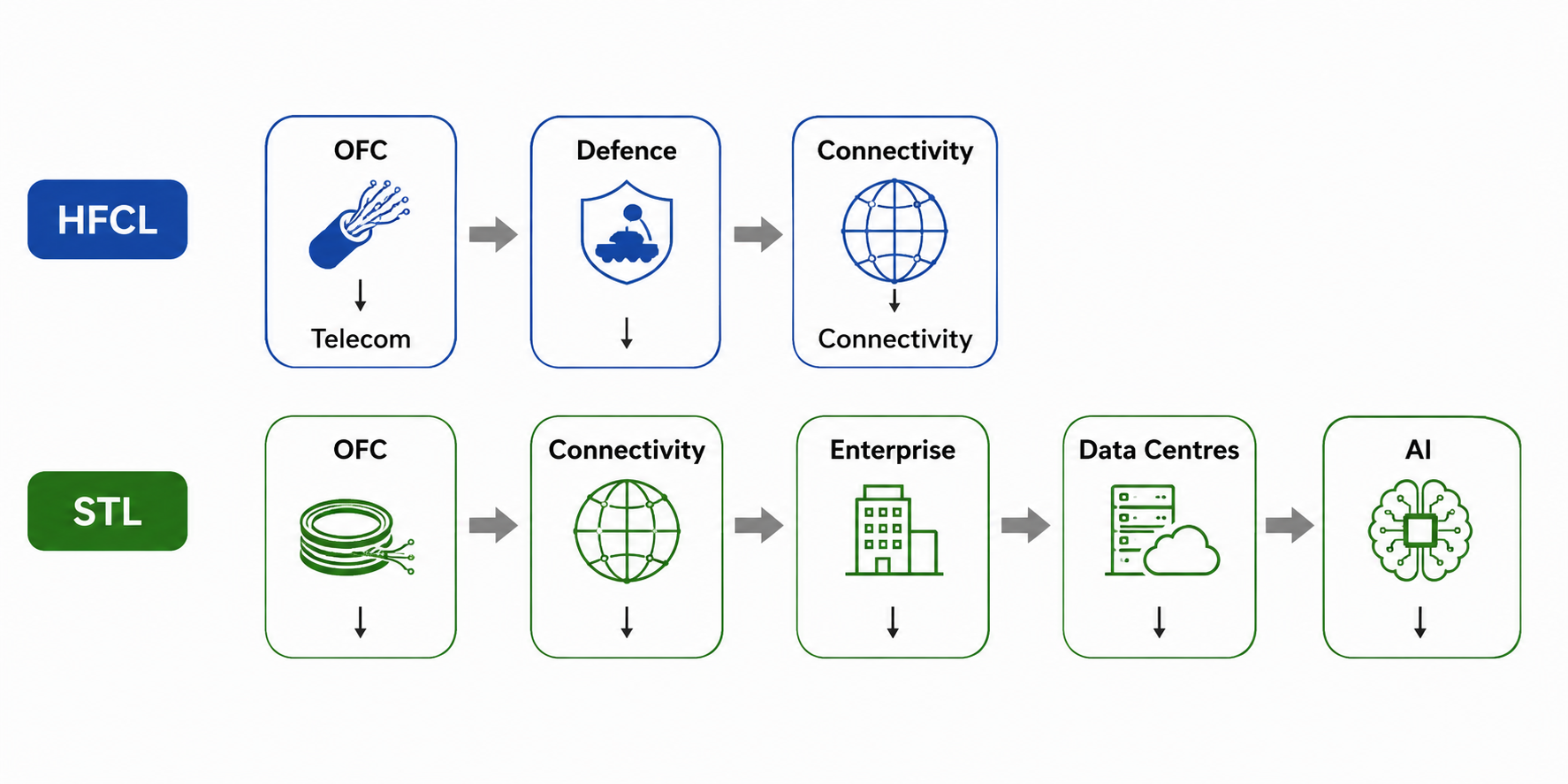
HFCL: OFC + Telecom + Defence + Connectivity
STL: OFC + Connectivity + Enterprise + Data Centres + AI
HFCL is building a diversified technology business, while STL is increasingly positioning itself as an AI-ready connectivity infrastructure provider.
HFCL's own strategy is to increase higher-margin product revenue, expand exports beyond 60%, develop hyperscaler-focused optical solutions and scale its defence business.
STL, meanwhile, is aggressively increasing its exposure to data centres, enterprise connectivity and hyperscalers.
Our view is therefore simple: STL deserves a premium only if this shift toward AI, data centres and higher-value connectivity translates into faster and more sustainable earnings growth.
Data Centres + AI are the biggest reason for STL's premium
This is where STL's story becomes fundamentally different.
STL's Data Centre contribution jumped from just 1% of revenue in FY26 to 21% in Q1 FY27.
More importantly, management expects Data Centre + Enterprise to reach up to 50% of FY27 revenue.
The company has already secured:
- $1.11 billion (~₹10,000+ Cr) multi-year AI data-centre connectivity contract
- $100 Mn+ hyperscaler orders for its Neuralis data-centre portfolio
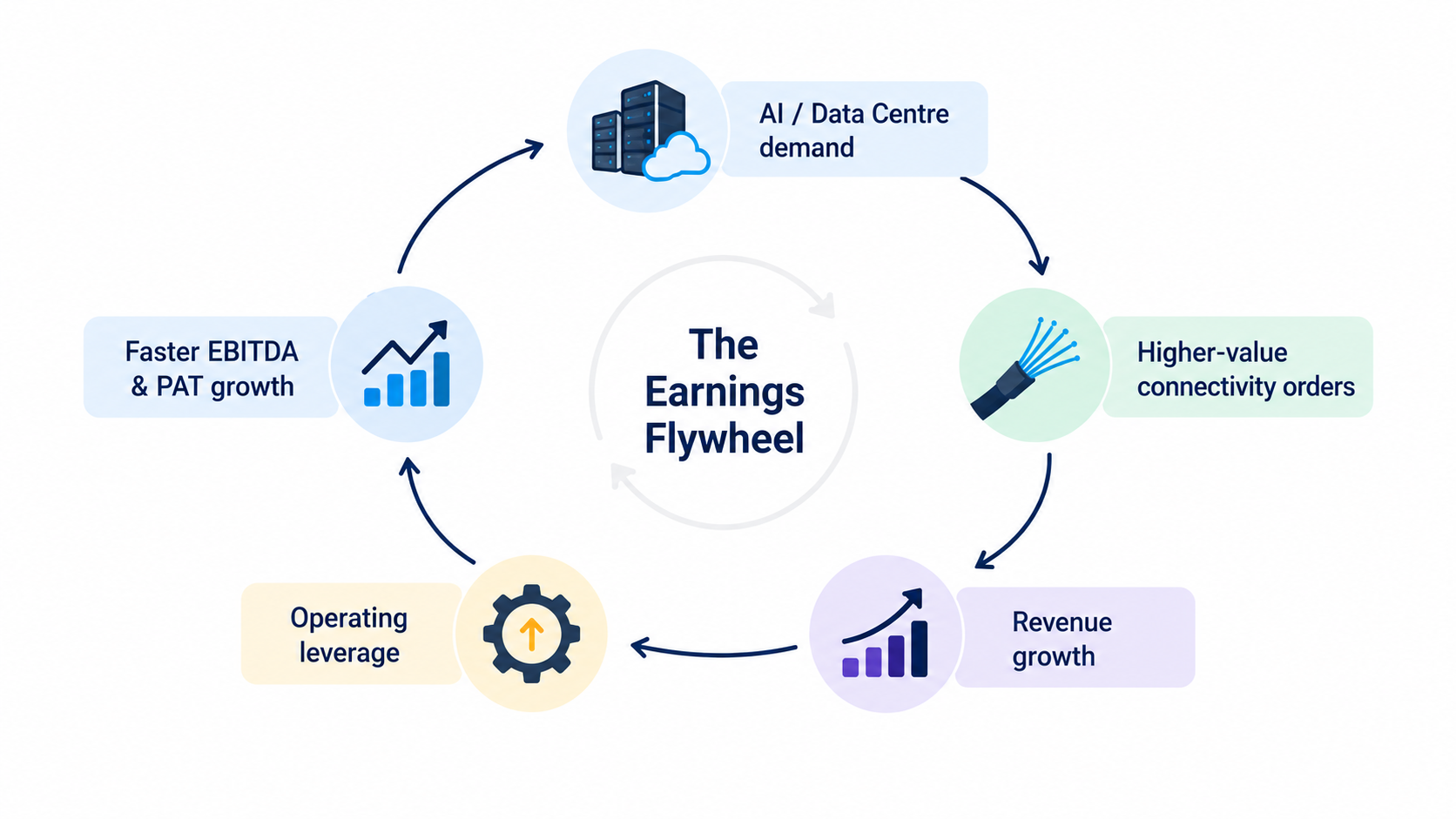
The important point is not simply that AI requires more electricity or more data centres. AI workloads are increasing power and connectivity density inside each facility, creating demand for higher-capacity and specialised fibre and connectivity products. This can also improve product mix and potentially support better margins.
STL is therefore trying to move from:
Selling fibre/cables
to
Selling the connectivity architecture required inside AI data centres.
Its optical-connectivity attach rate has already risen from 15% to 16%, with a target of 25% by FY27-end.
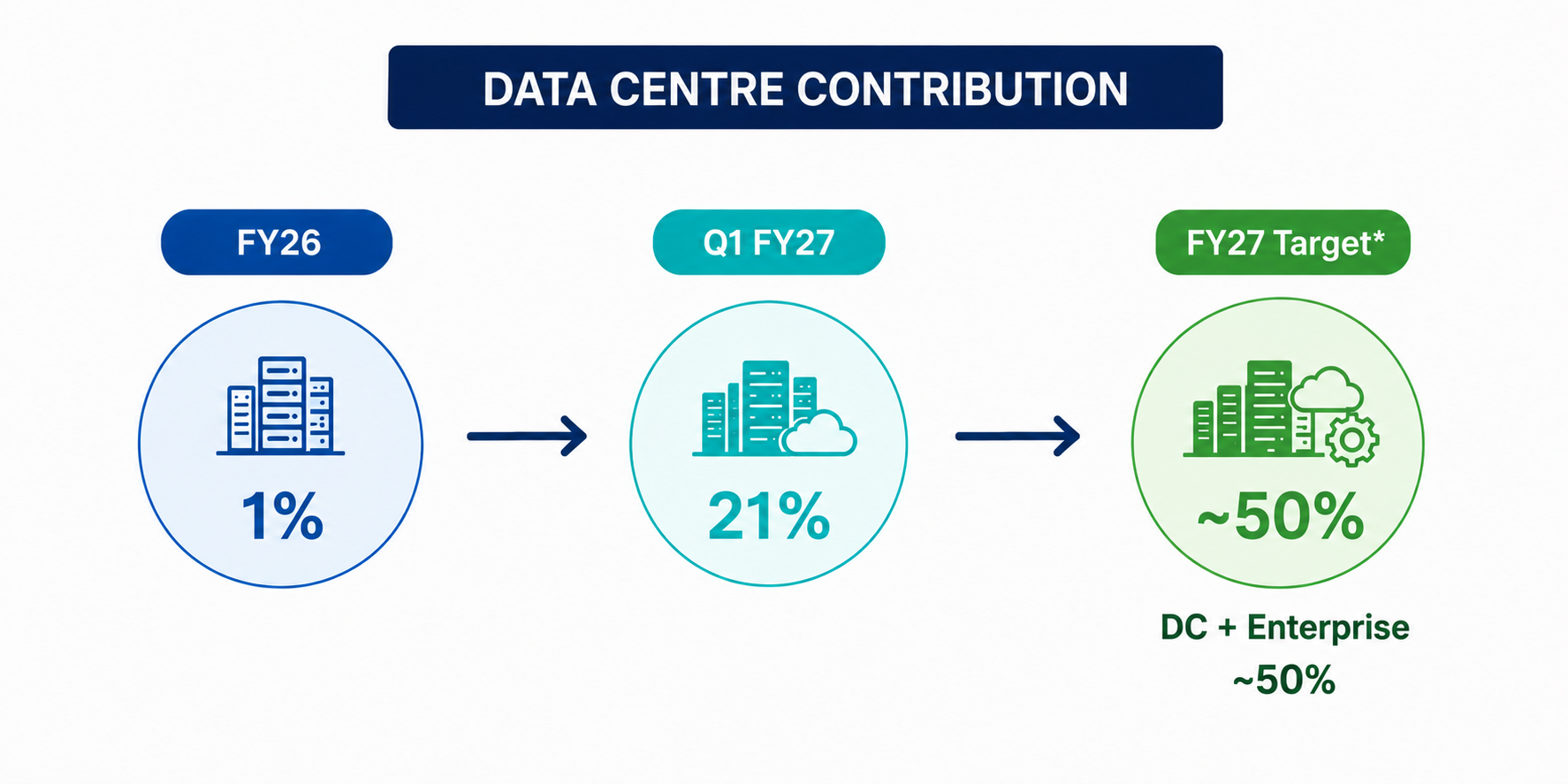
This is the core reason the market is willing to value STL as more than a fibre company.
The premium is also backed by extraordinary earnings acceleration
STL's Q1 FY27 numbers explain why investors are willing to look beyond its expensive headline PE:
Q1 FY27 | STL |
Revenue | ₹1,910 Cr |
YoY growth | 87% |
EBITDA | ₹397 Cr |
| EBITDA growth | 184% |
| EBITDA margin | 20.8% |
| PAT | ₹197 Cr |
| Order book | ₹18,618 Cr |
Management has now raised its FY27 EBITDA-margin guidance to 23%.
The order book also jumped 2.4× QoQ, providing visibility for future execution.
STL's Higher PE Does Not Mean HFCL Is a Weaker Business
This is perhaps the most interesting part of the comparison.
HFCL's Q1 FY27 numbers were actually stronger on several current metrics:
Q1 FY27 | HFCL | STL |
Revenue | ₹1,915 Cr | ₹1,910 Cr |
Revenue growth | 120% | 87% |
EBITDA | ₹445 Cr | ₹397 Cr |
| EBITDA margin | 23.25% | 20.8% |
| PAT | ₹246 Cr | ₹197 Cr |
| Order book | ₹26,665 Cr | ₹18,618 Cr |
HFCL has also raised its FY27 revenue-growth aspiration to 40%+.
So STL's 130× PE is not being justified by superior current financial performance.
The Growth Drivers: Where Are HFCL and STL Positioned?
Both companies benefit from the broader optical-connectivity cycle, but their growth drivers are increasingly different. HFCL has a more diversified set of growth engines, while STL is concentrating more heavily on higher-value connectivity, Enterprise and Data Centres.
Growth Driver | HFCL | STL |
1. Core Optical Fibre & Connectivity | Strong - OFC remains a core business; capacity is being expanded significantly | Strong - Optical Fibre, OFC and connectivity remain the core platform |
2. Telecom / Network Expansion | Strong - domestic telcos, BharatNet, 4G/5G and network rollouts | Strong - telecom operators, FTTx and rural connectivity across global markets |
3. Defence & Aerospace | Major growth engine - defence products moving towards serial production; ~₹2,000 Cr confirmed export order book through proposed aerospace acquisition | Limited |
4. Enterprise | Emerging through networking and system-integration solutions | Major focus - management wants to scale Enterprise + Data Centre contribution |
| 5. Data Centres & AI | Emerging - developing high-fibre-count cables and interconnect solutions for hyperscalers | Major growth engine - Q1 FY27 Data Centre contribution reached 21%; DC + Enterprise targeted at up to 50% of FY27 revenue |
| 6. Exports | Strong - exports ~56% of revenue; target >60% | Strong - global manufacturing footprint and customers across 100+ countries |
| 7. Higher-value Products | Major focus - targeting 80–85% product revenue and moving away from low-margin turnkey work | Major focus - increasing integrated connectivity solutions and next-generation optical platforms |
HFCL's strategy explicitly focuses on higher-margin products, capacity expansion, exports, hyperscaler optical solutions and higher-value defence products.
STL's FY27 priorities are to increase integrated-connectivity revenue, scale Enterprise & Data Centre, strengthen next-generation optical platforms and expand margins through operating efficiencies.
So, where is the difference?
HFCL's growth is broader:
OFC + Telecom + Defence + Exports + Hyperscaler products
while STL's growth is increasingly concentrated around:
OFC + Integrated Connectivity + Enterprise + Data Centres + AI
HFCL therefore has more diversified growth optionality, including a meaningful defence opportunity, while STL has a more concentrated exposure to the AI/data-centre connectivity opportunity. HFCL's current order book is also above ₹26,000 Cr, providing multi-year visibility across Telecom, Defence and Connectivity.
The valuation boils down to one bet
At 130× PE, STL is being valued on the assumption that:
- Data Centre + Enterprise scales rapidly
- AI/hyperscaler orders keep growing
- Integrated connectivity increases revenue per customer
- EBITDA margins move toward ~23%
- ₹18,618 Cr order book converts into revenue
- Net debt-free balance sheet supports the next growth phase.
- Higher capacity utilisation and operating leverage support further margin expansion
If these assumptions play out, today's PE can compress rapidly as earnings grow.
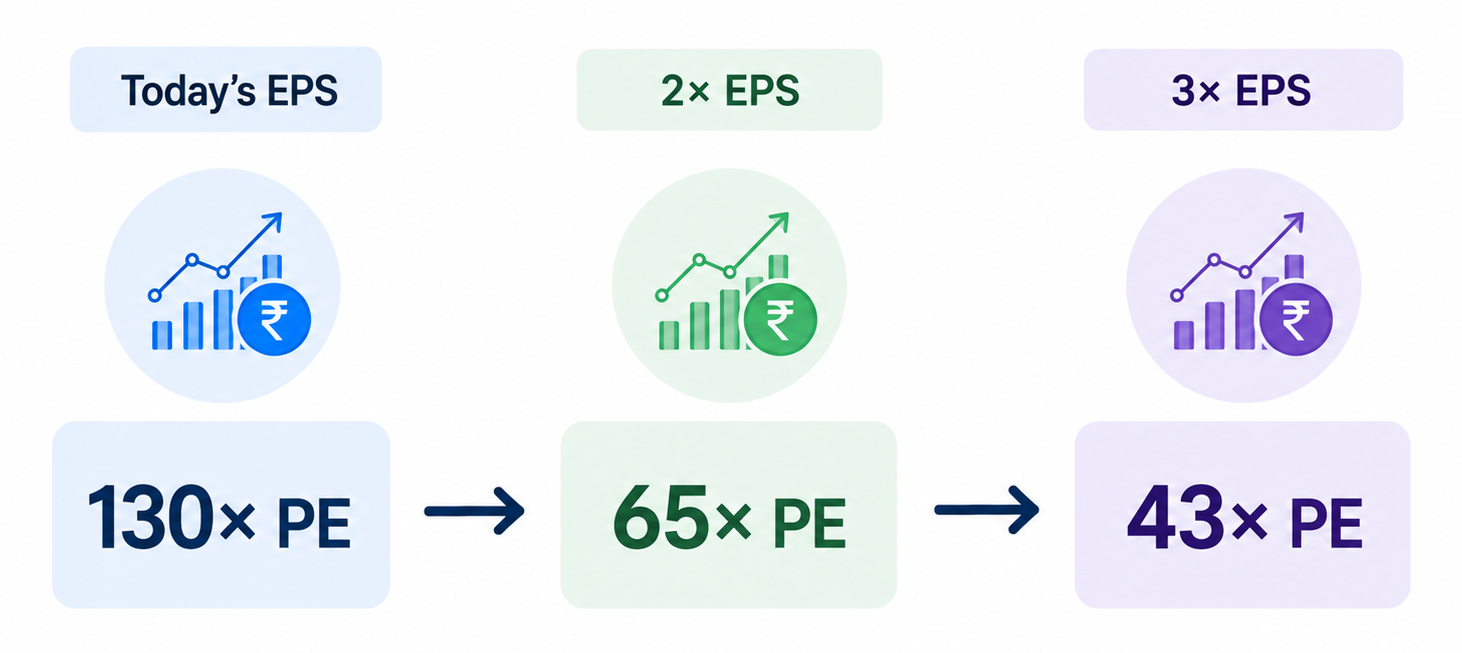
Same stock price. Higher earnings. Lower effective PE.
What Could Go Wrong?
STL's premium valuation is ultimately a bet on rapid earnings growth from AI, data centres and higher-value connectivity. At ~130× PE, the biggest risk is not that the business deteriorates - it is that growth falls short of what the valuation already assumes.
- Data Centre ramp-up disappoints
STL expects Data Centre + Enterprise to reach up to 50% of FY27 revenue, versus Data Centre contributing 21% in Q1 FY27. If this ramp-up is slower than expected, the biggest pillar supporting the premium valuation weakens.
- AI demand is strong, but expectations are already very high
STL has secured large AI/data-centre contracts, but the market is already pricing in continued rapid growth. Any slowdown in hyperscaler capex, delays in data-centre projects or slower conversion of AI orders could lead to a sharp valuation reset. STL's current order book stands at ₹18,618 Cr, making execution equally important.
- Margins need to keep improving
STL delivered a strong 20.8% EBITDA margin in Q1 FY27 and has raised its FY27 target to 23%. At 130× PE, merely maintaining current margins may not be enough - investors are expecting continued operating leverage.
- Integrated connectivity must scale
The valuation assumes STL can increasingly move from selling fibre/cables towards higher-value connectivity solutions. Its attach rate is currently 16%, with a target of 25% by FY27-end. Failure to achieve this would weaken the argument that STL deserves a structurally higher multiple.
- High valuation itself is the biggest risk
This is the most important one.
At ~130× PE, STL has very little room for an earnings disappointment. Even if the company continues growing, slower-than-expected earnings growth can cause PE compression.
Conclusion
The overall optical-connectivity opportunity remains attractive, with HFCL and STL positioned to benefit from different growth engines.
HFCL = Diversified Growth
OFC + Telecom + Defence + Connectivity
STL = AI & Connectivity-led Growth
OFC + Data Centres + Enterprise + Hyperscalers
STL's ~2.4× higher PE reflects the market's expectation that its increasing exposure to AI, data centres and higher-value connectivity solutions will drive faster earnings growth. The early evidence is encouraging - 21% Q1 Data Centre contribution, 50% DC + Enterprise target, ₹10,000+ Cr AI data-centre contract, ₹18,618 Cr order book and 184% EBITDA growth.
However, valuation remains the key differentiator. At ~130× PE, STL already discounts significant future growth, leaving less room for execution disappointments.
Our View:
Bullish on the industry, but selective on companies and valuations.
The opportunity is attractive, but growth alone is not enough - investors must assess the quality of growth, margin potential, execution and the price being paid for it.