Why Is HBL Engineering Moving Beyond Telecom Batteries?
HBL Engineering is not moving beyond telecom batteries because batteries have become a weak business. It is moving because one part of the battery portfolio is becoming structurally less attractive while other applications are producing better economics.
The clearest evidence is HBL’s own FY26 disclosure: telecom operators have migrated towards lithium-ion, reducing demand for 2V-VRLA batteries, creating excess industry capacity and increasing pricing pressure. HBL has decided not to supply lithium-ion packs to telecom because margins are too low to justify several years of warranty exposure.
The financial question is therefore much more specific:
How much revenue and operating profit could HBL lose from telecom, and what has to replace it by FY30?
That calculation reveals both the opportunity and the limitation of HBL’s battery strategy.
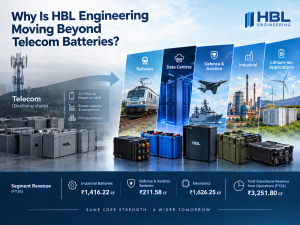
HBL Does Not Disclose Pure Telecom Revenue But ₹731 Crore Shows the Exposure
There is an important disclosure limitation that should not be ignored.
HBL’s FY26 audited accounts do not separately report telecom revenue. Instead, the company groups domestic battery revenue from “Telecom/Industry” together.
That bucket generated ₹731.37 crore in FY26, almost unchanged from ₹732.90 crore in FY25. HBL’s total battery revenue across domestic and export markets was ₹1,416.22 crore.
Therefore, ₹731.37 crore is not telecom revenue. It is the maximum size of the disclosed domestic battery Telecom/Industry bucket, which also contains industrial customers.
This distinction matters.
It means an investor cannot legitimately say that ₹731 crore of HBL revenue is going to disappear.
But it does allow a useful sensitivity analysis.
| Share of Telecom/Industry bucket assumed to be telecom | Revenue potentially exposed | Operating profit at HBL FY26 Industrial Battery margin* |
| 25% | ₹182.84 Cr | ₹45.03 Cr |
| 50% | ₹365.69 Cr | ₹90.06 Cr |
| 75% | ₹548.53 Cr | ₹135.09 Cr |
| 100% | ₹731.37 Cr | ₹180.12 Cr |
*Illustrative sensitivity only. HBL does not disclose telecom-specific operating margin; the calculation applies the FY26 Industrial Batteries segment operating margin to the hypothetical revenue exposed.
This gives a more useful definition of “lost telecom economics.”
Even if half of the Telecom/Industry battery bucket were telecom, the revenue at risk would be roughly ₹366 crore. At the Industrial Batteries segment’s FY26 operating margin, that would represent roughly ₹90 crore of operating profit.
But the actual figure could be lower because the ₹731 crore includes industry revenue, and HBL itself says telecom lithium-ion economics are unattractive.
The Margin Difference Explains Why HBL Is Willing to Walk Away
Revenue mix alone does not explain the strategy. Profitability does.
HBL’s FY26 consolidated segment accounts allow the operating economics of its three reportable businesses to be reconstructed.
| FY26 segment | Revenue | Derived segment operating profit | Operating margin | Approx. EBITDA margin* |
| Industrial Batteries | ₹1,416.22 Cr | ₹348.78 Cr | 24.6% | 25.9% |
| Defence & Aviation Batteries | ₹211.58 Cr | ₹73.24 Cr | 34.6% | 39.4% |
| Electronics | ₹1,626.25 Cr | ₹844.99 Cr | 52.0% | 52.7% |
EBITDA is derived by adding separately disclosed segment depreciation to segment operating profit; it is not separately reported as segment EBITDA.
The underlying audited figures show Industrial Batteries with ₹1,416.22 crore of revenue, Defence & Aviation Batteries with ₹211.58 crore and Electronics with ₹1,626.25 crore.
The difference is significant.
- Industrial Batteries generated a 24.6% segment operating margin.
- Defence & Aviation Batteries generated 34.6%.
- Electronics generated almost 52%.
This does not mean every telecom battery has a 24.6% margin or every defence battery earns 34.6%. The segments contain multiple products.
But it does show the economic direction HBL is pursuing.
The company is trying to replace commoditising battery volumes with businesses where qualification, engineering content, technology ownership and customer-specific requirements create greater pricing power.
Management’s AGM commentary reinforces this. It said HBL’s exports are increasingly driven by Nickel-Cadmium and defence batteries, while it does not export much lead-acid because competition is too high. Management also said there is little margin in imported lithium-ion telecom products, which is why HBL is not participating in that market.
The Replacement Is Not One Product, It Is a Profit Pool
The mistake would be to assume that HBL needs to replace every rupee of telecom revenue with another rupee of battery revenue.
The margin data shows why.
If ₹100 crore of a lower-margin battery business disappears and ₹100 crore of a higher-margin specialised business replaces it, the effect on operating profit can be very different.
For example, applying the FY26 segment margins:
- ₹100 crore at the Industrial Batteries operating margin → roughly ₹24.6 crore operating profit.
- ₹100 crore at the Defence & Aviation Batteries margin → roughly ₹34.6 crore.
- ₹100 crore at the Electronics margin → roughly ₹52 crore.
These are not forecasts for individual products. They simply illustrate why HBL’s diversification strategy is economically meaningful.
The replacement requirement is therefore about both revenue and margin.
Data Centres: The Growth Is Real, But the Financial Disclosure Is Still Incomplete
Data centres are one of the clearest replacements for declining telecom lead-acid demand.
HBL is the only manufacturer of Lead PLT batteries in India, according to its FY26 Annual Report. During FY26, it secured orders from STT, NTT, Colt, CapitaLand, Digital Edge, Reliance and CtrlS and reported 100% growth in data-centre sales over the previous year.
It is also doubling PLT production capacity.
But this is where the article needs to be more disciplined than simply saying “sales doubled.”
HBL does not disclose the absolute FY26 data-centre revenue, the physical PLT capacity in MW/MWh or units, or a target utilisation rate for the expanded capacity in its FY26 Annual Report.
Therefore, a precise rupee revenue opportunity cannot be calculated from public company disclosures.
What can be calculated is the capacity relationship.
If FY25 data-centre revenue is D, FY26 revenue after 100% growth was:
FY26 revenue = 2D
If PLT capacity is then doubled and the additional capacity achieves the same utilisation and realisation as the existing capacity:
The expanded plant could support approximately another 2D of annual capacity at that utilisation level.
In other words, the incremental revenue capacity would be approximately equal to the entire FY26 data-centre revenue.
But because D itself is not disclosed, assigning a ₹100 crore, ₹200 crore or ₹500 crore data-centre opportunity would be an unsupported estimate.
That is an important investor takeaway in itself.
The company has demonstrated demand strongly enough to double capacity, but investors still need the next disclosures on capacity, utilisation and realised revenue to determine the financial scale of the opportunity.
PLT Also Has a Second Demand Pool: Defence
The economics of PLT are not dependent entirely on data centres.
HBL says its PLT batteries are accepted for battle tanks, armoured vehicles and artillery guns in both domestic and international markets.
This creates an interesting overlap.
The same technology can address:
Data centres → high-rate backup
Defence → high-reliability power in demanding environments
That is more valuable than a single-customer application because capacity can potentially be utilised across different demand cycles.
But again, the investor should watch actual revenue rather than simply counting approvals and customer names.
Nickel-Cadmium Is the Most Visible Battery Replacement Today
Among HBL’s battery businesses, Nickel-Cadmium has the clearest disclosed commercial traction.
HBL describes itself as the second-largest supplier of industrial Nickel-Cadmium batteries globally. FY26 saw double-digit growth, a healthy FY27 order book and strong fresh order flows. Capacity expansion is being undertaken to meet demand.
The demand is spread across:
- oil refineries
- power plants
- oil and gas pipelines
- metro rail
- locomotives
- railway pantographs
- utilities
- overseas data-centre backup
Exports grew around 15% in FY26, and HBL reported a healthy export order book as of March 31, 2026.
More importantly, management has explained why the economics are different from telecom.
Nickel-Cadmium batteries are used in applications where safety and reliability are critical. Management said customers are less likely to switch suppliers simply on price, while export markets offer somewhat higher margins.
This makes Ni-Cd the most tangible candidate to absorb part of the telecom decline during FY27-FY28.
The ₹200 Crore Defence Lithium-Ion Investment Needs a Return Test
The most capital-intensive part of HBL’s battery transition is its defence lithium-ion cell programme.
HBL says it has invested approximately ₹200 crore in R&D and a modern production plant for defence lithium-ion cells. The technology has been licensed from NSTL of DRDO, there is no foreign collaboration, and management says the facility is adequate for foreseeable demand with capacity expandable through line balancing.
Management also made an unusually direct financial statement at the 2025 AGM: it expected the project to make a profit from year one. The strategic rationale is that India’s defence procurement system places a premium on indigenous supply, while defence applications can support small-volume, specialised products.
But “profit from year one” is not enough to calculate the return.
HBL has not disclosed plant revenue capacity, expected utilisation, annual EBIT, ROCE or payback period.
A useful way to frame the investment is therefore through return hurdles:
| Return on ₹200 Cr investment | Annual operating profit required |
| 15% | ₹30 Cr |
| 20% | ₹40 Cr |
| 25% | ₹50 Cr |
| 30% | ₹60 Cr |
At a 20% annual operating return, for example, the project would need to generate around ₹40 crore of annual operating profit on ₹200 crore of capital, before considering tax, working capital and the timing of ramp-up.
That does not mean HBL will earn ₹40 crore.
It shows the level of profit the plant would need to generate for different return thresholds.
The case for attractive economics rests on HBL’s choice of market: small-volume defence cells rather than mass-market lithium-ion cells. The company explicitly says it is avoiding capital-intensive industrial cell manufacturing and focusing on customised, engineering-intensive, higher-margin applications.
That is the strategic rationale.
The missing piece is the financial disclosure.
Until HBL reports utilisation and revenue from the plant, the ₹200 crore investment should be viewed as a return opportunity under development, not an established high-ROCE business.
Rail Lithium-Ion Could Start Contributing Before Defence Cells Scale
Railways provide another route for HBL’s lithium-ion investment without requiring the company to manufacture cells itself.
HBL says it has received significant-volume lithium-ion orders for Vande Bharat trains. Production volumes are currently small but are expected to scale with the number of trains in service. Siemens Germany has also selected HBL as one of two suppliers for developing lithium-ion batteries, according to the FY26 Annual Report.
The commercial timing is therefore different from defence cells.
FY27: existing Vande Bharat orders and railway qualification.
FY28 onward: potential volume expansion as train production scales.
This is important because HBL’s replacement strategy does not depend entirely on its ₹200 crore defence cell plant.
Rail lithium-ion batteries can grow using imported cells and HBL’s battery integration capability, while defence uses HBL-made cells.
The FY27-FY30 Replacement Bridge
HBL’s FY26 Annual Report says its current businesses should, in management’s “likely scenario, not a prediction,” exceed ₹5,000 crore of total sales in FY30. It also identifies four businesses expected to contribute most to sales over the next four years: Kavach, Industrial Nickel-Cadmium batteries, electronic fuzes and electric drive trains for trucks.
For the battery portfolio specifically, the replacement bridge looks like this:
| Period | Business | Evidence of commercial scale | Role in replacement |
| FY27 | Industrial Ni-Cd | Double-digit FY26 growth + healthy FY27 order book | Primary near-term battery replacement |
| FY27 | PLT/Data centres | FY26 sales +100%; capacity being doubled | Near-term capacity-led growth |
| FY27 | Railway LIB | Significant-volume Vande Bharat orders | Existing but scaling opportunity |
| FY27 | Defence batteries | Established recurring replacement business | Existing earnings pool |
| FY28 | Defence LIB cells | ₹200 Cr plant; management says profit from year one | Potential new profit pool |
| FY28 | Railway LIB | Train production expected to scale | Potential volume acceleration |
| FY28-29 | Electric-drive batteries | 55T truck homologation expected March 2027; pilot sales July 2027 | New battery demand linked to drivetrain sales |
| FY29-30 | Ni-Cd + LIB + PLT + defence batteries | Multiple applications and capacity additions | Potentially larger replacement base |
This table should not be read as a revenue forecast.
HBL has not provided enough product-level revenue guidance to responsibly assign ₹X crore to each row.
Instead, it shows the timing of the businesses that can contribute to replacing declining telecom economics. Check our latest video for more details.
What Has to Happen If Telecom Losses Reach ₹366 Crore?
The sensitivity analysis provides a useful benchmark.
If half of HBL’s FY26 Telecom/Industry battery bucket were ultimately attributable to telecom, the exposed revenue would be approximately ₹366 crore.
The company would then need to replace roughly ₹366 crore of revenue to maintain the same top line, assuming no other changes.
But if the replacement comes from higher-margin businesses, the required revenue could be lower from a profit replacement perspective.
For example:
- ₹366 crore at the Industrial Batteries segment’s 24.6% operating margin → roughly ₹90 crore operating profit.
- ₹260 crore at the Defence & Aviation segment’s 34.6% margin → roughly ₹90 crore operating profit.
- ₹173 crore at the Electronics segment’s 52% margin → roughly ₹90 crore operating profit.
Again, these are illustrative calculations using reported segment margins, not forecasts of the individual businesses.
That is the key financial insight:
HBL does not necessarily need to replace every lost telecom rupee with another battery rupee if the replacement mix carries structurally higher margins.
But There Is a Timing Gap
The replacement is unlikely to happen simultaneously.
Ni-Cd already has a commercial order book. PLT already has customers and is undergoing capacity expansion. Railway lithium-ion already has orders. Defence batteries are an established business.
But the ₹200 crore defence-cell plant is still an investment whose financial output needs to be demonstrated, while electric-drive batteries depend on the commercial rollout of HBL’s electric drivetrain.
HBL’s own FY26 report says electric-truck homologation is expected by March 2027, with pilot sales targeted for July 2027. Maritime electric-drive sales are expected to remain limited until the end of September 2027.
That means the battery replacement bridge has a clear sequencing:
- FY27: Ni-Cd + PLT + existing railway and defence batteries
- FY28: greater railway LIB + defence lithium-ion + initial electric-drive battery contribution
- FY29-FY30: potential scaling of newer applications
The timing matters because telecom pressure can arrive before every replacement business reaches meaningful scale.
The Real Test Is Margin Replacement, Not Battery Replacement
HBL’s FY26 numbers show why this strategy deserves to be analysed through profitability.
- The Industrial Batteries segment generated ₹1,416.22 crore with a derived operating margin of 24.6%.
- Defence & Aviation Batteries generated ₹211.58 crore at 34.6%.
- Electronics generated ₹1,626.25 crore at 52.0%.
The company therefore does not need to preserve the old portfolio exactly as it was.
But it does need to avoid replacing high-volume telecom revenue with low-utilisation new capacity.
That creates three financial checkpoints for FY27-FY30:
- First: utilisation.
New PLT and Ni-Cd capacity must translate into sales rather than merely expanding the asset base.
- Second: conversion of qualifications into orders.
Railway and defence lithium-ion programmes need to move from approved technology to recurring commercial revenue.
- Third: return on new capital.
The ₹200 crore defence lithium-ion investment needs to produce enough profit to justify the capital deployed.
These metrics will determine whether HBL’s battery strategy genuinely improves the quality of earnings.
Conclusion
The telecom risk is real, but its exact size is not publicly disclosed.
HBL’s audited accounts show a ₹731.37 crore Telecom/Industry domestic battery bucket, but because telecom and industrial customers are combined, that number cannot be treated as telecom revenue. A 50% telecom assumption would imply around ₹366 crore of revenue exposure, while a 75% assumption would imply around ₹549 crore.
Against that potential loss, HBL already has a commercial replacement base in Nickel-Cadmium, PLT, railway batteries and defence batteries, while lithium-ion defence cells, railway LIB and electric-drive batteries provide additional growth avenues.
The margin data makes the strategy more compelling financially: FY26 operating margins were approximately 24.6% for Industrial Batteries, 34.6% for Defence & Aviation Batteries and 52.0% for Electronics.
But the newer businesses still need to prove their economics.
HBL has not disclosed the absolute revenue, physical capacity or utilisation of its data-centre PLT business, nor the revenue capacity or ROCE of its ₹200 crore defence lithium-ion plant. Those disclosures will determine whether the new businesses can actually replace the earnings exposed to telecom.
So the central question for FY27-FY30 is no longer whether HBL is moving beyond telecom.
It is whether Ni-Cd, PLT, railway lithium-ion and defence batteries can replace the lost telecom economics faster than the telecom business loses them.
That is the financial bridge investors need to watch.