Why Is HBL Engineering Building New Businesses?
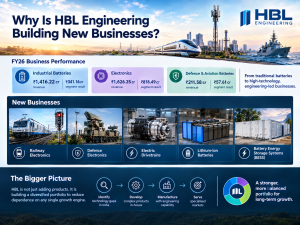
HBL Engineering’s FY26 numbers show why the company is building businesses beyond its traditional battery portfolio. Consolidated revenue reached ₹3,302.83 crore, EBITDA was ₹1,171.98 crore, and PAT was ₹814.89 crore. But the most important change was within the business mix: Electronics generated ₹1,626.25 crore, almost half of HBL’s revenue.
The problem is that nearly half of that Electronics revenue came from one product.
HBL’s FY26 Annual Report says Kavach contributed almost 50% of Electronics sales. That implies roughly ₹813.13 crore of Kavach revenue in FY26, or about 24.6% of HBL’s consolidated revenue. HBL expects Kavach to remain strong through FY27 and FY28, but says competition could increase and both sales and PBT could decline from FY29 onwards.
That makes diversification less about entering fashionable new markets and more about filling a measurable future gap.
The question for investors is therefore simple: Can HBL convert its pipeline of TMS, electronic fuzes, electric drives and lithium-ion products into enough commercial revenue before Kavach becomes a slower-growth business?
Kavach Has Become Too Important to Ignore
The concentration is visible in the numbers.
FY26 Electronics revenue was ₹1,626.25 crore. HBL says Kavach contributed almost 50%, putting the implied FY26 Kavach revenue at approximately ₹813.13 crore. Against consolidated revenue of ₹3,302.83 crore, that is approximately 24.6% of the entire company.
This creates a very specific sensitivity.
If FY26 Kavach revenue were to decline by 20%, the revenue reduction would be approximately ₹162.63 crore. A 30% decline would mean approximately ₹243.94 crore of revenue disappearing, assuming the FY26 Kavach base as the reference point.
That is not a forecast. It is a sensitivity calculation using HBL’s disclosed “almost 50%” contribution.
HBL itself has already acknowledged the risk. Its FY26 Annual Report says Kavach sales should remain good in FY27 and FY28, but competition could increase from FY29 and both sales and PBT could decline. At the September 2025 AGM, management similarly said there could be a decline in FY28, depending on qualification and order timing.
So HBL does not necessarily need another ₹800-crore business immediately.
It needs enough businesses to absorb a ₹163-244 crore annual revenue gap if Kavach eventually falls 20-30% from its FY26 base.
The FY27-FY30 Replacement Bridge
The table below is deliberately a revenue gap if Kavach declines, not a management forecast.
HBL has not disclosed individual FY27-FY30 revenue targets for TMS, fuzes or electric drives, so assigning invented numbers to each product would overstate the evidence.
| Fiscal year | Kavach assumption vs FY26 | Revenue gap to replace | What the disclosed pipeline says |
| FY27 | No decline assumed | ₹0 crore | HBL expects Kavach sales to grow over FY26 |
| FY28 | No specific decline quantified | Not quantifiable | HBL expects sales to remain good, but says a decline is possible |
| FY29 | 20% decline | ₹162.63 crore | HBL expects competition to increase and Kavach sales/PBT could decline |
| FY29 | 30% decline | ₹243.94 crore | Same sensitivity |
| FY30 | 20% decline sustained | ₹162.63 crore annually | New businesses would need to replace the lost run-rate |
| FY30 | 30% decline sustained | ₹243.94 crore annually | Same replacement requirement |
The comparison becomes particularly interesting for TMS/CTC. At the 2025 AGM, management said TMS/CTC could eventually generate ₹100-300 crore a year if deployment accelerates, while stressing that it would not be another Kavach-sized opportunity.
At the lower end of that range, TMS alone would cover roughly 61% of a ₹163 crore Kavach decline. At ₹300 crore, it could cover more than the entire annual gap created by a 20-30% decline.
But that does not mean HBL will earn ₹300 crore from TMS. It is management’s stated potential range, not a revenue forecast.
That distinction is critical.
TMS Is Already Beyond the R&D Stage
TMS/CTC is one of the strongest candidates to become a post-Kavach revenue contributor because HBL is not starting from a laboratory prototype.
The FY26 Annual Report says less than 2% of India’s railway network is covered by TMS, while the network is expanding. HBL’s software has been developed in-house and has already been proven satisfactory in four installations.
At the AGM, management added that HBL had obtained a reference that makes qualification easier against foreign competitors. It also said TMS/CTC would be smaller than Kavach but could potentially reach ₹100-300 crore of annual sales if the Railways accelerates deployment.
That gives TMS a different status from several other HBL projects:
- Technology: developed
- Reference installations: four
- Qualification barrier: substantially addressed
- Current revenue: not separately disclosed
- Annual potential disclosed by management: ₹100-300 crore
- Commercial timing: deployment-dependent
The important point is that HBL does not need TMS to become another Kavach.
If Kavach loses ₹163-244 crore of annual revenue, a TMS business reaching even the upper end of management’s stated range could materially address that gap.
But the railway’s adoption rate remains the variable HBL cannot control. Check our latest video for more details.
Electronic Fuzes Have Moved From R&D to Early Commercialisation
Electronic fuzes are further along than the earlier article suggested.
HBL says it began developing the technology in-house in 2006 and has developed the components and subsystems without importing proprietary items. The company says its electronic fuzes for grenades have received Ministry of Home Affairs approval and sales have started. Indian Army approval is expected during 2027, while approval for fuzes used in 155 mm artillery shells is also expected during 2027. A licensed manufacturing facility has been established in Telangana.
That changes how the business should be described.
It is no longer correct to call fuzes simply an “R&D opportunity”.
It is better classified as:
R&D → qualification → initial commercial sales → broader military approvals.
There is still an important limitation: HBL does not separately disclose FY26 fuze revenue, order-book value, production capacity or a FY28/FY30 revenue target.
Management has also said that ammunition fuzes are less profitable per unit because they are sold in large volumes, while some other fuze applications are more profitable. The company therefore intends to scale selectively rather than immediately chase maximum volume.
This makes the opportunity difficult to quantify today, but the commercialisation evidence is stronger than a simple “future product” label suggests.
Electric Drives Are Still Pre-Scale, but the Milestones Are Concrete
Electric drive trains are at a different stage.
HBL began developing electric drivetrains around 2016 and later focused on 55-ton electric trucks. The company says its complete drivetrain- batteries, motors, electronics and BMS is designed and developed in-house, with battery cells imported.
The project has now moved well beyond an early prototype.
HBL has completed approximately 40,000 km of internal road trials on its 55-ton trucks. The current expectation is for homologation approval by March 2027, followed by pilot sales beginning in July 2027.
That gives the business a clear commercialisation path:
40,000 km testing → homologation by March 2027 → pilot sales July 2027 → potential scaling thereafter.
However, HBL has not disclosed a revenue target or order book for electric truck drivetrains.
There is also a second route through maritime applications. HBL and Cochin Shipyard formed Green Maritime Propulsion Pvt Ltd in June 2026, and the JV has already placed an order with HBL for batteries for two electric tugs. HBL says marine sales will remain limited until the end of September 2027 while the products complete marine-standard development.
So electric drives should currently be viewed as commercialisation-stage rather than a meaningful existing revenue contributor.
Lithium-Ion Is Already Generating Orders, but the Economics Are Different
Lithium-ion is more advanced than electric drives in some applications, but it is important not to treat all lithium-ion activity as one business.
HBL explicitly avoids competing in commodity lithium-ion cell manufacturing because large-scale cell production requires substantial capital. Instead, it focuses on customised, engineering-intensive battery applications.
There are three important areas.
For railways, HBL says it has received significant-volume orders for lithium-ion batteries for Vande Bharat trains. It also says Siemens Germany has selected HBL as one of two suppliers for developing lithium-ion batteries.
For defence, the company has invested approximately ₹200 crore in R&D and a modern production plant for lithium-ion cells. HBL says the plant is adequate for foreseeable demand and can be expanded through line balancing.
For electric mobility and marine applications, HBL will use lithium-ion batteries as part of complete drive systems, with the maritime JV already placing an order for two electric tugs.
The key limitation is disclosure: HBL does not separately report lithium-ion revenue, order value or capacity utilisation.
So lithium-ion is already commercial in selected applications, but its contribution to consolidated earnings cannot yet be isolated from the public financial statements.
BESS Is Not Yet Quantifiable as a Separate Growth Engine
Battery Energy Storage Systems are another area where the previous article went too far by grouping every new technology together.
HBL’s website describes containerised lithium-ion BESS solutions and says it has installations across rail, defence and industrial applications.
However, the FY26 Annual Report does not separately disclose BESS revenue, order-book value, installed capacity, utilisation or a FY30 revenue target.
That means BESS should not be inserted into a Kavach-replacement model as if HBL has already disclosed a ₹X crore opportunity.
The same principle applies to HBL’s other exploratory businesses. The Annual Report says “other industrial electronics products” and “special defence products” are still in exploratory/R&D stages and are expected to be commercialised by FY30.
For an investor, this distinction matters:
An installation is evidence of capability. An order is evidence of commercial demand. Revenue is evidence of financial contribution.
They are not interchangeable.
HBL Is Spending on Technology Before It Spends Heavily on Scale
The capital-allocation story also explains why HBL can afford to maintain a long pipeline.
HBL’s FY26 Annual Report says its business model is to develop technology internally, enter niche markets and avoid capital-intensive businesses. The company explicitly says capital is required mainly after technology has been established, when the business moves toward scaling.
There are concrete examples.
The defence lithium-ion programme has absorbed approximately ₹200 crore for R&D and a production plant.
At the consolidated level, HBL spent ₹150.32 crore on purchases of fixed assets including CWIP in FY26, compared with ₹121.65 crore in FY25. Capital advances were another ₹23.81 crore.
Capital work-in-progress at March 31, 2026 stood at ₹127.48 crore, compared with ₹68.18 crore a year earlier.
There is also a direct R&D expense line. HBL recognised ₹25.90 crore of R&D expenditure in FY26 that was not eligible for capitalisation, versus ₹9.72 crore in FY25. Separately, its gross carrying amount of new-product-development expenditure remained ₹56.15 crore, with no FY26 additions to that capitalised category.
These numbers should not be interpreted as “₹200 crore was spent on every new business.” They show something more useful: HBL is funding technology development and selective manufacturing capacity rather than committing to giant greenfield projects before the technology is proven.
The Segment-Margin Story Needs to Be Read Correctly
The economics of diversification also need to be interpreted carefully.
HBL’s FY26 consolidated segment disclosure shows revenue of ₹1,626.25 crore for Electronics, ₹1,416.22 crore for Batteries and ₹211.58 crore for Defence & Aviation.
Using the segment expense disclosures, Electronics generated approximately 52.0% segment operating margin, compared with approximately 24.6% for Batteries and 34.6% for Defence & Aviation.
But this does not mean HBL made ₹844.99 crore of EBITDA from Electronics.
The ₹844.99 crore figure is derived from Electronics revenue less its disclosed identifiable and allocated operating expenses. At the consolidated level, total segment operating income was ₹1,139.24 crore. After ₹76.88 crore of unallocable expenses, operating profit was ₹1,062.36 crore. Other income of ₹58.99 crore took profit before interest and exceptional items to ₹1,121.35 crore.
Consolidated EBITDA was ₹1,171.98 crore, while PAT was ₹814.89 crore.
That reconciliation is important because segment operating income and consolidated EBITDA are different accounting measures.
The conclusion is nevertheless clear from the disclosed numbers: Electronics had a much higher operating margin than the Batteries segment in FY26, which gives HBL an economic reason to keep developing technology-led electronics businesses.
What Can Actually Replace Kavach?
The answer is not one product.
HBL’s own FY26 Annual Report identifies four business units expected to contribute most to sales over the next four years: Kavach, Industrial Nickel Cadmium batteries, electronic fuzes and electric drive trains for trucks. It separately says industrial electronic products and special defence products currently in development are expected to be commercialised by FY30.
That provides a more realistic way of looking at the post-Kavach transition.
| Business | Current stage | Revenue/order visibility | Commercialisation timeline | Role in replacing Kavach |
| Kavach | Scaled commercial business | ~₹813 crore implied FY26 revenue | Already commercial | Existing base; sales/PBT could decline from FY29 |
| TMS/CTC | Commercial/reference stage | Four satisfactory installations; <2% of railway network covered; management indicated ₹100-300 crore annual potential | Deployment-dependent | The clearest quantified railway replacement opportunity |
| Electronic fuzes | Early commercialisation | Grenade fuze sales have started; other approvals pending | Army/155 mm approvals expected in 2027 | Could become a meaningful defence contributor, but no revenue target disclosed |
| Electric drives | Pre-scale commercialisation | 40,000 km testing; two-tug battery order through marine JV | Truck homologation March 2027; pilot sales July 2027 | Potential medium-term contributor; no revenue target disclosed |
| Lithium-ion batteries | Commercial in selected applications | Significant Vande Bharat orders; defence plant established | Already commercial in rail; defence capacity available | Diversifies battery/eMobility revenue; individual revenue not disclosed |
| BESS | Installed/deployed, but not separately reported | HBL reports installations, but no FY26 revenue/order value separately disclosed | Ongoing | Cannot yet be quantified as a Kavach replacement |
The table shows why a simple “next Kavach” argument is misleading.
TMS has the clearest disclosed annual revenue range. Fuzes have actual early sales and a manufacturing facility but lack disclosed revenue figures. Electric drives have completed substantial testing but are still approaching pilot sales. Lithium-ion already has meaningful orders, but its financial contribution is not separately disclosed. BESS has installations but insufficient financial disclosure to put into the replacement bridge.
The More Important Number Is HBL’s FY30 Target
There is another way to assess whether the strategy is progressing.
HBL’s FY26 Annual Report says its current businesses should together achieve more than ₹5,000 crore of sales in FY30, although the report explicitly labels this a “Likely Scenario for FY30 and Beyond” and says it is not a prediction.
At the 2025 AGM, management had spoken of an MDA target of approximately ₹4,500 crore by FY30, and said that number remained reasonable.
The newer annual report’s >₹5,000 crore scenario is therefore useful as management’s latest disclosed framework, but it should not be treated as formal guidance.
More importantly, HBL says the four largest contributors over the next four years are expected to be Kavach, Nickel Cadmium batteries, electronic fuzes and electric drive trains.
That suggests HBL does not expect the post-Kavach story to come entirely from new products.
The replacement mechanism is broader:
existing battery businesses + TMS + fuzes + electric drives + lithium-ion + other products under development.
That is a portfolio transition rather than a one-for-one product replacement.
The Real Test: Are New Businesses Becoming Earnings?
HBL has already crossed an important threshold with Kavach. The FY26 results show what happens when a long R&D programme finally becomes a large commercial business.
The next test is whether the same process is now working across the pipeline.
TMS has references and a management-stated potential range. Fuzes have moved into initial sales, with additional military approvals expected in 2027. Electric drives have completed 40,000 km of testing and have a defined homologation and pilot-sales timeline.
Lithium-ion has significant rail orders and a ₹200 crore defence R&D/manufacturing investment. The marine business has already produced an order for batteries for two electric tugs.
But only some of these milestones translate into current earnings.
That is why the next two to four years matter.
If Kavach remains strong through FY27-FY28 as management expects, HBL has time to commercialise the next products. If Kavach revenue subsequently falls by 20-30%, the company would need roughly ₹163-244 crore of additional annual revenue simply to replace that lost Kavach revenue at the FY26 base.
TMS alone has a management-indicated potential range that could address a substantial part of that gap. Fuzes and electric drives could add further revenue as approvals and pilot programmes convert into commercial orders. Lithium-ion provides an already-commercial layer around rail, defence and mobility.
The strategy therefore does not depend on finding another Kavach.
It depends on whether multiple smaller businesses can cross the same R&D-to-revenue bridge that Kavach crossed before Kavach’s growth begins to slow materially.
For HBL, that is the real measure of diversification: not the number of new products under development, but the number that become separately meaningful sources of revenue, cash flow and profit.