Top 5 UCITS ETFs That Can Help Indian Investors Reduce US Estate Tax Exposure
If you're reading this article, chances are you're already aware of the US Estate Tax and how it can affect Indian investors holding US-listed assets. One of the most effective ways to reduce this exposure is by investing through Irish-domiciled UCITS ETFs instead of directly owning US stocks or US -listed ETFs.
The best part? You don't have to give up investing in world-class companies like Apple, Microsoft, Nvidia, Amazon, or Meta. Many UCITS ETFs continue to invest in these global leaders while offering a more estate tax-efficient investment structure for non-US investors.
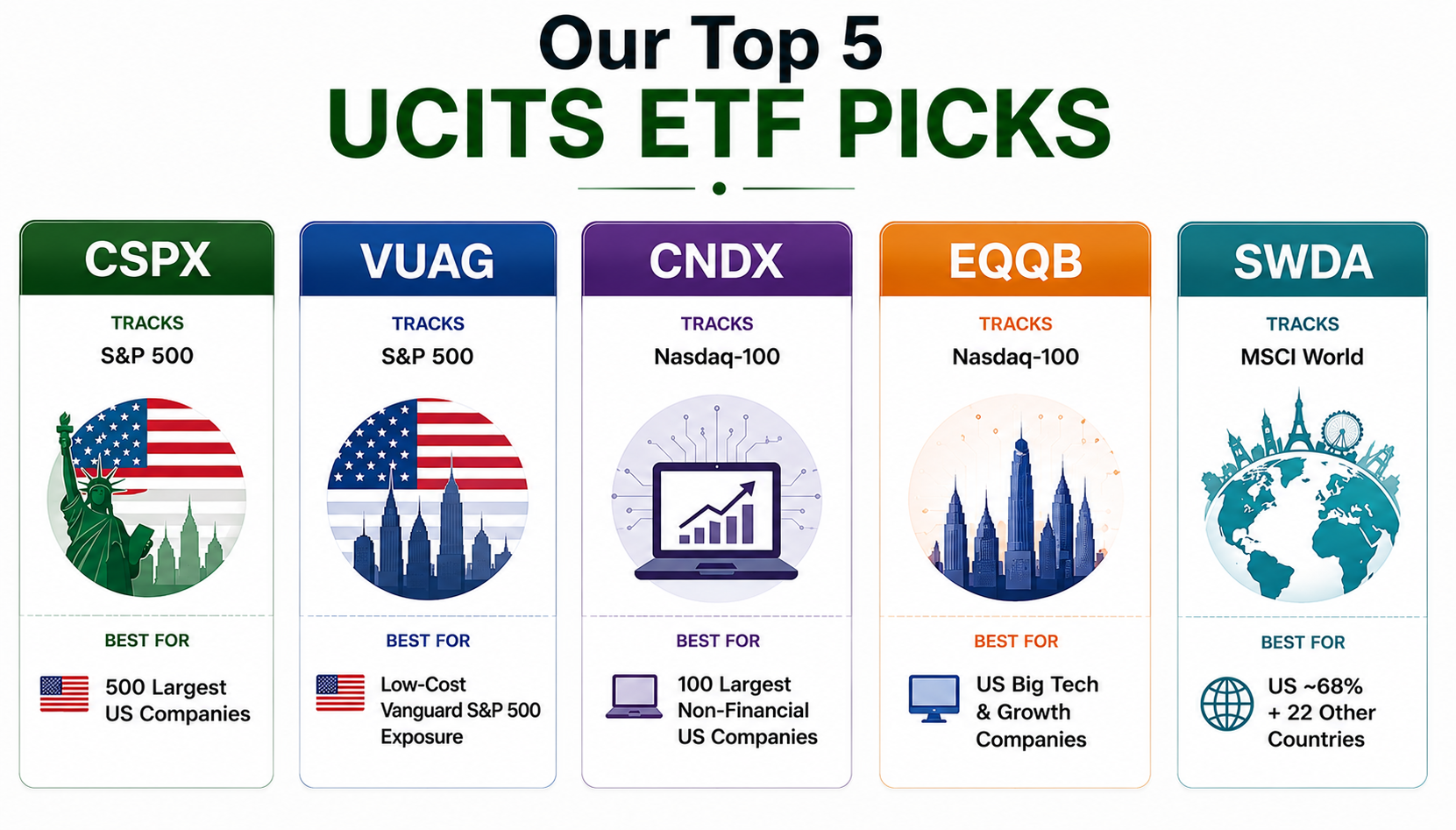
However, with hundreds of UCITS ETFs available in Europe, choosing the right one can be overwhelming. Some track only the S&P 500, others focus on the Nasdaq-100, while some provide exposure to thousands of companies across developed and emerging markets.
Let's dive into the top five UCITS ETFs that every Indian investor should know about.

How We Selected These ETFs
Not all UCITS ETFs are created equal. While there are hundreds of UCITS ETFs available in Europe, only a handful have become the preferred choice for long-term global investors.
For this list, we focused on ETFs that combine large fund size, low expense ratios, strong liquidity, broad diversification, and a long track record. We also gave preference to Irish-domiciled UCITS ETFs, as they are commonly used by international investors seeking a more estate tax-efficient way to gain exposure to US and global equities.
It's important to note that this list is not ranked from best to worst. Each ETF serves a different investment objective. Some are designed to track the S&P 500, others focus on the Nasdaq-100, while some provide exposure to thousands of companies across developed and emerging markets.
The right ETF ultimately depends on your investment goals, risk appetite, and desired level of diversification.
1. iShares NASDAQ-100 UCITS ETF (CNDX)
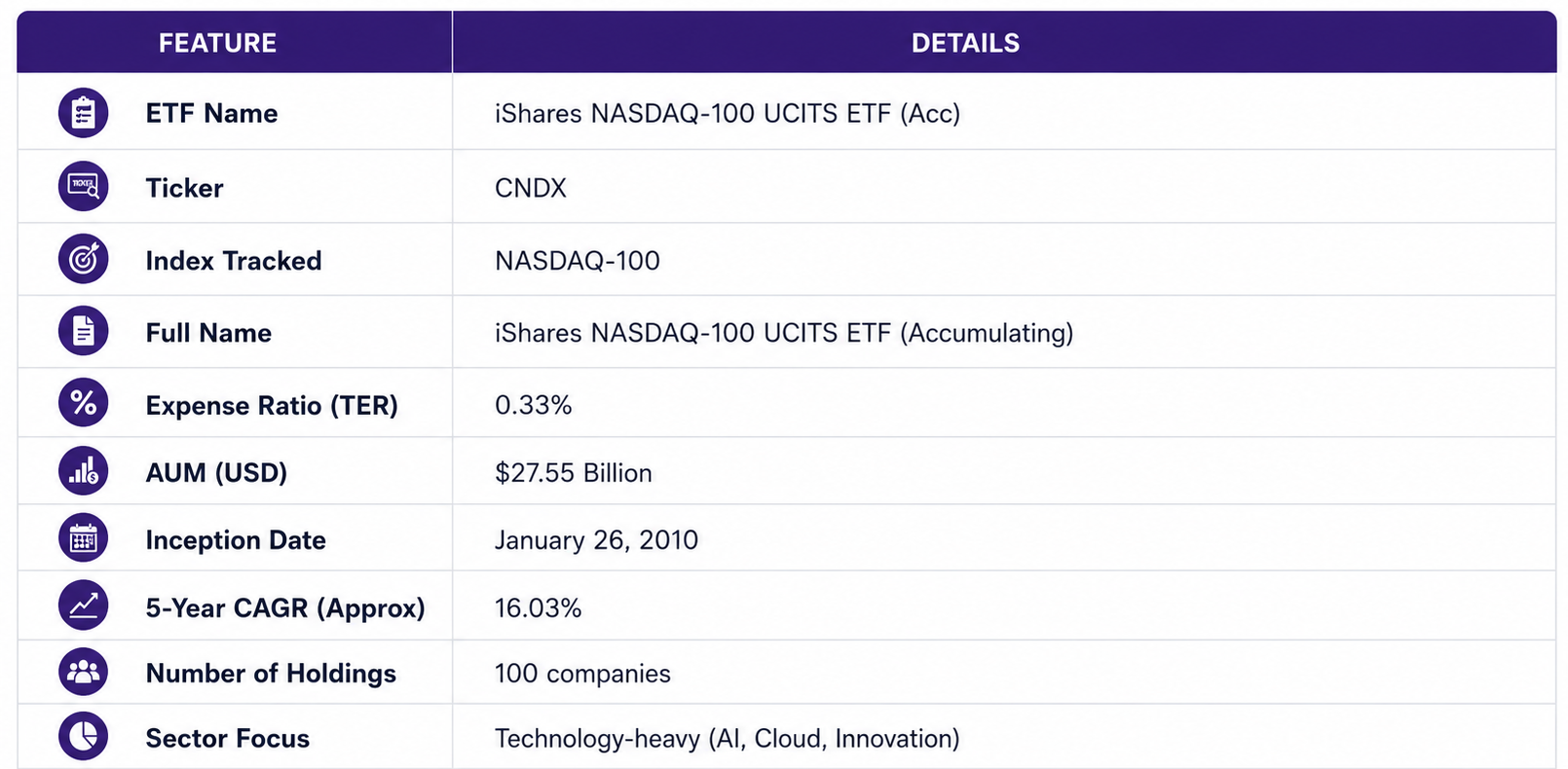
The iShares NASDAQ-100 UCITS ETF (CNDX) is one of the most widely used UCITS ETFs for gaining exposure to high-growth innovation and technology-driven companies in the United States.
This ETF tracks the NASDAQ-100 Index, which includes 100 of the largest non-financial companies listed on the NASDAQ stock exchange. These companies represent some of the most influential businesses in the global economy, particularly across technology, artificial intelligence, cloud computing, digital platforms, and consumer innovation.
The portfolio typically includes globally dominant names such as Apple, Microsoft, Nvidia, Amazon, Meta Platforms, Alphabet, Tesla, Broadcom, Netflix, and Costco, making it a highly concentrated exposure to the world’s leading innovation ecosystem.
Launched in 2010, CNDX has built a strong long-term track record and has grown into a large, institutional-grade ETF with multi-billion-dollar assets under management. Over the years, it has become a core holding for global investors seeking focused exposure to the US technology sector through a UCITS structure.
One of the defining characteristics of CNDX is its growth-oriented and high-conviction structure. Unlike broader indices such as the S&P 500, the NASDAQ-100 is heavily tilted toward technology and innovation companies, which have historically driven a significant portion of global equity market returns.
The ETF is domiciled in Ireland and UCITS-compliant, making it accessible to international investors, including Indian investors who want exposure to US growth companies without directly holding US-listed securities.
Due to its concentration in high-growth sectors, CNDX is generally preferred by investors who are comfortable with higher volatility in exchange for stronger long-term growth potential.
Why Investors Prefer CNDX?
CNDX has become a preferred choice for global investors due to several structural advantages:
- Provides focused exposure to the world’s leading technology and innovation companies
- Strong representation of AI, cloud computing, and digital economy leaders
- Long operating history of over a decade
- High liquidity supported by large institutional participation
- UCITS structure enabling international accessibility
- Suitable for long-term growth-oriented portfolios
Things to Consider
- Highly concentrated in technology and growth sectors
- More volatile compared to diversified indices like MSCI World
- Returns heavily dependent on a small number of mega-cap companies
- Not designed as a standalone diversified portfolio
2. Invesco NASDAQ-100 UCITS ETF (EQQB)
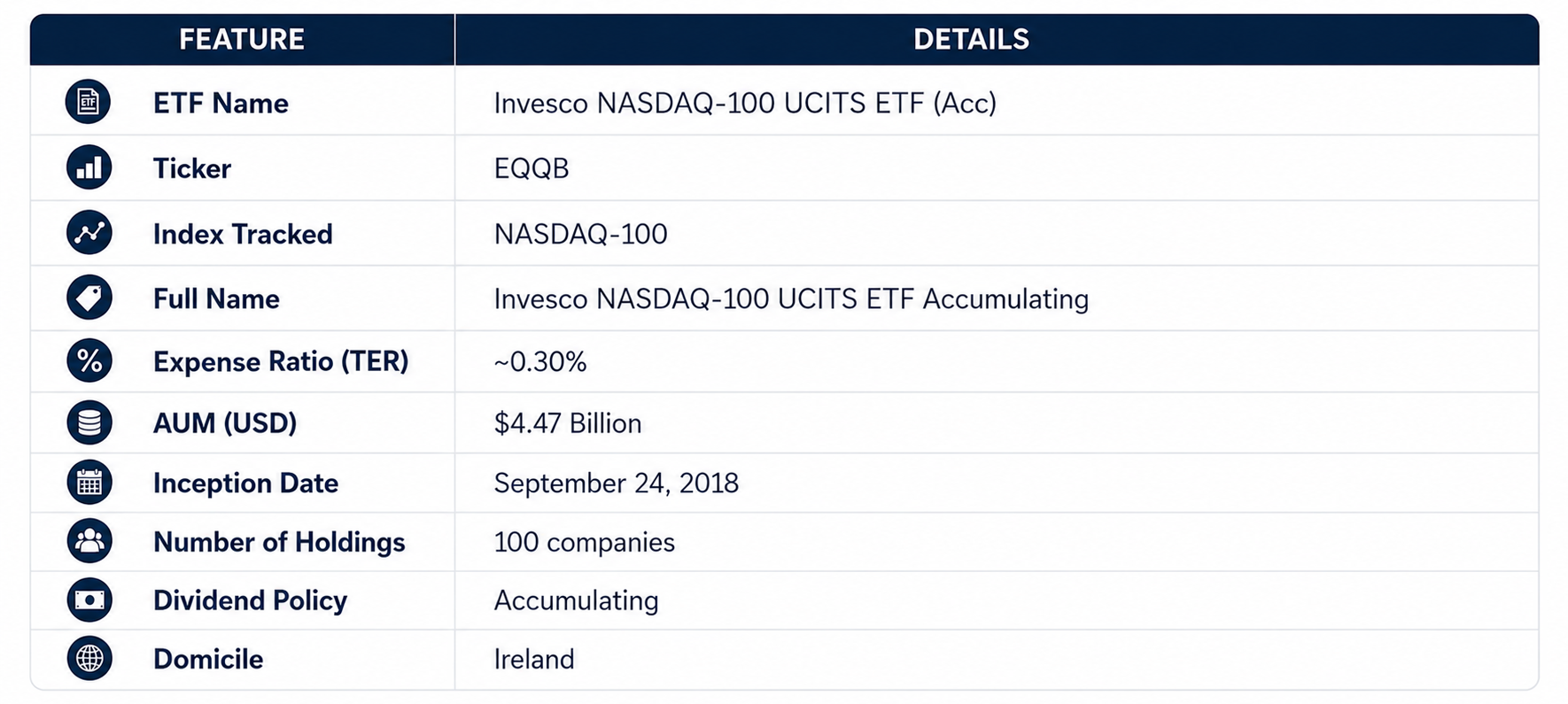
The Invesco NASDAQ-100 UCITS ETF (EQQB) is another way to gain exposure to the NASDAQ-100 Index, which includes 100 of the largest non-financial companies listed on the NASDAQ exchange.
Just like CNDX, this ETF gives investors access to global technology and innovation leaders such as Apple, Microsoft, Nvidia, Amazon, Meta, and Alphabet, along with other high-growth companies that dominate the modern digital economy.
The key difference is simply that EQQB is another option within the same index universe, managed by Invesco and structured under the UCITS framework in Ireland.
This makes it suitable for investors who want Nasdaq-100 exposure but prefer an alternative ETF provider or structure compared to CNDX.
Why Investors Consider EQQB?
EQQB is chosen by investors for several practical reasons:
- Provides exposure to the NASDAQ-100 Index
- Includes leading global technology and innovation companies
- Offers an alternative to other NASDAQ-100 UCITS ETFs like CNDX
- Managed by Invesco, a globally recognized asset manager
- Structured under UCITS framework for international investors
- Suitable for long-term growth-oriented portfolios
Things to Consider
- Highly concentrated in technology and growth sectors
- Similar exposure to CNDX (no major diversification difference)
- Performance depends heavily on a small group of mega-cap companies
- Not suitable as a standalone diversified portfolio
3. iShares Core S&P 500 UCITS ETF (CSPX)
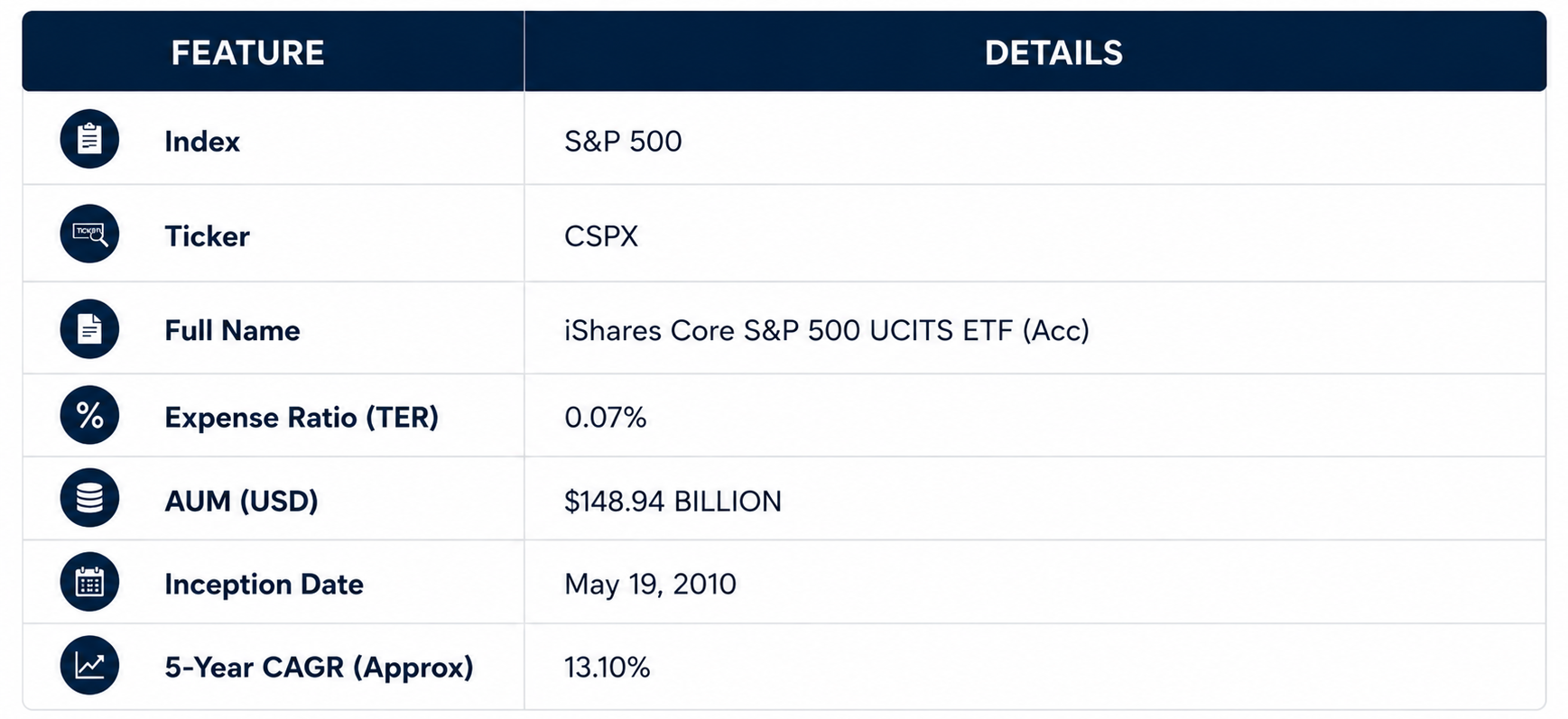
The iShares Core S&P 500 UCITS ETF (CSPX) is one of the most widely used UCITS ETFs for gaining exposure to the largest 500 publicly listed companies in the United States.
Managed by BlackRock (iShares), the world’s largest asset manager, CSPX tracks the S&P 500 Index, which represents approximately 80% of the total US stock market capitalization. This makes it one of the most efficient ways to gain broad exposure to the US equity market through a single investment.
The ETF includes globally dominant companies such as Apple, Microsoft, Nvidia, Amazon, Meta Platforms, Alphabet, Berkshire Hathaway, JPMorgan Chase, Broadcom, and Tesla, covering key sectors like technology, healthcare, financials, consumer goods, and industrials.
Launched in May 2010, CSPX has built a strong track record of more than a decade and has grown into a multi-billion-dollar institutional-grade ETF, widely held by global investors, pension funds, and long-term wealth managers. Its scale and longevity reflect strong global confidence and consistent investor adoption over time.
One of the key strengths of CSPX is its extremely low cost structure, with a total expense ratio of just 0.07% per year, making it one of the most cost-efficient ways to access US equities in UCITS format.
The ETF follows an Accumulating structure, meaning dividends from underlying companies are automatically reinvested into the fund. This helps investors benefit from long-term compounding without manual reinvestment.
For Indian investors, CSPX also offers an indirect way to gain exposure to US equities through a UCITS-compliant, Ireland-domiciled structure, which is widely used in global portfolio construction.
Overall, CSPX is often considered a core portfolio holding for long-term investors seeking simple, low-cost, and diversified exposure to the US stock market.
Why Investors Prefer CSPX?
CSPX is widely used in global portfolios due to its strong structural advantages:
- Exposure to 500 of the largest US companies
- One of the lowest-cost S&P 500 UCITS ETFs available
- Very high liquidity supported by massive global AUM
- Long track record of more than a decade
- Managed by BlackRock, a global leader in asset management
- Accumulating structure supports long-term compounding
Things to Consider
- Entirely dependent on US equity market performance
- Limited international diversification
- Heavy influence from top mega-cap companies
4. Vanguard S&P 500 UCITS ETF (VUAG)
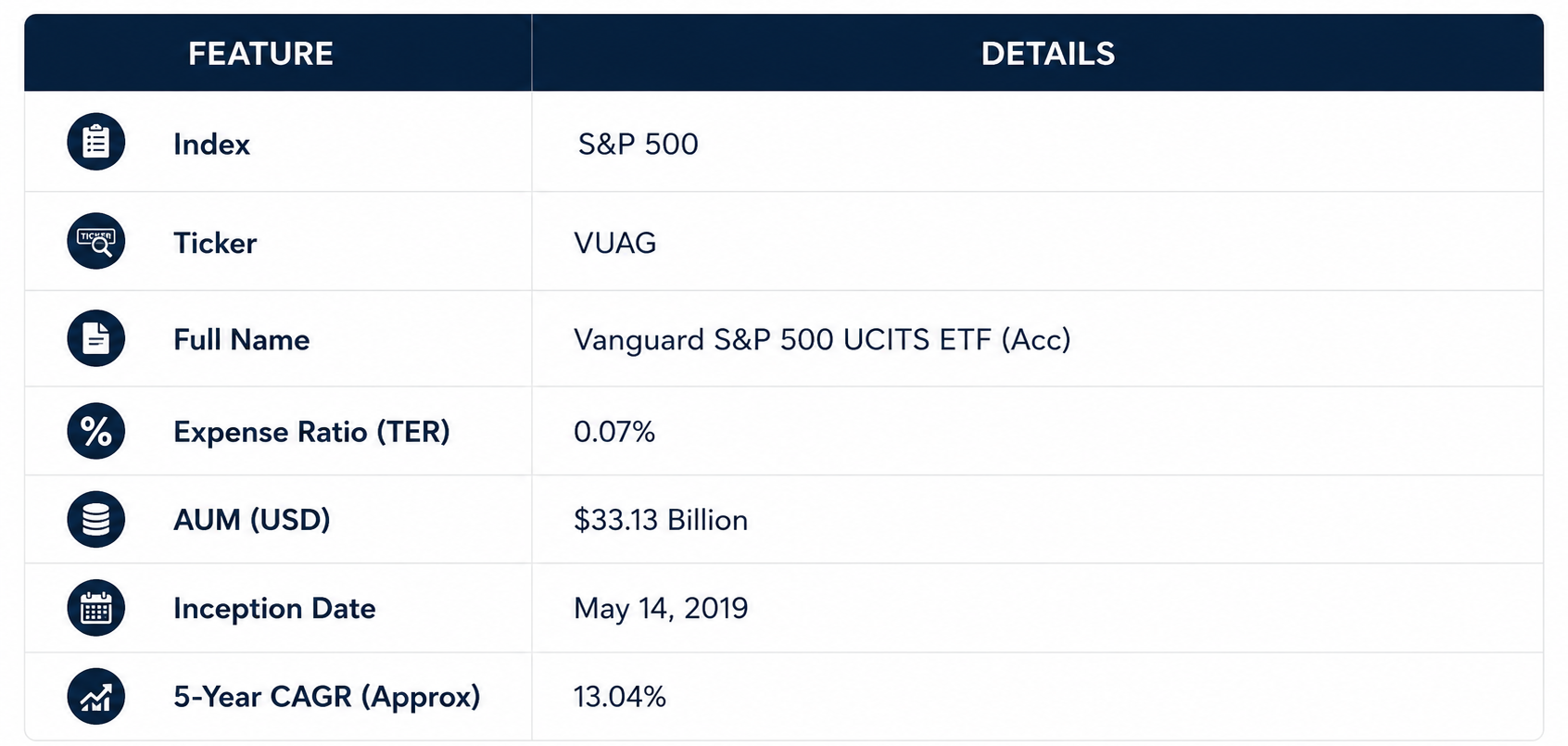
One of the key advantages of VUAG is its very low expense ratio of 0.07%, which is identical to CSPX. This makes it highly cost-efficient for long-term investors, especially those focused on minimizing fees while maximizing compounding over time.
VUAG follows an Accumulating structure, meaning dividends from the underlying companies are automatically reinvested back into the fund. This helps investors benefit from compounding without needing to manually reinvest dividend income.
Why Investors Prefer VUAG?
VUAG is widely used in global portfolios due to its strong structural advantages:
- Exposure to 500 of the largest US companies
- Low-cost passive investing backed by Vanguard’s reputation
- Strong global investor trust and large asset base
- Accumulating structure for long-term compounding
- High liquidity and easy accessibility via European brokers
- Simple, core building block for equity portfolios
Things to Consider
- Entirely dependent on US equity market performance
- Limited diversification outside the United States
- Similar performance profile to CSPX (no major differentiation in index exposure)
5. iShares Core MSCI World UCITS ETF (SWDA)
If you're looking for global diversification instead of investing only in the United States, the iShares Core MSCI World UCITS ETF (SWDA) is one of the most popular UCITS ETFs.
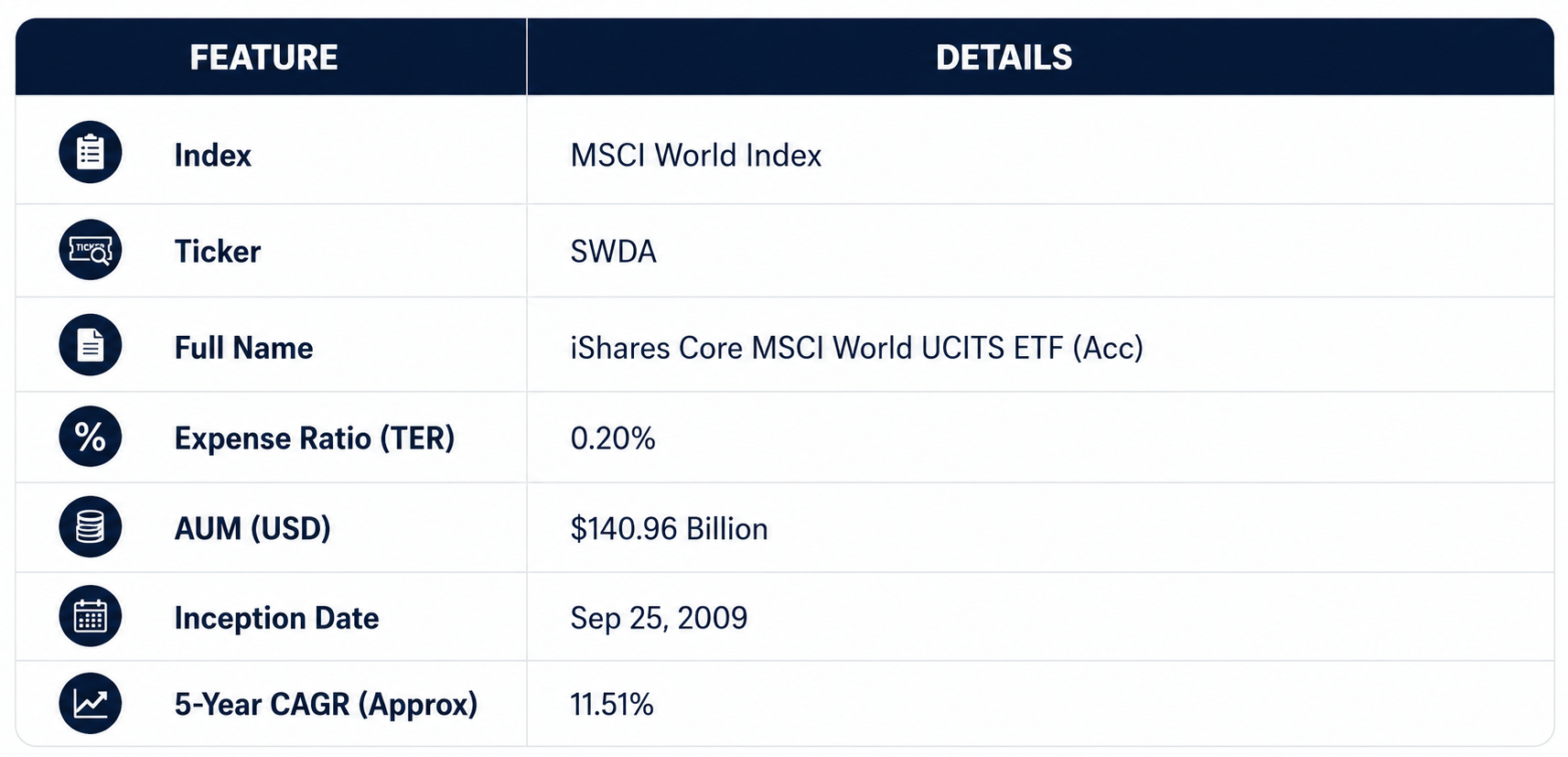
start="182" data-end="485">Managed by BlackRock (iShares), SWDA tracks the MSCI World Index, offering exposure to over 1,200 large and mid-cap companies across 23 developed markets. While the US remains the largest allocation, investors also gain exposure to Japan, the UK, France, Germany, Switzerland, Canada, and Australia.
Unlike an S&P 500 ETF, SWDA invests across multiple developed economies and industries. Its holdings include Apple, Microsoft, Nvidia, Amazon, Meta Platforms, Nestlé, ASML, Novo Nordisk, Toyota, and LVMH.
Launched in September 2009, SWDA has over 17 years of history and more than $140 billion in assets. Its scale, liquidity, and long track record make it a core holding for many investors.
The ETF follows an Accumulating structure, automatically reinvesting dividends received from the underlying companies back into the fund. Combined with its broad diversification and low-cost passive approach, SWDA is widely regarded as a strong long-term "buy-and-hold" investment for investors seeking global developed market exposure.
For Indian investors looking to build an internationally diversified portfolio through an Ireland-domiciled UCITS ETF, SWDA offers a simple way to invest across multiple developed economies while benefiting from a globally recognized investment structure.
Why Investors Prefer SWDA?
SWDA has become one of the most widely used global equity ETFs because it offers:
- Exposure to more than 1,200 companies across developed markets
- Diversification across 23 developed countries
- Reduced dependence on a single country's economy
- Long track record dating back to 2009
- One of the largest UCITS ETFs globally with over $140 billion in assets
- Accumulating structure that automatically reinvests dividends
- A simple "buy-and-hold" solution for long-term investors
Things to Consider
- Invests only in developed markets and does not include emerging markets such as India, China, or Brazil.
- The United States still represents the largest allocation in the index due to its market size.
- Slightly higher expense ratio than S&P 500 UCITS ETFs such as CSPX and VUAG.
To understand the concept of taxation on US stocks and ETFs in detail, watch our youtube video below.
Which UCITS ETF Should You Choose?
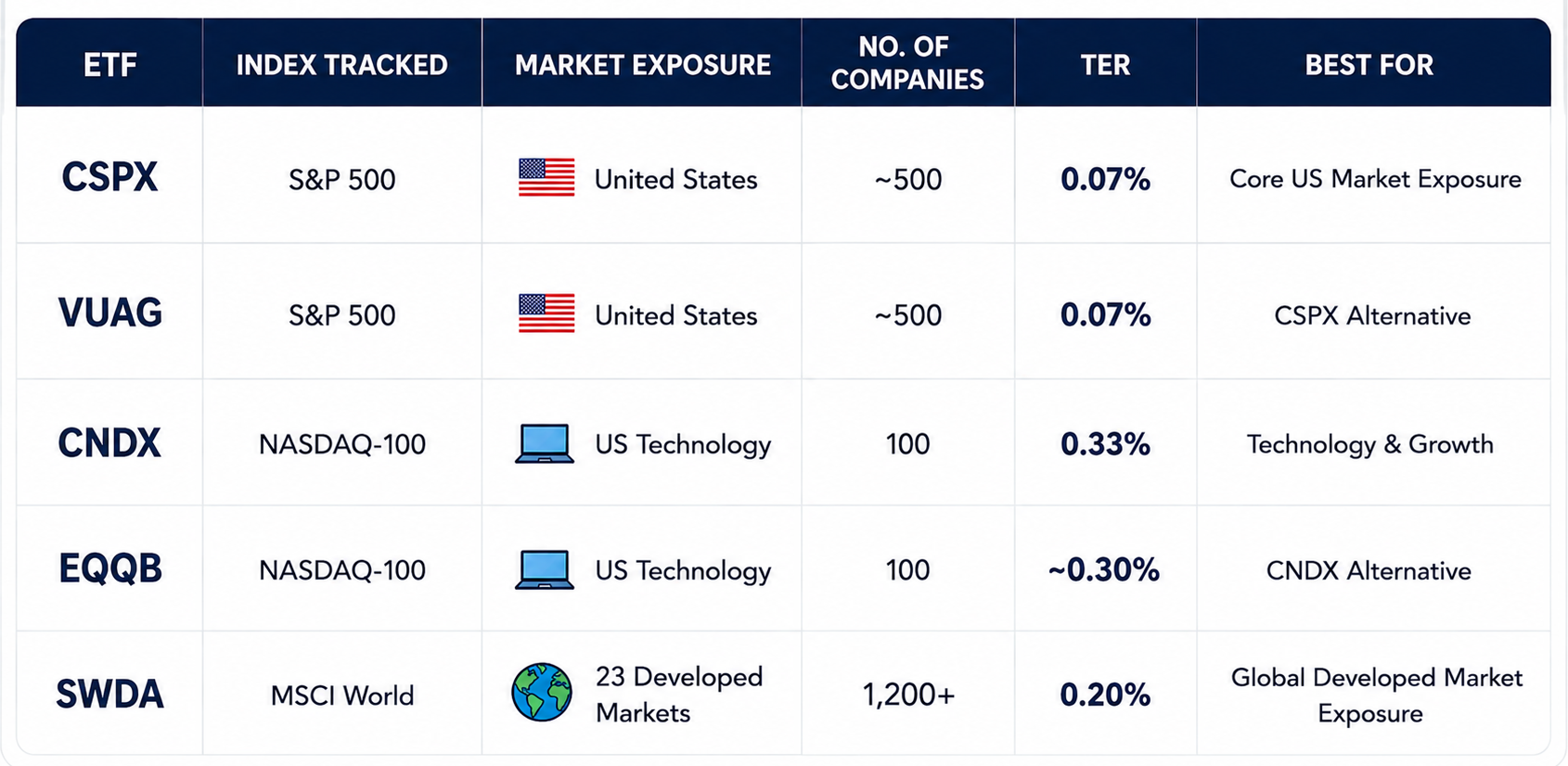
After exploring the five ETFs, it's clear that there isn't a single "best" UCITS ETF for everyone. Each fund is designed with a different investment objective in mind, and the right choice ultimately depends on your goals, risk appetite, and the level of diversification you want in your portfolio.
For investors seeking broad exposure to the US stock market, both CSPX and VUAG are excellent choices. Since they track the same S&P 500 Index, their performance is expected to be very similar over the long term. The decision between the two often comes down to your preferred fund provider—BlackRock (iShares) or Vanguard.
If your investment thesis focuses on technology, AI, and innovation, CNDX and EQQB provide targeted exposure to the NASDAQ-100. Their sector concentration, however, may lead to higher volatility.
If your goal is global diversification, SWDA is the most diversified option. It invests in over 1,200 companies across 23 developed markets, reducing reliance on any single country while maintaining exposure to major economies.
Rather than chasing past returns, choose the ETF that best fits your long-term strategy. Holding the right ETF consistently is often better than frequently switching funds.
Conclusion
Choosing the right international investment isn't just about maximizing returns—it's also about investing through the right structure.
For Indian investors, Irish-domiciled UCITS ETFs offer a practical way to gain exposure to global companies while addressing the US estate tax considerations discussed in our previous article. Whether you prefer the broad US market through CSPX or VUAG, technology-focused growth with CNDX or EQQB, or global diversification via SWDA, each ETF serves a different investment objective.
Ultimately, there is no single "best" ETF. The right choice depends on your financial goals, risk appetite, and long-term investment strategy. By selecting a well-diversified, low-cost UCITS ETF that aligns with your objectives, you can build a portfolio designed for sustainable long-term wealth creation.