The Turnaround Trophy- Reviving Birla Tyres And A Demerger On The Way
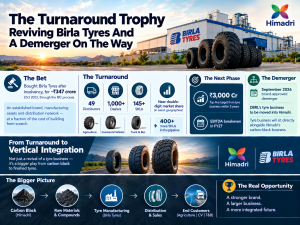
Himadri did not buy Birla Tyres when the business was thriving. It acquired the distressed tyre business through the corporate insolvency resolution process for approximately ₹347 crore in October 2023, betting that an established brand and existing manufacturing assets could be revived without the cost and time involved in building an entirely new business.
The bet is now entering a more demanding phase. Birla Tyres generated ₹187 crore in revenue in FY26, rebuilt its distribution network and expanded its product portfolio. Yet Himadri wants the business to reach ₹3,000 crore in annual revenue within the next four years. It also expects EBITDA breakeven in FY27.
There is another development. In September 2026, Himadri's board approved a scheme to bring Dalmia Bharat Refractories' tyre business directly into Himadri through a demerger, subject to approvals. The move could strengthen the connection between Himadri's carbon-black business and tyre manufacturing.
But three questions matter more than the headline announcements: how quickly can revenue scale, what will it cost to reach profitability, and will vertical integration produce measurable financial benefits?
From Insolvency To A ₹3,000 Crore Ambition
The acquisition gave Himadri access to a tyre business with existing manufacturing infrastructure, a recognised brand and an established route to market. Rather than starting from zero, it could focus on restarting production, rebuilding dealer relationships and introducing products suited to current demand.
The early commercial progress is visible. By FY26, Birla Tyres had generated ₹187 crore in revenue. Its distribution network had expanded to 43 distributors and more than 1,000 dealers, according to Himadri's April 2026 earnings-call disclosure. Subsequent company updates cited 49 distributors. The portfolio includes agricultural and commercial-vehicle products such as AgriPlus, AgriWin, KalaPatthar, Shaan+, BT339 and Ultra Trac.
However, the revenue target changes the scale of the challenge. Moving from ₹187 crore to ₹3,000 crore requires revenue to increase approximately 16 times.
Management has identified the direction of growth, but it has not provided a detailed annual revenue forecast by product category. That distinction matters: a larger dealer network and more products create opportunities, but they do not establish how much revenue those opportunities will generate.
What Would It Take To Reach ₹3,000 Crore?
The most useful way to test the ambition is to calculate the pace of growth required.
Management stated in April 2026 that it was targeting ₹3,000 crore of tyre-business revenue within the next four years, while declining to provide year-on-year guidance. A four-year path from ₹187 crore would require roughly 100% annualised revenue growth.
One way to illustrate the scale is to consider a hypothetical doubling trajectory:
- FY26: ₹187 Cr, the reported starting point.
- FY27: approximately ₹374 Cr.
- FY28: approximately ₹748 Cr.
- FY29: approximately ₹1,496 Cr.
- FY30: approximately ₹3,000 Cr.
These are mathematical milestones, not management forecasts. They show the pace required if the four-year target is interpreted as FY30.
The growth would have to come from several sources. Off-the-road (OTR) tyres, used in applications such as mining and industrial equipment, and agriculture tyres could support the initial expansion. Commercial-vehicle and truck-and-bus tyres could broaden volumes. Exports could extend the addressable market, while the planned passenger-car radial (PCR) facility could open a new market from FY28.
The difficulty is that the company has not disclosed how much of the ₹3,000 crore target is expected from each category. Without product-level capacity, utilisation and revenue guidance, assigning precise contributions to OTR, agriculture, exports or PCR would create a forecast unsupported by disclosed information.
The target is therefore mathematically possible, but its operating feasibility remains unproven.
FY27 EBITDA Breakeven Is The First Financial Test
Revenue growth is only half the turnaround. The business must also cover its manufacturing and operating costs.
Himadri expects Birla Tyres to reach EBITDA breakeven in FY27. That would mean the tyre operation earns enough from its business to cover operating expenses before interest, taxes, depreciation and amortisation.
However, the available disclosures do not establish Birla Tyres' current standalone EBITDA loss, fixed-cost base, plant utilisation or the precise revenue required for breakeven. These figures are essential for judging how difficult the target will be.
Consider two possible situations. If the plant has substantial unused capacity and a large part of its costs are already fixed, additional production could improve profitability without a proportionate increase in overheads. If utilisation remains low, production costs are high or sales require heavy discounts, revenue growth may not translate into breakeven as quickly.
The company has said that capacity utilisation will be increased progressively over the next 12-24 months, with production ramp-up aligned to demand and distribution expansion. That provides a direction, but not a quantified utilisation target.
Investors should therefore track three milestones: FY27 EBITDA breakeven, subsequent EBITDA-margin improvement and the generation of operating cash flow. Breakeven alone would mark progress; sustained profitability would demonstrate that the business model is working. Check our latest video for more details.
Four Hundred New SKUs: Opportunity With A Cost
Birla Tyres plans to introduce nearly 400 additional stock-keeping units across agriculture, commercial vehicles, truck and bus tyres and emerging segments.
The strategy is straightforward. Different vehicles and applications require different tyre sizes and specifications. A wider portfolio can help the company serve more customers through its existing dealer network and increase sales per distributor.
The new agricultural ranges AgriPlus and AgriWin, alongside products such as KalaPatthar, Shaan+, BT339 and Ultra Trac, are part of this effort to rebuild the product offering.
But every additional SKU carries an operating cost. The company may need to hold more sizes in inventory, manage additional production runs and maintain availability across a wider distribution network. Products that sell slowly can tie up cash even when reported revenue is growing.
The important measure is not how many SKUs are launched. It is how many generate repeat orders, how quickly inventory moves and whether the additional products improve profitability.
PCR Tyres Could Open A New Growth Market
Himadri plans a dedicated passenger-car radial facility by FY28, with an emphasis on electric vehicles and SUVs.
This would take Birla Tyres beyond its present emphasis on agriculture, commercial vehicles and other established categories. It also creates an opportunity to build a presence in passenger-car tyres as the vehicle market changes.
But a planned facility is not the same as revenue capacity already available for sale.
Himadri's earlier investor presentation identified ₹306 crore of capex associated with Birla Tyres and stated that additional investment would be incurred over the following three years for upgrading, modernisation and full-capacity commencement. The available disclosures do not establish a separate, fully quantified PCR project budget, its final installed capacity or a product-wise revenue ramp-up.
Those missing details matter. A PCR facility requires investment before it contributes meaningfully to sales, and new products must establish customer acceptance and distribution. The business may need further funding for capacity expansion and working capital as it scales, although the exact requirement has not been disclosed.
The key milestones are commissioning by FY28, the pace of capacity utilisation after commissioning and the extent to which PCR sales add to not merely replace revenue from existing categories.
What Does The Demerger Actually Change?
On September 21, 2026, Himadri's board approved a scheme to transfer Dalmia Bharat Refractories' tyre business to Himadri as a going concern, subject to the necessary approvals.
Under the proposed scheme, eligible DBRL shareholders would receive one Himadri share for every 260 DBRL shares held. The arrangement is a share-based transaction rather than a cash purchase.
The structure matters because it brings the tyre business directly into Himadri's corporate framework. It could simplify the relationship between the tyre operation and Himadri's existing carbon-black business, while giving DBRL shareholders an interest in Himadri through the proposed share entitlement.
The financial reporting implications also matter. Once the scheme becomes effective, the tyre undertaking would be transferred to Himadri under the approved arrangement, and its results would be reflected according to the applicable consolidation and accounting requirements. The transaction remains subject to approvals; investors should not treat the proposed structure as already completed.
There is also an important distinction between the two revenue figures disclosed for FY26. Himadri reported ₹187 crore of revenue from Birla Tyres, while the demerger disclosure cited ₹149.31 crore of turnover for DBRL's tyre business. The figures relate to different reporting scopes and should not be combined without a reconciliation.
Can Vertical Integration Improve The Economics?
Himadri already manufactures carbon black, an important raw material used in tyre production. Bringing the tyre business directly into the group creates a potential downstream chain:
Carbon black → tyre manufacturing → finished tyres.
This could improve coordination in procurement, product development, manufacturing and logistics. It may also allow the businesses to work more closely on product specifications and supply planning.
However, strategic logic is not the same as a quantified financial benefit. Himadri has discussed potential synergies, but the available disclosures do not provide a specific annual savings estimate for internal carbon-black sourcing, logistics or procurement.
It would therefore be premature to assign a rupee value to the benefits or assume that the integration will automatically improve margins. Carbon black still has an economic cost, even when sourced internally, and the actual benefit depends on transfer pricing, production efficiency, external sourcing alternatives and the ability to pass costs through to customers.
The right test is whether the integration produces measurable improvements in gross margins, operating costs, inventory management and returns on capital.
Working Capital Could Become A Hidden Constraint
A business expanding from ₹187 crore to ₹3,000 crore will need to fund much more than factory production. It must also support inventory, dealer credit, receivables and the logistics of serving a larger market.
The planned addition of nearly 400 SKUs could increase the number of products that need to be stocked. A larger dealer network may also require credit terms to support sales. If revenue expands faster than cash collection, the business could report growth while absorbing cash.
The available disclosures do not establish Birla Tyres' standalone FY26 inventory, receivables, operating cash flow or cash-conversion cycle. Without those figures, a precise working-capital estimate would be speculative.
An illustrative calculation can still show the scale of the issue. If the business eventually reaches ₹3,000 crore of annual revenue, every 10 days of revenue tied up in net working capital would represent approximately ₹82 crore, using a 365-day year. This is a sensitivity calculation, not an estimate of Birla Tyres' actual working-capital requirement.
The real funding need will depend on inventory days, customer-credit terms, supplier-credit terms and how much of the additional growth can be financed through operating cash flow. These metrics should be tracked alongside revenue and EBITDA.
What Investors Should Watch Next?
The turnaround has several identifiable milestones, but each needs financial proof.
- FY27: Does Birla Tyres achieve EBITDA breakeven?
- FY27-FY28: Does utilisation rise alongside demand, without excessive discounting or inventory accumulation?
- FY28: Does the PCR facility reach commissioning, and what capacity and investment figures are disclosed?
- Following the demerger: Are the expected approvals secured, and how does the transaction affect ownership and consolidated reporting?
- During expansion: Do margins and operating cash flow improve as revenue grows?
- Against the ₹3,000 crore target: Does management provide a more detailed breakdown of revenue by product, capacity and geography?
These milestones would help investors distinguish genuine operating progress from a growth story driven mainly by ambitious targets.
Conclusion
Himadri's investment in Birla Tyres has moved beyond the initial task of reviving an insolvent business. The company has restarted operations, rebuilt distribution and begun expanding its product portfolio. The proposed demerger could also bring the tyre operation more directly into Himadri's carbon-black value chain.
But the distance between ₹187 crore of FY26 revenue and a ₹3,000 crore ambition remains substantial. The company has not yet disclosed enough standalone operating data to independently assess the breakeven revenue, the full PCR investment requirement or the working capital needed to support that expansion.
For investors, FY27 EBITDA breakeven is the first test. PCR commissioning, stronger utilisation, measurable integration benefits and cash generation are the tests that follow.
Birla Tyres may become a meaningful downstream business for Himadri. But until growth translates into sustainable profits and cash flow, the turnaround trophy remains within reach, not yet won.