The “Atmanirbhar” Battery Bet- LFP Cathode Plant Ex-China
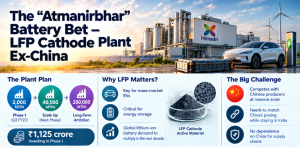
China dominates the LFP battery-material business so completely that building a commercial plant outside the country sounds almost unrealistic. Yet that is exactly the bet Himadri Speciality Chemical is making. The company is starting with a 2,000 MTPA LFP cathode active material facility in Q3 FY27, plans to scale it to 40,000 MTPA, and ultimately has ambitions for 200,000 MTPA.
The opportunity is enormous: LFP is becoming one of the most important battery chemistries for mass-market EVs and energy storage, while global lithium-ion battery demand is expected to multiply over the next decade. But demand alone does not make this investment attractive.
Himadri has to compete against Chinese producers that already have massive scale and established supply chains. More importantly, management says it wants to sell its LFP material at prices comparable with China while producing it in India without depending on China. That is where the real investment question begins.
Can Himadri actually manufacture LFP cheaply enough to match China, earn attractive margins, and justify the ₹1,125 crore it is investing in Phase I? If it can, this could become much more than an “Atmanirbhar” manufacturing story, it could become Himadri’s entry into a global battery-materials market dominated by China.
The Real Test Is Not Capacity. It Is Profitability.
China has built a dominant position in lithium iron phosphate (LFP) battery materials through scale, established supply chains and manufacturing experience. Himadri Speciality Chemical is attempting to break into this market by building a commercial-scale LFP cathode active material facility outside China.
The company’s roadmap starts with a 2,000 MTPA milestone targeted for Q3FY27, followed by a 40,000 MTPA Phase I facility involving ₹1,125 crore of investment. Its longer-term ambition is to reach 200,000 MTPA.
The opportunity is meaningful. Global lithium-ion battery demand is forecast to exceed 5.7 TWh by 2035, driven by electric vehicles and energy storage. LFP is particularly relevant for mass-market vehicles and stationary storage because of its safety, thermal stability, cycle life and cost advantages.
But a growing market does not automatically make a new manufacturing plant profitable. Himadri must demonstrate that its product meets customer specifications, that production costs remain competitive and that customers buy enough material to keep the plant running efficiently.
For investors, the key question is whether Himadri can turn its first-mover position into a sustainable cost and profitability advantage.
Can Himadri Really Match China’s Prices?
Management’s ambition to manufacture in India without depending on China is central to the investment case. However, the ability to manufacture locally does not automatically translate into lower costs.
The economics depend on several components:
- Lithium, iron and phosphate inputs: Raw-material prices and procurement terms can materially affect the cost per tonne. Himadri needs reliable sourcing and competitive purchase prices; local production alone does not guarantee cheaper inputs.
- Energy: LFP production requires energy for processing and thermal operations. Energy prices, consumption per tonne and plant efficiency can influence conversion costs.
- Conversion costs and yields: Labour, processing, maintenance and the amount of usable product obtained from each batch determine how much it costs to manufacture saleable material. Better yields and fewer rejected batches can improve economics without requiring a lower selling price.
- Logistics and sourcing: Manufacturing in India could reduce certain transport costs for Indian customers and help customers diversify their supply chains. The advantage will depend on where inputs are sourced and where finished material is sold.
- Scale and utilisation: Chinese manufacturers benefit from established capacity and manufacturing experience. Himadri must build its own operating efficiency as production expands.
The annual report describes a research-led progression from laboratory and pilot facilities to commercial production. That approach can help improve process consistency before large-scale output begins.
However, the company has not disclosed a sufficiently detailed LFP cost breakdown to prove that its total manufacturing cost matches China. The thesis therefore remains a cost-competitiveness target to be demonstrated, not an established advantage.
The evidence to watch is the cost per saleable tonne, product yield, customer pricing and EBITDA margin as production scales. Check our latest video for more details.
Customer Qualification: IBC Is Progress, Not Proof Of Large Orders
Himadri’s partnership with International Battery Company (IBC) provides a route to test its materials in actual battery applications. But investors need to distinguish between technical progress and confirmed commercial demand.
The company’s FY26 annual report says trials are underway to develop cells using Himadri’s LFP cathode material, alongside its anode materials and Sicona’s silicon-carbon anode technology. These efforts are linked to applications including grid storage, drones, electric aviation, defence and AI data centres.
The report also describes the broader Himadri-IBC relationship as advancing material integration and commercialisation. It does not, however, establish a confirmed commercial volume for Himadri’s LFP cathode material or disclose a definitive LFP qualification date.
The distinction matters because battery materials typically move through several stages:
- Sample: The supplier provides material for laboratory evaluation.
- Qualification: The customer checks consistency, electrochemical performance and compatibility with its cell design.
- Trial production: The material is tested in a production-like process and, where applicable, in cells or packs under real operating conditions.
- Commercial order: The customer places an order for an agreed quantity, price and delivery schedule.
Progress at one stage does not guarantee the next. A material may perform well in a laboratory but still require process changes, additional testing or customer approval before commercial use.
IBC is therefore a useful validation pathway, but it should not be treated as proof that the 40,000 MTPA plant will immediately operate at high utilisation. Investors should look for explicit disclosures of LFP qualification, repeat orders, contracted volumes and actual sales.
What Could 40,000 MTPA Earn? An Analyst Sensitivity
Revenue alone cannot establish whether a ₹1,125 crore investment will generate attractive returns. The missing variables are utilisation, selling price, operating margin and the amount of capital tied up in the business.
The following is an illustrative analyst model, not a Himadri forecast. It assumes a selling realisation of ₹2 lakh per tonne and an EBITDA margin of 20%. Neither assumption should be mistaken for a disclosed LFP selling price or management margin guidance.
| Plant utilisation | Saleable output | Revenue | EBITDA at 20% margin | Investment / EBITDA |
| 30% | 12,000 tonnes | ₹240 Cr | ₹48 Cr | 23.4× |
| 50% | 20,000 tonnes | ₹400 Cr | ₹80 Cr | 14.1× |
| 70% | 28,000 tonnes | ₹560 Cr | ₹112 Cr | 10.0× |
| 90% | 36,000 tonnes | ₹720 Cr | ₹144 Cr | 7.8× |
Calculations use ₹1,125 crore of investment. Figures are illustrative and rounded.
The sensitivity shows why capacity announcements can be misleading. At 30% utilisation, the model generates just ₹48 crore of annual EBITDA. At 70%, that rises to ₹112 crore. The same installed capacity can therefore produce very different economic outcomes depending on how quickly demand and production ramp up.
At 70% utilisation, the result also changes significantly with the margin:
| EBITDA margin | Annual EBITDA | Investment / EBITDA |
| 15% | ₹84 Cr | 13.4× |
| 20% | ₹112 Cr | 10.0× |
| 25% | ₹140 Cr | 8.0× |
These multiples are not ROCE or payback periods. Investment divided by EBITDA is a simple operating-return proxy; it excludes depreciation, tax, working capital, financing and any additional capital required. A proper ROCE calculation needs operating profit after tax and the relevant capital employed. A true payback calculation must use cash flows after operating costs, tax, maintenance capex and working-capital requirements.
The conclusion is straightforward: Himadri needs both high utilisation and healthy margins. A large revenue number alone will not justify the investment.
The 2,000-to-40,000 MTPA Jump Is A 20-fold Execution Test
Himadri’s first 2,000 MTPA milestone is important because it can help establish process stability, product consistency and customer acceptance. But it represents only 5% of the proposed 40,000 MTPA Phase I capacity.
Scaling up is not simply a matter of installing 20 times more equipment. The company must reproduce product quality across larger production runs, maintain yields, secure raw materials and meet customer specifications consistently.
Several problems could weaken the economics:
- Slow qualification: Production capacity may be ready before customers approve the material.
- Low utilisation: Fixed costs are spread across fewer tonnes, potentially reducing margins.
- Poor yields: More material may be lost or rejected during production, increasing the cost of saleable output.
- Pricing pressure: Chinese suppliers could respond aggressively, limiting Himadri’s ability to pass on higher costs.
- Working-capital pressure: Raw-material inventory and customer payment cycles may absorb cash even when reported revenue grows.
The model above makes the utilisation risk tangible. At the same assumed price and margin, moving from 70% to 30% utilisation cuts annual EBITDA from ₹112 crore to ₹48 crore.
The first 2,000 tonnes should therefore be viewed as a validation milestone, not evidence that the full plant can immediately generate returns at scale. The next proof point is repeatable production that customers are willing to purchase in meaningful quantities.
The 200,000 MTPA Ambition Is A Separate Capital-allocation Decision
Himadri’s expansion plans should be assessed in three distinct stages.
| Stage | Capacity / investment | What must be proven |
| Initial validation | 2,000 MTPA; targeted for Q3FY27 | Stable production, consistent quality and customer testing |
| Phase I commercial scale | 40,000 MTPA; ₹1,125 Cr investment | Qualification, repeat orders, competitive unit costs and rising utilisation |
| Longer-term ambition | 200,000 MTPA; potential investment of approximately ₹4,800 Cr | Proven demand, attractive returns at commercial scale and a clear funding plan |
The ₹4,800 crore figure represents the stated potential investment associated with the longer-term expansion ambition; it should not be treated as an approved or committed outlay unless separately confirmed.
The progression matters because 200,000 MTPA is five times the 40,000 MTPA Phase I capacity and involves a much larger capital commitment. It should not be valued as though the entire capacity already exists or has secured customers.
Before committing to that scale, Himadri would need evidence that Phase I can deliver consistent product quality, repeat commercial orders, competitive costs and returns that justify reinvestment. Customer demand must grow alongside capacity rather than be assumed to follow it.
This is particularly important in a market where China already has substantial manufacturing scale and the annual report itself acknowledges overcapacity in China. Global demand growth creates an opportunity, but it does not eliminate the risk of price competition.
Conclusion
Himadri’s LFP project could give it a position in a strategically important battery-material supply chain outside China. Its research-led approach, local manufacturing base and relationship with IBC offer a foundation for that ambition.
But the investment case is still being built. The decisive milestones are commercial qualification, repeat orders, saleable output, capacity utilisation and the margin earned on every tonne.
The 2,000 MTPA milestone can establish technical credibility. The 40,000 MTPA facility must establish commercial economics. Only after those results are visible can a 200,000 MTPA expansion be assessed as a rational capital-allocation decision.
The strongest evidence that Himadri’s battery bet is working will not be the capacity it announces. It will be the cash and returns generated by the capacity it successfully sells.