Software as a Catalyst: How HCL Software Redefines the Services Imperative
For decades, IT services companies grew by adding more people. But in the age of AI, headcount is becoming a weaker competitive advantage.
The firms that own technology may ultimately outperform those that simply implement it.
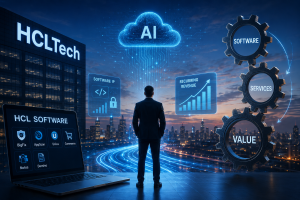
That makes HCLTech’s software business particularly interesting. Through HCL Software, the company is doing something most traditional service providers struggle to achieve: turning intellectual property into a strategic asset that deepens customer relationships, creates recurring revenue, and reduces dependence on labor-led growth.
AI and the Breakdown of Hour-Based Billing
AI is not just improving productivity, it is reshaping pricing itself.
As generative AI tools reduce effort in coding, migration, and testing by 30-50% in certain workflows, traditional Time & Material contracts come under pressure. Every efficiency gain directly reduces billable hours unless pricing models evolve.
This is why the industry is moving toward outcome-based pricing and managed services structures. However, this transition is uneven and difficult to execute at scale.
HCLTech’s software portfolio introduces a partial hedge. Unlike services revenue, software subscriptions are not directly tied to human effort. They create recurring income streams that are structurally insulated from productivity shocks.
The Problem With Pure Services
The traditional services model has always faced a scalability challenge.
A consulting engagement ends. A modernization project concludes. A migration initiative eventually reaches completion.
Even long-term managed services contracts require continuous renewal and constant proof of value. Revenue is generated through people, and growth typically requires hiring more people.
This model remains highly profitable at scale, but it is inherently labor-dependent.
Software operates differently.
Once a software platform becomes integrated into an enterprise’s operations, the relationship often extends for years. Customers continue paying subscription, maintenance, or support fees because the software becomes part of critical business workflows.
Unlike project-based services, software can generate recurring revenue without requiring a proportional increase in headcount.
That distinction may become increasingly important as AI improves developer productivity and enterprises seek greater efficiency from technology partners.
The Acquisition That Changed HCLTech’s Economics
In 2019, HCLTech acquired a portfolio of enterprise software products from IBM for approximately $1.8 billion. The deal included products such as BigFix, AppScan, Domino, Notes, Unica, and Commerce.
At the time, many viewed the acquisition as a mature software portfolio with limited growth potential. HCLTech saw something different: a recurring revenue engine that could complement its services business.
The acquisition gave HCLTech ownership of intellectual property, software maintenance revenue, and direct access to thousands of enterprise customers. More importantly, it allowed the company to participate in enterprise software spending rather than relying exclusively on services budgets.
From Vendor to Platform Partner
The most important advantage of software ownership is not revenue. It is relevance.
Technology service providers are often viewed as external vendors hired to execute specific projects. Their engagement begins when a project starts and weakens once implementation is complete.
Software changes that dynamic.
When an enterprise deploys security software, automation platforms, data management tools, or customer experience applications, those products become embedded within the organization’s technology stack.
Replacing them becomes expensive, disruptive, and operationally risky.
As a result, the relationship evolves from a project-based engagement into a long-term platform partnership.
This creates a deeper level of customer integration than traditional services contracts can typically achieve.
Instead of periodically selling projects, software owners become participants in the customer’s ongoing technology journey.
The Economics of Stickiness: Stability or Stagnation?
HCL Software’s strategic value is anchored by its annual recurring revenue (ARR), which sits at $1.05 billion. This creates a level of predictability rarely seen in project-driven technology services. Unlike services contracts, which are episodic and sensitive to client budget cuts, embedded software contracts tend to renew due to high switching costs and integration complexity.
However, the latest financial data reveals a stark reality: stickiness does not automatically imply expansion.
In HCL’s full-year FY26 results, while the company's Services division grew a resilient 4.8%, HCL Software revenue fell by 4.1% year-on-year, with ARR dipping slightly by 0.5%.
This data proves that HCL Software behaves strictly as a stability engine and a cash generator, rather than a growth-led SaaS platform. The ARR improves earnings predictability, but it is currently fighting a battle against legacy churn.
Why Software Margins Matter?
The strategic importance of HCL Software becomes clearer when viewed through the lens of margin structure rather than headline revenue.
Traditional IT services businesses typically operate in a labor-intensive model where revenue growth requires proportional increases in headcount. Margins are constrained by utilization rates, wage inflation, and delivery complexity. Even at scale, operating margins tend to remain structurally bounded.
Software operates on a different economic base.
Once a product is built and deployed, incremental revenue carries significantly lower delivery costs. This leads to structurally higher gross margins and more efficient revenue conversion compared to services
However, in HCL’s case, the more important point is not that software is high-margin in isolation, but that it improves the quality mix of the overall business. It introduces a non-linear revenue layer that is less dependent on workforce scaling.
This creates a dual-effect structure:
- Services continue to drive scale through execution capacity
- Software improves margin resilience and earnings stability
The result is not margin expansion at the group level in a dramatic sense, but a gradual re-rating of earnings quality from purely labor-driven output to a blended model with recurring, asset-like income.
In this context, software is less about explosive profitability and more about structural financial insulation in a sector increasingly exposed to AI-driven efficiency shocks.
The Cross-Selling Flywheel
The strategic value of HCL Software extends beyond its direct revenue contribution.
Software creates opportunities to sell additional services.
A customer adopting an enterprise platform may require implementation support, cloud migration, integration services, cybersecurity consulting, performance optimization, managed services, and AI enhancements.
Each software deployment creates multiple opportunities for adjacent revenue streams.
This produces a flywheel effect.
Software adoption generates services demand.
Services teams strengthen customer relationships.
Stronger relationships create opportunities for additional software sales.
The result is an ecosystem approach rather than a purely transactional model.
This is one reason enterprise software companies often command premium valuations. The software itself is only part of the economic value. The surrounding ecosystem frequently generates even larger revenue opportunities over time.
Legacy vs Growth: The Internal Structure of HCL Software
HCL Software is best understood as a layered system rather than a single business.
- The digital workplace layer (Notes, Domino) acts as a legacy cash generator with high retention but limited growth potential.
- The security and IT operations layer (AppScan, BigFix) represents the strategic growth engine, positioned in markets where AI and automation can meaningfully expand functionality and value.
- The customer experience layer (Unica, Commerce) sits in a competitive SaaS environment, where differentiation is difficult but enterprise relationships still provide cross-selling advantages.
The key insight is that value is distributed unevenly across the portfolio rather than uniformly.
This is where HCLTech differs from most Indian IT services companies.
Competitor Battleground
HCLTech’s approach stands out not because it is the only Indian IT firm with software ambitions, but because it is the only one that scaled through acquisition rather than internal incubation.
Infosys has maintained a narrow software footprint, with Finacle as its flagship banking platform. Finacle is deeply embedded in core banking systems, but remains an exception rather than a structural pivot toward software ownership.
Tata Consultancy Services followed a different model entirely through Digitate (Ignio), building an AI-driven automation platform organically. This reflects a patient, R&D-heavy approach where software is developed internally rather than acquired.
HCLTech chose a third path: speed through acquisition. The $1.8 billion IBM deal instantly delivered scale, customer access, and product IP, but also introduced the complexity of integrating legacy-heavy software into a services-dominant organization.
AI and the Breakdown of Billing Models
Artificial intelligence is not just reshaping how software is built, it is directly destabilizing how IT services are priced.
In traditional delivery models, revenue is closely tied to effort: number of engineers, hours billed, and project duration. This structure worked in a world where software development scaled linearly with human input.
AI breaks that linkage.
In modern enterprise environments, generative AI tools are already compressing development and maintenance cycles by 30-50% in specific workflows such as code generation, test case creation, and system documentation. This means the same output increasingly requires fewer billable hours.
For IT services firms operating on Time & Material contracts, this creates a direct economic tension: productivity gains do not automatically translate into revenue gains. Instead, they often result in revenue compression unless pricing shifts toward outcome-based or fixed-scope models.
This is where software ownership becomes strategically relevant.
Unlike services revenue, which declines in value as productivity increases, software revenue is largely decoupled from effort. Once deployed, enterprise software monetizes through subscriptions, renewals, and usage, not human hours.
In effect, AI introduces a deflationary force on labor-led revenue, while strengthening the relative attractiveness of IP-led revenue models. HCLTech’s software portfolio therefore functions less as a growth engine and more as a structural hedge against this emerging productivity shock.
Can HCL Software Become an AI Platform?
The strategic question for HCL Software is not whether it has value today, but whether it can evolve beyond its IBM legacy into a modern AI-enabled platform layer.
At present, the portfolio is still anchored in products designed for earlier enterprise computing cycles- security tools, endpoint management systems, collaboration suites, and marketing automation platforms. While these products remain embedded in large enterprises, their architectural foundations were not originally designed for AI-native workflows.
The opportunity lies in transformation rather than continuation.
If products like BigFix, AppScan, and Unica can be re-engineered with AI-native capabilities such as automated remediation, predictive security analysis, and intelligent customer journey optimization, HCL Software could shift from being a maintenance-heavy portfolio to an active enterprise intelligence layer.
However, this transition is not guaranteed.
There is an inherent tension between maintaining legacy revenue streams and investing aggressively in next-generation platforms. Legacy products generate stable cash flows but often consume engineering bandwidth and product attention.
This creates a structural question:
Is HCL Software evolving into an AI-first platform business, or is it primarily optimizing a legacy-installed base while selectively adding AI features on top?
The answer will determine whether it becomes a strategic growth asset or remains a high-quality but structurally mature annuity business.
Service-Provider Dilemma
Running a software business inside a services-led organization creates an inherent structural tension.
Services companies are optimized for utilization, delivery efficiency, and linear workforce scaling. Success is measured in billable hours and project margins.
Software companies operate on a different logic entirely. They require upfront R&D investment, longer product cycles, and tolerance for failed releases before achieving product-market fit.
This raises a critical question for HCLTech: is HCL Software being operated as an independent product organization, or as a support extension of the services engine?
If software is primarily used to enable cross-selling rather than to build standalone platform strength, its long-term competitive positioning may remain constrained despite strong embedded customer relationships.
The Challenges Are Real
HCL Software’s strategy is strong on positioning, but constrained on execution.
A large part of the portfolio is still anchored in legacy IBM-era products, which provide stable cash flows but limit the speed of transition toward AI-native platforms. Balancing maintenance revenue with meaningful product reinvention remains a structural constraint.
The business also operates in highly competitive software categories such as cybersecurity, endpoint management, and marketing automation, where global SaaS players invest far more aggressively in R&D and product innovation.
Finally, there is ongoing friction between software and services priorities within the organization. Aligning long-cycle product development with a services-led operating model can dilute focus and slow decision-making.
These challenges do not weaken the strategy, but they define its boundaries. The real test is whether HCL Software can modernize fast enough to sustain relevance beyond its legacy base.
Conclusion
The significance of HCL Software is not that it transforms HCLTech into a software company.
It doesn’t.
Services remain the core of the business and are likely to remain so for years.
The significance is that it provides HCLTech with strategic optionality at a time when the traditional services model is facing unprecedented disruption.
Software generates recurring revenue, strengthens customer retention, enables cross-selling opportunities, and reduces dependence on pure headcount growth.
Most importantly, it allows HCLTech to participate in a different layer of enterprise technology spending, one built around ownership rather than execution.
As artificial intelligence reshapes how technology services are delivered, that distinction could become increasingly important.
For decades, scale was the defining competitive advantage in IT services.
In the next decade, intellectual property may matter just as much.