Satin Housing Finance & Satin Finserv: Is Diversification De-Risking Satin Creditcare?
The Indian microfinance industry has long been a story of high growth and financial inclusion, but it has also been shaped by recurring cycles of regulatory change, political intervention, and fluctuations in rural economic conditions. While these challenges affect the entire sector, they also expose the limitations of business models that rely too heavily on a single lending segment.
Recognising this reality, Satin Creditcare has gradually expanded beyond its traditional microfinance business. Through Satin Housing Finance and Satin Finserv, the company is building a broader lending platform that serves customers as their financial needs evolve from small income-generating loans to MSME financing and affordable housing. Rather than diversifying into unrelated businesses, Satin is leveraging its existing customer relationships to create multiple, complementary growth engines.
This shift is about more than expanding the loan book. It represents an effort to reduce earnings volatility, strengthen customer retention, and build a more resilient franchise capable of performing across different credit cycles. As the contribution from non-microfinance businesses continues to grow, an important question emerges: Is Satin still simply a microfinance institution, or is it evolving into a diversified retail lender that the market has yet to fully recognise?
This article examines how Satin Housing Finance and Satin Finserv are reshaping the company’s business model, why this diversification strategy matters, and whether it could ultimately change how investors value Satin Creditcare.

Why Pure-Play Microfinance Businesses Always Trade at a Discount?
To understand why Satin Creditcare’s diversification strategy is important, it is first necessary to understand why even well-managed microfinance institutions have historically traded at lower valuation multiples than diversified retail NBFCs. Unlike housing finance companies or diversified lenders, MFIs operate in a business where earnings are heavily influenced by external factors that are often beyond management’s control.
Several structural risks contribute to this perception:
- Political Intervention
Election-related loan waiver announcements and expectations of debt relief have repeatedly influenced repayment behaviour across various states. Even temporary disruptions in collections can significantly increase provisioning requirements because microfinance portfolios consist primarily of unsecured loans.
- Weather and Rural Income Volatility
A large proportion of borrowers depend on agriculture and informal employment. Weak monsoons, floods, droughts, or disruptions in rural economic activity can quickly reduce repayment capacity and increase credit costs.
- Regulatory Changes
The RBI’s tighter borrower exposure norms introduced during FY25 highlighted how regulatory intervention can directly impact loan growth, borrower eligibility, and operational efficiency. While these measures improve the industry’s long-term sustainability, they often create short-term pressure on profitability.
- Borrower Overleveraging
The rapid rise in multiple borrowing across lenders led to higher credit costs and increased provisioning across the industry. The episode demonstrated how quickly earnings can come under pressure when the entire business depends on a single lending segment.
These structural challenges explain why investors generally assign lower valuation multiples to pure-play microfinance companies despite strong long-term demand for financial inclusion. Satin Creditcare recognised this limitation several years ago and gradually expanded into businesses that naturally complement its core franchise.
A Recovery That Is Stronger Than Headlines Suggest
While much of the discussion around Satin Creditcare has centred on improving asset quality, the company’s recovery extends well beyond lower non-performing assets. Several operating metrics indicate that profitability is improving because of stronger execution rather than merely favourable industry conditions.
Key indicators of the recovery include:
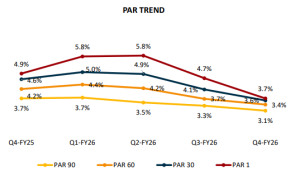
- Improving Asset Quality: Portfolio at Risk (PAR 90) declined to 3.1% as of March 2026, representing approximately ₹297 crore.
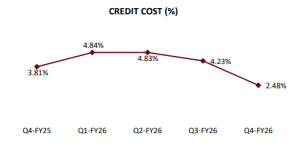
- Lower Credit Costs: Annual credit costs reduced from 4.6% in FY25 to 3.8% in FY26, while Q4 FY26 credit costs fell further to 2.5%, indicating a steady normalisation in credit losses.
- Stronger Collections: Current bucket collection efficiency improved to around 99.5%, reflecting healthy repayment behaviour across the portfolio.
- Expanding Profitability: Annual Net Interest Margin remained healthy at approximately 13.5-14%, while Q4 FY26 NIM increased to 15.2%, supported by lower provisioning and improving operating performance.
- Higher Operating Leverage: Management estimates that every 100-basis-point reduction in annual credit cost contributes approximately ₹110-120 crore to pre-tax earnings, highlighting the significant earnings impact of improving asset quality.
The recovery has also been supported by lower funding costs and a stronger balance sheet, giving the company greater flexibility to invest in businesses beyond traditional microfinance.
As a result, Satin is entering its next phase of growth from a position of improving profitability, stronger capital, and healthier operating fundamentals rather than relying solely on higher loan disbursements.
From Microfinance to a Diversified Lending Platform
Satin Creditcare’s diversification strategy is not about moving away from microfinance—it is about reducing dependence on a single lending business by building complementary growth engines around its existing customer base.
The strategy is built on three key pillars:
- Expanding Beyond Microfinance
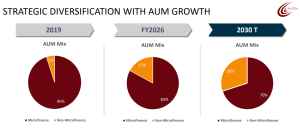
Non-microfinance businesses now contribute 17% of the group’s consolidated AUM, up from just 5% in FY19. This gradual shift is helping create a more balanced portfolio with multiple sources of earnings.
- Building Complementary Lending Businesses
The company’s diversification has been driven by two focused subsidiaries:
- Satin Housing Finance, which provides affordable housing loans.
- Satin Finserv, which focuses on MSME financing for growing businesses.
Rather than operating independently, both businesses leverage relationships created through Satin’s microfinance franchise.
- Creating a Long-Term Retail Lending Platform
Management aims to increase the non-microfinance portfolio to 30% of total AUM by FY30. The objective is not simply portfolio diversification but creating an integrated lending ecosystem where customers can continue borrowing from the group as their financial needs evolve.
This approach allows Satin to deepen customer relationships, improve retention, lower acquisition costs, and build a business that is less vulnerable to the cyclical nature of the microfinance industry. Over time, this diversified lending platform has the potential to generate more stable earnings while strengthening the company’s long-term competitive position.
Satin Housing Finance: Turning Financial Inclusion into Home Ownership
Financial inclusion is often viewed as the first step in a customer’s economic journey, but it is rarely the final destination. As household incomes improve and repayment discipline is established, financial priorities begin to change. The need for working capital gradually gives way to aspirations such as purchasing a home, constructing an additional floor, or renovating an existing property. Recognising this natural progression, Satin Creditcare established Satin Housing Finance Ltd. (SHFL) to ensure that customers could continue their financial journey within the group’s ecosystem instead of migrating to another lender.
Unlike traditional housing finance companies that compete aggressively for new borrowers, SHFL benefits from a significant competitive advantage, access to customers with an established repayment history. Years of servicing microfinance borrowers provide Satin with valuable insights into customer behaviour, income patterns, and credit discipline. This existing relationship not only reduces customer acquisition costs but also strengthens underwriting, allowing the company to lend with greater confidence than institutions evaluating these borrowers for the first time. In an industry where sourcing quality borrowers is often expensive, this relationship-driven model creates a meaningful structural advantage.
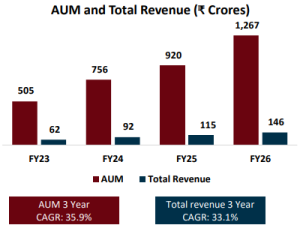
The subsidiary’s growth reflects the effectiveness of this strategy. Satin Housing Finance has expanded its Assets Under Management to ₹1,267 crore, delivering an impressive three-year AUM CAGR of 36%. The business primarily focuses on affordable housing loans across Tier II, Tier III, and semi-urban markets, where housing demand continues to outpace the availability of formal credit. These markets remain significantly underpenetrated by traditional lenders, creating a long runway for sustainable expansion as urbanisation, rising incomes, and government initiatives continue to support affordable home ownership.
More importantly, SHFL strengthens Satin Creditcare’s overall business model in ways that extend beyond portfolio diversification. Housing loans are secured by tangible assets, making their risk profile fundamentally different from unsecured microfinance lending. As the contribution from housing finance gradually increases, the group’s earnings become less dependent on a single lending segment and more balanced across multiple asset classes.
This not only improves the resilience of the franchise but also positions Satin to capture a larger share of a customer’s financial lifecycle. Rather than simply financing today’s income-generating needs, the company is helping finance tomorrow’s long-term aspirations, a strategic shift that could become one of its most valuable competitive differentiators over the coming decade.
Satin Finserv: Financing the Next Stage of Entrepreneurial Growth
While home ownership represents one milestone in a borrower’s financial journey, business expansion often comes much earlier. Many microfinance customers begin with small loans to support activities such as retail trading, dairy farming, tailoring, food businesses, or local services. As these enterprises grow, however, their funding requirements quickly exceed the limits of a traditional microfinance loan. This is where Satin Finserv Limited (SFL) plays a crucial role within the group’s lending ecosystem.
Rather than viewing these borrowers as customers who have “graduated” out of microfinance, Satin sees them as long-term relationships with evolving financial needs. Satin Finserv focuses on providing MSME loans with higher ticket sizes, enabling entrepreneurs to purchase equipment, expand inventory, increase working capital, or scale their businesses.
By supporting customers at this stage of their growth, the company not only deepens its relationship with existing borrowers but also participates in a much larger and structurally attractive credit market. India’s MSME sector continues to face a significant financing gap, with millions of small businesses still underserved by traditional banks due to limited credit histories or inadequate collateral. This creates a substantial opportunity for specialised lenders capable of combining local market knowledge with disciplined underwriting.
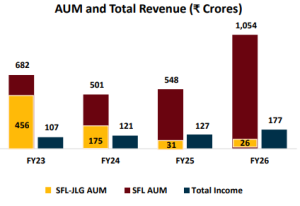
The subsidiary’s growth over the past few years highlights both the strength of this opportunity and the effectiveness of Satin’s strategy. Satin Finserv’s Assets Under Management reached ₹1,054 crore in FY26, delivering an impressive three-year AUM CAGR of 66%, making it one of the fastest-growing businesses within the group. Together with Satin Housing Finance, the company’s non-microfinance portfolio has expanded to ₹2,653 crore, steadily reducing the group’s dependence on unsecured microfinance lending while creating additional avenues for earnings growth.
More importantly, Satin Finserv demonstrates that diversification is not simply about entering new businesses, it’s about strengthening the existing one. A successful entrepreneur who receives timely growth capital is more likely to expand income, improve repayment capacity, and eventually require additional financial products, including housing finance. Instead of losing these customers to competing lenders as their ambitions grow, Satin continues to serve them through another specialised platform within the group.
This interconnected model transforms customer relationships from one-time lending transactions into long-term financial partnerships, creating higher customer lifetime value and a business model that becomes stronger with every stage of the borrower’s economic progress.
One Customer, Multiple Opportunities: The Real Strength of Satin’s Lending Ecosystem
What differentiates Satin Creditcare’s diversification strategy is that its subsidiaries are not standalone businesses pursuing unrelated opportunities. Instead, they form an integrated lending ecosystem that allows the company to deepen relationships with customers it already understands. This reduces acquisition costs, strengthens underwriting through years of repayment history, and increases the lifetime value of every successful borrower.
As customers progress from small microfinance loans to larger business financing and eventually affordable housing, Satin aims to remain their preferred financial partner at every stage. Rather than losing borrowers as their financial needs evolve, the company retains them within its own ecosystem through Satin Finserv and Satin Housing Finance, creating opportunities for cross-selling while improving customer retention.
This interconnected model makes the overall franchise stronger than the sum of its individual businesses. As the non-microfinance portfolio continues to expand towards management’s FY30 target of 30% of AUM, Satin is gradually building a lending platform that is not only more diversified but also more resilient, efficient, and capable of generating sustainable long-term growth.
Why Diversification Could Change How the Market Values Satin?
Despite its strategic transformation, Satin Creditcare continues to be viewed primarily as a microfinance institution. As a result, its valuation is still largely influenced by sentiment towards the microfinance sector rather than the progress of its diversified lending businesses. If management continues executing its long-term strategy, that perception could gradually change.
Several factors support this possibility:
- Current Market Perception
The company’s valuation remains closely linked to the performance of the microfinance industry because unsecured microfinance continues to be its largest business. This means sector-wide concerns often overshadow improvements in the rest of the franchise.
- A Stronger Business Mix
Non-microfinance businesses now contribute 17% of consolidated AUM, compared with only 5% in FY19. With management targeting 30% by FY30, Satin is steadily reducing its dependence on a single lending segment while creating multiple growth engines.
- Improving Operating Fundamentals
The diversification strategy is being supported by stronger execution across the business:
- PAR 90 improved to 3.1%.
- Annual credit costs declined from 4.6% to 3.8%, with Q4 FY26 at 2.5%.
- Collection efficiency strengthened to around 99.5%.
- Capital Adequacy Ratio (CRAR) remained healthy at 25.88%.
- Marginal cost of borrowing reduced to 10.82%, reflecting improved funding efficiency.
- Why a Re-rating Is Possible
Diversified retail NBFCs have historically commanded higher valuation multiples than pure-play MFIs because they benefit from more predictable earnings, lower concentration risk, and multiple revenue streams. If Satin successfully scales its housing finance and MSME businesses while maintaining disciplined asset quality, investors may gradually begin valuing the company as a diversified retail lender rather than solely as a microfinance institution. To know more, check our latest video.
The Road Ahead: Opportunities and Risks
Satin Creditcare’s long-term investment case is becoming increasingly dependent on the successful execution of its diversification strategy. While the opportunity is significant, investors should monitor both the growth drivers and the associated risks.
Key Opportunities
- Scaling Non-MFI Businesses: Continued expansion of Satin Housing Finance and Satin Finserv can diversify earnings and reduce reliance on unsecured microfinance.
- Higher Customer Lifetime Value: Serving customers across multiple stages of their financial journey can improve retention, lower acquisition costs, and create cross-selling opportunities.
- Operating Leverage: Lower credit costs, improving asset quality, and stronger collections can significantly enhance profitability over the coming years.
- Portfolio Transformation: Achieving management’s target of 30% non-microfinance AUM by FY30 would create a more balanced lending franchise with multiple growth engines.
Key Risks
- Regulatory Changes: The microfinance industry remains sensitive to changes in lending norms and borrower eligibility requirements.
- Macroeconomic Volatility: Rural income fluctuations, inflation, and adverse weather conditions can still influence repayment behaviour.
- Execution Risk: Scaling housing finance and MSME lending while maintaining underwriting discipline will be critical to long-term success.
- Competitive Pressure: Increasing competition in affordable housing and MSME lending could affect growth and margins over time.
Ultimately, Satin’s transformation is still underway. The company’s strategy has the potential to create a more resilient business model, but its long-term success will depend on management.
Conclusion
The biggest reason the market may be mispricing Satin Creditcare is that it continues to evaluate the company primarily as a microfinance institution, even though management is steadily building a broader retail lending platform. While the microfinance business will remain the foundation of the franchise, the long-term value of the company is increasingly likely to be shaped by businesses that generate growth through different customer segments, risk profiles, and economic cycles. If this transition succeeds, Satin’s future may depend less on the performance of the microfinance industry and more on the strength of its diversified lending ecosystem.
For investors, the most important metric to track over the next three to four years is not quarterly loan growth or short-term profitability, but the share of non-microfinance businesses in the group’s overall portfolio. Management’s target of increasing this contribution from 17% in FY26 to around 30% by FY30 will be the clearest indicator of whether the diversification strategy is translating into a structurally stronger business model.
If the company achieves this milestone while maintaining disciplined asset quality and healthy returns, the market may eventually begin valuing Satin Creditcare not as a cyclical microfinance lender, but as a diversified retail NBFC with multiple engines of sustainable growth. That shift in perception could prove to be one of the most important drivers of long-term shareholder value.