PGCIL: A Monopoly stock that pays you 3 Dividends a year
For dividend investors, consistency is often more important than the amount of the dividend itself. A company that pays regular dividends for decades generally creates more long-term wealth than one that occasionally offers a very high yield but struggles to sustain it.
This is where Power Grid Corporation of India Limited (PGCIL) stands out.

Over the years, PGCIL has established itself as one of India's most dependable dividend-paying companies, frequently rewarding shareholders with two interim dividends and one final dividend.
This predictable distribution pattern has made it a favourite among long-term income investors, retirees, and those looking to generate passive cash flow from their equity portfolio.
However, buying a stock simply because it pays multiple dividends is not a sound investment strategy. The real question is whether the business generates enough cash to maintain these payouts while continuing to invest for future growth.
Fortunately, PGCIL's business model is fundamentally different from most listed companies. It operates in a regulated industry with limited competition, highly predictable earnings, and cash flows that are far more stable than those of cyclical businesses. These characteristics provide a strong foundation for consistent dividend payments.
So, instead of asking "How much dividend does PGCIL pay?" investors should ask a more important question:
How is PGCIL able to pay three dividends every year, and can this continue for the next decade?"
Why PGCIL Enjoys a Monopoly-Like Position?
One of the biggest reasons behind PGCIL's consistent financial performance is that it operates in a business where competition is naturally limited.
Unlike sectors such as banking, FMCG, or automobiles - where companies constantly fight for market share - India's interstate power transmission network is not something that multiple companies can realistically duplicate.
Think about what it takes to build a nationwide transmission network.
It requires thousands of kilometres of high-voltage transmission lines, hundreds of substations, years of engineering expertise, approvals from multiple state governments, environmental and forest clearances, and investments worth tens of thousands of crores.
Even if a new company has enough capital, replicating this infrastructure would take decades.
This creates what economists call a natural monopoly.
A natural monopoly exists when building multiple competing networks is economically inefficient. Just as India doesn't need five separate railway tracks between Delhi and Mumbai, it also doesn't need multiple interstate transmission networks connecting the same regions.
This gives PGCIL an enormous competitive advantage. However, the monopoly itself is not the biggest reason dividend investors should pay attention.
The real advantage is what this monopoly does to the company's cash flows.
Why PGCIL's Business Model Supports Sustainable Dividends?

Every company can pay a dividend during good years. The real test is whether it can continue paying dividends through different economic cycles while still investing for future growth.
This is where PGCIL stands out.
Unlike power generation companies that depend on electricity demand, fuel prices, and merchant power tariffs. Most of the revenue of PGCIL comes from regulated transmission assets.
Once a transmission project is commissioned, the Central Electricity Regulatory Commission (CERC) allows the company to recover its operating costs, depreciation, interest on borrowings, and a regulated return on equity, provided the assets maintain the required availability.
For dividend investors, this difference is extremely important.
Because the majority of PGCIL's earnings are regulated rather than market driven, In FY26, regulated transmission revenue contributed approximately 94-95% of the company's total revenue, making PGCIL one of the least cyclical infrastructure businesses in India.
management has far better visibility into future cash flows than most listed companies. Instead of wondering whether electricity prices or fuel costs will impact profits next year, the company can estimate its earnings with a high degree of confidence.
This visibility makes capital allocation much easier. Every year, management can plan how much cash will be required for:
- Building new transmission projects.
- Servicing existing debt.
- Maintaining the transmission network.
- Returning excess cash to shareholders through dividends.
More importantly, PGCIL does not have to choose between growth and dividends every year. The company has consistently expanded its transmission network while continuing to reward shareholders with regular dividend payments.
This combination of regulated earnings, predictable cash generation, and disciplined capital allocation is the real reason behind PGCIL's strong dividend track record. Investors are not simply buying a high-yield PSU - they are investing in a business whose earnings are designed to remain relatively stable even when broader economic conditions become uncertain.
Government Ownership Supports Regular Dividends
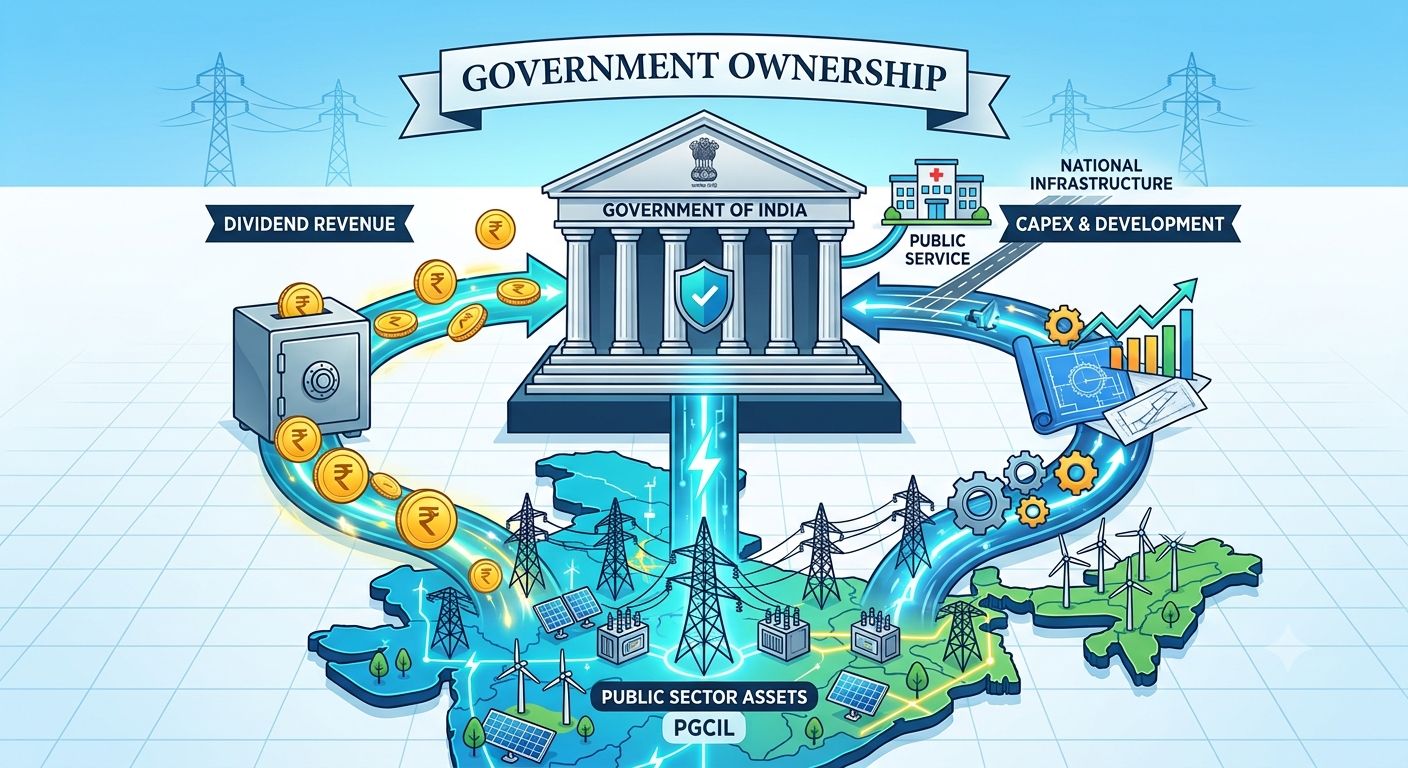
The Government of India is PGCIL's largest shareholder. This means that whenever the company declares a dividend, the government also receives its share based on its ownership stake.
The Government of India owning approximately 51.34% of PGCIL, more than half of every dividend declared by the company ultimately flows back to the government.
This makes dividend income an important source of non-tax revenue while still requiring the company to balance shareholder returns with future investment needs.
Dividend income is an important source of non-tax revenue for the government. As a result, the government generally prefers profitable public sector companies like PGCIL to maintain a consistent dividend track record.
However, this doesn't mean PGCIL can distribute all of its profits as dividends.
The company is also responsible for expanding India's transmission network to support rising electricity demand, renewable energy integration, and new infrastructure projects. These investments require significant capital.
Therefore, PGCIL has to strike a balance between two objectives:
- Reward shareholders through regular dividend payments.
- Retain enough cash to fund future transmission projects without putting excessive pressure on its balance sheet.
This balanced capital allocation policy has helped PGCIL maintain a reputation as a reliable dividend-paying company while continuing to invest in India's growing power infrastructure.
Can PGCIL Sustain Its Dividends?

Paying dividends consistently is one thing. Sustaining them for the next decade is a much bigger challenge.
To answer that question, investors should look beyond the dividend yield and evaluate whether the company's financial position can comfortably support future payouts.
Strong Operating Cash Flow
PGCIL has consistently generated strong operating cash flows, In FY26 the operating profit was ₹32,830 crore and most of its transmission assets earn regulated revenue throughout their useful life.
This provides the company with a reliable stream of cash that can be used to fund operations, service debt, invest in new projects, and reward shareholders.
For dividend investors, stable operating cash flow is far more important than reporting record profits in a single year.
Dividend Payout Ratio Remains Comfortable
A high dividend is attractive only if the company can afford to pay it.
PGCIL has generally maintained a balanced dividend payout policy, distributed a meaningful portion of its profits while retaining enough earnings to fund future expansion. This reduces the likelihood of aggressive dividend cuts during periods of higher capital expenditure.
Instead of maximising dividends in the short term, the company has focused on maintaining payouts that can be sustained over the long term.
Free Cash Flow Needs A Different Perspective
At first glance, PGCIL's free cash flow may not always appear impressive because the company continuously invests thousands of crores in expanding India's transmission infrastructure.
However, this should not automatically be viewed as a warning sign.
Unlike many businesses where heavy capital expenditure simply replaces old assets, PGCIL's investments create new regulated transmission assets that generate additional revenue for decades. In other words, today's capital expenditure lays the foundation for tomorrow's earnings and future dividends.
Capital Expenditure Supports Future Dividend Growth
India's electricity demand is expected to grow significantly over the coming years, driven by renewable energy, electric vehicles, data centres, and industrial expansion.
To support this demand, PGCIL continues investing in interstate transmission lines, substations, Green Energy Corridors, and high-voltage transmission projects across the country.
While these investments require substantial capital today, they also expand the company's regulated asset base, allowing future earnings and dividend-paying capacity to grow over time.
If you'd like to learn how dividends can generate long-term passive income you can watch my video on 10 Dividend Stocks for Passive Income
Final Thoughts
PGCIL's dividend story is not built on unusually high profits or aggressive payout ratios. It is built on something far more valuable - predictability.
Its regulated business model, stable cash flows, natural monopoly-like position, and disciplined capital allocation provide a strong foundation for consistent dividend payments. While no dividend is ever guaranteed, PGCIL possesses many of the characteristics that long-term dividend investors look for in a reliable income-generating business.
That said, investors should not evaluate PGCIL solely on the basis of its dividend yield. Future dividend growth will also depend on factors such as transmission asset expansion, regulatory decisions, capital expenditure requirements, and earnings growth.
For investors seeking a stock that can generate regular cash flow while benefiting from India's rising electricity demand, PGCIL remains one of the strongest dividend candidates in the Indian market.
In the end, the question isn't whether PGCIL can pay another dividend this year. The more important question is whether its business model can continue generating predictable cash flows over the next decade. Based on its current fundamentals, the answer appears encouraging.