Kovai Medical’s ₹600 Crore Bet: Analyzing the 600-Bed Expansion Strategy
In the hospital industry, future growth is often measured not by quarterly earnings but by bed additions. Unlike many businesses that can scale production relatively quickly, hospitals must invest heavily in physical infrastructure years before they can generate meaningful returns.
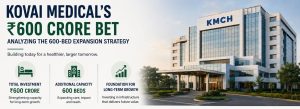
Kovai Medical Center and Hospital (KMCH) is making one of its biggest growth bets yet, committing nearly ₹600 crore towards expanding its healthcare network. The company plans to invest ₹300 crore to increase the capacity of its Sulur hospital from 109 beds to 409 beds, while another ₹300 crore will fund a brand-new 300-bed dedicated Children’s Hospital at its flagship campus.
For long-term investors, these projects are more than just new buildings, they represent the foundation of KMCH’s next phase of growth. The bigger question is whether the company can successfully navigate the long gestation period that comes with hospital expansion.
Why Bed Capacity Matters More Than Revenue?
Unlike many businesses, hospitals cannot rapidly scale operations. Every additional patient ultimately requires physical infrastructure, specialized equipment, doctors, and nursing staff. As a result, bed additions often act as the earliest indicator of future revenue growth.
This relationship is visible in KMCH’s own numbers. Over the last few years, the company has consistently grown revenues while maintaining operating margins in the 27-28% range and return on capital employed above 22%, demonstrating an ability to efficiently monetize its existing assets.
However, there is only so much growth that can be extracted from existing infrastructure. At some point, the next phase of earnings expansion depends on adding new capacity.
Breaking Down the ₹600 Crore Expansion
| Project | Investment | Current Capacity | Planned Capacity |
| Sulur Hospital Expansion | ₹300 crore | 109 Beds | 409 Beds |
| Dedicated Children’s Hospital | ₹300 crore | New Facility | 300 Beds |
Together, these projects represent one of the largest expansion initiatives in the company’s history. Beyond simply increasing the bed count, they also diversify the hospital network and create new avenues for specialized care. This has been explained in detail in our video.
The Sulur Expansion: Growth at the Cost of Pricing Power?
The Sulur expansion does more than add 300 beds, it gradually shifts a larger portion of KMCH’s business towards a different patient demographic. Unlike the flagship Avanashi Road campus, which benefits from a strong urban catchment and higher-value specialty care, Sulur primarily serves an industrial and manufacturing belt where affordability plays a bigger role in healthcare decisions.
This could create an interesting trade-off for investors. While the project significantly expands the company’s ability to serve more patients, the average revenue generated per occupied bed may remain below that of its flagship operations.
In other words, Sulur could become a powerful driver of volume growth, but not necessarily of margin expansion.
As the facility matures, the market will likely watch whether the additional scale can offset the possibility of lower blended pricing across the network.
The Children’s Hospital: Building a Specialty Moat
The proposed 300-bed Children’s Hospital may prove to be more than just another expansion project. Pediatric and neonatal care are highly specialized segments that require significant investment, experienced clinicians, and years of trust-building with patients
By creating a dedicated children’s facility, KMCH strengthens its position in an area where competition is naturally limited. At the same time, specialized pediatric care often acts as an entry point into the broader healthcare ecosystem, helping build long-term patient relationships.
However, specialty hospitals also tend to have longer payback periods than general hospitals, meaning investors may need to be patient before the full financial benefits become visible.
Brownfield VS Greenfield Expansion
Not all hospital expansions create value in the same way. Expanding an existing facility, known as a brownfield project, is generally cheaper and faster because much of the infrastructure and patient ecosystem is already in place. The Sulur project follows this approach, allowing KMCH to increase capacity from 109 to 409 beds while leveraging its existing operations.
The new Children’s Hospital, on the other hand, is effectively a greenfield investment. While such projects typically involve a longer gestation period, they also create entirely new revenue streams and strengthen the company’s long-term healthcare ecosystem.
By combining both approaches, KMCH appears to be balancing growth with capital efficiency - a strategy that could help preserve its historically strong return ratios as it expands.
Understanding the Hospital Gestation Period
One of the biggest challenges in analyzing hospital stocks is understanding the gap between investment and returns.
Unlike many industries, new hospitals rarely become profitable immediately after commissioning. Significant costs including medical equipment, staffing, and administration are incurred upfront, while patient volumes build gradually.
Typically, a new hospital takes around two to three years to reach break-even and four to five years to achieve mature occupancy levels. During this period, financial metrics such as margins and return ratios can temporarily come under pressure even though the business is creating long-term value.
For investors, patience often becomes just as important as the expansion itself.
The Hidden Cost of Expansion
| Metric | Position |
| Cash & Liquid Investments | ~₹270 Cr |
| Annual Cash Accruals | ₹350+ Cr |
| Debt-to-Equity | ~0.35x |
| Planned Capex | ₹600 Cr |
| Historical ROCE | ~23% |
| Potential Temporary ROCE Range | 16-18% |
KMCH enters this investment cycle from a position of financial strength. The company maintains a relatively conservative balance sheet, with low leverage and healthy annual cash generation, reducing the risk that the ₹600 crore expansion becomes a funding challenge.
The bigger question is not solvency, but efficiency. New hospitals begin incurring depreciation, staffing, and operating costs long before they reach mature occupancy. As a result, the company’s historically strong return on capital employed (ROCE) could temporarily moderate during the ramp-up phase.
For investors, this creates an interesting dynamic: short-term financial ratios may weaken even while the underlying business is building the foundation for its next phase of growth.
The Short-term Cost of Long-term Growth
Large capital expenditure cycles frequently create what investors refer to as an “earnings valley.”
Employee costs, depreciation, and interest expenses begin almost immediately, while revenues take time to catch up. This can make short-term profitability appear weaker, even when the underlying business remains fundamentally healthy.
For KMCH, the next few years may therefore be less about maximizing quarterly earnings and more about successfully executing one of the largest expansion programs in its history.
A Capacity Story, Not an Earning Story
The ₹600 crore investment should ultimately be viewed through a long-term lens.
If both projects ramp up successfully, the additional 600 beds could materially expand the company’s revenue-generating ability over the coming years.
In many ways, investors are not simply valuing KMCH’s current earnings, they are evaluating management’s ability to convert new capacity into sustainable cash flows.
That is often how the market values hospital businesses: years before the full earnings potential actually appears in the financial statements.
The Micro-Market Battlefield: Coimbatore’s Hospital Competition
A hospital expansion does not succeed just by adding beds. Its outcome depends heavily on local competition and patient flow. Coimbatore is already a strong healthcare hub for Tamil Nadu and parts of Kerala, making it a highly competitive market.
Flagship Campus vs Established Hospitals
At its Avanashi Road campus, KMCH’s upcoming 300-bed Children’s Hospital will compete directly with major hospitals like PSG Hospitals (1,400-bed trust hospital) and GKNM Hospital, which is strong in women and child healthcare.
Specialised players like Ganga Hospital (around 650 beds, orthopaedics and trauma) and GEM Hospital (gastroenterology specialist) further dominate high-value treatment segments.
This means KMCH cannot rely on scale alone. Its pediatric hospital will depend on how effectively it uses its multi-speciality network to retain patients in a competitive specialty-driven market.
Sulur Expansion: New Market or Patient Leakage Risk?
The Sulur expansion from 109 to 409 beds is a key strategic move into an industrial and semi-urban belt.
Unlike city centres, major competitors like KG Hospital and Sri Ramakrishna Hospital have limited presence here, giving KMCH a first-mover advantage in the Sulur-Trichy corridor.
However, the key risk is patient migration. Even after expansion, many patients may still travel 20-25 km to Coimbatore city for complex treatments at established hospitals, which could limit occupancy.
To succeed, KMCH will need to position Sulur as a fully capable tertiary hospital, not just a satellite facility.
Valuation Matrix: What is the Market Pricing In?
Hospital stocks are usually expensive during expansion phases because investors price in future growth early. Large national hospital chains like Apollo, Max Healthcare, and Fortis often trade at premium 50x-60x price-to-earnings (P/E) multiples. Even regional outperforming players such as KIMS and Yatharth command valuations above 35x earnings because the market aggressively prices in future bed capacity.
In comparison, KMCH currently trades at a distinct regional discount of around 24x trailing earnings. This indicates that the market is valuing the company strictly on its legacy operations and is heavily discounting the compounding impact of its upcoming 600-bed expansion cycle.
If we build a forward estimate assuming a realistic 14% revenue CAGR as the new beds gradually come online, consolidated revenues would scale from the baseline of ₹1,584 crore to roughly ₹2,700 crore by FY30. Assuming steady operational execution allows KMCH to maintain a healthy 14% net profit (PAT) margin- which is structurally supported by mature operating EBITDA margins recovering to the 28%- 29% range once the expansion gestates-net profit would reach approximately ₹380 crore.
At the current market capitalization of roughly ₹5,900 crore, this means KMCH is effectively trading at an incredibly cheap 15.5x FY30 estimated earnings.
For long-term investors, this valuation gap highlights a massive margin of safety. The market is effectively pricing the stock as if it will remain a localized, single-campus operation, giving you the upcoming 300-bed pediatric hospital and the 300-bed Sulur expansion virtually for free.
What Investors Should Watch?
As the expansion progresses, a few indicators will provide valuable insight into execution:
- Construction and commissioning timelines.
- Occupancy growth at the expanded Sulur facility.
- Progress on the Children’s Hospital.
- Margin trends during the ramp-up period.
- The company’s ability to maintain its historically strong return ratios.
These factors will likely determine whether the current investment cycle translates into long-term shareholder value.
Conclusion
Kovai Medical’s ₹600 crore expansion is not simply a capital expenditure announcement, it’s a statement about where management believes the company’s next decade of growth will come from.
The market often rewards hospital businesses long before new facilities reach full utilization, but only when investors have confidence in execution. If KMCH can successfully convert these 600 additional beds into high-return assets while preserving the operational discipline that has defined the business so far, this investment cycle could become one of the company’s most important growth drivers.