Is Texmaco Ready for a Recovery?
Texmaco Rail & Engineering’s recovery case now hinges on a simple numerical gap: management’s current growth trajectory of roughly 15% is below the ~19% CAGR required to double FY26 revenue by FY30.
That gap is more important than the size of the order book itself.
FY26 revenue fell to ₹4,377 crore from ₹5,107 crore in FY25, while PAT declined to ₹194 crore from ₹226 crore. Q1 FY27 then started with another 17.3% revenue decline to ₹753 crore. Yet the company entered the year with a ₹9,923 crore order book, including the South African programme, while Electrical Infrastructure revenue grew 76.8% to ₹175 crore.
The recovery therefore has a clear test. Texmaco needs to convert its backlog into sustained revenue growth, rebuild operating profit and generate cash while adding enough new orders to close the gap between its current ~15% trajectory and the ~19% CAGR required for its 2030 ambition.
The Real Problem Is The Growth Gap
Texmaco’s FY25 performance created a much higher base. Revenue had risen 45% to ₹5,107 crore, but FY26 reversed part of that progress as wheelset shortages, US tariffs and disruption in the Kalindee business affected execution.
FY26 revenue consequently fell to ₹4,377 crore, 14.3% below FY25. PAT fell 14.1% to ₹194 crore.
Management is now targeting roughly 15-20% annual revenue growth over the next one to two years, driven by private-sector and export orders.
But the longer-term arithmetic is harder.
To double ₹4,377 crore of FY26 revenue by FY30, Texmaco would need revenue of about ₹8,754 crore. That requires approximately 18.9% CAGR for four years.
At 15% CAGR, FY30 revenue would reach only about ₹7,650 crore roughly ₹1,100 crore below the doubling target.
So the recovery thesis requires more than a return to normal execution. Texmaco needs to sustain growth closer to 19-20%, or generate additional growth through fresh orders after the existing backlog is executed.
That is the central question for the stock: can the company move from a 15% growth trajectory to the ~19% pace required for its stated ambition?
Q1 FY27 Shows Profit Recovery, But Not Yet Revenue Recovery
Q1 FY27 does not yet close that gap.
Revenue fell 17.3% year-on-year to ₹753 crore, while EBITDA was ₹81 crore, broadly stable from ₹83 crore despite the lower revenue. EBITDA margin consequently improved to 10.8% from 9.2%. PAT rose 85.9% to ₹52 crore.
The PAT improvement was helped by lower finance costs, which declined 18.2% year-on-year, while the business also benefited from cost optimisation and a better mix.
That makes the quarter better than the headline revenue decline suggests, but it does not establish a full recovery.
A useful definition is:
Texmaco should be considered in recovery only when three conditions occur together:
- Revenue returns to sustained double-digit growth rather than one-quarter improvement.
- EBITDA grows faster than revenue or at least maintains a stable margin while revenue expands.
- Operating cash flow remains positive as revenue grows, without a disproportionate increase in receivables or inventory.
Q1 has provided evidence for the second condition, but not yet the first. The cash-flow evidence must also improve alongside the revenue recovery. Check our latest video for more detailed explanation.
The South African Order Can Help, But ₹4,100 Crore Is Not Near-Term Revenue
The ₹4,100 crore South African programme is the largest visible catalyst, but its headline value needs to be broken down carefully.
The announced contract covers more than 2,200 freight wagons and a 15-year maintenance commitment. Management clarified that the announced value includes wagon pricing plus 15 years of maintenance. The maintenance component represents approximately 30-35% of the total value. The locomotive component is separate and was not included in the ₹4,100 crore headline value when the original contract was announced.
That means roughly 65-70% of ₹4,100 crore, or ₹2,665-₹2,870 crore, relates to the wagon portion.
Management expects around 50% of the wagon-order revenue to be recognised in FY28.
On that basis, the direct FY28 revenue opportunity from the wagon portion is approximately ₹1,333-₹1,435 crore, before considering the separately negotiated locomotive programme.
That is significant against FY26 revenue of ₹4,377 crore: the potential FY28 recognition alone equals roughly 30-33% of FY26 annual revenue.
But it should not be added mechanically to FY28 revenue forecasts. Revenue recognition depends on production, delivery and contractual milestones. The maintenance component will be spread over 15 years rather than recognised upfront, while the locomotive value is additional but separate.
The order therefore provides a meaningful bridge toward higher revenue, but it does not eliminate the need for fresh orders to sustain the ~19% CAGR required through FY30.
Electrical Infra Can Offset Only Part Of Freight Weakness
Electrical Infrastructure is becoming an important counterweight to the freight business, but its current scale puts a limit on how much it can offset.
Revenue from the business rose 76.8% year-on-year to ₹175 crore in Q1 FY27.
That implies Q1 FY26 Electrical Infra revenue of roughly ₹99 crore. The year-on-year increase was therefore approximately ₹76 crore.
Meanwhile, company-wide revenue declined by ₹157 crore, from ₹910 crore to ₹753 crore.
So the ₹76 crore incremental Electrical Infra revenue offset approximately 48% of the company’s ₹157 crore year-on-year revenue decline.
That is meaningful, but it also shows why the business cannot yet compensate fully for freight weakness.
Electrical Infra represented about 23% of Q1 FY27 revenue, while Freight Cars remained around 69%.
For diversification to materially change the earnings trajectory, Electrical Infra would need to keep growing while freight revenue also recovers. Its current growth rate can cushion the downturn; it cannot yet replace the freight business as Texmaco’s primary revenue engine.
The ₹9,923 Crore Order Book Solves Visibility, Not The Growth Gap
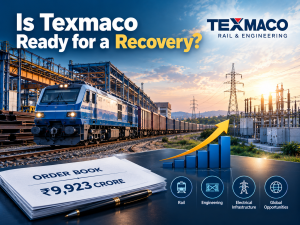
Texmaco had a consolidated order book of ₹9,923 crore as of June 30, 2026, after securing more than ₹5,200 crore of fresh orders during Q1.
The order book is therefore approximately 2.3 times FY26 revenue.
That provides substantial execution visibility. But backlog-to-revenue conversion is different from growth.
If the current backlog supports only roughly 15% growth over the next two years, Texmaco still needs additional orders to maintain the ~19% CAGR required for its 2030 objective.
This creates a two-step recovery equation:
Existing backlog → revenue recovery
New order intake → sustained 19% growth
The first can repair the near-term earnings decline. The second determines whether Texmaco can actually reach its longer-term growth ambition.
96.4% Private And Export Orders Bring New Risks Too
The shift away from Indian Railways is significant. Private-sector and export orders accounted for 96.4% of the freight-car order book in Q1 FY27, compared with 21% in FY25.
But that number should not automatically be interpreted as lower risk.
A private/export-heavy book changes the risk profile rather than simply reducing it.
Exports introduce currency, freight, geopolitical and country-specific risks. Management has also indicated that higher export volumes increase freight costs because the company bears freight charges on export wagons, with the corresponding income recorded in revenue.
Private customers can also have different ordering cycles and financing structures from Indian Railways.
The South African contract itself demonstrates both sides of this equation: it expands Texmaco’s addressable market, but also requires international execution, local manufacturing considerations and a long-term maintenance commitment.
Therefore, the relevant metric is not whether private/export orders are higher. It is whether those orders deliver higher revenue growth without sacrificing margins, cash conversion or balance-sheet efficiency.
Cash Flow Is The Missing Confirmation
Texmaco’s FY26 cash flow gives the recovery thesis a useful starting point.
Consolidated operating cash flow rose sharply to ₹362.7 crore, compared with negative ₹46.6 crore in FY25. Capital expenditure was ₹167.1 crore, leaving approximately ₹195.6 crore of cash generation after capex.
That is a substantial improvement from FY25, when working-capital absorption had been severe.
However, the FY26 improvement partly reflected working-capital movements. Trade receivables generated ₹79.7 crore of cash and inventory absorbed ₹15.9 crore, while payables absorbed ₹50.7 crore.
The next test is therefore not simply whether operating cash flow remains positive.
As revenue accelerates, Texmaco needs to demonstrate that cash conversion remains healthy without another large build-up in receivables or inventory.
For the recovery thesis, a useful scorecard is:
- OCF should remain positive as revenue grows.
- OCF should increasingly track EBITDA rather than lag it materially.
- Capex should remain covered by operating cash generation.
- Receivable and inventory growth should remain controlled relative to revenue.
- Debt reduction should continue rather than being reversed to finance growth.
FY26 provides the first evidence of cash-flow repair. FY27 must establish that it is repeatable.
The Indian Railways Opportunity Should Be Treated As Upside, Not A Required Catalyst
The earlier version treated the delayed Indian Railways wagon tender as the biggest trigger. That is too strong without a sufficiently quantified tender value and award timeline.
Texmaco already has enough order visibility to grow without immediately depending on a single domestic tender. The company had more than 6,000 pending wagon orders and a ₹9,923 crore overall order book at June 2026.
Indian Railways therefore remains an important potential source of incremental demand, particularly because Texmaco has an established freight-car manufacturing base.
But without a firm tender size and execution schedule, it should not be inserted into the base-case recovery calculation.
The more measurable trigger is already available: can the existing backlog generate revenue growth of closer to 19% rather than 15%?
Vision 2030 Should Not Be Used To Fill The Growth Gap
Texmaco’s Vision 2030 includes freight cars, foundry and components as the core, while areas such as defence, renewable energy and Invariz.ai provide diversification opportunities.
The investment case should separate these categories.
The freight-car, Electrical Infra and Rail & Green businesses already generate revenue and have identifiable order books. These can be used to assess current earnings.
Defence and newer technology initiatives are different. The company has discussed significant future investments and long-term targets, but these are not yet large enough to be treated as established earnings streams.
The same applies to the RVNL JV. Without a disclosed near-term revenue opportunity large enough to affect the group’s financial trajectory, it is better treated as strategic optionality rather than a core part of the recovery calculation.
For the next two years, investors do not need Vision 2030 to work perfectly. They need the existing businesses to close the growth gap.
Valuation Is Already Pricing In Some Recovery
The stock also needs to be assessed against what the market is currently paying for that recovery.
As of September 15, 2026, Texmaco’s market capitalisation was around ₹4,504 crore, with the stock at approximately ₹110.7. Its trailing P/E was around 20.8x and forward P/E around 20.3x, while the price-to-sales ratio was approximately 1.07x.
That is not a valuation that assumes FY26 conditions continue indefinitely.
At roughly 21x earnings, the market is already attaching value to some improvement in future profitability. The key question is therefore not whether Texmaco has an order book. It is whether earnings can grow sufficiently to make that valuation sustainable.
The valuation becomes easier to justify if revenue moves toward the required ~19% CAGR, EBITDA margins remain around or above current levels and operating cash flow follows earnings.
If revenue remains closer to 15% while margins stagnate and cash conversion weakens, the earnings denominator may not expand quickly enough to support the current valuation.
This makes the growth gap relevant not only to Vision 2030, but also to the stock’s current earnings multiple.
What Would Actually Confirm A Recovery?
The recovery should be tracked through five measurable indicators rather than through order announcements alone.
- Revenue growth:
Move from Q1’s -17.3% YoY decline to sustained double-digit growth, with the medium-term trajectory moving toward ~19% CAGR.
- South African execution:
Track wagon production and revenue recognition against the approximately ₹1,333-₹1,435 crore potential FY28 wagon revenue contribution implied by management’s 50% recognition expectation.
- Electrical Infra:
Maintain growth while increasing its absolute contribution. The ₹76 crore Q1 incremental revenue contribution shows that it can cushion freight weakness, but the segment needs to become substantially larger before it can independently drive group growth.
- Cash conversion:
FY26 OCF of ₹363 crore was a major improvement. The next step is proving that operating cash flow continues to rise with EBITDA rather than being driven primarily by working-capital releases.
- Order replenishment:
The ₹9,923 crore backlog provides visibility, but the company must continue winning orders after that backlog is converted. Otherwise, a strong FY27–FY28 execution cycle could still leave FY29–FY30 growth below the required pace.
These five indicators provide a cleaner definition of recovery than PAT alone.
So, Is Texmaco Ready For A Recovery?
Texmaco has moved beyond the stage where the recovery case is based only on management commentary. The company has a ₹9,923 crore order book, a large South African programme, rapidly growing Electrical Infra and substantially improved FY26 operating cash flow.
But the central issue remains unresolved.
A roughly 15% growth trajectory is not enough to double FY26 revenue by FY30. The mathematical requirement is approximately 19% CAGR. That leaves a gap of roughly four percentage points every year.
The South African order can help close part of that gap, with around ₹1,333–₹1,435 crore of wagon-related revenue potentially recognised in FY28 based on the company’s stated execution expectation. Electrical Infra can cushion freight weakness, having already offset nearly half of Q1’s company-wide revenue decline on a year-on-year incremental basis. But neither is sufficient on its own.
The recovery should therefore be treated as unconfirmed until revenue growth, EBITDA and cash flow improve together.
The framework is straightforward:
Backlog conversion → revenue growth → margin expansion/maintenance → operating cash flow → order replenishment.
If Texmaco progresses through all five stages, the 2030 growth ambition becomes increasingly supported by operating evidence. If revenue remains below the required growth rate or cash fails to follow earnings, the order book will represent visibility without enough acceleration.
For investors, the next few quarters should therefore be judged less by individual order announcements and more by whether Texmaco is steadily closing the 15% versus ~19% growth gap while converting accounting profits into cash.