How Hobel Bellows could help Unimech enter Reactor Components?
Unimech has already crossed the first barrier in India’s nuclear supply chain: qualification and order wins. The next barrier is more valuable- moving into critical reactor components.
Its ₹450 crore acquisition of Hobel Bellows, completed in April 2026, could provide that bridge. Hobel brings capabilities in metallic bellows, expansion joints, flexible tubing and precision tubular assemblies, which management believes have direct synergies with the domestic nuclear reactor market.
But there is an important catch. Hobel is not yet certified by NPCIL for the specific reactor-component opportunity. A fresh qualification process of about one year is required.
That makes Hobel an interesting strategic option rather than an immediate nuclear revenue contributor.
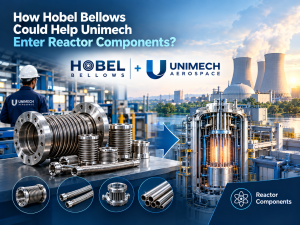
What Does Hobel Bring To Unimech?
The most important part of the acquisition is not simply Hobel’s existing business. It is the manufacturing capability that Unimech can potentially take into its nuclear offering.
Hobel manufactures:
- Metallic bellows
- Expansion joints
- Flexible tubing
- Precision tubular assemblies
These products give Unimech capabilities that are different from the electromechanical subsystems through which it initially entered the nuclear sector. Management has explicitly described the Hobel capabilities as a direct synergy with Unimech’s domestic nuclear ambitions.
This creates a logical progression in Unimech’s nuclear strategy.
The company first established itself as a qualified supplier across around 10 nuclear subsystems. It then began participating in tenders from NPCIL, NTPCL and NFC and converted this capability into actual orders.
Hobel could now broaden the type of components Unimech can potentially offer.
That is the real strategic rationale for the acquisition: not just more capacity, but access to another layer of the nuclear component value chain.
Why Are Reactor Components The Bigger Opportunity?
Unimech’s existing nuclear business has already achieved commercial validation. Its subsidiary Innomech Aerospace Toolings received a ₹72.20 crore NPCIL order for support equipment for Tarapur Atomic Power Station Units 3 and 4, with deliveries scheduled through December 2028.
Hobel could potentially take the company a step further.
Management has specifically linked Hobel’s expansion-joint capability to applications involving the reactor vessel and steam generators.
This matters because the opportunity is no longer simply about supplying equipment around a nuclear plant. It potentially puts Unimech closer to the reactor island, where component qualification and technical capability become much more important.
From an investor’s perspective, this could increase the strategic value of Unimech’s nuclear platform in two ways:
- Broader product offering: Unimech could potentially supply more types of components to nuclear projects.
- Deeper positioning: It could move from support-equipment opportunities toward specialised reactor-related components.
However, these are potential benefits, not current revenue streams.
How Hobel Fits Into Unimech’s Existing Nuclear Strategy?
Hobel’s potential should not be viewed separately from what Unimech has already built.
The company has been in the nuclear business for 3-3.5 years and is qualified for around 10 subsystems. Management has also said it is formally participating in tenders across NPCIL, NTPCL and NFC.
This gives Hobel a potentially useful platform.
Instead of entering nuclear from scratch, Unimech can potentially use its existing nuclear experience and qualification base while adding Hobel’s specialised manufacturing capabilities.
The strategy can therefore be viewed as:
Existing nuclear qualifications → access to tenders → Hobel’s specialised component capabilities → fresh qualification → potential reactor-component orders
This is more interesting than a simple acquisition-led diversification story.
The company is effectively trying to expand its nuclear addressable market from within, by increasing the range of components it can potentially supply.
The strategy also fits with Unimech’s stated interest in upcoming reactor programmes. Management said the company is looking at opportunities from four new nuclear reactors, supported by the qualifications it already has.
Why NPCIL Certification Is The Key Hurdle
The biggest risk to the Hobel nuclear thesis is also clearly identifiable: certification.
Hobel does not currently possess the specific NPCIL certification required for the relevant reactor-component opportunity. Management expects a fresh qualification process of approximately one year.
This means the ₹450 crore acquisition should not be interpreted as ₹450 crore of immediate nuclear opportunity.
There are several steps between acquiring Hobel and generating nuclear revenue from these products:
Capability → qualification → tender participation → order win → execution
Each stage matters.
Even after certification, Unimech will still need to win orders. Management has highlighted the role of L1/L2 dynamics in government procurement and has indicated that it bids only where the economics meet its margin thresholds.
Therefore, certification is necessary but not sufficient.
For investors, the first meaningful catalyst is successful NPCIL qualification. The second is whether that qualification actually converts into orders at acceptable margins.
Could Hobel Increase Unimech’s Nuclear Order Opportunity?
Unimech already has a sizeable nuclear opportunity relative to the business it has built in just a few years.
Management said cumulative nuclear order wins had reached ₹87 crore, while the company had bid for around ₹800 crore worth of nuclear orders.
The ₹800 crore figure should not be treated as an order book. It represents orders for which the company has bid.
Hobel could potentially expand the company’s participation in this opportunity by adding products that Unimech could qualify for future nuclear applications.
This creates an important distinction:
Unimech’s existing qualifications determine where it can bid today. Hobel could potentially increase where it can bid tomorrow.
That is why the acquisition could have a strategic impact beyond Hobel’s standalone business.
If the relevant Hobel products obtain NPCIL approval, Unimech could potentially approach future nuclear projects with a wider component basket.
The company would therefore have two layers of nuclear growth:
- Current: Existing qualified subsystems and order wins.
- Future: Hobel-enabled reactor components, subject to certification and order conversion. Check our latest video for more details.
What Makes This Different From Unimech’s First Nuclear Breakthrough?
Unimech’s first nuclear breakthrough was essentially about proving that it could enter the market and win business.
The Hobel opportunity is different. It is about how far into the value chain Unimech can go.
The January 2026 NPCIL order demonstrated that Unimech’s nuclear qualifications could translate into a ₹72.20 crore commercial contract.
Hobel potentially changes the next question from:
Can Unimech supply nuclear equipment?
to:
How many critical components can Unimech eventually qualify and supply?
That distinction is important for understanding the acquisition.
A broader product portfolio could allow the company to participate in more parts of future nuclear projects. But it also means additional qualification requirements, execution responsibilities and competitive bidding.
So Hobel does not eliminate the challenges of entering nuclear. It potentially gives Unimech more opportunities to take those challenges on.
What Investors Should Watch From Here?
The Hobel nuclear thesis can be tracked through a few concrete milestones rather than broad claims about India’s nuclear expansion.
- NPCIL certification
This is the immediate milestone. Without certification, the reactor-component opportunity remains prospective.
- New nuclear orders
The company needs to demonstrate that its growing qualification base converts into actual contracts. Cumulative nuclear wins had reached ₹87 crore by August 2026.
- Order conversion
The company had bid for around ₹800 crore of nuclear opportunities. Investors should focus on how much becomes an actual order rather than treating the bid value as revenue visibility.
- Margins
Winning nuclear orders is not enough if government procurement pressure results in weak economics. Management has indicated that it selectively bids based on margin thresholds.
This makes qualification + order conversion + profitability the three numbers to watch.
Conclusion
Hobel Bellows could become important to Unimech’s nuclear strategy because it potentially gives the company a new route into specialised reactor components.
Unimech has already established a nuclear presence, with qualifications across around 10 subsystems and cumulative nuclear order wins of ₹87 crore.
Hobel adds metallic bellows, expansion joints, flexible tubing and precision tubular assemblies, with management identifying direct synergies with domestic reactor applications.
But the acquisition alone does not make Unimech a reactor-component supplier. NPCIL certification is still pending, and the relevant qualification process is expected to take about one year.
Therefore, the most important way to view Hobel is as a strategic bridge. Unimech has already proved it can enter nuclear; Hobel could help it move deeper into the reactor value chain.
The real payoff will come only if Hobel’s capabilities clear the qualification hurdle and subsequently translate into recurring, profitable nuclear orders.