India’s Wire Industry – Growth Targets & Export Ambitions Explained
India's wires and cables industry is moving beyond its traditional dependence on construction and conventional power projects.
The bigger opportunity is that cable demand is becoming linked to almost every major area of India's infrastructure investment - from power transmission and renewable energy to data centres, railways, manufacturing and exports.
The industry was estimated at around ₹90,000 crore in FY25, with the market projected to reach approximately ₹1.9 lakh crore by FY30.
But the headline market-size projection is only part of the story. The more important question for investors is whether the underlying demand drivers are strong enough to support that pace of expansion.
The answer is increasingly yes - but not uniformly across every segment.
Power infrastructure and renewable energy are likely to remain the industry's largest structural demand engines, while data centres, exports and specialty cables provide additional growth and margin opportunities.
The companies best positioned to benefit are not necessarily those adding the most capacity, but those that can convert that capacity into higher utilisation, stronger market share and better product mix.
| Indian Wires & Cables Industry | Values |
| FY25 Market Size | ~₹90,000 crore |
| FY30 Industry Estimate | ~₹1.9 lakh crore |
The Investment Thesis in One View

The Indian cable industry's growth case rests on four interconnected trends:
- Power infrastructure: the largest and most dependable source of demand.
- Renewables and electrification: expanding the need for both generation-side and transmission infrastructure.
- Specialty products and data centres: creating higher-value applications beyond conventional wires.
- Exports and formalisation: allowing organised manufacturers to gain access to larger markets and potentially increase market share.
The bullish case therefore does not depend on one segment delivering exceptional growth. It depends on several infrastructure cycles expanding simultaneously while organised manufacturers capture a larger share of the value pool.
But the more important question is not simply how large the wires and cables market can become. The real shift is in where this demand is coming from.
Earlier, cable demand was closely tied to housing construction, real estate projects and conventional power infrastructure. Today, the industry is increasingly connected to India's broader electrification story.
Why Is India's Wire Industry Growing Faster Than Before?
The structural change in India's cable industry is not simply that demand is increasing. It is that demand is becoming more diversified and more electricity-intensive.
Earlier, cable manufacturers were heavily exposed to housing construction, real estate and conventional power projects. Today, the same industry is serving a much wider investment base - including renewable-energy plants, transmission networks, metros, factories, data centres and EV infrastructure.
This matters because these sectors operate on different investment cycles. A slowdown in residential construction does not necessarily mean a slowdown in transmission spending, renewable projects or industrial capex.
The industry is therefore becoming less dependent on any single sector.
More importantly, India's economic growth itself is becoming increasingly dependent on electricity. Manufacturing plants require automated electrical systems, data centres need continuous power, EVs require charging infrastructure and renewable projects need grid connections.
The cable industry is consequently shifting from being primarily construction-linked to being increasingly linked to India's broader electrification cycle.
That is a more durable demand story because infrastructure can keep generating cable requirements even when individual construction cycles fluctuate.
India's Power Infrastructure Is the Biggest Growth Engine
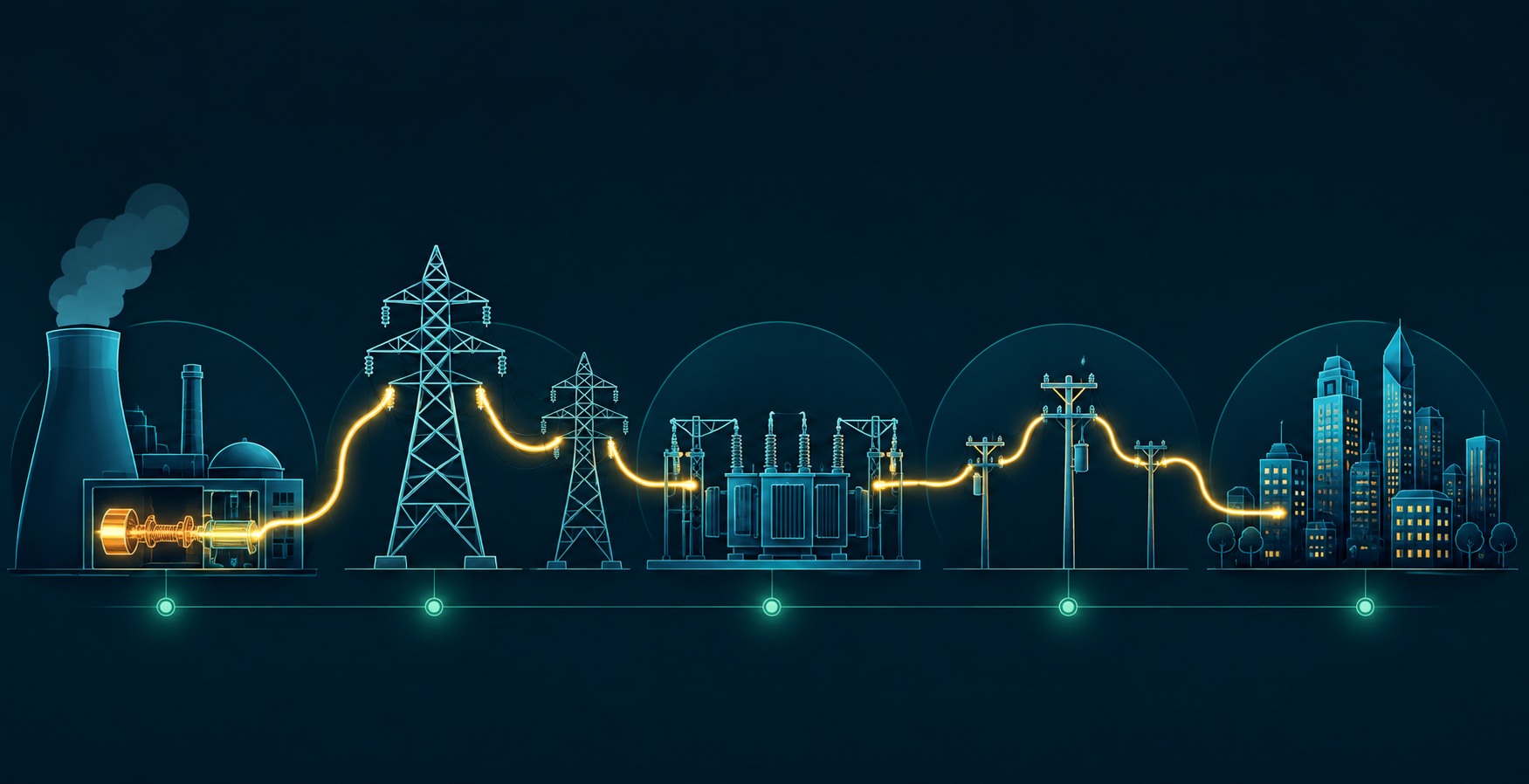
If one growth driver deserves the highest weight in the industry's FY30 outlook, it is power infrastructure.
The reason is simple: every new source of electricity requires infrastructure to move that electricity to the end user.
A new power plant, solar park or wind farm creates demand not only at the generation site, but also across transmission lines, substations and distribution networks.
This creates a broader investment cycle:
Generation - Transmission - Substations - Distribution - End Consumer
For cable manufacturers, that distinction matters. The opportunity is not limited to supplying cables inside a power plant. New generation capacity can trigger additional spending across the entire electrical network.
India's rising electricity consumption strengthens this argument. Industrial expansion, urbanisation, data centres, EV adoption and infrastructure development all increase the need for reliable power.
For investors, power infrastructure should therefore be viewed as the industry's base-load growth engine. Renewable energy, data centres and other emerging applications can accelerate growth, but the underlying demand for transmitting and distributing electricity is likely to remain the largest and most durable opportunity.
Renewable Energy Is Creating New Demand
India's renewable-energy expansion is creating a new source of demand for wires and cables because a solar or wind project requires much more electrical infrastructure than the generation equipment itself.
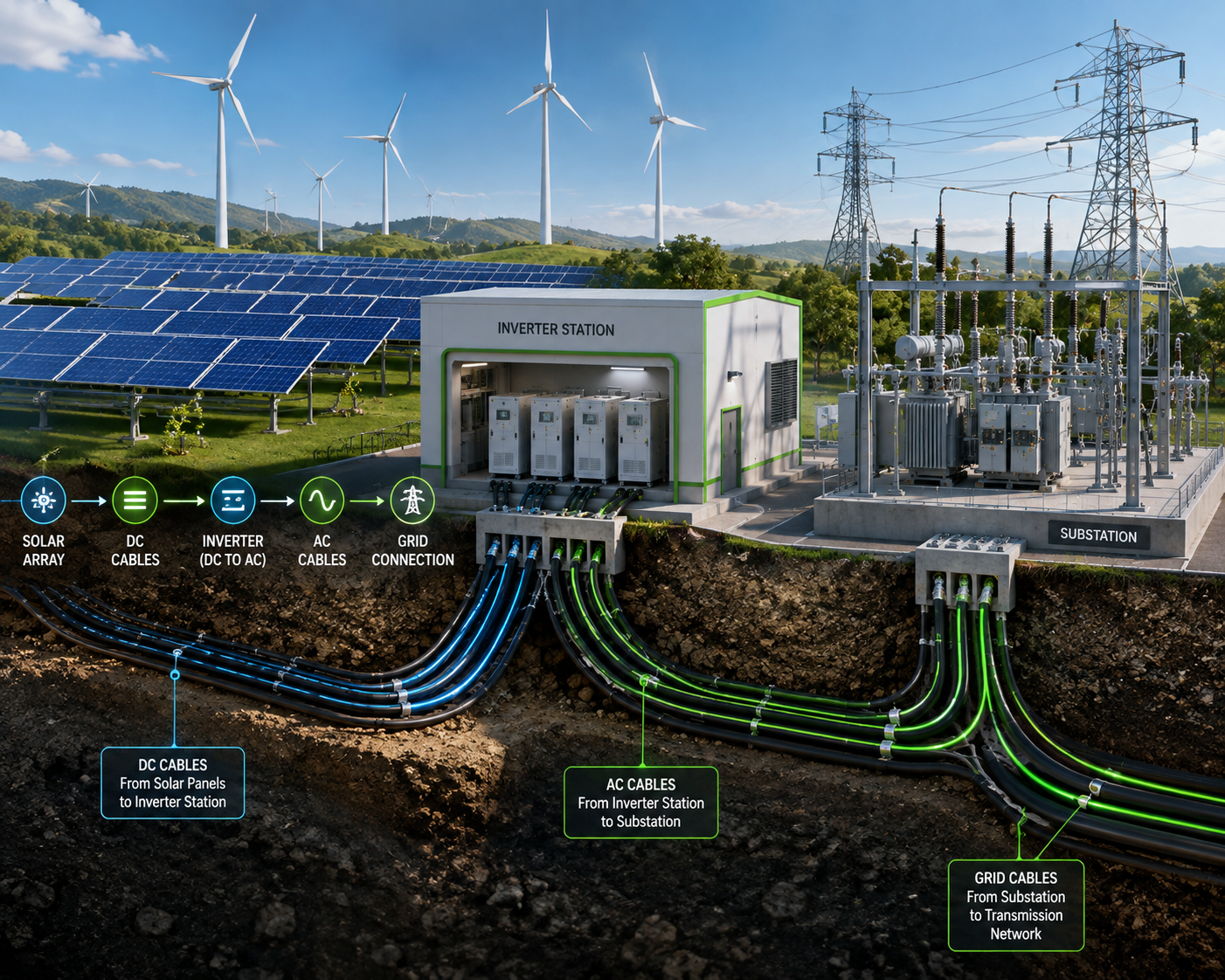
In a solar project, electricity is initially generated as DC power. DC cables carry this electricity to inverters, which convert it into AC power. The electricity is then moved towards pooling substations before being connected to the wider transmission network.
This creates demand for multiple cable applications within the same project:
- DC cables - connect solar panels and collect generated power.
- AC cables - carry converted electricity towards substations.
- Inverter cables - connect generation equipment with the power-conversion system.
- Underground cables - are used where power needs to be carried within or around renewable projects.
- Transmission cables - connect renewable projects with the broader electricity grid.
The distance factor matters
Renewable projects are often located far from major cities and industrial centres because developers choose locations with strong solar radiation or wind resources.
The electricity generated at these locations still needs to reach consumption centres. This increases the need for transmission infrastructure and grid connectivity, creating another layer of demand for cable manufacturers.
The investment significance goes beyond the cable used inside the renewable project itself. Large renewable projects are often located away from major consumption centres, which means electricity must travel longer distances before reaching the grid and ultimately the consumer.
That creates a second layer of opportunity: grid connectivity and transmission investment.
For cable manufacturers, renewable growth therefore has a multiplier effect. More generation creates demand for collection and conversion infrastructure, while the geographic distance between generation and consumption can create additional transmission requirements.
This makes renewable energy one of the industry's strongest incremental growth drivers - particularly when combined with India's broader investment in transmission infrastructure.
Why Do Data Centres Need So Much Cable?
Data centres are becoming another important demand driver because they are highly power-intensive facilities that require electricity continuously and reliably.
A hyperscale data centre can contain thousands of servers operating around the clock. Electricity therefore has to be distributed through multiple layers of infrastructure, from the incoming grid connection to transformers, switchgear, UPS systems and finally the server racks.

This creates demand for several types of cables:
- High-voltage cables - bring and distribute large amounts of incoming power.
- Low-voltage cables - distribute electricity within the facility.
- Fire-resistant cables - help maintain critical systems during fire emergencies.
- Fibre-optic cables - handle high-speed data transmission between systems.
- Copper structured cabling - connects servers and networking equipment.
- UPS and battery connections - link backup power systems to critical loads.
- Generator cabling - connects backup generators to the facility's electrical network.
The important point is that cable demand comes from the entire electrical and connectivity infrastructure, not just from the servers themselves.
AI is increasing the opportunity
The rise of AI is making this requirement even more important. AI workloads rely on high-performance GPUs that consume significantly more power than conventional computing systems.
As data centres increase their computing density, they require:
- Higher-capacity power distribution
- More robust backup systems
- Greater electrical reliability
- More cabling for high-density server environments
Therefore, AI growth can increase cable demand even without a proportional increase in the number of data centres, because each facility can require more power infrastructure as its computing intensity rises.
The bigger takeaway
Renewable energy and data centres represent two different sides of India's electrification story.
Renewables increase the need to generate and transmit electricity, while data centres increase the need to distribute and consume electricity reliably.
Both ultimately require more electrical infrastructure - creating new and increasingly diversified demand for India's wire and cable manufacturers.
Export Ambitions - Can India Become the Next Global Cable Manufacturing Hub?

India's wire and cable industry is not only benefiting from domestic infrastructure spending. Exports are becoming an increasingly important second growth engine.
India's wire and cable exports increased from approximately ₹8,300 crore in FY20 to ₹19,800 crore in FY25. That represents an increase of roughly 2.4 times in five years, showing that Indian manufacturers are becoming increasingly relevant in overseas markets.
| Year | Wire & Cable Exports |
| FY20 | ~₹8,300 crore |
| FY25 | ~₹19,800 crore |
The more important question is whether this export growth is cyclical or reflects a genuine improvement in India's competitiveness.
There are reasons to believe the latter is emerging.
China+1 is opening the door
Global buyers increasingly want supply-chain diversification rather than complete dependence on one manufacturing geography. India benefits from a large domestic market, an established manufacturing base and growing production capabilities.
However, China+1 alone is not enough. International buyers will shift sourcing only if Indian manufacturers can meet the required combination of cost, quality, certification and delivery reliability.
India is moving beyond cost competition
Competitive labour costs provide an initial advantage, but long-term export success depends more on manufacturing scale and product capability.
Leading Indian manufacturers are increasingly targeting products that require stricter technical standards and certifications. This reduces dependence on purely price-sensitive commodity exports.
Capacity is necessary - but not sufficient
Indian manufacturers are adding capacity to serve both domestic and international demand. Larger plants can improve economies of scale, but capacity expansion only creates shareholder value if it is eventually utilised.
This is an important distinction for investors:
Export opportunity and new capacity does not automatically equal higher profits.
The real test is whether companies can fill that capacity with higher-value orders while maintaining acceptable margins.
Specialty cables could make exports more valuable
The biggest opportunity may therefore lie in the product mix.
Products such as extra-high-voltage, railway, marine, solar and specialised industrial cables require greater technical capability and certification than standard house wires.
If Indian manufacturers increase their share of these categories, exports can contribute not only to revenue growth but also to better margins and stronger returns on capital.
India does not need to become the world's lowest-cost cable producer to succeed globally. It needs to become a competitive, reliable supplier of increasingly sophisticated cable products.
The Product Mix Is Becoming More Sophisticated
Perhaps the most important long-term change is that Indian cable exports are increasingly moving beyond basic products.
Higher-value opportunities include:
- Extra-high-voltage cables
- Railway cables
- Marine cables
- Solar cables
- Data-centre-related cables
- Other specialised industrial cables
These products generally involve higher technical requirements and stricter certifications than conventional house wires.
Export growth is valuable, but export growth in high-value products can be even more valuable.
If Indian companies can increase their share of specialty cables, export growth can potentially contribute not only to revenue but also to better margins and stronger return on capital.
Data centres are becoming a new growth engine for cable demand. But which listed companies are best positioned to benefit from this trend? here you can watch my video on Data Center Stocks in India
Organized Players Are Taking Market Share
The formalisation of India's cable industry could be almost as important as the industry's underlying growth.
The market has historically included a large number of regional manufacturers, particularly in relatively standardised products. But the economics of large infrastructure projects increasingly favour manufacturers that can demonstrate consistent quality, certifications, supply reliability and technical capability.
This creates a structural advantage for organised companies.
A large data centre, metro project or industrial facility cannot afford repeated cable failures. Customers therefore have greater incentive to select vendors with established manufacturing standards, testing capabilities, certifications and after-sales support.
The significance of this data is that organised companies can potentially benefit from two forms of growth at the same time:
- The overall cable market expands.
- Their share of that market increases.
That combination can produce faster revenue growth than the industry itself.
However, formalisation should not be treated as an automatic guarantee of market-share gains. Regional manufacturers remain competitive in price-sensitive segments, while large new entrants can add capacity and intensify competition.
The strongest evidence of formalisation will therefore be sustained market-share gains accompanied by stable or improving margins, rather than market-share expansion alone.
Why Margins Could Improve - and Why They May Not
Revenue growth alone does not determine whether the cable industry's expansion creates value for shareholders. The bigger question is what happens to the product mix and operating leverage as companies scale.
Standard wires are relatively price-sensitive, while specialty products can command better economics because they require technical expertise, certifications and customer qualification.
The margin opportunity is therefore strongest where companies increase their exposure to:
- Premium branded wires
- Specialty and high-voltage cables
- Export-oriented products
- Technical and project-based solutions
There is also an operating-leverage opportunity. New plants initially increase depreciation and other fixed costs. Once utilisation rises, however, those costs can be spread across a larger production base.
That can improve margins - but only if demand grows fast enough.
This creates an important counterargument to the industry's bullish narrative: capacity expansion can improve margins at high utilisation, but destroy returns if companies build too much capacity ahead of demand.
Investors should therefore track three variables together:
Product mix + Capacity utilisation + EBIT margin
A company showing revenue growth without improving utilisation or margins may be expanding faster than it is creating economic value.
Can India's Wire Industry Really Double by FY30?
The projected increase from approximately ₹90,000 crore in FY25 to ₹1.9 lakh crore by FY30 looks impressive, but the more useful way to analyse it is through the implied growth rate.
The market would need to grow by roughly 2.1 times in five years, which translates into an implied CAGR of approximately 16.1%. That is ambitious.
For the projection to be achieved, the industry would need to sustain a mid-teens growth rate for five consecutive years. This is possible, but it should not be treated as a base-case certainty.
What needs to go right?
The industry does not need every segment to grow at 16%. Instead, growth can come from a combination of large established markets and faster-growing niches:
| Segment | Long-Term Outlook |
| Power Infrastructure | Very Strong |
| Renewable Energy | Very Strong |
| Data Centres | High Growth |
| Real Estate | Strong |
| Railways | Strong |
| Industrial Automation | Growing |
| EV Infrastructure | Early but High Potential |
| Exports | Very Strong |
Power infrastructure and renewable energy are likely to provide the largest volume contribution, while data centres, specialty cables and exports can grow faster from smaller bases.
This makes the overall target more plausible than assuming one segment will drive the entire industry.
But there is a second side to the argument
The projection assumes that infrastructure spending remains strong, capacity additions are absorbed by demand and competition does not cause a significant deterioration in pricing.
It also assumes that commodity-price volatility does not materially disrupt industry economics.
Therefore, ₹1.9 lakh crore should be viewed as an achievable bull-to-base industry trajectory.
For investors, the more important question is not whether the industry reaches exactly ₹1.9 lakh crore. It is whether individual companies can grow faster than the industry while maintaining or improving margins and returns on capital.
What Could Break the Investment Thesis?
The industry's structural growth story is strong, but four risks could prevent that growth from translating into attractive shareholder returns.
Capacity Could Grow Faster Than Demand
The industry's expansion opportunity is attracting significant investment in new manufacturing capacity.
That is positive when demand grows alongside supply. But if multiple manufacturers commission capacity at the same time, utilisation could fall and pricing pressure could increase. For investors, capacity announced is not the same as earnings delivered.
The key indicators are commissioning timelines, utilisation and incremental return on capital.
Commodity Prices Can Disrupt Margins
Copper and aluminium are major inputs, and their prices can move sharply. Manufacturers can often pass higher costs through to customers, but there can be a time lag. During that period, margins can temporarily contract.
The strongest companies are therefore not necessarily those with the lowest input costs, but those with better pricing discipline and pass-through mechanisms.
Competition Could Challenge Market-Share Gains
Formalisation creates an opportunity for organised players, but it also makes the industry more attractive to large entrants.
Additional capacity from companies such as Adani Enterprises and UltraTech Cement could increase competitive intensity.
If supply grows faster than demand, the result could be lower pricing and weaker margins across the industry.
Therefore, market-share gains must be judged alongside pricing power and profitability.
Valuation Could Absorb the Growth
This is perhaps the biggest risk for investors. A company can deliver strong revenue and profit growth and still generate poor stock returns if its valuation already assumes even stronger future performance.
For premium-valued cable companies, investors should therefore ask:
How much of the expected growth is already reflected in the share price?
The distinction is crucial:
A structurally attractive industry does not automatically make every stock attractive at every valuation.

Final Verdict: The Industry Story Is Stronger Than the Average Stock Story
India's wire and cable industry has a credible structural growth opportunity, but investors should not confuse industry growth with automatic stock-market returns.
The strongest part of the thesis is the demand side. Power infrastructure and renewable energy provide large, long-duration markets, while data centres, specialty cables and exports create additional opportunities for faster growth and better product mix.
The industry's projected expansion from roughly ₹90,000 crore to ₹1.9 lakh crore by FY30 implies around 16% annual growth.
That is achievable if India's infrastructure spending remains strong and multiple end markets expand simultaneously, but it is ambitious enough to require disciplined execution.
The real winners are therefore unlikely to be companies that simply add the most capacity.
They will be the companies that can fill that capacity, gain market share, move toward higher-value products, expand exports and protect margins despite commodity and competitive pressures.
That leads to a more selective investment conclusion:
India's cable industry deserves a structural growth premium - but individual cable stocks deserve that premium only when earnings growth, return on capital and valuation justify it.
For investors, the next phase should therefore be judged less by headline revenue growth and more by market-share gains, capacity utilisation, specialty-product mix, export growth, EBIT margins and valuation discipline.
That is where the difference between a good industry and a good investment will be decided.