Export Opportunity in Defence Electronics: Can Paras Defence Break Beyond India?
The global defence optics and electro-optical (EO/IR) market is expanding rapidly. Sensor-heavy warfare, drone proliferation, and multi-domain surveillance systems are driving this growth. Advanced militaries no longer account for demand alone. Mid-tier defence spenders are also prioritizing imaging, thermal detection, and counter-drone systems as core battlefield infrastructure.
This trend creates a long-term opportunity for Paras Defence. The key question is not whether demand exists, but whether the company can convert it into a scalable export engine.
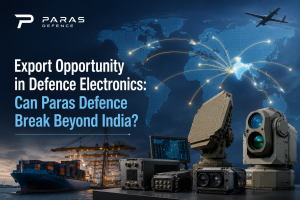
Where The Export Opportunity Actually Lies?
Paras Defence is unlikely to compete directly with global defence primes that dominate full EO/IR system integration. Instead, its export pathway is more realistically concentrated in sub-system manufacturing and precision optical components, where global OEMs increasingly outsource production to capable, cost-efficient suppliers.
Three export channels stand out:
Tier-1 global OEM supply chain integration
Large defence contractors outsource precision optics assemblies, rugged imaging modules, and specialized optical sub-components. Certification, consistency, and manufacturing precision drive this segment far more than branding.
Geographically diversified defence procurement markets
Regions such as the Middle East, Southeast Asia, and parts of Africa are actively reducing dependence on single-origin suppliers. These markets are increasingly open to surveillance, border security, and defence imaging systems sourced from alternative defence ecosystems.
Counter-UAV and perimeter security systems
One of the fastest-growing sub-segments in defence electronics, where EO/IR systems are embedded into detection and tracking modules. Adoption cycles are relatively faster compared to traditional defence platforms due to urgent operational demand.
On paper, this positioning makes exports a credible second growth engine for Paras Defence. However, the shift from opportunity to execution is constrained by three structural realities.
The Working Capital Constraint
The first and most critical constraint is the company’s cash conversion structure. Paras Defence operates with very high receivable days (~270+ levels historically), reflecting long payment cycles typical of defence procurement environments.
Export markets do not necessarily solve this issue; in many cases, they intensify it. Defence optics exports involve extended validation cycles, multi-stage certifications, and milestone-linked payments. This means cash outflows for prototyping, testing, and compliance often precede meaningful inflows by a wide margin.
As a result, export scaling is not purely a demand function, it is a balance sheet endurance test. The key question is whether Paras can fund prolonged working capital cycles without diluting equity or expanding debt.
Valuation VS Execution Gap
Paras Defence continues to trade at a premium valuation (~90x–100x earnings range), which already reflects strong medium-term growth expectations.
However, export revenues still form a relatively small portion of the company’s ₹476.57 crore revenue base. This creates a timing mismatch between:
- market expectations of global scaling
- and actual conversion of export pipelines into stable cash flows
The missing clarity is not whether exports will grow, but how quickly they translate into meaningful revenue contribution and operating leverage.
Capacity And Manufacturing Depth
The third and often under-discussed factor is production capacity. Defence optics is not a scalable assembly-line business; it is constrained by highly specialized infrastructure including diamond-turning machines, optical coating chambers, vibration-isolated cleanrooms, and precision metrology systems.
This makes capacity not just a technical constraint, but a strategic sequencing issue in how domestic and export demand are balanced.
Technology Moat: Is Paras Defence Truly Export-Ready?
A critical but often overlooked question is whether Paras Defence’s capabilities are fully aligned with global export-grade defence optics standards.
Defence optics is not just a manufacturing business- it is a certification-heavy engineering domain, where credibility is built through long qualification cycles with trusted defence ecosystems. Paras has demonstrated strong capabilities across ISRO-linked and Indian defence programs. Export markets, however, require additional validation for platform compatibility, environmental standards, and interoperability.
This creates an important distinction between being domestically proven versus globally embedded. The export opportunity therefore depends not only on production capability, but also on how quickly Paras can align its systems with internationally benchmarked qualification frameworks used by global OEMs.
Qualification Cycle Reality
Unlike traditional manufacturing or software exports, defence optics does not scale in a linear manner.
This means that one export contract is not equivalent to recurring revenue in the near term. Instead, it represents the beginning of a multi-year integration process with uncertain scaling velocity.
As a result, export growth in this segment is structurally back-ended. Revenue visibility tends to lag capability by several years, and scaling is determined more by program approvals than by demand availability.
Conclusion
The export opportunity for Paras Defence is structurally strong but operationally constrained.
Global demand for defence optics is expanding, procurement ecosystems are diversifying, and high-growth segments like counter-UAV systems are opening faster adoption cycles.
However, internal constraints- working capital intensity, valuation expectations, capacity depth, and the non-linear nature of qualification cycles mean that export growth is unlikely to follow a smooth trajectory.
Exports can still evolve into a meaningful second growth engine for Paras Defence, but only as a gradual, capability-led expansion layered on top of domestic defence demand rather than an immediate step-change in growth momentum.