Dhan US Stocks Review: Features, Pros & Cons
Investing in global companies like Apple, Nvidia, Microsoft, Amazon, and Tesla is no longer limited to wealthy investors or international fund managers. Indian investors can now access the world’s largest stock market directly from their brokerage accounts.
Among the newer entrants in this space, Dhan has launched US stock investing with the promise of a seamless investing experience, fractional share ownership, and integrated portfolio tracking.
But how does Dhan actually compare with established platforms? Are the charges competitive? Is the platform suitable for beginners, long-term investors, and active traders?
This detailed review analyzes Dhan’s US stock offering from an investor’s perspective- covering features, pricing, strengths, limitations, and whether it deserves a place in your global investing portfolio.

Why US Stock Investing Matters for Indian Investors?
The US market accounts for nearly 60% of global equity market capitalization and hosts many of the world’s most influential technology, healthcare, semiconductor, AI, and consumer brands.
While Indian markets provide exposure to domestic growth, US investing offers:
- Geographic diversification
- Access to global innovation leaders
- Exposure to sectors underrepresented in India
- Dollar-denominated assets
- Participation in long-term global growth trends
For investors building wealth over decades, global diversification has increasingly become a necessity rather than a luxury.
What is Dhan US Stock?
Dhan US Stocks is the international investing platform integrated within the Dhan ecosystem that allows Indian investors to buy shares of US-listed companies.
The offering enables users to:
- Invest directly in US equities
- Purchase fractional shares
- Access ETFs
- Track holdings through Dhan’s platform
- Fund investments through the Liberalised Remittance Scheme (LRS)
Instead of investing through mutual funds or ETFs listed in India, investors gain direct ownership exposure to US-listed securities.
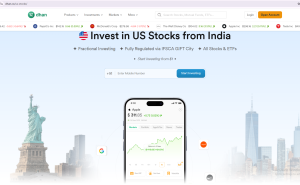
How Dhan US Stocks Works Through GIFT City?
Dhan’s US investing ecosystem operates through its GIFT City-based subsidiary, Raise IFSC, under the regulatory oversight of the International Financial Services Centres Authority (IFSCA).
The platform uses global partners such as ViewTrade and GloMoPay to facilitate international investing while remaining within an RBI and FEMA-compliant framework.
For investors, this structure provides an additional layer of confidence because funds are routed through India’s regulated international financial ecosystem rather than through an entirely foreign investing arrangement.
Key Features of Dhan US Stocks
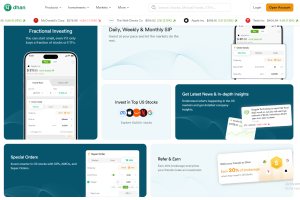
Fractional Share Investing
One of the biggest barriers to US investing has traditionally been the high share prices of companies like Amazon, Microsoft, or Nvidia.
Dhan addresses this through fractional investing.
Instead of purchasing an entire share, investors can invest any amount and own a fraction of a stock.
This makes portfolio diversification significantly easier for retail investors.
Access to Leading US Companies
Investors can gain exposure to companies across sectors including:
- Technology
- Artificial Intelligence
- Cloud Computing
- Healthcare
- Consumer Brands
- Financial Services
- Semiconductors
This expands investment opportunities beyond what is available in Indian markets.
ETF Investing
Many investors may not want to select individual stocks.
Dhan allows investment in US-listed ETFs that provide exposure to:
- S&P 500
- Nasdaq 100
- Technology sector
- Healthcare sector
- Dividend-focused portfolios
- Broad market indice
For beginners, ETFs often represent a simpler and lower-risk entry point than stock picking.
Unified Investment Experience
Existing Dhan users can manage:
- Indian equities
- Futures & Options
- Mutual Funds
- ETFs
- US Stocks
within a single ecosystem.
This reduces the operational complexity of maintaining multiple investing platforms.
Portfolio Tracking
The platform provides consolidated visibility into holdings, helping investors track:
- Portfolio value
- Asset allocation
- Individual positions
- Performance metrics
A unified dashboard improves monitoring and decision-making.
Account Opening and Funding Process
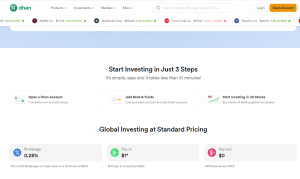
The process generally involves:
- Activating US stock investing
- Completing required documentation
- Funding the account through LRS-compliant remittances
- Converting INR into USD
- Purchasing US securities
While the process is largely digital, investors should understand that international investing involves additional regulatory and banking steps compared with domestic stock investing.
Charges and Costs Investors Should Understand
The biggest mistake investors make when evaluating US investing platforms is focusing only on brokerage.
The actual cost structure includes multiple layers.
Currency Conversion Costs
Every investment requires converting Indian Rupees into US Dollars.
Even small differences in forex spreads can materially impact long-term returns.
For frequent investors, currency conversion costs often become more significant than brokerage fees.
Remittance Charges
Banks may levy:
- Wire transfer charges
- Forex conversion fees
- GST
- Other applicable banking costs
These vary across banks and transaction sizes.
Tax Implications
Investors should understand:
- Capital gains taxation
- Dividend taxation
- Double taxation treaty benefits
- Foreign asset reporting requirements
Tax treatment can materially affect realized returns and should be considered before investing.
Dhan US Stocks Fee Structure
| Fee Component | Charges |
| Brokerage | 0.25% of transaction value (Minimum $0.01) |
| Account Maintenance Charges (AMC) | ₹0 |
| Funding Fee | Free for transfers above $100 |
| Funding Fee Below $100 | $1 |
| Withdrawal | Free |
For long-term investors, the absence of account maintenance charges and withdrawal fees makes the platform relatively attractive. However, investors should evaluate total investment costs rather than focusing only on brokerage.
The Hidden Cost Most Investors Ignore
The actual cost of international investing extends beyond brokerage fees.
Currency Conversion Costs
Every US stock purchase requires conversion of Indian Rupees into US Dollars.
Forex spreads can have a significant impact on long-term returns, particularly for investors making regular investments.
Banking and Remittance Charges
Depending on the bank used, investors may incur:
- Wire transfer charges
- Forex conversion fees
- GST
- Other remittance-related expenses
In many cases, these costs can exceed brokerage expenses.
Currency Risk
Returns depend on both stock performance and USD-INR exchange rate movements.
A strengthening rupee can reduce returns even if the underlying stock performs well.
Taxation of US Stocks for Indian Investors
Taxation is often one of the most misunderstood aspects of international investing.
Dividend Taxation
Dividends from US companies are generally subject to a 25% US withholding tax.
However, Indian investors can claim a foreign tax credit under the India-US Double Taxation Avoidance Agreement (DTAA), preventing double taxation on the same income.
Capital Gains Taxation
Under current tax rules:
- Long-term capital gains on international equities are taxed at 12.5%.
- Short-term capital gains are taxed according to the investor’s applicable income tax slab.
Investors should focus on post-tax returns rather than merely comparing brokerage costs across platforms. This has been explained in detail in our latest video.
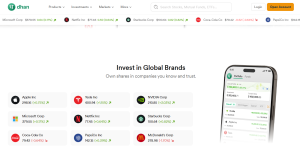
User Experience and Platform Design
Dhan has built its reputation around a clean, trader-friendly interface.
For US stock investors, the platform generally offers:
- Simple navigation
- Modern user interface
- Quick stock discovery
- Easy portfolio tracking
- Mobile-first investing experience
This is particularly attractive for younger investors already familiar with the Dhan ecosystem.
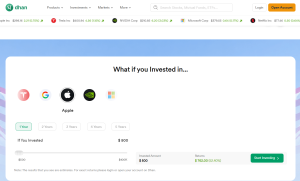
Pros of Dhan US Stock
Seamless Integration
Existing Dhan users can access US investing without shifting to an entirely new investing ecosystem.
Fractional Investing
Allows participation in expensive US stocks with small amounts of capital.
Diversification Benefits
Investors can build exposure beyond the Indian market.
Beginner-Friendly Interface
The platform is relatively easy to navigate compared with traditional international investing solutions.
Access to Global Growth Themes
Exposure to:
- Artificial Intelligence
- Cloud Computing
- Semiconductors
- Biotechnology
- Global Consumer Brands
that may not have direct Indian equivalents.
Cons of Dhan US Stocks
Currency Risk
Returns are influenced by both stock performance and USD-INR movements.
Even strong stock performance can be offset by adverse currency fluctuations.
Additional Cost Layers
International investing involves:
- Forex spreads
- Remittance fees
- Banking charges
- Tax complexities
These costs are often overlooked by new investors.
Limited Research Ecosystem
Compared with large global brokers, the research and analytical ecosystem remains relatively limited.
Serious investors may still need external research platforms.
Regulatory Complexity
International investing introduces compliance and reporting considerations not present in domestic investing.
Who Should Use Dhan US Stocks?
Suitable For
- Long-term Investors
- Existing Dhan users
- Investors seeking global diversification
- ETF investors
- Beginners starting international investing
Less Suitable for
- Extremely active US traders
- Investors seeking advanced institutional research tools
- Investors making frequent forex transfers
Comparison With Other US Investing Options
Most Indian investors currently choose among three approaches:
| Approach | Best For | Limitation |
| Direct US Stocks via Dhan | Ownership and Flexibility | Forex and remittance costs |
| International Mutual Funds | Simplicity | Fund manager dependency |
| International ETFs | Diversification | Limited stock-level control |
Dhan’s offering sits between simplicity and direct ownership, making it attractive for investors who want greater control over their global portfolio.
The Bigger Question
Is Dhan Building a Complete Wealth Platform?
The launch of US stocks is not merely a product addition.
It reflects a broader trend where Indian brokers are evolving from transaction platforms into comprehensive wealth ecosystems.
The future battle among brokers is unlikely to be about brokerage charges alone. It will be about who can offer investors access to every major asset class- Indian equities, global equities, mutual funds, ETFs, fixed income products, and alternative investments, within a single platform.
US stock investing strengthens Dhan’s position in that larger race.
Conclusion
Dhan US Stocks succeeds in making global investing more accessible for Indian investors. The platform combines a modern user experience, fractional share investing, and integrated portfolio management within the broader Dhan ecosystem.
However, investors should look beyond convenience and carefully evaluate currency conversion costs, remittance expenses, taxation, and long-term portfolio objectives.
For existing Dhan users seeking international diversification, the platform offers a compelling entry point into global markets. While it may not yet match the depth of institutional-grade international brokers, it provides enough functionality for most retail investors building long-term exposure to the world’s largest equity market.
Dhan US Stocks is best viewed not as a trading product, but as a global diversification tool that allows Indian investors to participate in some of the world’s most important growth trends from a single investing platform.