Dixon Technologies – How do they Make Money? | Business Model Explained
The smartphone in your pocket, the television in your living room, or the laptop on your desk may carry the logo of a global brand, but there’s a good chance that brand didn’t manufacture it.
As electronics companies increasingly outsource production to specialized manufacturers, Electronics Manufacturing Services (EMS) companies have become the invisible force behind the industry’s growth. Instead of investing billions in factories, brands are relying on manufacturing partners to build products at scale while they focus on innovation, marketing, and distribution.
Dixon Technologies has emerged as one of India’s biggest beneficiaries of this shift. Without owning a single consumer brand, the company manufactures millions of electronic products for leading global and domestic companies, making it one of the country’s largest EMS players.
So, how does Dixon make money? And what makes its business model scalable enough to deliver consistent growth despite operating in a low-margin industry? Let’s take a closer look.
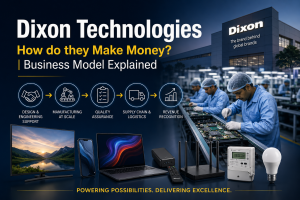
Dixon Technologies At a Glance
Founded in 1993, Dixon Technologies has evolved from a television manufacturer into India’s largest Electronics Manufacturing Services (EMS) company. Rather than selling products under its own brand, the company manufactures electronic products for leading global and domestic brands across multiple categories, including smartphones, consumer electronics, home appliances, lighting products, wearables, telecom equipment, and IT hardware.
What makes Dixon’s business unique is its position in the electronics value chain. The company operates behind the scenes, providing end-to-end manufacturing solutions; from sourcing components and assembling products to testing, packaging, and, in some cases, product design. This allows brand owners to focus on product development, marketing, and distribution while outsourcing the complex task of manufacturing.
Today, mobile phones and other EMS products account for the majority of Dixon’s business, highlighting the company’s successful expansion beyond its traditional television manufacturing operations. This diversification has also reduced its dependence on a single product category, enabling it to participate in multiple high-growth segments of India’s electronics manufacturing industry.
More importantly, Dixon isn’t competing with the brands it manufactures for, it is enabling them. As more companies adopt an asset-light approach and India strengthens its position as a global manufacturing hub, Dixon has become an essential partner in the country’s electronics ecosystem rather than just another manufacturer.
How Does Dixon Technologies Make Money?
Most people think Dixon Technologies manufactures smartphones, televisions, and laptops. In reality, its business is helping global brands avoid manufacturing them.
Building large-scale electronics factories requires significant capital, a robust supplier network, and the ability to scale production efficiently. Instead of investing in these capabilities, many brands outsource manufacturing to partners like Dixon and focus on product innovation, branding, and distribution.
The company’s revenue is driven by manufacturing volumes rather than retail sales. In smartphones, management has highlighted that reported revenue largely comprises the Bill of Materials (BoM) passed through to customers along with a conversion charge. Since the full cost of components is recognised as revenue, higher component prices or premium devices can inflate revenue without proportionately increasing profits.
This is why Dixon operates with relatively low EBITDA margins of 3.9% despite reporting strong revenue growth. However, the business compensates through high asset turnover, efficient capacity utilisation, and disciplined capital allocation, enabling it to generate a robust ROCE of 44.8%.
Ultimately, Dixon isn’t selling electronics- it’s selling manufacturing expertise, supply-chain execution, and the ability to produce millions of devices efficiently at scale. Check our latest video for more details.
Revenue Breakdown: Where Does Dixon’s Revenue Come From?
Dixon’s revenue mix has undergone a remarkable transformation over the last few years. While the company initially built its business around consumer electronics, today it derives the majority of its revenue from smartphones and other EMS products, reflecting the rapid shift in India’s electronics manufacturing landscape. More importantly, the company is steadily expanding into adjacent product categories and high-value components, reducing its dependence on any single business over the long term.
FY26 Revenue Mix
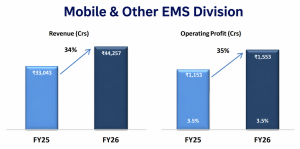
Mobile & Other EMS (91%)
- The company’s largest and fastest-growing business, manufacturing smartphones and other electronic devices for leading global brands. This segment remains Dixon’s primary growth engine, supported by rising outsourcing, exports, and expanding manufacturing capacity. Management also expects strong sequential smartphone volume growth, with the proposed Vivo joint venture offering significant long-term upside.
More importantly, this business provides the scale that strengthens Dixon’s procurement power and supports expansion into higher-value component manufacturing.
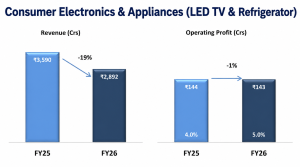
Consumer Electronics & Appliances (6%)
- Manufactures LED televisions and refrigerators, with an increasing focus on Original Design Manufacturing (ODM). The company is also expanding into premium products such as Mini LED TVs, deep freezers, visicoolers, and side-by-side refrigerators, allowing it to move up the value chain.
It also diversifies revenue beyond smartphones while leveraging Dixon’s existing manufacturing capabilities.
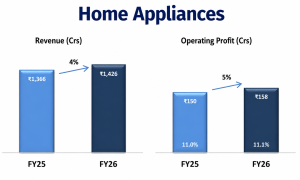
Home Appliances (3%)
- Produces washing machines and is broadening its portfolio through new fully automatic models, robotic vacuum cleaners, and other adjacent categories, strengthening its position in India’s growing appliance market.
This expansion broadens customer relationships and reduces dependence on a single product category.
Emerging Businesses
- Telecom equipment, IT hardware, lighting, wearables, and component manufacturing are becoming important growth pillars. Investments in display modules, camera modules, SSDs, and other components reflect Dixon’s strategy to increase localisation, improve value addition, and capture a larger share of the electronics manufacturing value chain.
Over time, these businesses are expected to increase value addition and improve Dixon’s position across the electronics value chain.
Dixon’s evolving revenue mix highlights an important shift in strategy. Rather than simply producing more electronic devices, the company is building a diversified manufacturing platform capable of serving multiple industries while steadily increasing the value it contributes to every product it manufactures.
Why Do Global Brands Choose Dixon?
Manufacturing electronics at scale is far more complex than simply assembling products. It requires continuous investments in factories, automation, supplier relationships, skilled manpower, quality control, and regulatory compliance. For most consumer brands, these activities consume significant capital without creating meaningful competitive differentiation.
By partnering with an EMS player like Dixon, brands can adopt an asset-light model, allowing them to focus on product innovation, branding, marketing, and distribution while leaving manufacturing to a specialised partner.
Some of the key advantages of outsourcing to Dixon include:
- Lower capital investment: Brands can expand production without investing in expensive manufacturing facilities.
- Faster scalability: Production can be ramped up quickly to meet changing consumer demand and new product launches.
- Established supply chain: Dixon’s long-standing supplier network simplifies component sourcing and procurement.
- Manufacturing expertise: Years of experience across multiple product categories help ensure quality, efficiency, and timely execution.
- Support for localisation: With increasing backward integration into components such as display and camera modules, Dixon enables brands to source a larger share of products domestically.
As global supply chains continue to diversify and India strengthens its position as a manufacturing hub, the value proposition for companies like Dixon becomes even stronger. For many brands, outsourcing is no longer just a cost-saving decision, it’s a strategic choice that improves flexibility, reduces execution risk, and accelerates time-to-market.
What Gives Dixon a Competitive Advantage?
The EMS business is often perceived as a low-margin industry with limited differentiation. However, Dixon has demonstrated that scale, execution, and continuous value addition can create meaningful competitive advantages even in a contract manufacturing business.
Its biggest strength lies in its ability to offer customers a comprehensive manufacturing ecosystem rather than just assembly services. Over the years, the company has expanded across smartphones, consumer electronics, home appliances, telecom equipment, IT hardware, and wearables, allowing it to leverage common manufacturing infrastructure, supplier relationships, and engineering expertise across multiple product categories.
Several factors reinforce Dixon’s competitive position:
- Switching Costs: Once a brand integrates its manufacturing, supplier network, and quality systems with an EMS partner, changing manufacturers becomes costly and operationally complex. This creates long-term customer relationships built on execution and reliability.
- Economies Of Scale: High production volumes enable Dixon to negotiate better component prices, improve factory utilisation, and spread fixed costs across millions of units, supporting its cost competitiveness.
- Backward Integration: By expanding into components such as display modules, camera modules, and SSDs, Dixon captures more value from every device while strengthening customer stickiness through deeper supply-chain integration.
Perhaps Dixon’s biggest competitive advantage is customer integration. Once a global brand aligns its sourcing, manufacturing processes, quality standards, and supply chain with a partner, switching manufacturers becomes operationally complex, time-consuming, and costly. This creates long-term relationships that are built not just on pricing, but on execution, reliability, and trust; advantages that are difficult for new entrants to replicate.
Key Growth Drivers Of Dixon Technologies
Dixon’s future growth isn’t expected to come solely from manufacturing more smartphones. The company’s strategy is to deepen its presence across the electronics value chain by expanding into new product categories, increasing component localisation, and strengthening export capabilities. This approach not only diversifies revenue streams but also enables Dixon to capture a larger share of value from every product it manufactures.
1. Strengthening Its Smartphone Leadership
Mobile & Other EMS remains Dixon’s largest growth engine. Excluding the proposed Vivo partnership, management expects FY27 smartphone volumes to remain broadly stable as higher average selling prices offset softer demand.
However, approval of the Vivo joint venture could add another 20-22 million smartphone units annually, significantly expanding Dixon’s manufacturing scale. The company is also commissioning a new 1 million sq. ft. facility in Noida, while the Longcheer JV (The joint venture between Dixon Technologies and China's Longcheer Intelligence named Dixtel Infocomm, with Dixon holding a 74% stake and Longcheer holding 26%) is expected to commence operations in Q3 FY27, further enhancing capacity.
Export opportunities through Ismartu and Motorola are expected to provide additional growth avenues.
Higher production volumes drive revenue growth, while greater scale improves procurement efficiency and factory utilisation.
2. Moving Beyond Assembly to Higher Value Addition
A key strategic priority is increasing localisation through component manufacturing. Dixon is scaling up camera module capacity from 70 million to 180-190 million units over the next 15-18 months, while its HKC joint venture (Dixon Technologies and China-based HKC Overseas formed a joint venture to manufacture display modules in India. Valued at approximately ₹370 crore, the partnership operates through Dixon's subsidiary, Dixon Display Technologies) will begin commercial production of display modules during FY27.
The company is also entering SSD manufacturing and exploring additional components such as power supplies and mechanicals. These investments are aimed at increasing domestic value addition, strengthening customer relationships, and improving the long-term economics of the business.
Component manufacturing not only creates new revenue streams but also improves value addition and strengthens long-term profitability.
3. Building Multiple Growth Engines
Beyond smartphones, Dixon is expanding aggressively across telecom equipment, IT hardware, lighting, consumer electronics, and home appliances. Management expects telecom revenue to reach ₹7,500-8,000 crore in FY27, while the IT hardware business is projected to grow more than threefold, supported by new facilities, laptops, desktops, tablets, and future component integration.
In consumer appliances and lighting, new product launches, premium offerings, export orders, and capacity expansions are helping the company diversify beyond its traditional businesses and reduce dependence on any single product category.
Diversifying across product categories reduces dependence on smartphones while improving capital efficiency and creating multiple growth drivers.
Taken together, these initiatives show that Dixon’s strategy is no longer centred on producing higher volumes alone. The company is steadily transforming into a more integrated electronics manufacturing platform, one that manufactures not just finished products but also many of the critical components that go into them.
That shift has the potential to increase value addition, deepen customer partnerships, and create more sustainable long-term growth.
Financial Performance Snapshot
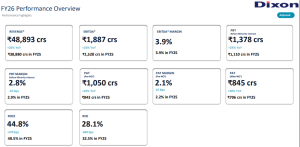
Dixon delivered another strong year of operational growth in FY26, driven by higher manufacturing volumes across its core businesses. While the reported financials benefited from one-time gains, the adjusted numbers reflect healthy growth in the company’s underlying manufacturing operations.
Despite operating in a low-margin industry, Dixon continues to generate robust returns on capital through efficient execution, disciplined working capital management, and its ability to scale production across multiple product categories.
This highlights that the company’s long-term strength lies not in earning high margins on every product, but in consistently delivering high-volume manufacturing with strong capital efficiency.
Key Risks to the Business Model
While Dixon has built a strong position in India’s EMS industry, investors should keep the following risks in mind:
- Customer concentration: A meaningful portion of the company’s revenue comes from a few large customers, including Motorola, Xiaomi, and Transsion (through Ismartu). Any change in their outsourcing strategy, product demand, or inventory cycles could temporarily impact Dixon’s growth.
- Thin operating margins: Electronics manufacturing is inherently a low-margin business. Sustaining profitability depends on maintaining high production volumes, operational efficiency, and continuous improvements in value addition.
- Execution risk: Dixon is simultaneously expanding into components, display modules, telecom equipment, IT hardware, and other new categories. Delays in ramping up new facilities or execution challenges could affect growth and returns.
- Regulatory approvals: Strategic partnerships with Vivo, HKC, and Longcheer are subject to India’s Press Note 3 (PN3) regulatory framework for investments from neighbouring countries. Any delay in approvals or project implementation could impact expansion timelines.
Despite these risks, Dixon’s continued diversification across customers, product categories, and component manufacturing is expected to strengthen the resilience of its business model over the long term.
Conclusion
Dixon Technologies represents more than just a successful contract manufacturer, it reflects the structural transformation of India’s electronics manufacturing industry. By combining scale, execution, and increasing value addition, the company has evolved from an assembler of electronic products into a strategic manufacturing partner for some of the world’s leading brands.
While challenges such as thin margins, customer concentration, and rapid technological shifts remain, Dixon’s continued investments in components, localisation, and new manufacturing capabilities position it to capture a larger share of the electronics value chain.
If the company continues to execute on this strategy, it could remain one of the biggest beneficiaries of India’s emergence as a global manufacturing hub.
Dixon’s long-term opportunity isn’t manufacturing more electronics, it’s manufacturing a larger portion of every electronic product through backward integration. If executed well, this strategy could strengthen both its competitive position and long-term earnings power.