Why Satin Creditcare Could Be the Biggest Beneficiary of Microfinance Sector Recovery?
Investment opportunities often emerge when an industry is beginning to recover rather than when it is already thriving. During periods of stress, investor attention naturally shifts toward rising risks, weakening earnings, and deteriorating sentiment. Yet these challenging phases also separate businesses with resilient operating models from those that relied on favourable market conditions to grow. When the cycle eventually turns, companies that preserved asset quality, protected their balance sheets, and continued investing through the downturn are often the first to benefit from improving fundamentals.
India’s microfinance sector appears to be approaching such an inflection point. After nearly two years of rising borrower stress, elevated credit costs, slower loan growth, and regulatory tightening, the industry is showing early signs of stabilization. The recovery remains gradual, but improving collection trends, stronger underwriting standards, and a more disciplined lending environment suggest that the worst of the credit cycle may now be behind it.
Among the listed microfinance institutions, Satin Creditcare Network Ltd. has quietly strengthened its position during this difficult period. While several lenders remained focused on repairing their balance sheets, Satin continued improving asset quality, maintained profitability, diversified beyond traditional microfinance, and invested in technology and risk management. As the sector transitions from repair to recovery, these strategic decisions could position the company to benefit disproportionately from the next phase of growth.
The key question, however, is not whether India’s microfinance industry will recover, it is whether Satin Creditcare has built the right foundation to outperform as that recovery unfolds.

The Boom That Became a Reset
For much of the last decade, India’s microfinance sector was one of the country’s strongest financial inclusion stories. Easy access to credit, expanding branch networks, and rising borrower demand helped the industry’s Gross Loan Portfolio (GLP) cross ₹4 lakh crore.
However, rapid growth also led to multiple lenders targeting the same borrowers, increasing household leverage and weakening underwriting discipline.
The turning point came when rising delinquencies and higher provisioning costs exposed these structural weaknesses. Growth slowed as lenders shifted their focus from aggressive disbursements to repairing portfolio quality. In response, the industry introduced stricter lending practices through MFIN’s revised guardrails, including tighter bureau checks and limits on borrower leverage. While these measures temporarily moderated loan growth, they also laid the groundwork for a healthier and more sustainable lending environment.
Today, the sector is gradually entering a new phase. Improving collection trends, moderating credit costs, and better borrower discipline suggest that the worst of the stress may be behind it. More importantly, the recovery is likely to reward lenders that used the downturn to strengthen their balance sheets rather than chase growth.
For investors, that changes the focus. The question is no longer whether the microfinance sector will recover, but which institutions are best positioned to convert that recovery into stronger earnings and shareholder returns. Satin Creditcare appears to be one of the companies that enters this new cycle with a stronger foundation than many of its peers.
This is concise, avoids repeating ideas that will be covered later, and transitions naturally into the next section on why recoveries create earnings opportunities.
A Necessary Reset
Unlike previous microfinance disruptions that were triggered by localized political events or external shocks, the recent slowdown demanded structural reforms. The objective was not simply to revive loan growth but to ensure that future growth would be more sustainable. Regulators and industry bodies increasingly recognized that preventing excessive borrower leverage was just as important as expanding access to credit.
To address these concerns, the Microfinance Institutions Network (MFIN) introduced revised guardrails for responsible lending. Among the most significant changes was reducing the maximum number of lenders per borrower from four to three, while retaining the aggregate indebtedness cap of ₹2 lakh. The framework also strengthened credit bureau checks, discouraged lending to borrowers with significant repayment delinquencies, and encouraged stricter underwriting practices across member institutions. These measures were aimed at reducing systemic risk rather than accelerating short-term loan growth.
The impact was immediate. Institutions became considerably more selective in approving loans, and portfolio growth slowed as lenders prioritized asset quality over market share. Although this weighed on short-term financial performance, it also marked an important shift in the industry’s operating philosophy. Sustainable lending began replacing aggressive expansion as the primary objective.
While these reforms initially appeared to be a headwind, they may ultimately prove to be one of the industry’s biggest long-term strengths. Credit cycles rarely end because demand disappears, they end because lending standards become unsustainable. By tightening borrower eligibility, strengthening underwriting, and improving credit discipline, the industry has laid the foundation for a healthier recovery, one that is likely to be driven by stronger portfolio quality rather than excessive leverage.
That shift is already becoming visible across the sector, and the early signs suggest the recovery may be more meaningful than many investors currently appreciate.
The Reset is Creating The Next Opportunity
The early stages of a credit recovery often produce the strongest earnings growth for financial institutions. Unlike manufacturing or consumer businesses, lenders do not require explosive loan growth to significantly improve profitability. A decline in credit costs and provisioning requirements can have a much larger impact on earnings than an equivalent increase in disbursements.
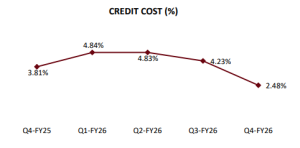
This dynamic is already becoming visible across the microfinance sector. As collection efficiency improves and fresh slippages moderate, provisioning requirements are beginning to normalize. For Satin Creditcare, annual credit costs declined from 4.6% in FY25 to 3.8% in FY26, while Q4 FY26 credit costs fell further to just 2.5%. At the same time, current collection efficiency reached 99.5%, indicating a meaningful improvement in repayment behaviour across the portfolio.
The financial impact of these improvements is substantial. According to the company’s disclosures, every 100 basis point reduction in annual credit costs has the potential to increase pre-tax earnings by ₹151.7 crore . Because much of Satin’s operating infrastructure has already been built, lower provisioning flows directly into profitability, creating significant operating leverage. This explains why earnings often recover faster than loan growth during the initial stages of a credit cycle.
For investors, this marks an important shift in the investment thesis. The opportunity is no longer centred on identifying the fastest-growing lender but on finding businesses that can convert improving asset quality into stronger earnings and higher returns on capital. Satin Creditcare appears increasingly well positioned to do exactly that. To know more, check our latest video.
Built During the Downturn, Not After It
The real quality of a lender is revealed during periods of stress, not during years of abundant liquidity and rapid loan growth. As rising borrower leverage and higher delinquencies challenged the microfinance sector, many institutions were forced to prioritize balance sheet repair over expansion. Satin Creditcare took a different approach, focusing on strengthening its franchise while maintaining profitability.
The numbers reflect that strategy. During FY26, the company reported its highest-ever consolidated AUM of ₹15,174 crore, up from ₹12,784 crore a year earlier. Net Interest Income increased 21% to ₹1,849 crore, while Pre-Provision Operating Profit rose 23% to ₹928 crore, demonstrating that the core business continued to generate healthy operating earnings despite elevated credit costs. Profit After Tax stood at ₹332 crore for FY26, with Q4 PAT surging 124% Quarter-to-Quarter to ₹162 crore, highlighting the pace at which profitability improved as provisioning requirements declined.
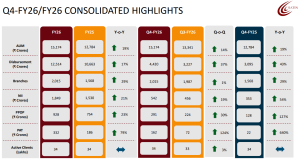
The recovery becomes even more evident when examining the company’s balance sheet. Satin’s Capital Adequacy Ratio stood at 25.88%, comfortably above the regulatory requirement, while its marginal cost of borrowing declined by 43 basis points year-on-year to 10.82%. Together, these metrics provide the company with both financial flexibility and a lower funding cost as lending activity accelerates.
Rather than emerging from the downturn in repair mode, Satin enters the next phase of the cycle with stronger capital, improving profitability, and the capacity to grow. That combination could become an important competitive advantage as the industry recovery gathers momentum.
More Than a Microfinance Company
One of the most overlooked aspects of Satin Creditcare’s investment case is that it is no longer solely a microfinance lender. While microfinance remains the foundation of the business, management has steadily expanded into affordable housing finance and MSME lending, creating a more diversified lending platform. This strategy is not simply about adding new products, it is about reducing dependence on a single business segment while increasing the lifetime value of each customer.
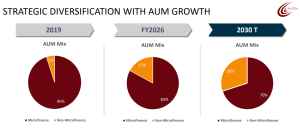
The transformation is already becoming visible in the numbers. In FY19, non-microfinance businesses accounted for only 5% of the group’s Assets Under Management. By FY26, that share had increased to 17%, representing a non-MFI portfolio of ₹2,653 crore. Management has outlined an ambitious target of increasing this contribution to 30% of consolidated AUM by FY2030, signalling that diversification will remain a central pillar of the company’s long-term strategy.
The two subsidiaries are scaling rapidly. Satin Housing Finance ended FY26 with an AUM of ₹1,267 crore, delivering a three-year CAGR of 36%, while Satin Finserv, which focuses on MSME lending, expanded its AUM to ₹1,054 crore, representing a remarkable three-year CAGR of 66%. Although these businesses are still relatively small compared with the core microfinance franchise, they address larger and more diversified credit markets with different risk-return characteristics.
Diversification also has important financial implications. Housing finance typically generates lower net interest margins than microfinance but benefits from significantly lower credit costs because loans are secured. MSME lending, meanwhile, allows Satin to retain borrowers whose financing needs evolve beyond traditional group loans. As these businesses scale, they have the potential to improve earnings stability, reduce portfolio concentration, and create a more balanced return profile across credit cycles. This makes Satin’s long-term story considerably broader than a simple recovery in the microfinance sector.
Why Satin Could Benefit More Than Its Peers?
A recovery in the microfinance sector is expected to lift the entire industry, but not every lender is likely to benefit equally. The biggest winners are typically those that enter the next cycle with stronger balance sheets, lower credit costs, sufficient capital, and multiple growth drivers. Satin Creditcare appears to possess each of these characteristics, giving it the potential to outperform many of its peers over the medium term.
One of Satin’s biggest advantages is the pace at which its profitability can improve as credit costs normalize. The company reported Pre-Provision Operating Profit of ₹928 crore in FY26, an increase of 23% year-on-year, highlighting the underlying strength of its lending franchise. As credit costs declined from 4.6% to 3.8%, profitability improved sharply, with Q4 FY26 Profit After Tax rising 124% year-on-year to ₹162 crore. Since every 100 basis point reduction in credit costs can add approximately ₹110-120 crore to pre-tax earnings, further normalization could have a disproportionate impact on future profitability.
Unlike many pure-play microfinance institutions, Satin is gradually reducing its dependence on a single lending segment. Through its affordable housing finance and MSME businesses, the company is building additional growth engines beyond traditional group lending. As these businesses scale, they have the potential to improve earnings stability, diversify revenue streams, and reduce concentration risk over the long term.
Another key strength is Satin’s healthy capital position and improving funding profile. This provides the financial flexibility to pursue future growth while maintaining a disciplined approach to lending, positioning the company to capitalize on the sector’s recovery without compromising balance sheet strength.
Perhaps the biggest difference between Satin and several of its peers is timing. While many lenders are still focused on repairing portfolios impacted by the recent downturn, Satin has already completed much of that work. It enters the next phase of the cycle with improving asset quality, stronger operating profitability, and a diversified lending platform. If the sector recovery continues, these advantages could allow Satin to convert industry tailwinds into faster earnings growth than many competing microfinance institutions.
| Metric (FY26) | Satin Creditcare | CreditAccess Grameen | Fusion Finance | Spandana Sphoorty |
| AUM | ₹15,174 Cr | ₹29,590 Cr | ₹7,407 Cr | ₹4,420 Cr |
| Asset Quality | Improving | Strong | Recovering | Recovering |
| Profitability | Profitable | Profitable | Under pressure | Recovering |
| Business Diversification | High (MFI + Housing + MSME) | Primarily MFI | Primarily MFI | Primarily MFI |
| Capital Position | Strong | Strong | Adequate | Adequate |
| Valuation (P/B) | Discount to peers | Premium | Discount | Discount |
While CreditAccess commands a premium because of its scale and consistent execution, Satin stands out for a different reason. It combines improving asset quality with a diversified lending platform, yet continues to trade at a meaningful valuation discount. If management sustains execution and the microfinance recovery strengthens, the gap between Satin’s fundamentals and its valuation could narrow over time.
Is the Market Undervaluing Satin?
Why is the market discounting Satin today?
Despite improving fundamentals, Satin continues to trade at a valuation discount to several larger peers. Much of this reflects broader investor caution toward the microfinance sector following two years of elevated credit costs and weaker profitability. The market also continues to view Satin primarily as a microfinance lender, with limited recognition of its growing housing finance and MSME businesses. Until investors gain confidence that earnings improvements are sustainable, this valuation discount is likely to persist.
What could change investor perception?
The market’s view is likely to change if Satin continues delivering consistent improvements in profitability and asset quality. A sustained decline in credit costs, continued growth in non-microfinance businesses, improving return ratios, and strong quarterly earnings would demonstrate that the company’s recovery is structural rather than cyclical. Consistent execution across these areas would strengthen investor confidence in the business model.
When could a rerating happen?
Valuation reratings rarely occur because management announces ambitious targets, they occur when financial performance consistently validates those expectations. If Satin continues expanding earnings while maintaining disciplined underwriting and increasing the contribution of its diversified lending businesses, the market may begin valuing the company more in line with stronger-performing peers. In that scenario, investors would benefit not only from earnings growth but also from a potential expansion in valuation multiples. .
Key Risks
While the outlook for both the microfinance sector and Satin Creditcare has improved, the investment case is not without risks. The industry’s recent recovery is still in its early stages, and its sustainability will depend on factors that are not entirely within the company’s control. Investors should therefore evaluate Satin not only on its growth potential but also on the challenges that could slow or derail its progress.
One of the biggest risks remains asset quality. Although borrower leverage has moderated following tighter industry guardrails, microfinance lending is inherently unsecured and closely linked to the financial health of low-income households. Unexpected disruptions such as weak monsoons, inflationary pressures, or regional economic slowdowns can quickly affect repayment behaviour. Any meaningful deterioration in collections would lead to higher provisioning costs and delay the company’s earnings recovery.
Another important factor is the regulatory environment. The microfinance industry operates under close regulatory oversight, and policy changes can have a significant impact on growth and profitability. The recent reforms introduced by the Microfinance Institutions Network (MFIN) have strengthened lending discipline and improved the industry’s long-term outlook. However, future regulatory changes related to borrower eligibility, lending practices, or pricing could influence business economics. In addition, state-level political developments and loan waiver announcements have historically affected repayment behaviour in certain regions, creating short-term uncertainty for lenders.
Competition is another challenge. While the industry has become more disciplined, it remains highly competitive, with NBFC-MFIs, banks, and small finance banks all targeting the same borrower segments. As credit demand recovers, maintaining growth without compromising underwriting standards will require continued execution. At the same time, Satin’s newer businesses, particularly affordable housing finance and MSME lending, must scale profitably. Diversification strengthens the long-term investment case, but it also introduces execution risk, as these businesses operate in competitive markets with different risk profiles from traditional microfinance.
Ultimately, Satin’s investment thesis depends on management’s ability to balance growth with discipline. The company has navigated one of the sector’s toughest periods successfully, but sustaining this momentum will require consistent execution, prudent capital allocation, and continued improvement in asset quality. These risks do not undermine the long-term opportunity, but they highlight why investors should monitor quarterly performance closely as the recovery unfolds.
Conclusion
The recovery in India’s microfinance sector is likely to benefit the industry as a whole, but the strongest investment opportunities are rarely found in the average performer. They emerge in companies that have used the downturn to strengthen their balance sheets, improve operating efficiency, and prepare for the next phase of growth.
Satin Creditcare appears to fit that description. The company enters the recovery with improving asset quality, declining credit costs, healthy capital buffers, and a diversified lending platform that extends beyond traditional microfinance. These strengths provide multiple drivers for future earnings growth while reducing dependence on a single lending segment.
For investors choosing between Satin and other listed microfinance institutions, the difference lies in the combination of recovery and transformation. While many peers are still rebuilding after the recent credit cycle, Satin has already begun positioning itself for the next one. If management continues executing with the same discipline and the sector recovery remains on track, Satin could not only participate in the industry’s revival but potentially emerge as one of its strongest long-term beneficiaries.